Thursday, June 18, 2026 · 10 curated articles
Editor's Picks
The era of the 'chatbot' is officially dead; we have entered the age of the 'Agentic Utility.' Today's news cycle confirms that the industry is pivoting away from mere linguistic fluency toward hard-nosed execution and environmental discovery. For years, we’ve treated context windows as a luxury; with the release of GLM-5.2, featuring its 1M-token context and 'IndexShare' architecture, the open-source community has effectively democratized the ability to ingest entire codebases. What’s more telling is the 'effort level control' system—a clear signal that we are moving toward a paradigm where developers must manage compute as a tactical resource rather than a static API call. We are no longer just asking questions; we are orchestrating long-horizon trajectories that require models to think before they leap.
However, the results from CEO-Bench serve as a sobering bucket of ice water for those intoxicated by the 'AGI is here' hype. Despite the massive context windows of models like Claude 4.8 and GPT-5.5, the inability to consistently manage a 500-day startup simulation reveals a fundamental weakness in current architectures: the 'Planning-Execution Gap.' Writing code is easy; managing the cascading consequences of pricing, marketing, and cash flow in a noisy environment is where today’s frontier models still falter. For engineers, this suggests that the next two years won't be about increasing parameter counts, but about refining the feedback loops and world-modeling capabilities necessary for agents to survive 'wild' environments without burning through their seed capital.
To bridge this gap, we need more than just smarter models; we need a standardized way for agents to interact with the world. The introduction of the Agentic Resource Discovery (ARD) specification is perhaps the most significant structural development of the year. By shifting from hardcoded tool schemas to dynamic, intent-based discovery, Microsoft, Google, and Hugging Face are building the 'DNS of AI.' If an agent can’t find the right tool for a task at runtime, it is effectively blind. For developers, the message is clear: stop building brittle, siloed integrations. The future belongs to federated, discoverable ecosystems where agents can autonomously scale their own capabilities. The infrastructure is finally catching up to the ambition, but the simulation of real-world management remains the final boss.
Foundation Models
Foundation models serve as the versatile backbone of modern AI, evolving from simple chat interfaces to sophisticated systems capable of handling massive datasets. Recent breakthroughs highlight a significant shift toward extreme context windows, enabling models like GLM-5.2 to process millions of tokens for complex, long-horizon tasks such as advanced software engineering. These advancements reflect a broader industry trend of optimizing large-scale architectures for specialized professional workflows while maintaining robust open-source accessibility.
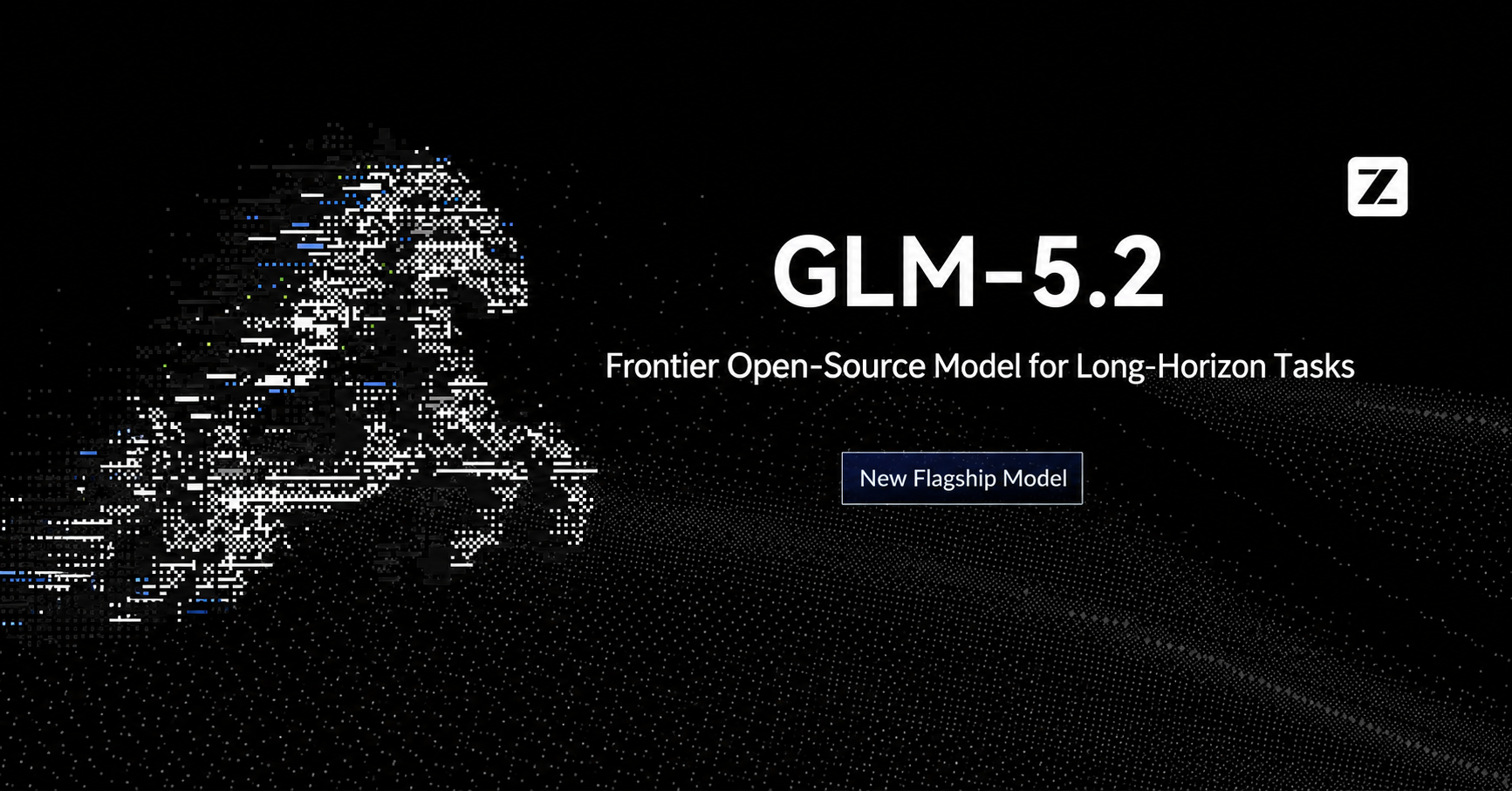
GLM-5.2: An Open-Source 1M-Context Model Optimized for Long-Horizon Coding Tasks
IndexShare, which reuses the same indexer across every four sparse attention layers, reducing per-token FLOPs by 2.9× at a 1M context length.
On this benchmark, GLM-5.2 trails Opus 4.8 by only 1%, while edging out GPT-5.5 by 1% and Opus 4.7 by 11%.
GLM-5.2 marks a significant advancement in long-horizon task capabilities by delivering a reliable 1M-token context under an MIT open-source license. The model introduces IndexShare architecture, which reuses indexers across sparse attention layers to reduce per-token FLOPs by 2.9x at its maximum context length. In benchmark evaluations, GLM-5.2 trails Claude Opus 4.8 by only 1% on FrontierSWE while outperforming both Opus 4.7 and GPT-5.5 on PostTrainBench. Technical improvements include an enhanced Multi-Token Prediction (MTP) layer that increases speculative decoding acceptance length by up to 20% and a flexible effort level control system. This system allows users to explicitly balance model capability against execution speed and computational costs for complex coding-agent trajectories. As the highest-ranked open-source model on multiple coding benchmarks, GLM-5.2 effectively closes the performance gap with closed-source frontier models like Gemini 3.1 Pro and Claude Opus 4.8.
Source: Hugging Face Blog
AI Applications
AI applications are transforming industries by integrating advanced machine learning models into real-world workflows and specialized hardware. This category highlights the practical deployment of artificial intelligence across sectors such as space exploration, healthcare, and robotics. By leveraging technologies like zero-shot vision-language models, organizations can automate complex decision-making processes and achieve unprecedented levels of autonomy, moving AI from theoretical research into impactful solutions that redefine operational efficiency.
NAVI-Orbital: First In-Orbit Zero-Shot Vision-Language Model for Earth Observation
NAVI-Orbital achieved what is, to the authors' knowledge, the first in-orbit demonstration of a vision-language model performing autonomous multi-modal inference
ground benchmarking (88.16% accuracy on the 7,960-image curated AID benchmark)
NAVI-Orbital successfully executed the first in-orbit demonstration of a zero-shot vision-language model performing autonomous multi-modal inference on April 16, 2026. The system utilizes the Gemma 3 model on a Low Earth Orbit spacecraft to classify captured scenes and generate natural-language descriptions of geographic features. By leveraging a graph-based state machine called LangGraph, the architecture coordinates specialized agents for both object detection and operator dialogue. Testing on the 7,960-image AID benchmark yielded a high accuracy of 88.16% without specific fine-tuning for the flight instrument. This approach allows operators to re-task the satellite using plain-English prompts instead of rigid command sequences. Ultimately, this hardware-accelerated GPU inference enables semantic compression of data, addressing the widening gap between rapid onboard collection and limited downlink bandwidth.
Source: arXiv cs.AI
AI Agents
AI agents are evolving from simple task executors into complex systems capable of long-term strategic decision-making and hardware integration. Recent developments like CEO-Bench highlight their ability to manage extended business simulations, while new standards in resource discovery enable dynamic tool interaction. These advancements, coupled with streamlined robotics workflows, bridge the gap between digital reasoning and physical execution, signaling a shift toward more autonomous and versatile agentic ecosystems.
CEO-Bench: Evaluating AI Agents via 500-Day Startup Management Simulations
Only Claude Opus 4.8 and GPT-5.5 finish above the $1M starting balance, and neither consistently turns a profit.
CEO-Bench, which evaluates these capabilities together by simulating a representative real-world task: operating a startup for 500 days.
Only Claude Opus 4.8 and GPT-5.5 finished above the $1M starting balance in the CEO-Bench simulation, though neither model consistently turned a profit. This benchmark evaluates language model agents by requiring them to manage a fictional startup for 500 days through a programmable Python interface. Agents must handle complex responsibilities including pricing, marketing, and budgeting while navigating noisy environments and uncertain long-term horizons. Success in this environment requires the ability to write sophisticated code for forecasting cash flow and mining negotiation histories to reveal hidden customer preferences. The research highlights a significant performance gap, as most state-of-the-art models struggle to orchestrate multiple moving parts toward a coherent goal. CEO-Bench serves as a rigorous testing ground for the intelligence needed to drive sustained, adaptive progress in real-world business scenarios.
Source: arXiv cs.AI
Integrating LeRobot with Strands Agents for Hub-to-Hardware Robotics Workflows
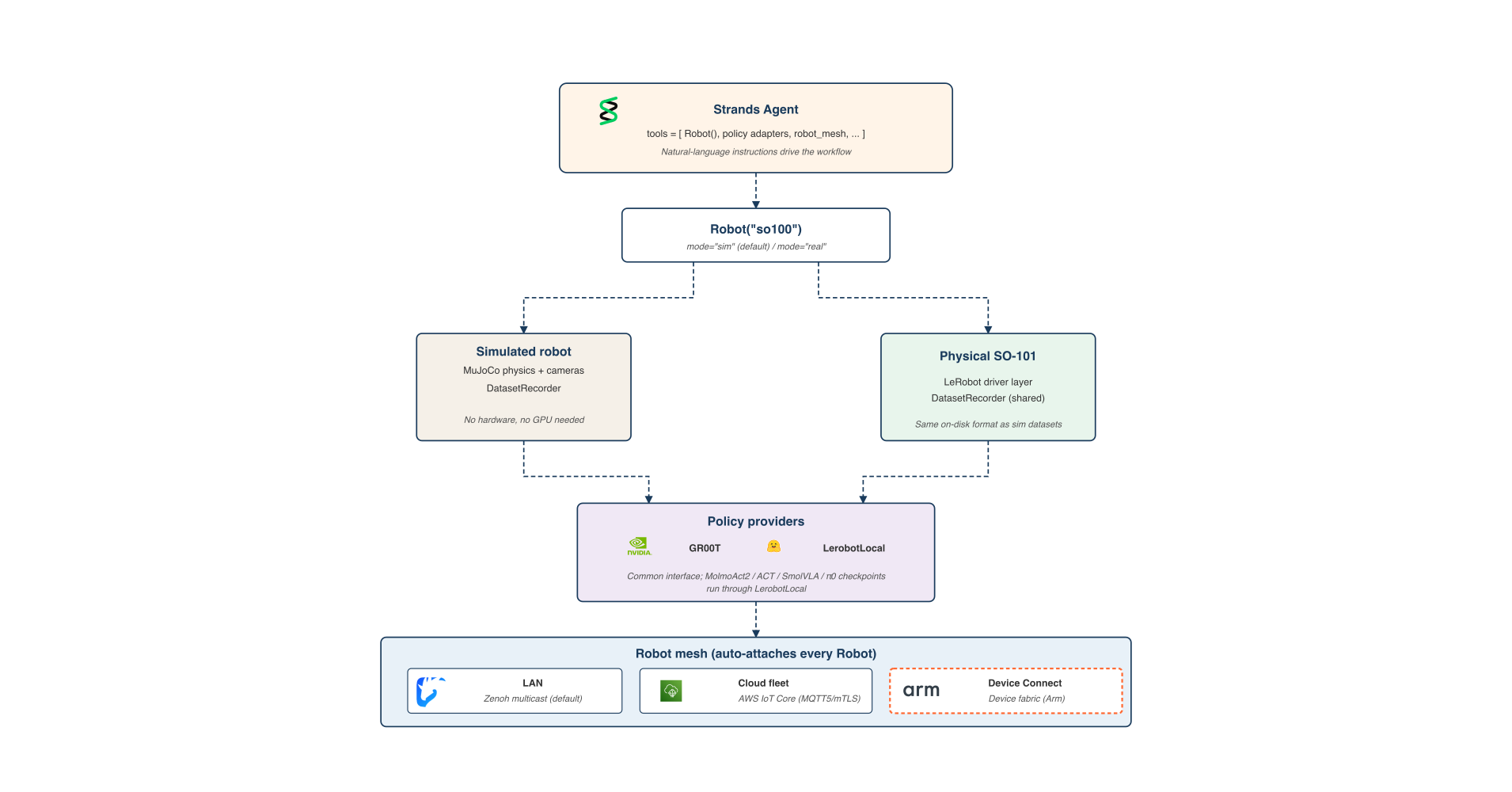
Strands Robots is an open source SDK from AWS (Apache 2.0) that exposes robot abstractions, simulation, and the LeRobot stack as AgentTools
the simulation tool records LeRobotDatasets in the same format LeRobot writes on hardware.
Strands Robots is an open-source SDK from AWS that integrates the LeRobot stack as AgentTools to consolidate robotic workflows into a single agent loop. This framework addresses the fragmentation of current robotics development, where recording, training, simulation, deployment, and coordination often require five distinct tools. By utilizing a unified dataset format, the SDK ensures that data captured in simulation matches the on-disk format of physical hardware recordings. The system supports policy inference via GR00T and LerobotLocal, including support for MolmoAct2 checkpoints. Developers can transition from a MuJoCo-backed simulation to physical hardware like the SO-101 by changing a single keyword argument in the agent code. Furthermore, the integration includes a built-in peer mesh powered by Zenoh to broadcast commands across robot fleets. The companion sample application allows users to test these capabilities in simulation without requiring specialized hardware or Hugging Face credentials.
Source: Hugging Face Blog
Agentic Resource Discovery: A New Standard for Dynamic AI Tool Integration
The Agentic Resource Discovery (ARD) specification is the discovery layer that sits in front of them.
It is a draft, open specification developed by contributors from Microsoft, Google, GoDaddy, Hugging Face, and others
The Agentic Resource Discovery (ARD) specification provides an open discovery layer that allows AI agents to find tools, skills, and other agents at runtime rather than relying on pre-installed configurations. This draft protocol, developed by contributors from Microsoft, Google, and Hugging Face, addresses the scalability limits of hardcoded MCP server URLs and context window constraints. By indexing capabilities with rich signals like publisher identity and compliance attestations, ARD shifts the ecosystem from static catalogs to intent-based natural language searches. Hugging Face has launched its reference implementation via the Discover Tool, which integrates semantic search across thousands of Spaces and MCP servers. The specification defines a static manifest format and a dynamic registry API to facilitate federated discovery across different platforms. This development enables agents to reach a growing ecosystem of services dynamically, reducing the maintenance burden for developers and expanding the reach of specialized AI tools.
Source: Hugging Face Blog

Developer Tools
This category tracks the evolution of software development environments, focusing on tools that enhance coding efficiency and streamline workflows. From advanced AI assistants like GitHub Copilot to sophisticated debugging systems, we examine how next-generation platforms optimize context management and model routing to support complex engineering tasks. Stay informed on the latest frameworks, version control updates, and automation utilities that empower developers to build robust, scalable applications with greater precision and speed.
How GitHub Copilot Optimizes Context Handling and Model Routing
Prompt caching helps Copilot reuse model state for repeated prompt prefixes instead of recomputing the same prefix on every request.
Tool search lets the model load tool definitions on demand, instead of sending every full tool schema into context on every turn.
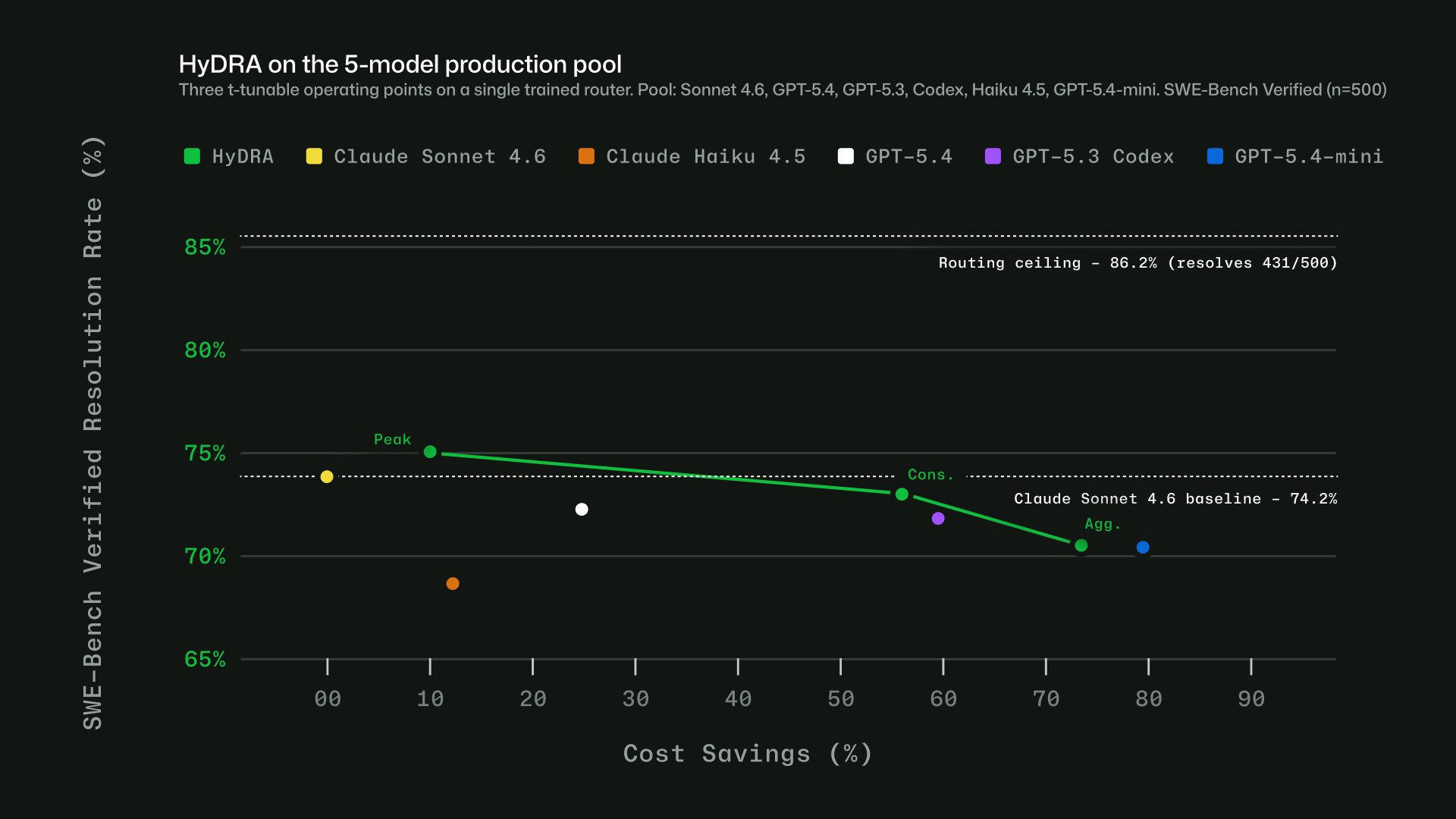
GitHub Copilot is implementing prompt caching and tool search in VS Code to reduce token consumption and improve session efficiency. Prompt caching allows the system to reuse model state for repeated prompt prefixes rather than recomputing them for every request. The introduction of tool search enables Copilot to load tool definitions on demand, preventing fixed costs associated with sending full tool schemas into context during every turn. Additionally, the new Auto model selection feature evaluates task intent and model health to automatically route queries to the most appropriate model. This system identifies when complex tasks require deep reasoning or when more efficient models can achieve the same outcome for simpler explanations. These updates collectively ensure that longer agentic sessions remain cost-effective while maintaining high performance across planning, debugging, and multi-file editing tasks.
Source: The GitHub Blog
Research
Explore the latest frontiers in academic AI research, highlighting breakthroughs in multimodal reasoning and spatial intelligence. These featured papers introduce MolmoMotion, a dataset and model for language-guided 3D motion forecasting, alongside the CaVe-VLM-CoT framework which improves the transparency of visual language models through closed-loop grounding. By bridging the gap between theoretical exploration and practical application, these studies push the boundaries of how machines interpret human intent and perceive the physical world with greater precision and clarity.
MolmoMotion: Language-Guided 3D Motion Forecasting and the MolmoMotion-1M Dataset
MolmoMotion-1M, the largest collection of 3D point trajectories paired with action descriptions, drawn from 1.16M videos.
MolmoMotion predicts where those points will move over the next few seconds in 3D space—achieving substantially stronger performance than existing forecasting methods.
MolmoMotion-1M comprises 1.16 million videos paired with 3D point trajectories and action descriptions, representing the largest open-source collection of its kind for motion forecasting. The MolmoMotion model utilizes this data to predict how specific object points will move in 3D space over several seconds based on RGB observations and natural language instructions. By representing motion as object-attached 3D points in world space, the system achieves a class-agnostic and view-stable approach that outperforms existing forecasting methods. This framework is specifically designed to support downstream applications such as robotics path planning and controllable video generation by providing physically plausible trajectories. The release also includes PointMotionBench, a human-validated benchmark of 2.7K video clips for measuring object-centric motion accuracy. These open-source resources aim to bridge the gap between retrospective motion perception and forward-looking predictive modeling for complex physical interactions.
Source: Hugging Face Blog

CaVe-VLM-CoT: Enhancing VLM Interpretability via Closed-Loop Grounding
CaVe-VLM-CoT achieves 87.1% accuracy and 56.6% CaVeScore on ScienceQA
detected ungrounded claims trigger structured feedback to the Extractor for targeted re-retrieval
CaVe-VLM-CoT achieves 87.1% accuracy on ScienceQA and 55.2% accuracy on the MMMU benchmark by implementing a modular reflection-based agentic-RAG framework. This system addresses the persistent issue of hallucinations in Vision-Language Models by enforcing evidence-grounded reasoning through a five-stage pipeline. The process utilizes an Extractor, Retriever, Solver, Citation Injector, and Verifier to ensure outputs remain visually faithful. When the Verifier detects ungrounded claims, it triggers structured feedback for targeted re-retrieval to correct errors dynamically. To evaluate this complex process, researchers introduced CaVeScore, a composite metric that weights accuracy alongside citation precision, recall, and cross-modal grounding. This approach demonstrates that structured feedback loops can significantly improve the reliability of multi-modal reasoning without requiring underlying architectural changes.
Source: arXiv cs.AI
Programming
Stay at the forefront of software development with the latest insights into coding practices, languages, and modern developer tools. This category explores advanced techniques like Git Worktrees to optimize your workflow, alongside updates on framework evolution and architectural patterns. Whether you are refining your local environment or scaling complex systems, these curated articles provide the technical depth needed to build robust, efficient, and maintainable software in a rapidly evolving industry ecosystem.
Git Worktrees: Streamlining Context Switching and Parallel Development
Git worktrees have been around since 2015, but it wasn't until recently they became popular.
With worktrees, you never leave your branch and you never stash, and your editor context for your original feature stays untouched.
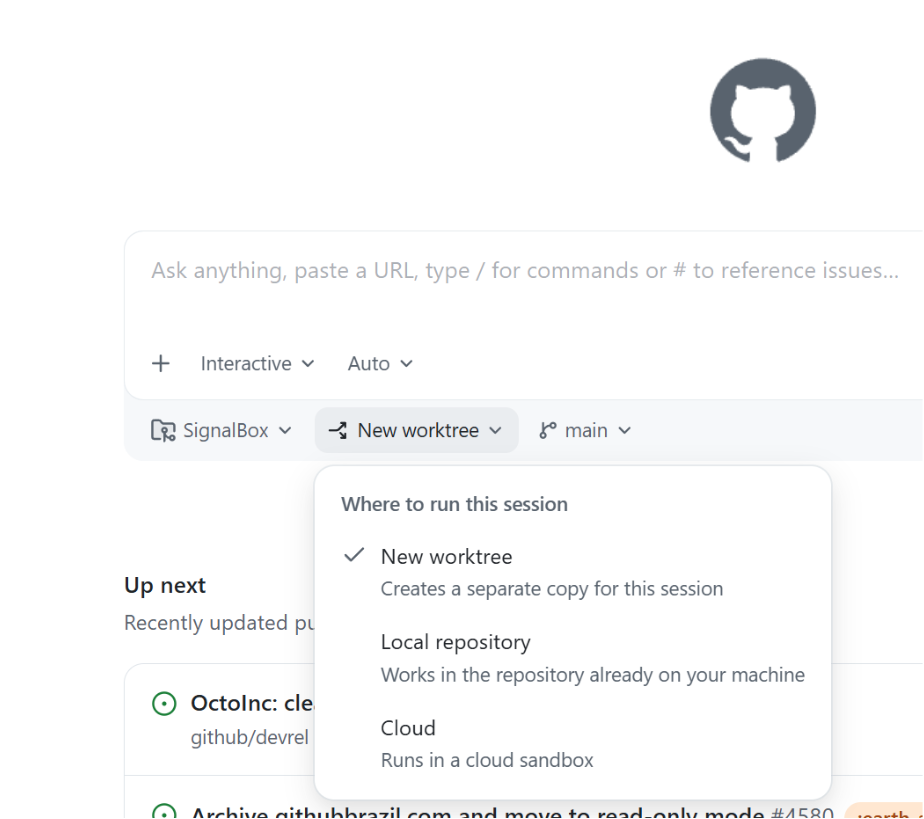
Git worktrees allow developers to maintain multiple working directories linked to a single repository, enabling simultaneous work on different branches without the need for git stash or frequent checkouts. While this feature has been available since 2015, it has recently gained significant traction as an efficient solution for managing the mental overhead of context switching. By creating sibling folders for tasks like urgent hotfixes, developers can keep their original editor environment untouched while working in a parallel workspace. This method eliminates the risk of stash conflicts and the repetitive process of reinstalling dependencies across different branches. Modern integrated development environments like VS Code now offer full support, further simplifying the transition. The surge in popularity is also attributed to the rise of AI-driven development and a growing "code review culture" that requires developers to manage multiple sessions simultaneously.
Source: The GitHub Blog
Data & Analytics
This category explores the evolving landscape of data management, focusing on how organizations are modernizing their infrastructure through AI-driven migration strategies and integrated cloud tools. From automating complex ETL processes to optimizing large-scale data warehouses, we cover the latest advancements in data engineering and analytics. Stay informed on how cutting-edge technologies like AI-powered planning are streamlining transitions to the cloud, ensuring data integrity and faster business insights for modern enterprises.
Modernize Azure Data Migration with AI-Powered Planning and Integrated Tools
Azure Copilot Migration Agent is extending Azure Migrate with new Azure Storage integration, now available in preview.
Azure Storage Mover: Free, managed online migration and synchronization tool for file/object data.
Enterprise storage migrations involve managing complex requirements for business continuity and performance beyond simple data copying. Microsoft is addressing these challenges by integrating the Azure Copilot Migration Agent into its Azure Migrate hub to provide AI-powered guidance for storage decision-making. This new preview feature helps organizations interpret environment assessments and map them to specific migration strategies, reducing the reliance on fragmented manual scripts. Tools such as Azure Storage Mover facilitate managed online synchronization, while Azure Data Box provides a secure offline transfer solution for massive datasets. The centralized migration hub also supports dependency analysis and business case development to align workloads with destination architectures like AI and analytics. By combining automated discovery with AI-driven insights, teams can minimize disruptions and maintain critical system alignment during large-scale transitions.
Source: Microsoft Azure Blog

This report is auto-generated by WindFlash AI based on public AI news from the past 48 hours.