Wednesday, September 9, 2026 · 10 curated articles

AI-generated conceptual illustration, not a fluid simulation.
Editor's Picks
OpenAI’s proposed Navier–Stokes proof puts a familiar question under extraordinary pressure: what must accompany a result before other people can build on it? The company has published a written argument and a Lean repository. Those artifacts make inspection possible. They also make precision essential: the stated forcing conditions, the formal theorem and the role of the unreleased discovery model matter as much as the headline. A claim becomes useful scientific knowledge through scrutiny and understanding.
Terence Tao’s warning about open research adds a different requirement. Research depends on people being willing to expose incomplete ideas to colleagues. If a promising direction immediately attracts a competitor with far more compute, sharing becomes harder to justify. That risk can exist even when the mathematics is valid and the competing proofs are different. Technical verification and research credit answer separate questions. A community that improves only the first can still damage the conditions that produce the next worthwhile question.
For software teams, the same concern takes a more practical form: can someone inspect, reproduce and revise what an agent hands over? Dart Skills CLI 1.0 ties guidance to a package rather than leaving it in a disconnected collection of instructions. Cloudflare Workers’ module loading addresses the behavior of imports, beyond the mere presence of familiar APIs. These changes make the surrounding context more explicit. They help developers identify whether a failure belongs to the model, the instructions, a dependency or the runtime.
Creative work has its own acceptance test. ChatGPT Images 2.5 emphasizes controlled edits and consistency across revisions. The valuable artifact is often the image after several rounds of feedback, when a client expects approved details to survive. A striking first output can be easy to admire and difficult to maintain. Evaluating preservation alongside generation changes which failures count, and makes the whole editing process part of the product.
Safety for Whom offers an especially clear measurement lesson: a lower harmful-response rate can coexist with a large loss of legitimate answers. Reporting both sides forces the tradeoff into view. The open weather model workflow does something similar for deployment, placing data preparation next to fast inference. In each case, a narrower headline conceals work that someone still has to perform.
A useful direction for AI development is therefore to attach better evidence and controls to stronger capabilities. Publish the assumptions with the theorem, ship the relevant guidance with the dependency, preserve the approved content through an edit, and measure the normal tasks a safety change disrupts. These are concrete ways to make accelerated output usable by people who did not create it. The resulting trust is earned through what others can examine and successfully do next.
Discovery, verification and research credit
OpenAI publishes a proposed Navier–Stokes proof
We do not intend to claim the Millennium Prize
OpenAI’s September 8 announcement describes a finite-time singularity under smooth forcing and publishes a paper plus Lean formalization. The discovery used an unreleased internal model; GPT-6 Astra handled the subsequent 17-hour formalization and verification, according to the company. The public repository identifies alternatives C and D of the prize formulation. Publication enables scrutiny, but should not be confused with prize adjudication. OpenAI says it will not claim the prize.
Source: OpenAI
Terence Tao warns of damage to open research
no longer sharing any promising research directions
Terence Tao warns that even a rumor of progress can attract enough AI effort to overtake an unfinished project. His statement, quoted by Simon Willison on September 9, concerns incentives to share promising directions. It follows the priority dispute around the fluid-equation results. Buckmaster’s account raises concerns about unpublished work; OpenAI denies accessing specific user data for the solution, while acknowledging uncertainty about de-identified training contributions. Those positions do not establish that appropriation occurred.
Source: Terence Tao, quoted by Simon Willison · Accounts of the priority dispute · OpenAI
Image creation becomes iterative
ChatGPT Images 2.5 adds more controlled editing
more precise editing
ChatGPT Images 2.5 launched September 8 with improved reference fidelity, local edits and multi-turn consistency. OpenAI reports up to 50% lower generation latency than Images 2.0. Sketch accepts drawn references, while image comments make edits more specific. The API adds Flare and the slower, precision-oriented Sunburst. These are vendor claims about quality and speed; the practical test for a creative team is whether repeated changes preserve the parts of an asset already approved.
Source: OpenAI
Helping agents understand and run software
Dart Skills CLI 1.0 ties agent guidance to packages
ship skills directly with their package
The Dart team’s September 8 release makes Skills CLI 1.0 an officially maintained tool after its origin at Serverpod. Package authors can bundle agent instructions in a top-level skills directory. Consumers discover them from immediate dependencies, with incremental handling of updates and removals. Git-hosted skills remain supported. Shipping guidance with a package helps align instructions with the installed API version; teams still need to review the instructions and any accompanying scripts as dependency content.
Source: Dart team
Cloudflare Workers rebuilds module loading for Node.js
Modules compile lazily when first imported
Cloudflare’s September 9 update rebuilds workerd’s module registry around URL resolution, consistent built-in module identity and lazy compilation. The new registry requires the new_module_registry compatibility flag. The post separately announces default Node.js API compatibility and an application limit of 64 MiB across plans, with the compressed-size limit removed. The distinction matters during migration: a larger upload allowance and more APIs do not automatically enable the new loader or guarantee every application behaves identically.
Source: Cloudflare
Matching models to compute
Kubernetes 1.37 advances workload-aware scheduling
disabled by default and require manual enablement
Kubernetes’ September 8 technical update describes Workload and PodGroup APIs, gang scheduling and workload-aware preemption moving to Beta in 1.37. CompositePodGroup adds Alpha support for hierarchical groups, useful when a training job needs multiple cooperating parts. The scheduling features discussed remain disabled by default, including the Beta capabilities. This reduces the gap between allocating individual Pods and admitting a whole useful workload, but operators must explicitly enable and validate the relevant gates.
Source: Kubernetes
Arm AI Portal connects models with hardware evidence
compare latency, memory and size
Arm launched AI Portal on September 8 with pre-optimized models, latency and memory comparisons, deployment examples and agent-accessible resources. Initial models include Qwen, Gemma and YOLO across supported runtimes. Bring-your-own-model optimization tooling is described as coming soon, while agent-ready resources have an early-access path. The portal addresses a practical gap: a model name alone cannot tell a developer how well the complete model, quantization and runtime combination fits a particular device.
Source: Arm
Measurable safety boundaries
Safety for Whom measures both refusal and usefulness
both sides of the boundary
Multiverse Computing’s September 8 research explanation examines narrow refusal boundaries using political prompts and Qwen3-8B. In one reported configuration, unsafe responses fell sharply while XSTest over-refusal reached 74%. Adding benign boundary examples in another comparison reduced false refusals from 32.94% to 4.16%, with harmful-request refusal falling from 91.88% to 87.72%. These are distinct experimental comparisons, not one combined result. A safety score needs its corresponding loss of legitimate utility.
Source: Multiverse Computing
Automatic Key Exchange cuts origin handshake retries
replaces the guess with a measurement
Cloudflare announced Automatic Key Exchange on September 8. It probes origin capabilities before selecting a TLS 1.3 key agreement, preferring a post-quantum hybrid where supported. During rollout, the company reports HelloRetryRequests falling from about 52% to 3.7% and p90 handshake latency improving by more than 150 ms. These measurements concern the reported deployment population and Cloudflare-to-origin connections. The improvement depends on origin support; it does not make every connection on the Internet post-quantum secure.
Source: Cloudflare
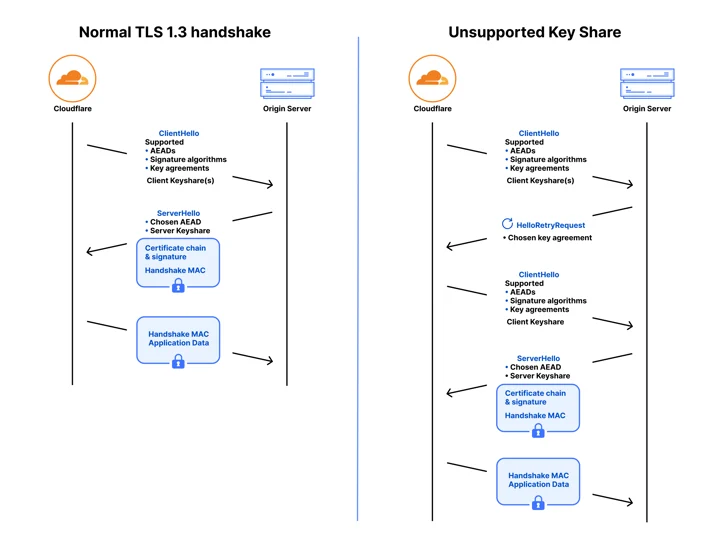
Source: Cloudflare. The right-hand sequence shows the extra round trip caused by a retry.
Making open models usable in science
Open weather models need usable initialization data
open weights don't make a model easy to run
Earthmover and Hugging Face published a September 8 workflow for running open weather models with analysis-ready data. It covers a demo, local Aurora inference, comparison against ERA5 and remote jobs. The authors estimate roughly 1 GB of initial conditions for a typical forecast and about 360 GB for a year of backtesting before outputs. Fast inference alone therefore understates operational work. Data access, format and hardware requirements still determine whether an open model is usable.
Source: Earthmover and Hugging Face
September 9, 2026 · AI-assisted research and writing. Chinese quotations are translations. Research results and performance figures are attributed to their sources and have not been independently reproduced by WindFlash.