Tuesday, September 8, 2026 · 10 curated articles
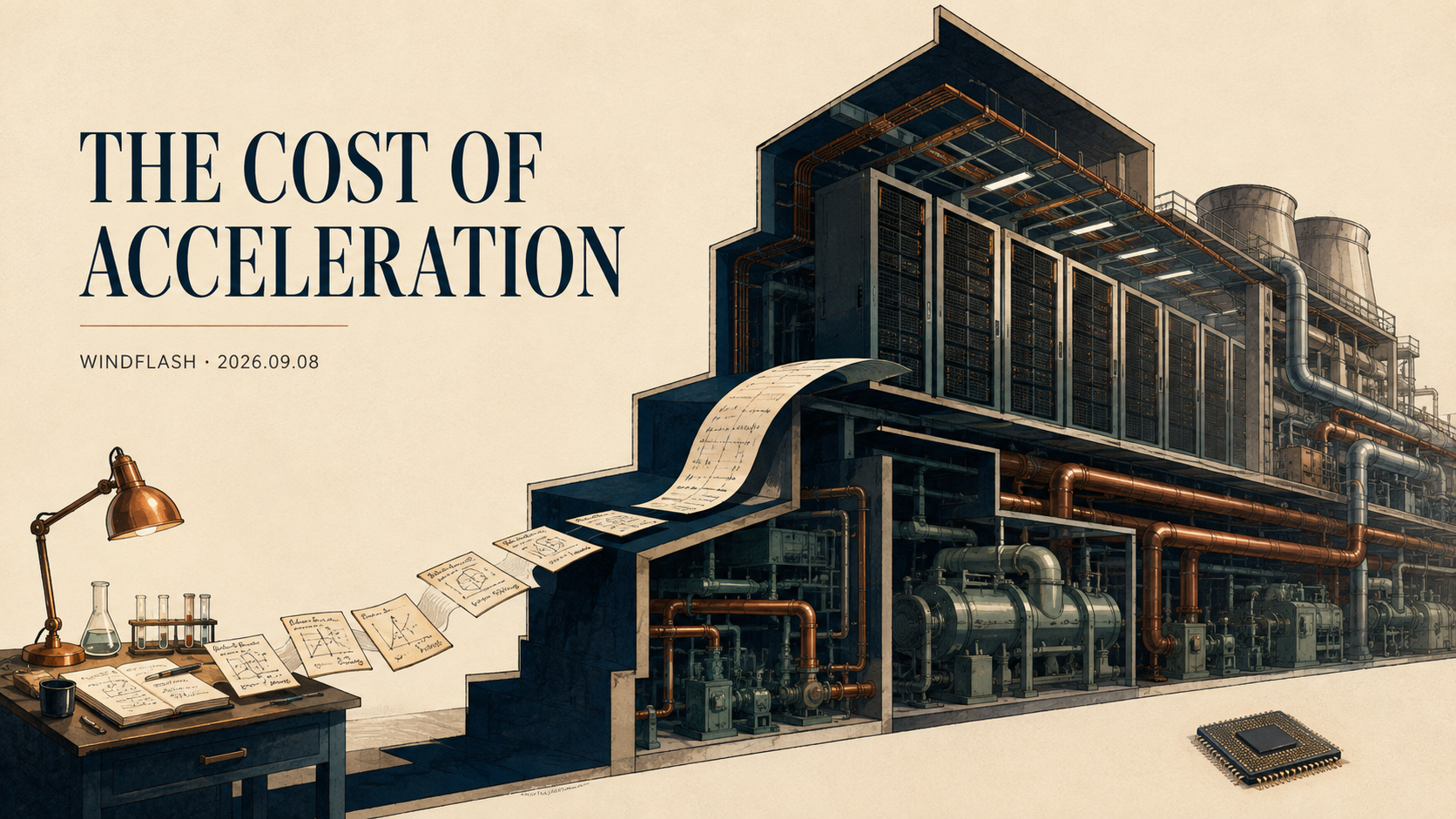
AI-generated conceptual illustration, not a photograph of a real research facility.
Editor's Picks
OpenAI’s research acceleration report puts a price-shaped number on a changing workflow: agent consumption valued at more than $600 per day for the median researcher. It is tempting to treat that as either an alarming bill or a productivity trophy. It is neither. The more useful accounting question is what the expenditure buys after review, unsuccessful attempts and waiting for experiments are included. A team can generate much more work without moving its most important decision any sooner.
This changes how an engineering organization should assess automation. Counting code, tokens or concurrent sessions is easy; assigning value to an experiment that rules out a bad idea is harder. The right comparison is not simply an agent against an employee for an hour. It is the cost of reaching an accepted result through the whole workflow. If experiment design or access to hardware remains the constraint, faster implementation moves the queue rather than eliminating it. Management needs to notice that shift before celebrating activity as progress.
MiniCPM5-2B and local deployment offer a different way to frame the same choice. Not every workload needs the strongest remotely hosted model. A narrowly defined task may benefit more from predictable resource requirements and control of its data. That is an argument for measuring the actual workload, not for declaring small models inherently cheaper. Long inputs, repeated attempts and the people maintaining the service still belong in the comparison. The accompanying UltraData-RL-2609 also makes a useful distinction between possessing training material and operating a trustworthy training process.
TALA’s open-source release suggests another cost-saving route: stop asking a language model to do every part of the job. Let it express intent and let specialized software handle a constrained operation. The relevant design question is where judgment adds value and where an established algorithm provides more predictable behavior. A smaller model plus a well-chosen tool may be a better system than a larger model repeatedly correcting its own output. That remains a hypothesis to test task by task, not a universal architecture.
The bill also extends beyond the organization using AI. The kernel.org crawler account describes expensive access to material available in a more efficient form. The Internet Archive infrastructure campaign makes preservation costs visible. Neither should be reduced to a story about model pricing. Sustainable automation has to account for the services it depends on and the people maintaining them. The strongest case for acceleration is not that machines can keep working indefinitely. It is that the complete system delivers more useful results without hiding its costs somewhere else.
Research acceleration and its limits
OpenAI research acceleration: $600 a day is usage, not productivity
agents still require significant human steering
OpenAI’s September 6 report puts the median researcher’s daily agent use above $600 at API prices by mid-August. This is a valuation of inference consumption, not the company’s actual bill or a measured productivity gain. More than half of successful tasks estimated at four to eight human hours involved intervention. The company reports more experiments, but also increased compute availability; the data does not isolate how much acceleration comes from agents.
Source: OpenAI
An Alien Mind: monitoring may become the bottleneck
confidence in monitoring
OpenAI chief scientist Jakub Pachocki’s September 6 essay argues that progress in reasoning is outpacing confidence in monitoring it. He describes diminishing reliance on chain-of-thought monitoring and calls for shared safety thresholds and coordination. This is a research leader’s assessment, not proof that recursive self-improvement has already been achieved. The practical tension is whether the institutions supervising increasingly automated research can improve their checks as quickly as the systems improve their capabilities.
Source: Jakub Pachocki · OpenAI
Smaller models, inspectable training
MiniCPM5-2B brings 128K context to local deployment
Number of Parameters: 2,516,756,480
OpenBMB released MiniCPM5-2B on September 7 for local assistants and constrained deployments. Its card lists 131,072 context tokens and about 2.52 billion total parameters, including embeddings; the non-embedding count is about 1.98 billion. That explains why the name says 2B while the hosting site rounds it to 3B. Published comparisons are the team’s own evaluation set, not a universal ranking. Weight size alone also says little about memory use at maximum context.
Source: OpenBMB · model card
UltraData-RL-2609 releases 85,995 checkable training tasks
The release includes test cases, not a sandbox.
UltraData-RL-2609, released September 7, contains 85,995 tasks spanning mathematics, code, long-context questions and scientific knowledge. Its value lies in explicit reference answers and verification rules rather than volume alone. Code samples include tests, but users must supply an execution sandbox. The card also limits its contamination checks to benchmarks known during construction. A reusable training resource still needs evaluation hygiene and safe execution when transferred into a different research setup.
Source: OpenBMB · dataset card
Let tools handle the geometry
TALA goes open-source with D2 0.9.0
TALA still takes care of routing
TALA became open-source under MPL-2.0 on September 7 and ships with D2 0.9.0. It supports fixed node positions alongside automatic layout, allowing a model or author to specify composition while the engine routes connections. The author also documents tradeoffs: adding a node can substantially change a layout, large graphs cost more time, and Dagre or ELK can suit directional graphs better. This is a useful division of labor, not an automatic guarantee of better diagrams.
Source: Alexander Wang · D2
The bill behind open access
Kernel maintainer reports 14–16 cores occupied by scrapers
rendering commits for scrapers
In an August 29 operational account, Konstantin Ryabitsev reports that 14–16 of 90 cores across five kernel.org nodes are persistently occupied rendering commit pages for scrapers. Simon Willison linked the account on September 7. The expensive work is repeated HTML generation, despite repositories being available to clone. The traffic attribution is the maintainer’s assessment, not identification of every caller. For data consumers, access method can matter as much as the amount downloaded.
Source: Konstantin Ryabitsev · kernel.org
Internet Archive ties September matching to infrastructure costs
your initial gift will be matched 2:1
The Internet Archive’s September 1 campaign says it maintains 210 petabytes of knowledge while funding storage, power, cooling and staff. Its September offer matches the initial payment of a new recurring donation of at least $25 at two to one. It does not promise to triple every future monthly payment. The campaign makes an infrastructure distinction explicit: free access describes what readers pay, not what preserving and serving a public archive costs.
Source: Internet Archive
Running the software you own
Jellyfin 12.0 makes the migration a major event
a backup is the only way back
Jellyfin 12.0 arrived September 7 with database and performance work plus improved support for books and comics. The release rewrites data on first boot, so reverting requires a backup rather than merely installing an older executable. Existing 10.10.7 or 10.11.x installations are supported upgrade starting points; older installations need an intermediate upgrade. Username case collisions and outdated plugins require attention too. The release notes frame ownership as an operational responsibility, not just freedom from subscriptions.
Source: Jellyfin · release team
Old cryptography, concrete boundaries
A 1999 CA key falls in 32 hours, not modern TLS
The E-Certify 512-bit roots were removed by Netscape in 2002.
Matthew McPherrin’s September 7 experiment factors two obsolete 512-bit E-Certify RSA roots in 32 and 29 hours on a desktop. They belonged to a narrow period of Netscape history and were removed in 2002. This is not a compromise of current browser trust or modern RSA key sizes. Claude Code assisted with historical artifact extraction and a compatibility server; the author explicitly does not certify every extracted record. The result is strongest when those historical boundaries remain visible.
Source: Matthew McPherrin
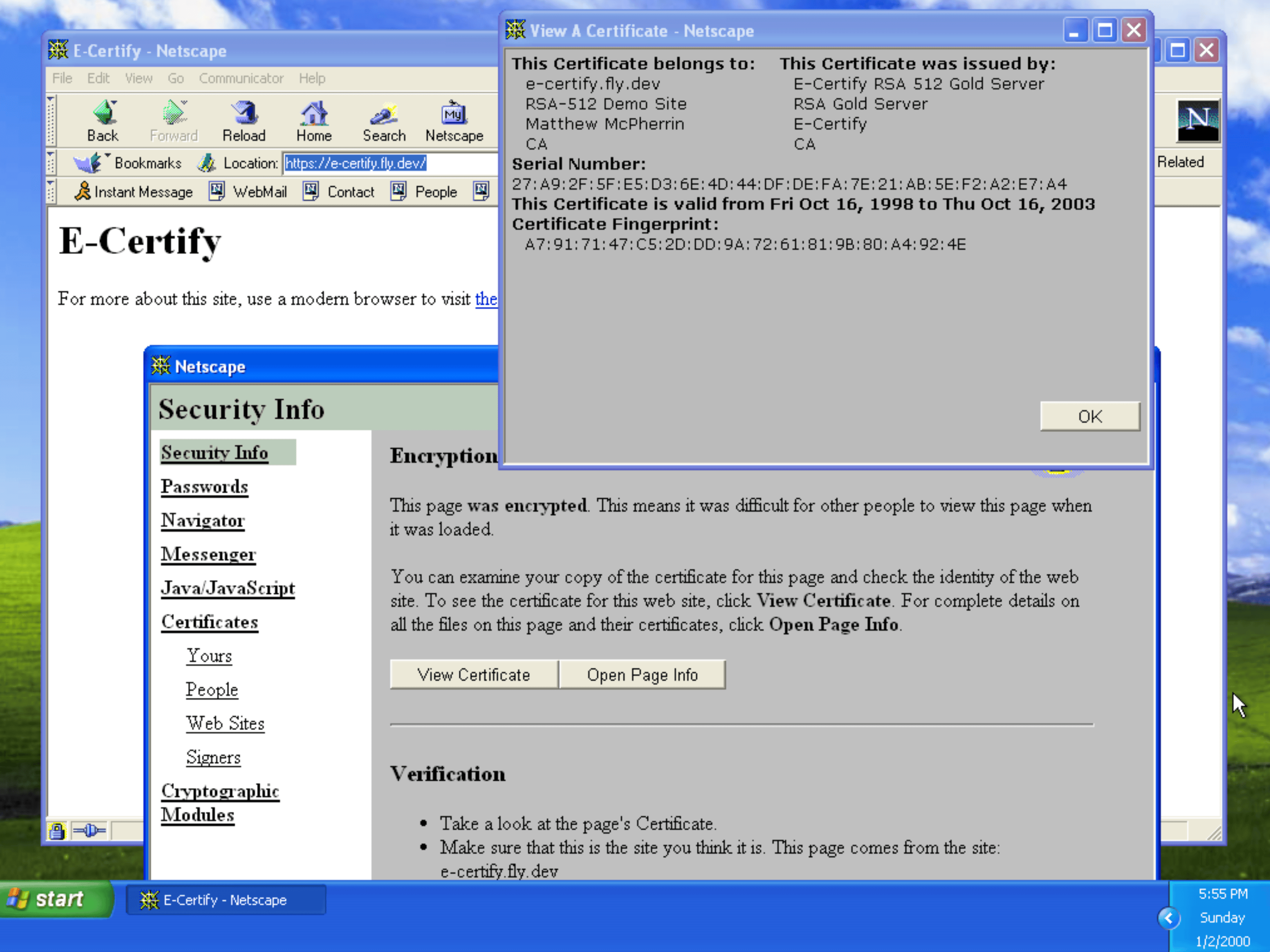
Source: Matthew McPherrin’s historical experiment. The screenshot shows Netscape 4.51, not a current browser.
Forecasts that reach operations
WeatherNext 3 trades coarser updates for hourly forecasts
generate forecasts every hour
Announced September 3, WeatherNext 3 incorporates raw satellite observations to refresh global forecasts hourly. DeepMind lists 5 km resolution for station-targeted temperature and humidity, and 10 km for other surface variables such as wind. Its integration routes include Google products and enterprise data tools. The useful question is which operational decision benefits from fresher information, not just which model tops a benchmark. Google separately labels Weather Lab experimental and directs official warnings to meteorological authorities.
Source: Google DeepMind
September 8, 2026 · AI-assisted research and writing. Quotations are attributed to their sources; Chinese quotations are translations. Reported experiments and operational figures have not been independently reproduced by WindFlash.