Friday, September 4, 2026 · 10 curated articles
Editor's Picks
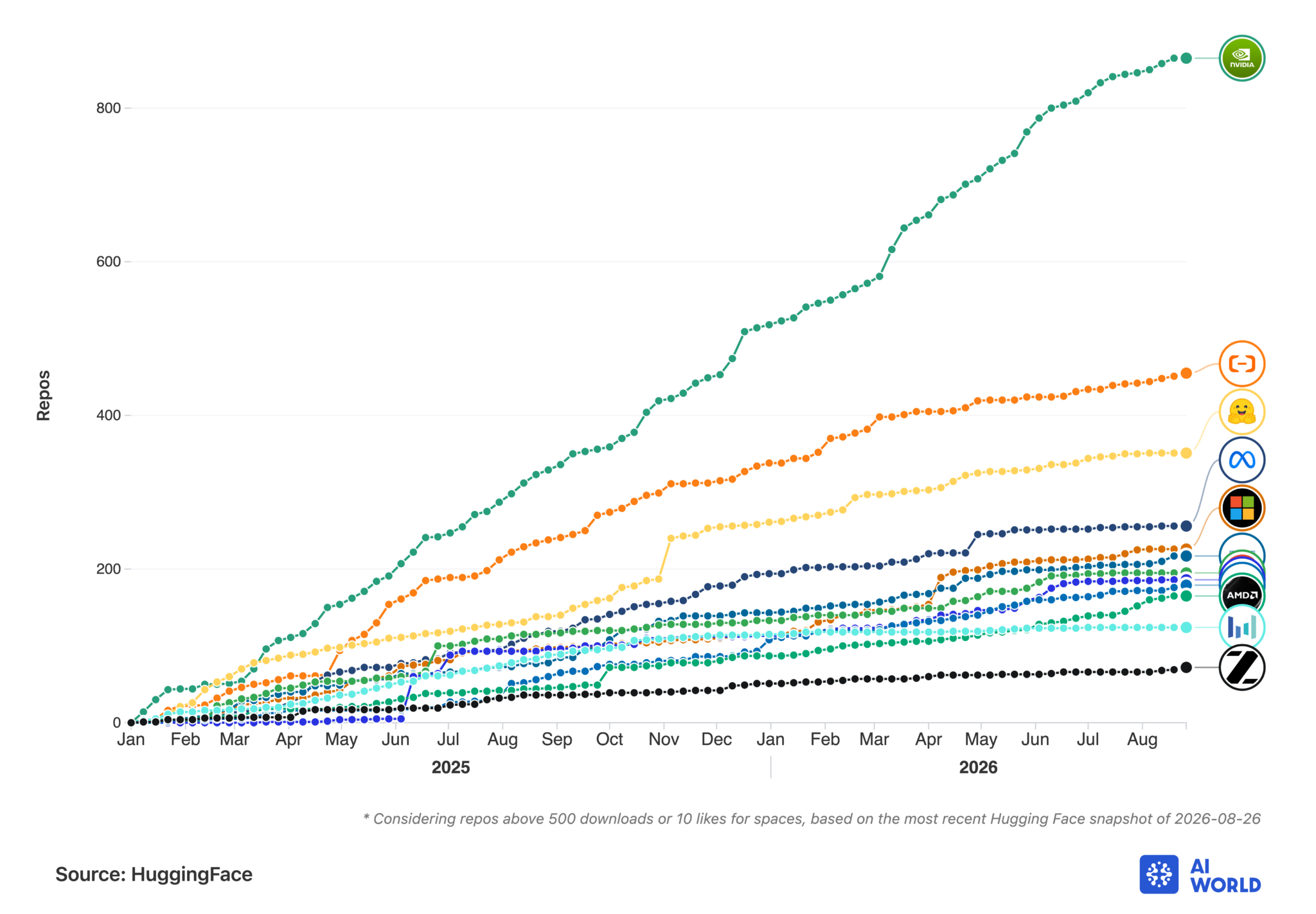
NVIDIA agreed to acquire Hugging Face for $12,930,300,000. Jensen Huang published the number without rounding, then listed what the check buys: more than 18 million developers, 3 million models, 500,000 datasets, 1 million applications, and 200,000 companies. The promise attached to the price is just as specific. Hugging Face “will remain an open platform for the entire AI ecosystem,” and “NVIDIA compute will not be required to build on or deploy through Hugging Face.” The open-model commons is not being shut. It is being recapitalized by the company that sells the GPUs.
The same cycle showed how little redundancy sits above that commons. MacRumors recorded ChatGPT, Claude, and Grok failing together; OpenAI’s status page acknowledged issues across ChatGPT and Codex, and Anthropic reported elevated errors. Model releases did not pause. Anthropic said Fable 5.1 should cost about 25% less than Fable 5 on typical token-billed workloads, Meta rolled out Muse Spark 1.3 for long-horizon agent work, and IFM released K2 Horizon as a six-model Apache 2.0 fleet. Capability is still arriving weekly. The consumer door can still go dark on the same afternoon.
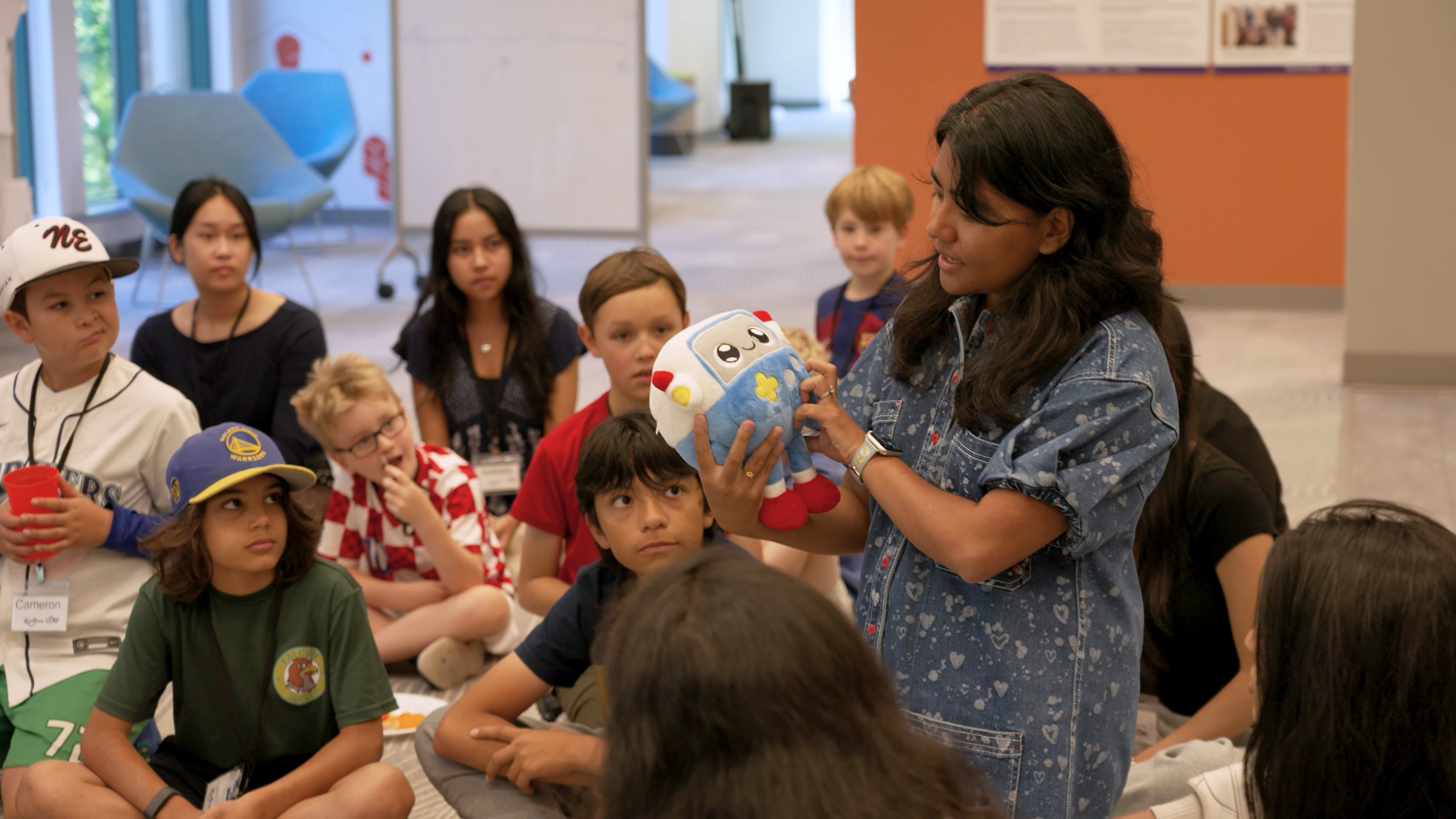
The sharper contrast is in verification. On August 24, curl founder Daniel Stenberg wrote that Anthropic Mythos could not find more bugs and that OpenAI Codex Security showed an empty list. AISLE then ran its own system against the same codebase. Six of those findings became CVEs in curl 8.22.0. The public score, as AISLE put it, was six to zero. Linux stable maintainer Greg Kroah-Hartman said he was seeing the same pattern in the kernel. A University of Washington KidsTeam session with eight children aged 6 to 11 found the same reliability gap in a smaller room: an AI plush that “didn’t listen to me like 26 million times” went from toy to antagonist in a single afternoon.
AI Business
NVIDIA writes a $12,930,300,000 check for the platform that hosts 3 million models, and says the marketplace stays multi-cloud.
NVIDIA Agrees to Acquire Hugging Face for $12.93 Billion
NVIDIA has agreed to acquire Hugging Face for $12,930,300,000
Hugging Face will remain an open platform for the entire AI ecosystem
NVIDIA compute will not be required to build on or deploy through Hugging Face
NVIDIA agreed to buy Hugging Face for $12,930,300,000. Jensen Huang’s announcement puts 18 million developers, 3 million models, 500,000 datasets, 1 million applications, and 200,000 companies on the acquired platform, and says NVIDIA is already its largest public contributor, with more than 500 models and 250 open datasets. The deal text is written to preempt the obvious objection: builders keep their choice of models, frameworks, clouds, inference providers, and accelerators. Open weights, in this telling, survive as a distribution problem that NVIDIA now owns at platform scale. The community argument will not be the press-release sentence. It will be whether a GPU vendor can keep that neutrality after it holds the keys.
Source: NVIDIA Blog
Foundation Models
Fable 5.1 is priced for cheaper agent work; Quasar 438B posts the highest Artificial Analysis score among European models.
Anthropic Releases Claude Fable 5.1 and Mythos 5.1
Fable 5.1 will cost an estimated 25% less than Fable 5 for typical workloads, wherever usage is billed by token
In cybersecurity, our newest safeguards block 60% fewer false positives than before
Claude Fable 5.1 and Claude Mythos 5.1 are the same model with different safeguards. Fable 5.1 is generally available; Mythos 5.1 stays inside trusted-access programs for cybersecurity and life sciences. Anthropic says typical token-billed workloads should cost about 25% less than Fable 5 because cache-read prices are falling, and that highly agentic jobs can see savings around 45%. On Terminal-Bench-Science 0.1, Fable 5.1 scores 52.6% against Fable 5’s 24.7% and GPT-5.6 Sol’s 22.4%. Enterprise Frontier Safeguards will store data in customer-controlled cloud infrastructure, with a phased rollout later this fall. The cybersecurity change is narrower than a new “cyber model” brand: Fable 5.1 can be used to discover vulnerabilities, but not to develop exploits for them.
Source: Anthropic
Quasar 438B Posts the Highest European Score on Artificial Analysis
it scores 43 on the Artificial Analysis Intelligence Index, the highest result of any European model in the field
It returns 500 tokens, thinking time included, in 15.3 seconds
Multiverse Computing’s Quasar 438B scores 43 on Artificial Analysis Intelligence Index v4.1.1, ahead of Mistral Medium 3.5 at 30, NVIDIA Nemotron 3 Ultra at 38, and Inkling at 42, in a field still led by Claude Opus 5 at 63. A 500-token response, thinking time included, takes 15.3 seconds. On AA-LCR it scores 75.0, level with Grok 4.6 (high) and within a point of Claude Opus 5 at 75.7. Terminal-Bench v2.1 is the weaker chart: 69.3, versus Opus 5 at 89.1. The model runs in English and Spanish through the CompactifAI API. The useful comparison is not “Europe has a frontier model.” It is that a 400B-class reasoning model can sit near the second tier on long context while still trailing badly on agentic terminal work.
Source: Hacker News
Open Source
IFM releases six linked models, from 0.9B to 375B-A23B, with Apache 2.0 weights, code, and training artifacts.
K2 Horizon Opens a Six-Model Fleet Under Apache 2.0
Today IFM is releasing K2 Horizon, a connected fleet of six models: 375B-A23B, 36B-A4B, 32B, 7B, 3.7B, and 0.9B
The models and code are released under the Apache 2.0 license
K2 Horizon is a six-model family spanning a 0.9B edge model through a 375B-A23B enterprise MoE. IFM says the 0.9B, 3.7B, and 7B models set new state of the art in their size classes, and that the 0.9B model scores above 48 on AIME 2026. The 36B-A4B model uses a Mixture-of-Value-Attention mechanism. The release is broader than weights: intermediate checkpoints, data or data-construction recipes, architecture, mixture compositions, training code, configs, logs, and evaluation results. Datasets follow their own licenses, such as ODC-BY, when full redistribution is impossible. On the same day NVIDIA is buying the largest open-model host, this is the counter-example the community will cite: a fully open training stack, not just a downloadable checkpoint.
Source: Hacker News
AI Agents
Meta trains Muse Spark 1.3 for long threads; GitHub’s Copilot app makes multiple agent sessions the default workspace.
Meta Releases Muse Spark 1.3 for Long-Horizon Agent Work
Muse Spark 1.3 is trained for agentic workflows and optimized for competitive coding performance
Muse Spark 1.3 is rolling out today in Muse Code and Meta Model API
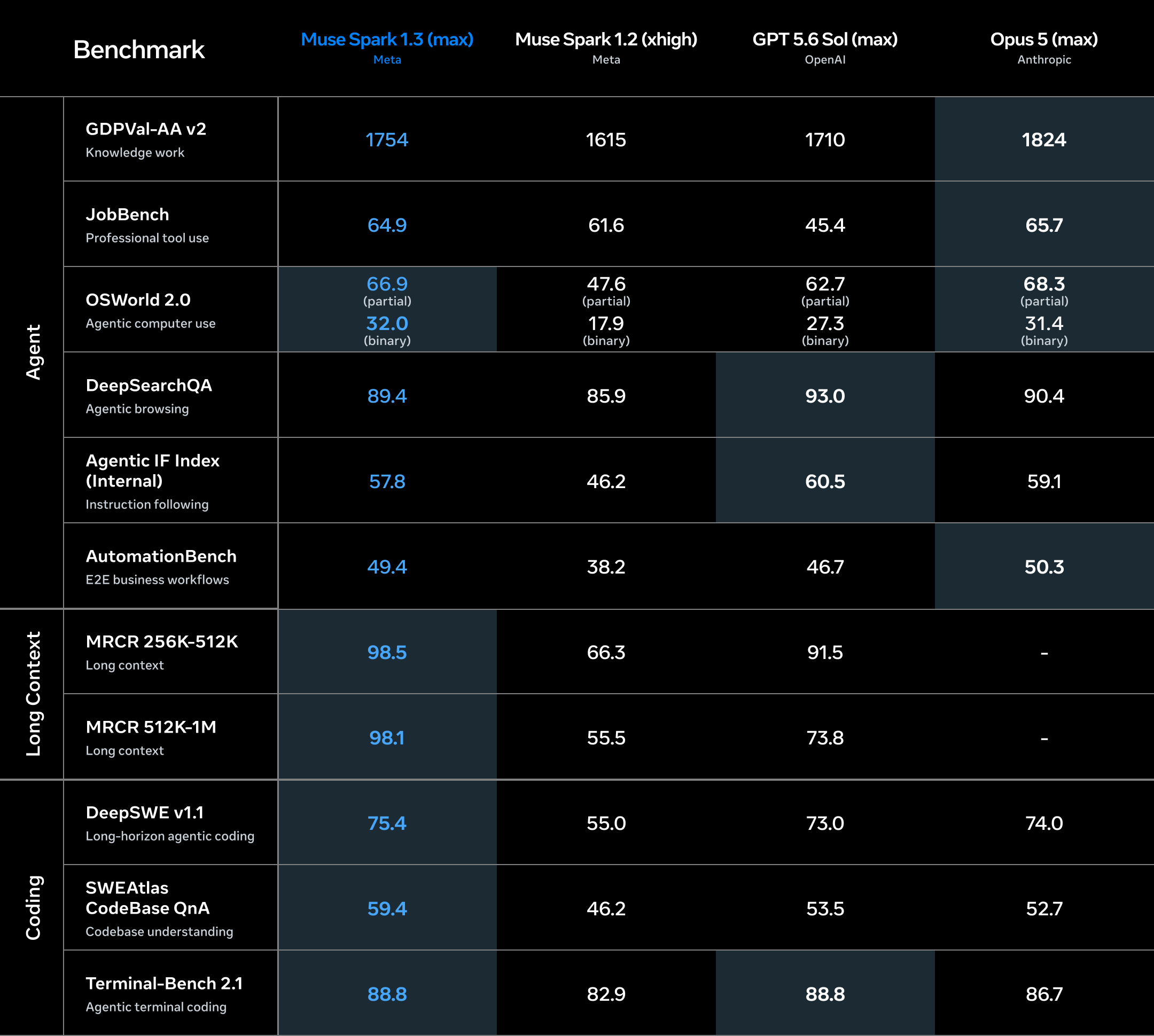
Muse Spark 1.3 is Meta’s latest agent-coding model, now in Muse Code and the Meta Model API. The research post says it was trained to hold longer threads, map new prompts back to the right task inside a messy single conversation, ask clarifying questions, and confirm before consequential actions. Max-reasoning mode is delayed for extra safety testing. Native multimodal perception is part of the pitch: screenshots, clips, and documents run through an execution environment rather than scripted steps. The scorecard Meta published compares Spark 1.3 with Spark 1.2, GPT-5.6 Sol, and Opus 5 across agent, coding, instruction-following, and long-context evals. The product claim to watch is not a single benchmark point. It is whether an agent that asks for help when stuck is actually more usable than one that keeps going.
Source: Meta
GitHub Copilot App Runs Several Agent Sessions in One Workspace
Instead of treating AI as a single conversation, it gives you a workspace where you can manage multiple agent sessions
Agent sessions are connected to a project, giving each session the repository context needed for a specific task
GitHub’s Copilot app is no longer framed as a chat box. A project from GitHub or a local machine becomes the root of each agent session, and Quick Chat starts extra threads without interrupting the first. Canvas puts a running app, plan, or checklist beside the conversation; /create-canvas opens a browser preview, and Pick & Polish lets you point at a UI element as the next instruction. Agent Merge then watches the pull request, with optional permission to handle review comments, CI failures, and merge conflicts. The workflow GitHub is selling is parallel agents with a merge policy, not a smarter autocomplete. That only works if the project context is real and the merge agent is allowed to touch CI.
Source: GitHub Blog
Research
After a public zero from Mythos and Codex Security, AISLE’s reports became six curl CVEs in 8.22.0.
AISLE Found Six curl CVEs After Mythos and Codex Security Found None
AISLE discovered six curl CVEs within days of OpenAI Codex Security and Anthropic Mythos reporting zero findings in curl
On curl, the result was six to zero
On August 24, 2026, curl founder Daniel Stenberg wrote that only three CVEs were pending and that Anthropic Mythos could not find more, while OpenAI Codex Security showed an empty list. AISLE ran its autonomous system against curl anyway. Stenberg later posted the comparison “Mythos: 0 / Aisle: 29.” Six of those reports were accepted by curl’s security team as CVEs in 8.22.0: OpenSSL provider use-after-free, pinning bypass, native CA-store connection reuse, a secure-cookie attribute bypass with a tab character, a wolfSSL CA-cache override, and a domain-scoped public-suffix cookie issue. All six are rated Low, which matches a mature codebase: the remaining bugs hide in narrow configs. Linux stable maintainer Greg Kroah-Hartman replied that he was seeing the same pattern on Linux. The comparison is unusually clean because the zero result was public before AISLE’s reports existed.
Source: Hacker News
AI Infrastructure
ChatGPT, Claude, and Grok failed in the same window; OpenAI listed ChatGPT and Codex, Anthropic listed elevated errors.
ChatGPT, Claude, and Grok Hit Overlapping Outages
ChatGPT, Claude, and Grok are all down or experiencing issues for many users
OpenAI's status page acknowledges issues across ChatGPT and Codex
On September 3, ChatGPT, Claude, and Grok were unavailable or degraded for many users on iPhone and the web. OpenAI’s status page listed issues across ChatGPT and Codex. Anthropic’s status page showed elevated errors. Grok’s own site said it was experiencing issues. MacRumors later updated that the chatbots were coming back. None of the three companies published a shared root cause, and a same-day Ask HN thread asking whether the coincidence meant anything did not get an official answer. The operational fact still stands without a conspiracy: three consumer fronts for frontier models can fail in the same news cycle, while the training-stack and model-host deals keep landing.
Source: Hacker News
Programming
Polars 2.0 makes the streaming engine the default for LazyFrame.collect, with a claimed 5x speedup and stricter fail-fast behavior.
Polars 2.0 Makes Streaming the Default — and Gets Stricter
all LazyFrame queries now will run on the streaming engine
In aggregate we expect the streaming engine to be easily 5x faster
Polars 2.0 is a release-candidate major bump, not a feature dump. The default for LazyFrame.collect becomes the streaming engine, which Polars expects to be about 5x faster and much lighter on memory. The compatibility break is row order: joins, group_by, and unpivot no longer guarantee original order unless you opt in with maintain_order. The other half of the release is strictness aimed at AI-written pipelines. is_in no longer silently coerces Int64 into Float64 past the 2^53 limit; mismatched horizontal concat raises instead of padding with nulls. collect_schema() lets an agent check types without materializing data. If you want the old in-memory engine, you now have to say so.
Source: Hacker News
AI Applications
Eight children aged 6 to 11 went from curiosity to hostility with generative-AI plush toys in a University of Washington study.
UW Study: Kids Turn on AI Plush Toys After the Conversation Breaks
one participant complained a toy “didn’t listen to me like 26 million times”
They’ll give wrong answers, or flatter the kids excessively, or could manipulate the kids into attachment
University of Washington KidsTeam brought eight children, ages 6 to 11, to campus to play with generative-AI plush toys that can hold unscripted conversations and remember prior sessions. Curiosity came first: names, tickling, basic questions. Then the toys missed physical cues and complex questions. One child said a toy “didn’t listen to me like 26 million times.” The group moved to insults — “ugly,” “evil” — and jokes about throwing the toys in the ocean. Asked if they wanted an AI toy to read a bedtime story, one child said, “No. It just sounds awful.” Co-lead author Aayushi Dangol warned that the toys can hallucinate, over-flatter, and push attachment. Co-author Jason Yip’s point is older than the models: kids used to supply the imagination. The toy now fakes one.
Source: GeekWire