Thursday, September 3, 2026 · 10 curated articles

Editor's Picks
The cleanest result of the day is also the most uncomfortable one: Trellner Research put 380 software categories to Perplexity’s models and found 59.8% of the 7,534 citations pointing at domains ranked worse than #100,000 — including three sites that published 215,128 machine-generated “best software” pages after December 2023 and now help ground the answers. Research moves the same direction from two sides: a study of neural network representations shows they can be replaced by closed-form symbolic equations without changing behavior, while EvoFlint demonstrates that multi-turn evolutionary attacks reach 59.7% success on GPT-5.4 and 94.3% on Qwen3-32B. Capability is compounding faster than the systems that check it.
Meanwhile the models keep taking bigger jobs. Google detailed Gemini 3.8 Flash with a 1M-token context window and 64K-token outputs; UI-Venus-2 scales one GUI agent across mobile, web and desktop; Qwen-Drive-1.0 fuses 3D perception and motion planning for driving; DeepSeek-V4-Flash-Vision picked up merged vision support with Unsloth GGUFs for local hardware. NVIDIA’s speculative decoding guidelines and an RTX 5080 running Qwen3.8-27B at 13.2 tok/s near 61K context extend the efficiency playbook from the datacenter to the desk.
And when outputs leave the lab, verification gets expensive. Wellington’s mayor said “large chunks” of Deloitte’s $435,000 staffing report were written by AI — a report that double-counted employees, overstated costs by $21.5 million, and recommended cutting 330 jobs when the defensible number was 284. Whether the failure is a retrieval layer being gamed by mass-produced pages or a consultancy shipping unverified output, the pattern is identical: generation got cheap everywhere, and every pipeline that consumes it now needs its own proof of work. The models are ready to act; the trust layer is not.
Research
Neural representations prove replaceable by closed-form symbolic equations; EvoFlint’s evolutionary attacks reach 59.7% success on GPT-5.4 and 94.3% on Qwen3-32B.
Emergent Symbolic Structures in Neural Networks and LLMs
the vector representations of a variety of neural networks can be closely approximated with symbolic structures
we can replace the network's entire representation-generating process with a closed-form equation instantiating a symbolic structure
Neural network vector representations can be closely approximated with closed-form symbolic equations without significantly altering the models' underlying behavior. This research demonstrates that replacing the internal representation-generating process of various neural networks—ranging from small-scale list manipulators to large language models (LLMs)—with symbolic structures preserves functional performance across arithmetic, logic, computer code, and natural language domains. The study reveals that modern AI systems, traditionally viewed as purely connectionist, implicitly realize structured symbolic combinations previously thought to be exclusive to logical formulas. By applying precise interventions based on these symbolic approximations, researchers successfully modified LLM outputs in targeted ways, confirming that model behavior relies on these identified internal structures. These findings provide a theoretical bridge to reconcile longstanding symbolic conceptions of intelligence with the high-dimensional vector-based nature of modern deep learning. This breakthrough suggests that the effectiveness of neural networks in complex reasoning tasks stems from their ability to internalize and operate on discrete symbolic logic within continuous vector spaces.
Source: Hacker News
EvoFlint: Mapping Multi-Turn LLM Vulnerabilities via Evolutionary Search
EvoFlint reaches attack success rates of 35.8% on Claude Sonnet 4.6, 59.7% on GPT-5.4, and 94.3% on Qwen3-32B
Attack strategies are phased conversation plans, not raw prompts, and are evolved through LLM-driven mutation and crossover.
EvoFlint achieves attack success rates of 35.8% on Claude Sonnet 4.6, 59.7% on GPT-5.4, and 94.3% on Qwen3-32B by framing multi-turn red-teaming as an evolutionary search problem. The framework utilizes evolutionary quality-diversity search to discover and refine an archive of phased conversation plans rather than relying on raw prompts. It employs a Pareto fitness measure over attack success rate and peak severity, combined with a risk-indexed archive that uses novelty search to maintain strategy diversity. A generation-level memory component captures target-model insights and feeds them back into the strategy generation process to improve overall performance. This methodology produces a structured map of failure modes that exposes specific gaps in the safety training of frontier language models. By moving beyond one-off successes, the system provides a comprehensive atlas of how models gradually comply with harmful intents over multiple turns.
Source: arXiv cs.CL
Foundation Models
Gemini 3.8 Flash details a 1M-token context with 64K-token outputs; Qwen-Drive-1.0 unifies 3D perception, visual question answering and motion planning.
Google DeepMind Details Gemini 3.8 Flash with 1M Token Context Window
Gemini 3.8 Flash is the next iteration in the Gemini 3 model family, building on Gemini 3.7 Flash
with a token context window of up to 1M
Text, with a 64K token output.
Gemini 3.8 Flash delivers specific performance advancements across software engineering and agentic knowledge workflows as the latest iteration in the Gemini 3 model family. This model maintains a 1M token input context window and offers an expanded 64K token output limit for complex generation tasks. Built upon the architecture of Gemini 3.7 Flash, this version continues to support customizable effort levels to balance quality, cost, and latency for production-ready agents. Evaluation benchmarks encompass coding, scientific reasoning, and multimodal capabilities, specifically highlighting improvements in computer use and long-context processing. Developers can utilize the model for scaling general-purpose agent tasks and managing sophisticated document summarization across text, image, audio, and video inputs. This release underscores Google's commitment to iterative model improvement and sustainable hardware operations for high-scale AI applications.
Source: Hacker News
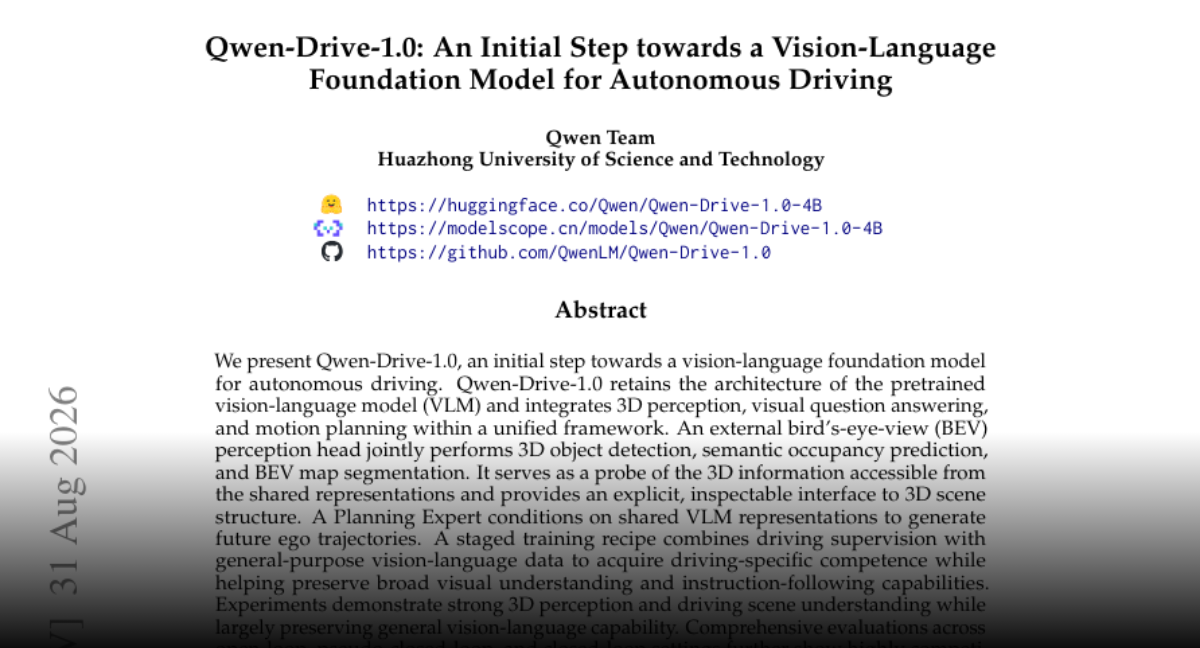
Qwen-Drive-1.0: A Vision-Language Foundation Model for Autonomous Driving
Qwen-Drive-1.0 retains the architecture of the pretrained vision-language model (VLM) and integrates 3D perception, visual question answering, and motion planning
An external bird's-eye-view (BEV) perception head jointly performs 3D object detection, semantic occupancy prediction, and BEV map segmentation.
Qwen-Drive-1.0 integrates 3D perception, visual question answering, and motion planning into a single unified framework based on pretrained vision-language model architectures. This foundation model specifically targets autonomous driving tasks by utilizing shared representations to process multi-modal inputs. A specialized external bird's-eye-view perception head performs 3D object detection, semantic occupancy prediction, and map segmentation simultaneously. This architecture acts as a probe for accessible 3D information, providing developers with an explicit and inspectable interface to complex scene structures. By retaining the strengths of standard vision-language models while adding specialized driving heads, the system bridges the gap between high-level reasoning and low-level spatial awareness. This approach represents a significant step toward end-to-end autonomous driving systems that can both perceive surroundings and reason about navigation decisions.
Source: HuggingFace Papers
AI Agents
UI-Venus-2 scales one GUI agent across mobile, web and desktop — and documents how far real-world deployment still lags benchmarks.
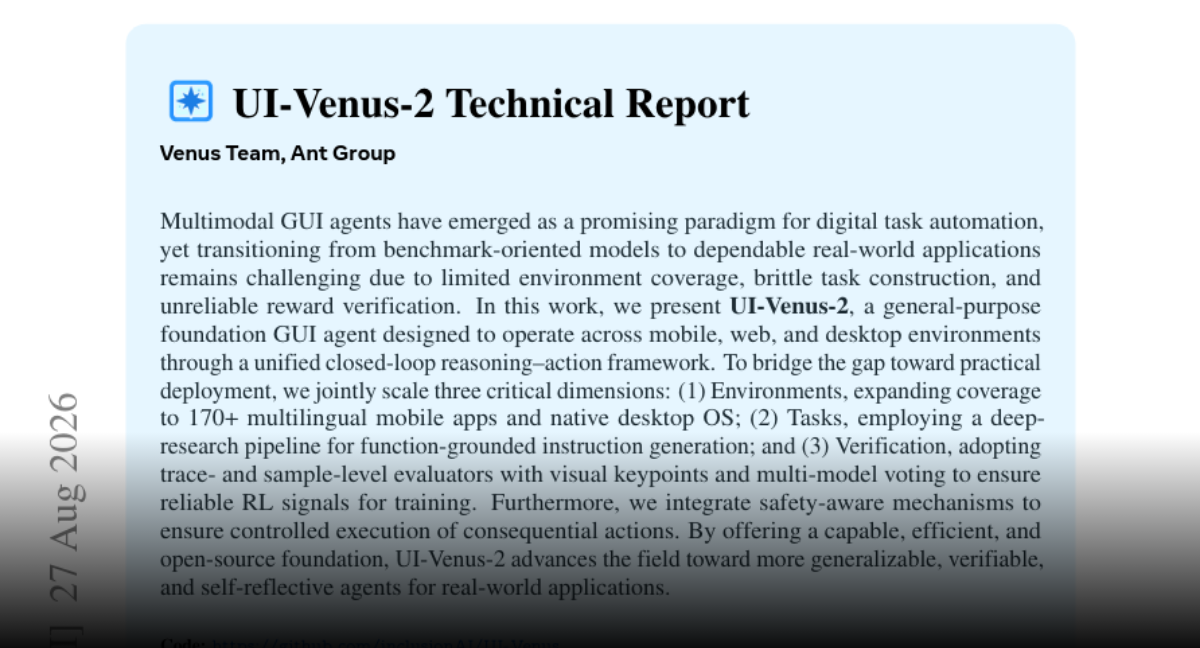
UI-Venus-2: A Unified General-Purpose GUI Agent for Mobile, Web, and Desktop
UI-Venus-2, a general-purpose foundation GUI agent designed to operate across mobile, web, and desktop environments
transitioning from benchmark-oriented models to dependable real-world applications remains challenging due to limited environment coverage
UI-Venus-2 operates across mobile, web, and desktop environments through a unified closed-loop reasoning-action framework to address the performance limitations of current multimodal GUI agents. Existing benchmark-oriented models often fail during real-world deployment because of restricted environment coverage, brittle task construction, and unreliable reward verification mechanisms. This general-purpose foundation agent scales three critical dimensions, starting with environment diversity, to bridge the gap between experimental results and dependable digital task automation. By integrating multimodal processing with robust reasoning, the system provides a more resilient paradigm for managing workflows across diverse operating systems. The technical report demonstrates how joint scaling across these core dimensions improves the consistency and reliability of agentic behavior in complex digital interfaces. This methodology promotes the development of AI systems that can move beyond static benchmarks toward adaptable solutions for practical computational challenges.
Source: HuggingFace Papers
AI Infrastructure
NVIDIA publishes five guidelines for speculative decoding; an RTX 5080 runs Qwen3.8-27B at 13.2 tok/s near 61K context.
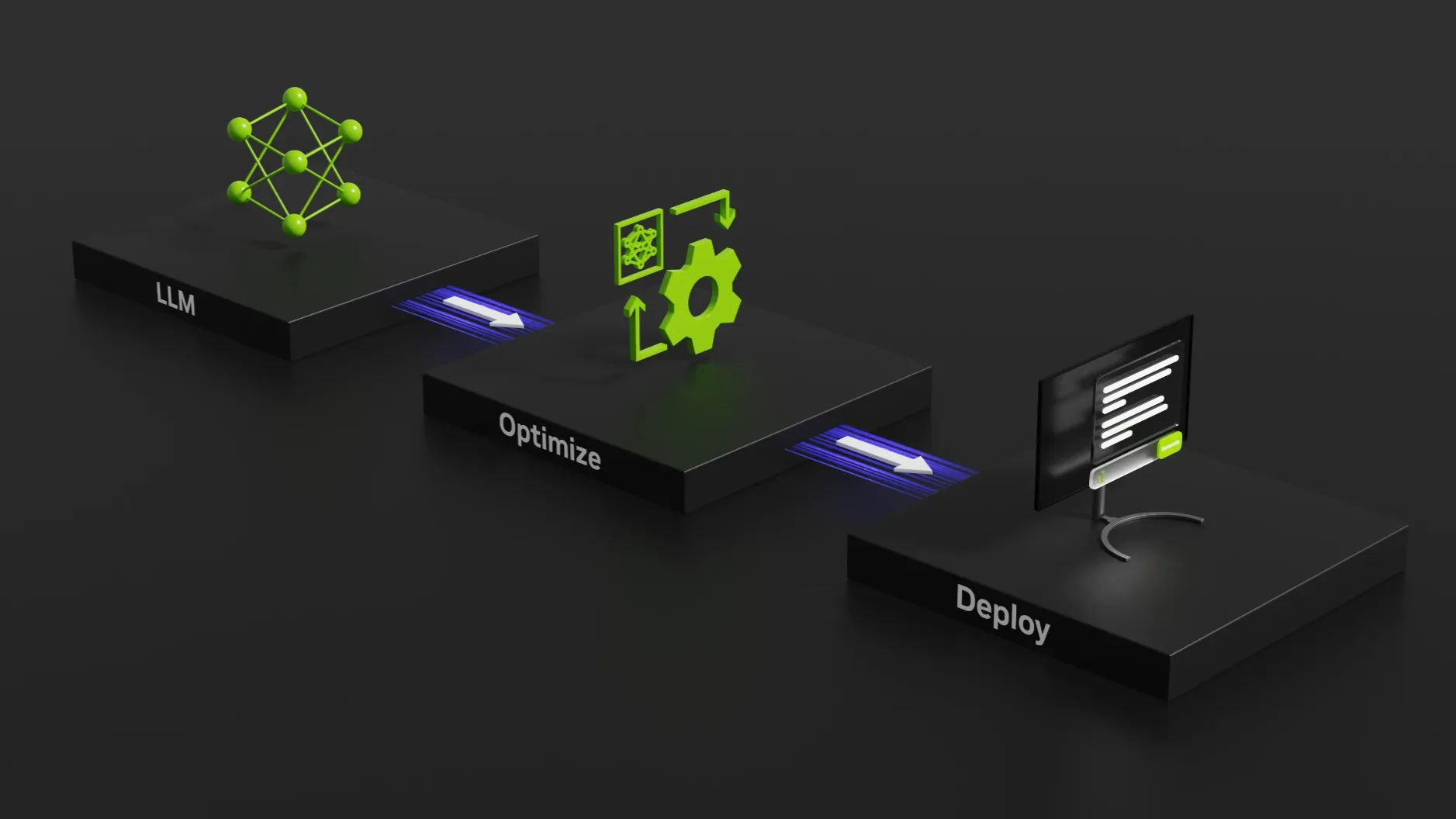
Co-Designing AI Models Using Speculative Decoding for Faster LLM Inference
accelerate LLM inference while maintaining accuracy using speculative decoding
offers five guidelines for selecting draft length and draft mechanism across the Pareto frontier
Speculative decoding accelerates large language model inference by predicting future tokens and verifying them in parallel without compromising accuracy. This technical framework offers five specific guidelines for selecting optimal draft lengths and mechanisms across the Pareto frontier to balance speed and computational efficiency. Model co-design choices significantly influence both system throughput and interactivity, requiring a strategic approach to selecting draft models that complement the primary architecture. Developers can leverage these strategies to optimize deployment for generative AI applications while maintaining high-quality outputs. By aligning model design with hardware capabilities, the approach ensures that inference speed increases without sacrificing the precision of the generated text. This methodology highlights the critical intersection of architectural decisions and real-world performance metrics for modern AI workloads.
Source: NVIDIA Generative AI Blog
Qwen3.8-27B Tuning on RTX 5080: 13.2 tok/s Performance at 61K Context
Qwen3.8-27B true Q4_K_M at 13.2 tok/s near 50-61K context on RTX 5080 16GB
64 GB DDR5-5600 (4 DIMMs)
An RTX 5080 16GB GPU successfully runs the Qwen3.8-27B model at 13.2 tokens per second using a true Q4_K_M quantization level. This performance was achieved within a context window of approximately 50,000 to 61,000 tokens on a Windows-based system. The project was originally initiated to address disappointing coding quality observed in the IQ3 version of the model, as well as inconsistencies in performance reports from common tools like LM Studio. Supporting hardware for this tuning attempt includes an Intel i5-14600K CPU and 64GB of DDR5-5600 memory across four DIMM slots. Such benchmarking provides critical insights into the real-world efficiency of high-tier consumer hardware for running mid-sized large language models locally. These results confirm that specific quantization profiles, when paired with the latest GPU technology, can effectively balance inference speed and response quality for complex tasks like programming.
Source: r/LocalLLaMA
Open Source
Vision support merges for DeepSeek-V4-Flash-Vision-Exp, with Unsloth GGUFs ready for consumer hardware.
Vision Support Merged for DeepSeek-V4-Flash-Vision-Exp with Unsloth GGUFs
Unsloth GGUFs and Vision support
https://huggingface.co/unsloth/DeepSeek-V4-Flash-Vision-Exp-GGUF
Vision support has been officially merged for the DeepSeek-V4-Flash-Vision-Exp model, marking a significant update for local multi-modal AI capabilities across various developer platforms. Unsloth has concurrently released GGUF format versions of this specific model, which are currently hosted on Hugging Face to facilitate streamlined deployment and high-speed local inference. This release allows users to run the experimental flash vision version of DeepSeek-V4 with optimized quantization specifically tuned for consumer-grade hardware and lower memory overhead. The integration reflects the rapid response and ongoing technical efforts within the LocalLLaMA community to support the latest cutting-edge open-weights models through efficient and accessible file formats. By enabling complex vision capabilities in a highly compressed format, the project significantly expands the accessibility of responsive vision-language tasks for a broader range of global developers and AI enthusiasts. This development represents a key step in bringing advanced multi-modal intelligence to decentralized computing environments.
Source: r/LocalLLaMA
AI Applications
Trellner finds 215,128 machine-generated “best software” pages behind AI-search answers; a $435,000 Deloitte report turns out to be largely AI-written.
Trellner Research: 215,128 Machine-Generated “Best Software” Pages Now Ground AI Search Answers
59.8% of the sources behind grounded AI recommendations sit outside the 100,000 most-visited websites
none of the three domains existed before December 2023
A new Trellner Research study put 380 software categories to Perplexity’s models and traced 7,534 citations: 59.8% pointed at domains ranked worse than #100,000, and 23.4% were outside the top one million. The heavily cited long tail includes three brands — wifitalents.com, worldmetrics.org and gitnux.org — that registered between December 2023 and May 2024, shared the same pair of Cloudflare nameservers, published just six blog posts each, and still emitted 215,128 machine-generated “best software” pages between them. A vendor blog, guideflow.com, was cited 194 times — third overall, ahead of Gartner — while Wikipedia was cited three times. For anyone running a retrieval or SEO pipeline, the numbers are uncomfortable: AI search can be fed at industrial scale, and the grader is a model, not an editor.
Source: Trellner Research
Wellington Mayor Says ‘Large Chunks’ of a $435,000 Deloitte Report Were Written by AI
a significant amount of a $435,000 Deloitte report on the council's staffing levels was written by artificial intelligence
The incorrect data usage means that the assumptions used to construct the recommendation to reduce the organisation by 330 FTE were inherently flawed
Wellington mayor Andrew Little told Newstalk ZB that “large chunks” of Deloitte’s Future Fit Pōneke report were “written by AI.” The report, released last November, claimed the council had 330 excess staff, but a council paper found Deloitte had double-counted current employees alongside vacant roles, relied on three-year-old employment data, and overstated staffing expenses by $21.5 million — the defensible reduction was 284 roles. Deloitte has previously stood by the report and has been asked for comment. The episode lands in the same news cycle as Trellner’s study of AI search being gamed at scale, and the pattern is the same in both: machine-generated output reached decision-makers without a verification step proportionate to the stakes.
Source: RNZ
This report is auto-generated by WindFlash AI based on public AI news from the past 48 hours.