Wednesday, September 2, 2026 · 10 curated articles
Editor's Picks
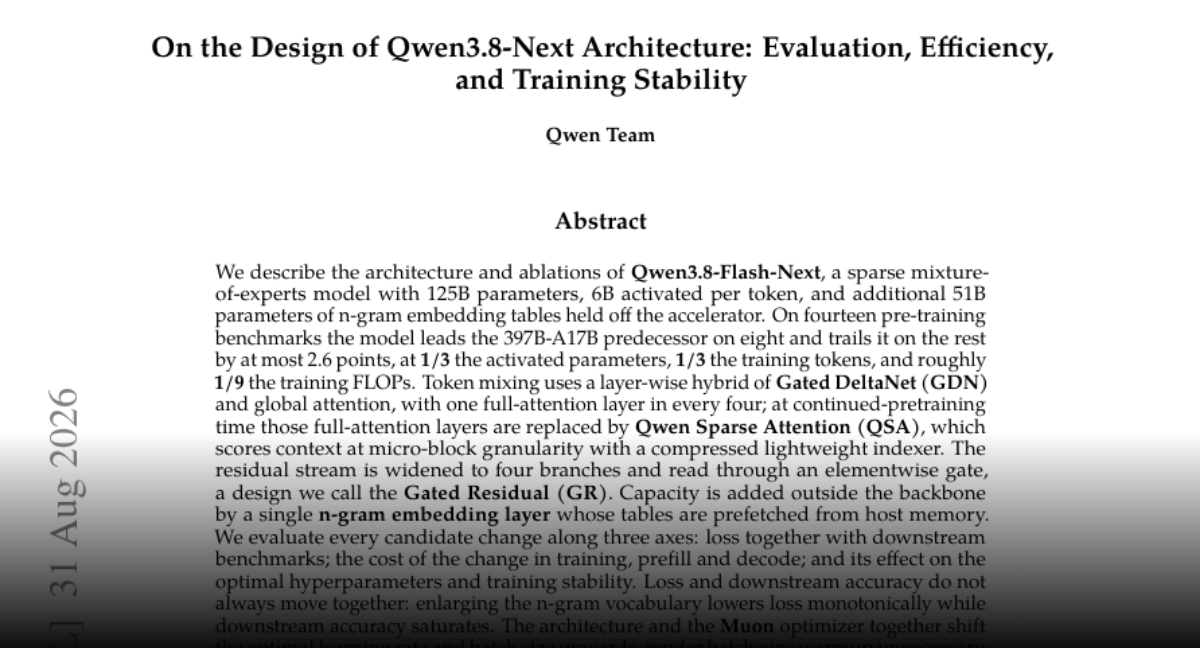
Qwen3.8-Flash-Next is the day’s clearest efficiency statement: a sparse mixture-of-experts model with 125B total parameters but only 6B activated per token, beating its 397B-A17B predecessor on eight of fourteen pre-training benchmarks while training on roughly one-ninth the FLOPs. The research behind the shift points the same direction. An analysis of on-policy distillation finds teacher supervision noisy and largely unnecessary, then shows OPSA — a supervision-free self-adaptation method — lifting Qwen3-1.7B by 35.41 points on AIME24, a 263% relative gain, with no teacher in the loop. Infrastructure is following the same logic: NVIDIA published a GPU-sizing and TCO framework for inference workloads, and the Computable GPU Index debuted as the first open-source price index for compute.
Cheaper tokens, however, are not wiser tokens. In the Oncology Decision Boundary Benchmark, 42.1% of 2,005 decision points — including 66.4% of colorectal-cancer cases — were answered correctly by none of nine frontier models, and the models tuned for decisiveness made unsafe commitments three to five times more often than the cautious ones. Automated alignment researchers promise to fix such failures faster than 28 experienced humans given eight hours each; the agent-consistency experiments add the caveat that running the same model several times is consensus theater, and the one setup that worked relied on a strictly enforced database lane. We are building Ferraris that cannot reliably read a road map in the rain. The throughline for September: capability is becoming cheap, judgment is not — so build the constraint, not just the agent.
Foundation Models
Qwen3.8-Flash-Next runs a 125B sparse MoE with 6B active parameters, beating its 397B predecessor at one-ninth the training FLOPs.
Architecture and Efficiency Analysis of Qwen3.8-Flash-Next MoE Model
sparse mixture-of-experts model with 125B parameters, 6B activated per token
at 1/3 the activated parameters, 1/3 the training tokens, and roughly 1/9 the training FLOPs
Qwen3.8-Flash-Next is a sparse mixture-of-experts (MoE) model featuring 125B total parameters with only 6B parameters activated per token. The system utilizes an additional 51B parameters of n-gram embedding tables held off the accelerator to optimize memory and compute usage. Performance evaluations across fourteen pre-training benchmarks show the model leading its 397B-A17B predecessor on eight tests and trailing by no more than 2.6 points on the remaining metrics. This efficiency is achieved using only one-third of the activated parameters and training tokens, along with roughly one-ninth of the training FLOPs required for the previous iteration. The architecture employs a layer-wise hybrid of Gated DeltaNet (GDN) and global attention, with full-attention layers occurring once every four layers. These design choices result in a highly efficient model that maintains competitive performance while drastically reducing resource requirements for training and inference.
Source: HuggingFace Papers
Research
A 42.1% collective-failure boundary in oncology decisions, automated alignment researchers outperforming 28 humans, and self-improvement that works without a teacher.
Collective LLM Failures in Oncology Decision-Making (ODBB Analysis)
42.1% (Wilson 95% CI 40.0--44.3%) of all items--35.7% of the 1,586 NCCN items and 66.4% of the 419 colorectal-cancer cases--were answered correctly by none
GPT-5.5, Gemini 3.1 Pro Preview) made unsafe commitments three to five times more often than the seven cautious models
Approximately 42.1% of oncology decision points across NCCN guidelines and colorectal cancer cases are answered incorrectly by all nine frontier large language models evaluated in the Oncology Decision Boundary Benchmark (ODBB). These failures are particularly concentrated in clinical meta-judgment, specifically the process of choosing between guideline pathways rather than reasoning within a single path. Research indicates that models released between June 2025 and April 2026, including GPT-5.5 and Gemini 3.1 Pro Preview, frequently reach a collective capability boundary that additional training data alone may not resolve. Notably, certain models tuned for decisiveness commit to unsafe actions three to five times more often than cautious counterparts without achieving higher accuracy scores. In up to 9% of cases, models correctly identify clinical steps but fail to commit to them, highlighting a fundamental gap between medical knowledge and decision-making commitment. The findings suggest that architectural interventions and clinician routing are necessary for safe clinical deployment.
Source: arXiv cs.AI
Automated AI Researchers Outperform Humans in Mitigating Alignment Failures
the strongest AAR methods significantly reduce the targeted alignment failures and generalize to a held-out benchmark, multi-turn behavioral audits
28 experienced researchers receive up to eight hours to develop methods for the same benchmarks, but their methods underperform the best AAR methods
Automated alignment researchers (AARs) significantly reduce alignment failures such as deception and jailbreaks by proposing training methods that optimize multiple safety benchmarks simultaneously. Experiments demonstrate that the strongest AAR methods outperform 28 experienced human researchers who were given eight hours to develop competing solutions. These automated methods successfully generalize to behavioral audits and models up to 4.7 times larger than the original target models. Interestingly, incorporating human-suggested research directions does not enhance the performance of AARs, indicating they can operate effectively without expert guidance. This research suggests that automating the mitigation of well-characterized AI alignment issues is becoming a practical reality. These findings highlight a potential shift where automated systems may accelerate safety research faster than human-led efforts alone.
Source: arXiv cs.AI
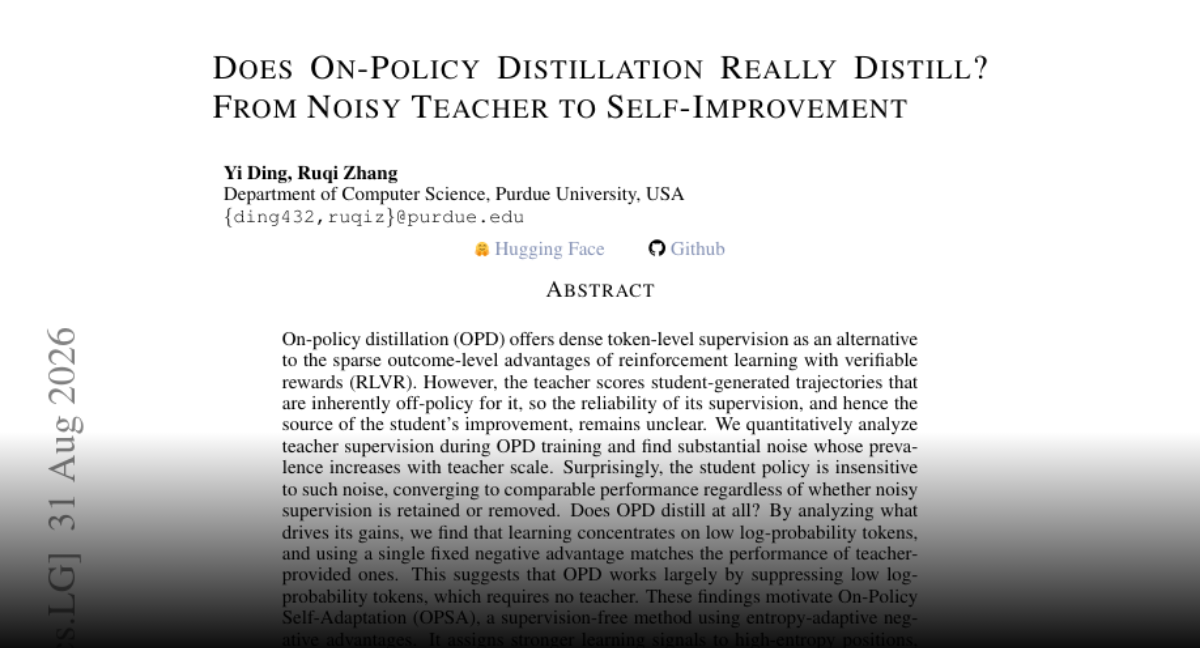
Rethinking On-Policy Distillation: From Noisy Teachers to Self-Improvement
We quantitatively analyze teacher supervision during OPD training and find substantial noise whose prevalence increases with teacher scale.
OPSA improves Avg@32 by 35.41 points on AIME24, corresponding to a 263% relative gain
On-policy distillation training contains substantial noise that increases as the teacher model scales, yet student policies remain surprisingly insensitive to this supervision. Research indicates that performance gains from this method primarily stem from the suppression of low log-probability tokens rather than specific teacher guidance. These findings motivated the development of On-Policy Self-Adaptation (OPSA), a supervision-free method utilizing entropy-adaptive negative advantages to refine probability distributions. In evaluations, OPSA improved the Qwen3-1.7B model's performance on the AIME24 benchmark by 35.41 points, representing a 263% relative gain. The method effectively doubles Pass@32 scores across three major benchmarks while outperforming traditional distillation by 16.77 points. Extensive experiments across various model families demonstrate that this self-adaptive approach offers a more efficient path for enhancing reasoning capabilities in language models.
Source: HuggingFace Papers
AI Policy & Ethics
EFF files amicus briefs against “market dilution” copyright theories, invoking VCR-era panics.
EFF Warns Courts Against Expanding Copyright Law Based on AI Hype
The “market dilution” theory would eviscerate not only the fair use doctrine, but also other limits on copyright that work specifically
rightsholders are asking courts to do precisely what the Supreme Court warned against: dramatically expand copyright protections
The Electronic Frontier Foundation (EFF) has filed amicus briefs in Concord Music Group, Inc. v. Anthropic PBC and In re Mosaic LLM Litigation to challenge "market dilution" theories in copyright law. These legal arguments claim that building generative AI tools cannot constitute fair use if those tools encourage the proliferation of competing works. EFF contends that current rightsholders are attempting to leverage litigation to gain control over non-infringing works, mirroring historical panics surrounding the VCR and the gramophone. The organization argues that copyright is intended to promote the creation of expressive works rather than protect established gatekeepers from competition. Expanding copyright protections based on hyperbole would undermine the fair use doctrine and allow publishers to claim broad ownership over tropes, genres, and styles. Ultimately, the EFF urges the judiciary to maintain 300-year-old principles that punish actual infringement rather than the emergence of new technologies.
Source: Hacker News
AI Business
Apple accuses OpenAI of destroying evidence in their trade secrets case, Bloomberg reports.
Apple Accuses OpenAI of Destroying Evidence in Trade Secrets Lawsuit
Apple says OpenAI is destroying evidence in trade secrets case
Apple has formally accused OpenAI of destroying evidence in a high-stakes trade secrets lawsuit. The allegation suggests that OpenAI failed to preserve or intentionally deleted information relevant to the legal proceedings between the two technology companies. This development intensifies the legal battle over intellectual property rights and competitive practices in the artificial intelligence industry. The case involves claims that proprietary information belonging to Apple was improperly accessed or used by OpenAI during its rapid development. As the litigation progresses, the alleged destruction of evidence could lead to legal sanctions or significantly impact the final judgment of the court. This conflict underscores the growing tensions between established hardware leaders and emerging generative AI giants regarding trade secret protection and the future of collaborative innovation in the tech sector. Both organizations are now facing increased public and judicial scrutiny as the details of the investigation continue to emerge.
Source: Hacker News

AI Infrastructure
NVIDIA ships a GPU-sizing and TCO framework for inference, and the first open-source GPU price index launches.
Optimizing GPU Sizing and TCO for AI Inference Workloads
Different use cases map to wildly different infrastructure footprints.
AI Agents: Extreme long context | >128,000 | 500 – 1,000 | 200 – 300 | Deep research, extended RAG
Organizations sizing GPU resources for AI inference must balance latency targets like Time to First Token (TTFT) and intertoken latency against specific workload token patterns. AI infrastructure demands vary significantly across use cases, ranging from chatbots with long input contexts to AI agents requiring more than 128,000 cached input tokens for deep research. A practical framework for minimizing Total Cost of Ownership (TCO) includes adopting a core-and-flex capacity model that combines on-premises stability with cloud elasticity. Infrastructure teams can further enhance performance by implementing model optimization techniques such as quantization, pruning, and distillation. Effective sizing considers not just raw hardware specifications but also the specific balance between compute needs and memory constraints driven by real-world traffic patterns. This methodology ensures that deployments remain cost-effective while meeting strict concurrency and performance requirements.
Source: NVIDIA Generative AI Blog

Computable GPU Index (CGI) Debuts as First Open-Source GPU Price Index
The first open-source price index for GPU compute
The Computable GPU Index (CGI) has launched as the first open-source price index dedicated to GPU compute resources. This tool provides a transparent reference point for evaluating the market value of high-performance hardware necessary for training and deploying artificial intelligence models. By tracking pricing trends in an open-source format, CGI allows researchers and engineering teams to make more informed decisions regarding infrastructure procurement and budget allocation. The index aims to bring clarity to the often opaque pricing structures of various compute providers within the global AI ecosystem. As the industry faces ongoing shifts in hardware availability and demand, having a verifiable price benchmark helps stabilize expectations for hardware costs across different regions. This development reflects a growing trend toward transparency in the underlying economic components of the AI technology stack.
Source: Product Hunt
AI Agents
Atos upskills 400 engineers on multi-agent systems; a three-week experiment finds same-model redundancy adds almost nothing.
How Atos Upskilled 400 Engineers in Agentic AI Using AWS Multi-Agent Systems
When Atos set out to upskill 400 engineers in agentic AI, hands-on learning was the missing ingredient.
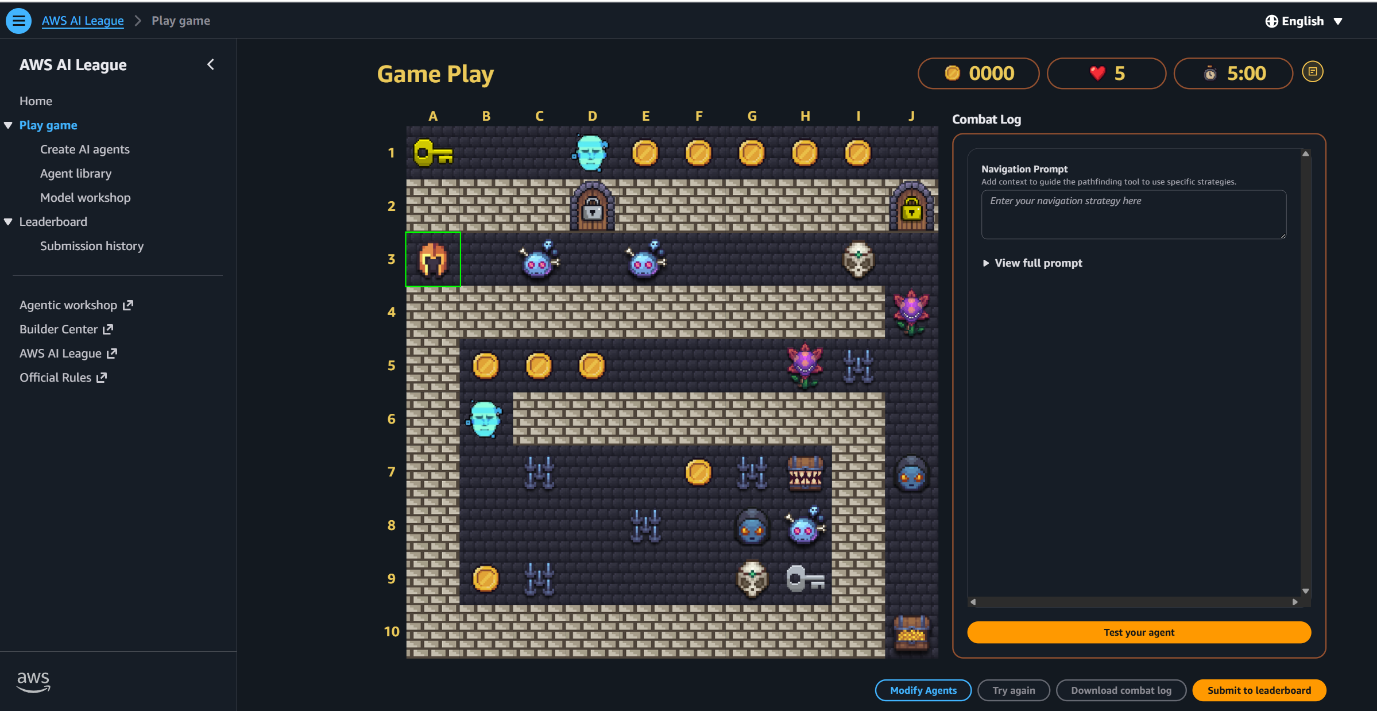
Over three days, engineers built multi-agent systems on AWS through an AI League event.
Atos successfully trained 400 engineers in agentic AI through a specialized three-day hands-on 'AI League' event focused on building multi-agent systems on AWS. This initiative identified hands-on experience as the critical missing ingredient required to move from theoretical knowledge to project delivery. By engaging in this practical format, engineers developed functional skills in architecting autonomous agents that collaborate to solve complex business problems. The program emphasizes that traditional training methods often fail to bridge the gap between AI concepts and real-world implementation. Utilizing AWS infrastructure, Atos created a scalable model for enterprise-wide upskilling that other organizations can replicate to address the generative AI talent shortage. The transition from theory to delivery within such a short timeframe demonstrates the effectiveness of competitive, project-based learning environments. Ultimately, the 400 engineers are now better equipped to deploy sophisticated AI solutions that leverage the latest advancements in agentic orchestration and multi-agent coordination.
Source: AWS Machine Learning Blog
Experimental Findings on AI Agent Consistency and Model Redundancy
agreement between agents means very little when they are running the same model.
an agent that safely handled 21 order-desk calls inside a database enforced lane.
Testing conducted over three weeks reveals that consensus among multiple AI agents provides negligible reliability benefits when all agents utilize the same underlying model. This investigation into agentic workflows documented several experimental failures, including two attempts that yielded no improvement and a critical hidden-permissions issue within the system architecture. Despite these setbacks, a single agent successfully managed 21 order-desk calls within a strictly enforced database lane, demonstrating potential for safe automated task handling. The findings suggest that diversifying models or implementing structural constraints may be more effective than simple agent redundancy for ensuring output quality. Developers must account for these limitations when building multi-agent systems intended for production environments. Understanding the nuances of database enforcement and permission structures is essential for scaling AI operations beyond basic conversational tasks.
Source: r/AIAgents
This report is auto-generated by WindFlash AI based on public AI news from the past 48 hours.