Thursday, August 27, 2026 · 10 curated articles

Editor's Picks
The top story on Hacker News today was not a model card. It was a purchase agreement. DuckLabs said it will join AWS in early September. DuckDB stays MIT-licensed, the nonprofit foundation keeps the project, and the team remains in Amsterdam. Amazon’s own note is blunter: it is buying the company, not the open-source database. The thread is split between relief that the engine finally has a balance sheet and suspicion that “open” is becoming a cloud-vendor acquisition channel.
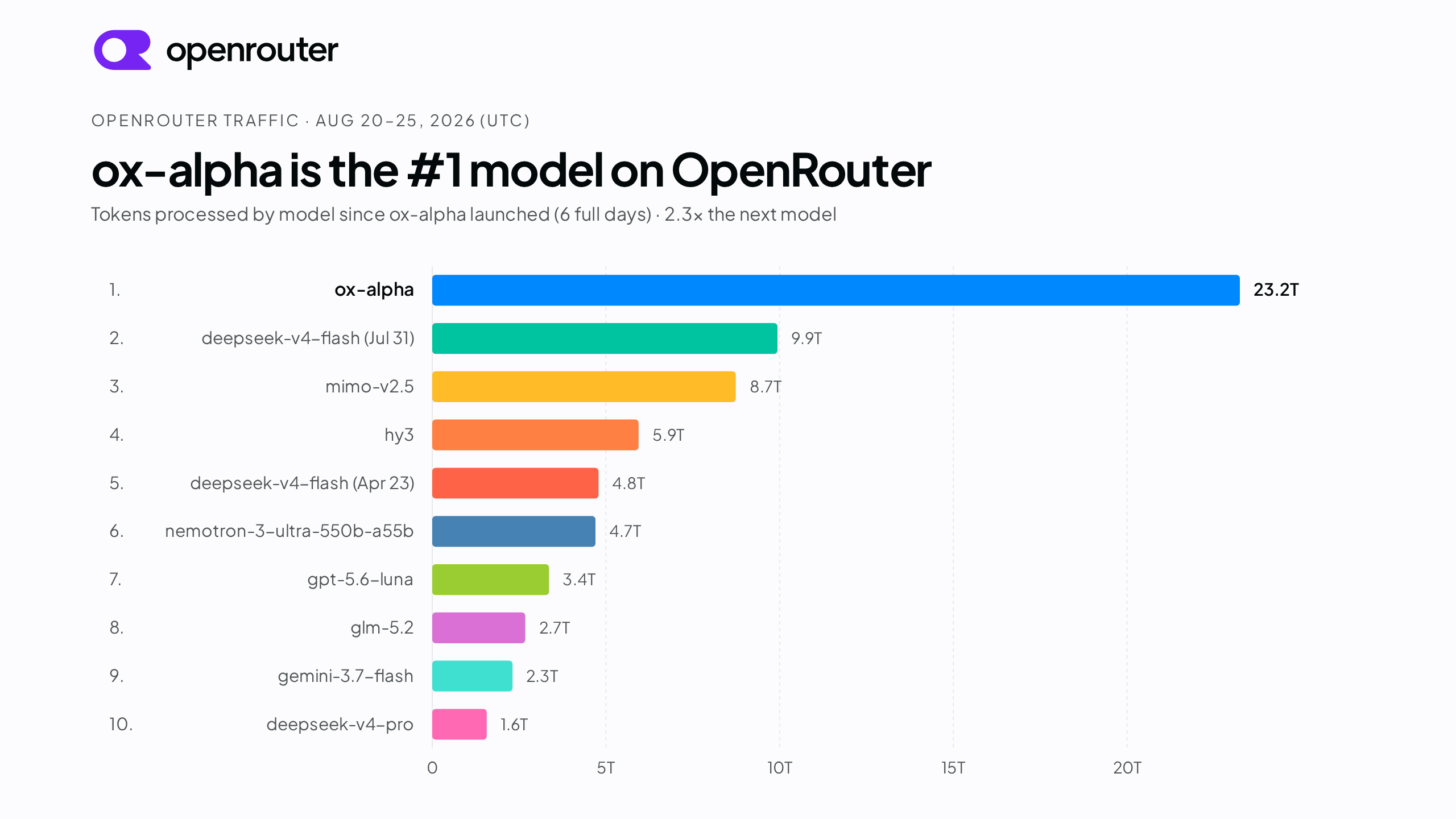
The rest of the front page filled with cheaper models. Z.ai introduced GLM-5.3-Flash as the first native multimodal model in the GLM-5 line: 320 billion total parameters, 18 billion active, at one-tenth the price of GLM-5.2 by the company’s count. Before the name went public, the same weights ran on OpenRouter as ox-alpha and became the most popular model of the week, served on Chinese chips. The weights are on Hugging Face. Qwen’s counterpart is Qwen3.8-Flash-Next, a 125 billion-parameter MoE plus 51 billion N-gram embeddings that activates 6 billion parameters per token. Training cost versus Qwen3.7-Plus is about one-ninth. The blog frames it as an architectural preview of Qwen4, the same move Qwen3-Next made before Qwen3.5.
That is why a page that only counts the word “AI” in new Hacker News titles feels less like a joke than a label printer. Strict mode ignores OpenAI and counts AI-powered. Extended mode adds model names. The clock resets each time such a headline lands. AWS is folding an analytical database into the cloud. Two labs are putting low-activation models on the same forum. Sites are starting to register real tools for agents instead of hoping a green button means confirm. The vote is no longer only about which model is smarter. It is about who owns the infrastructure, who can afford the next request, and how much of the front page is still written by a person.
Open Source
The highest-voted story is a database company changing hands, not a new checkpoint.
AWS buys DuckLabs. DuckDB stays on the MIT license
Today, we’re announcing that DuckLabs will join Amazon Web Services (AWS), which is expected to be effective in early September.
DuckDB and the other open-source components of the “Duck Stack” will remain free and open source under the MIT license
DuckLabs is the five-year-old, founder-owned company behind DuckDB. On August 26 it said the team will join AWS, stay in Amsterdam, and keep working on DuckDB, DuckLake, and Quack. Amazon says the deal buys the company, not the project. The independent DuckDB Foundation remains steward, the MIT license remains, and founders Hannes Mühleisen and Mark Raasveldt keep technical direction. The two sides have worked together since 2024. The useful argument in the comments is not whether DuckDB is good. It is whether a foundation can set the tempo once the people who write the code sit inside a cloud company, and whether a tool with more than a million downloads a day starts to look like an AWS feature.
Source: DuckLabs
Foundation Models
Two labs put cheaper models on the same front page. One tested under a fake name. The other published the skeleton first.
GLM-5.3-Flash: ox-alpha takes the mask off, 18B active
We introduce GLM-5.3-Flash, the first natively multimodal model in the GLM-5 series. With 320B total parameters and just 18B active parameters, it outperforms GLM-5.2 across benchmarks and real-world workloads at one-tenth the price
Before release, we tested GLM-5.3-Flash anonymously as ox-alpha on OpenCode and OpenRouter to gather user feedback.
Z.ai describes GLM-5.3-Flash as a hybrid of sparse and linear attention, trained on a 30 trillion-token multimodal corpus. On Artificial Analysis Intelligence Index v4.1.1 it reports a score of 57 at $0.045 per discounted task, a band of intelligence it says used to cost about ten times as much. Coding-plan users get triple the usable quota of GLM-5.3. Weights are at zai-org/GLM-5.3-Flash, with SGLang, vLLM, and TokenSpeed listed for local serving. The social fact is sharper than the benchmark table: the model had already been the week’s most popular OpenRouter destination under the name ox-alpha. The lab took the mask off itself.
Source: Z.ai
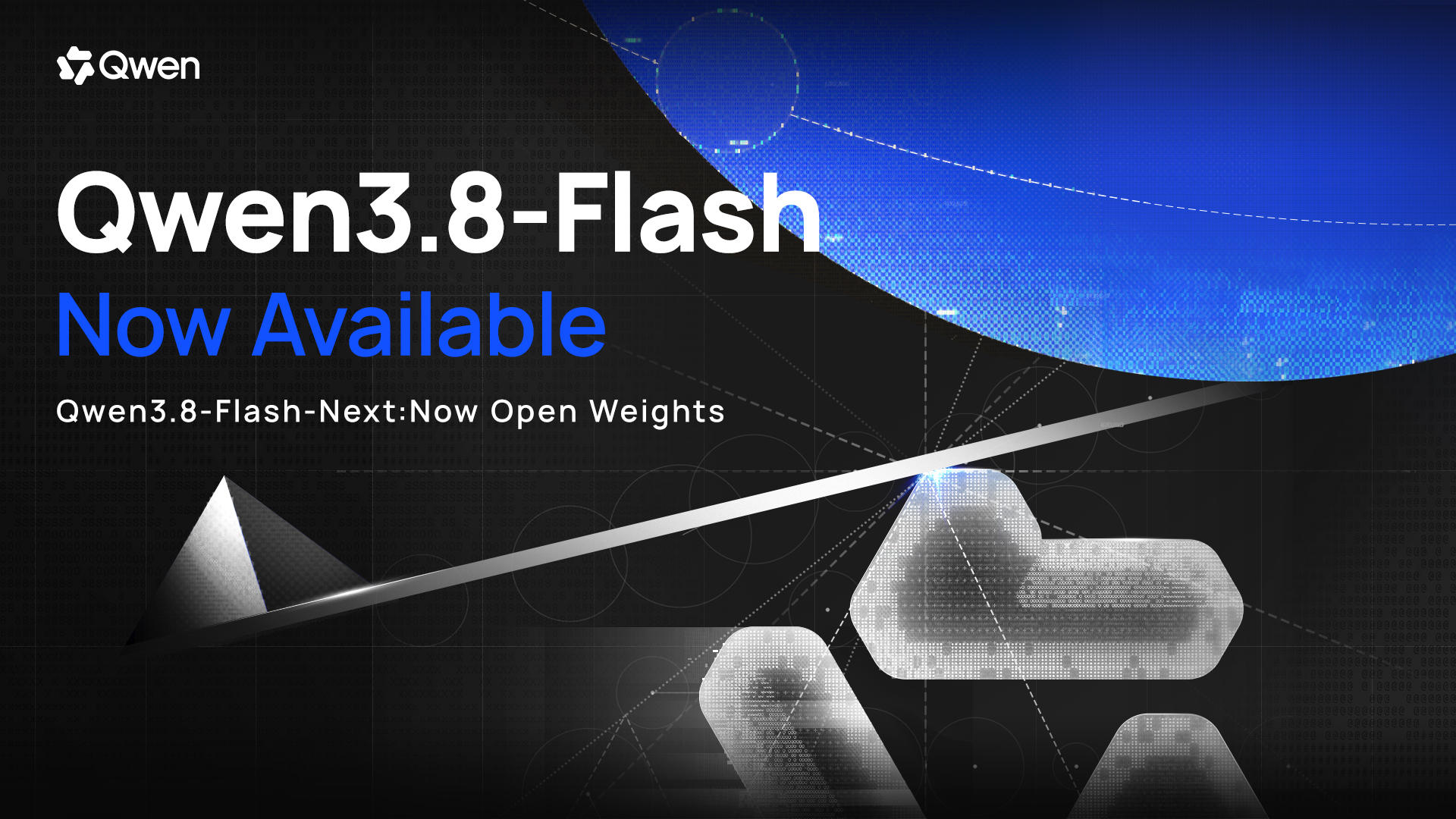
Qwen3.8-Flash-Next: 6B active per token, about one-ninth the training cost
Qwen3.8-Flash-Next features a 125B-parameter main model, supplemented by an additional 51B N-gram embeddings, with 6B parameters activated per token.
Compared with Qwen3.7-Plus, Qwen3.8-Flash-Next substantially reduces both training and inference cost — training takes only about 1/9 as much
Qwen presents Qwen3.8-Flash-Next as an early look at the architecture behind Qwen4. Attention mixes Gated DeltaNet with Qwen Sparse Attention. Residuals widen into four gated branches. An N-gram embedding table can live in host memory and prefetch. Native context is 262,144 tokens, extendable to 1,000,000 with YaRN. Weights are on Hugging Face and ModelScope. The 371-point HN thread is not about a rounder parameter count. It is about the sentence that puts activated parameters and the training bill in the same paragraph.
Source: Qwen
Developer Tools
Most retrieval stacks start too high. Users still want the doc that says how to reset a password.
RAG is simpler than the vector-database pitch
Nowadays, most people seem to over-engineer their RAG stack. They jump straight to embeddings, vector databases, and reranking pipelines.
Meanwhile, their users just want to find the doc that says “How to reset my password.”
This engineering note landed more than 300 points by treating RAG as a tooling choice: how fresh the corpus is, how stable it is, whether queries are keywords or semantics, and how many land per day. A corpus that churns more than 10 percent a day is a poor candidate for full pre-embedding. Fewer than 1,000 queries a day do not need the expensive path. It is not a new paper. It is the front page voting against “you must have a vector database.” Read next to the DuckDB sale, it is a reminder that infrastructure is consolidating while application advice is telling people to start with full-text search.
Source: Lighthouse Newsletter
Programming
If the executable is a database, state does not have to leak into /var and /tmp.
Queryable executables: program, site, and logs in one SQLite file
SELF, a format where the program is a SQLite database.
The file contains the program, the website, the routes and all the visitor logs.
Fatih pushes the SELF format one step further. If a program is a SQLite file, the running process can store state in the same file. self-httpd is the demo: one file is the server, the site, the routes, and the visitor log, updated transactionally. The thread sat near 300 points. It is a foil for the DuckDB deal. One story moves an analytical engine into AWS. The other stuffs a whole application back into a local SQLite file. Both are arguments about whose file the data lives in.
Source: Fatih Zakaria
AI Agents
Stop making the agent guess which of forty divs is the date picker.
WebMCP: websites register real tools for agents
Instead of the agent guessing what your site can do by staring at it, your site declares what it can do, as a set of clean, structured tools the agent can call directly.
And the best part: it already runs in Chrome behind a trial, and adding your first tool takes about ten minutes.
Most website agents still scrape HTML, guess at buttons, and break when the layout moves. WebMCP’s bet is that a page should register tools, such as book_table with a date, time, and party size. Chrome already has a trial. This is not a new model. It is a change in contract: from a screen humans look at to an interface agents can call. On the same day the front page argued about cheaper models, it also argued about whether those models should still operate websites by describing screenshots.
Source: Sreenath Menon
Emerging Tech
The forum started measuring how fast its own headlines fill with the word AI.
How much of today’s Hacker News is AI
Strict counts the standalone word AI in the titles of new Hacker News story submissions posted since midnight UTC.
The match is case-sensitive and word-bounded, so “OpenAI” does not count but “AI-powered” does.
hnstats.com reads the Hacker News APIs in the browser and counts new story titles since midnight UTC. Strict mode counts the standalone word AI. Extended mode adds “artificial intelligence” plus a list of model and vendor names. The clock resets when such a headline appears. It does not score models. It scores how the forum spends its time. Today’s front page already answered.
Source: hnstats
Research
The papers still publish bodies and video trainers as weights, not as slogans.
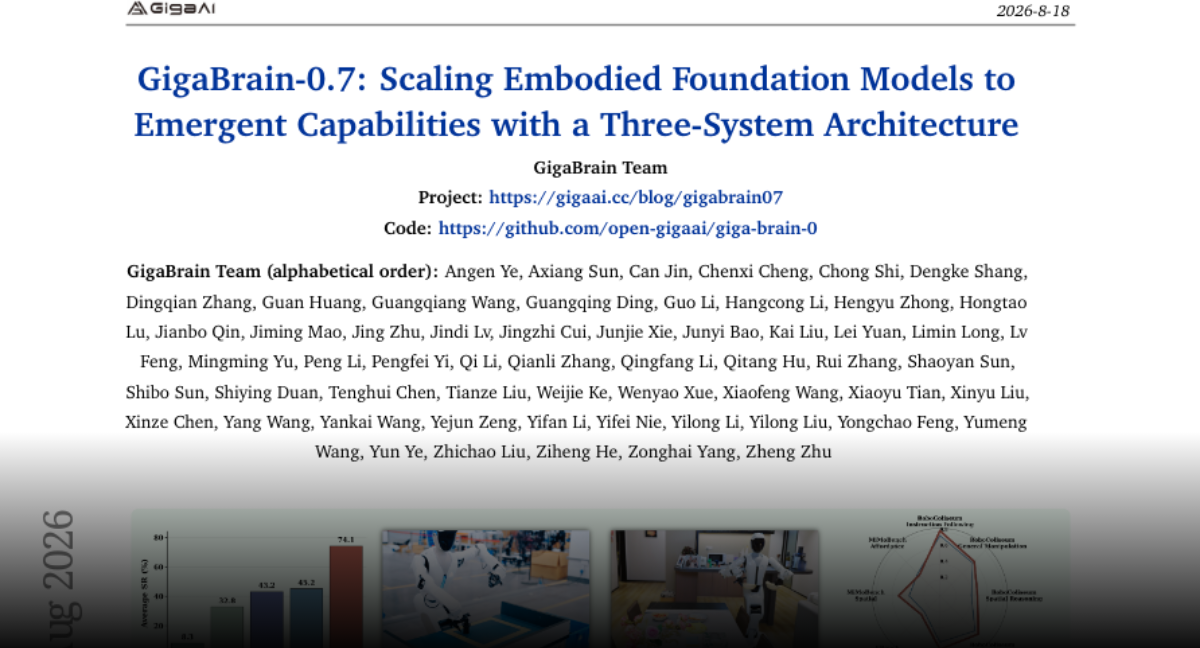
GigaBrain-0.7: a three-system model pretrained on 37,000 hours
GigaBrain-0.7 unifies understanding, prediction, and action through a three-system architecture, scales pretraining to over 37,000 hours of heterogeneous embodied data
All training code and pretrained model weights will be released.
Vision-language-action models do well in structured settings and weaken when the body or the task changes. GigaBrain-0.7 puts understanding, prediction, and action in one three-system design and jointly trains vision-language understanding with multi-embodiment action. The paper says training code and pretrained weights will be released. Unlike the API discounts on the front page, this is generalization written as a materials list.
Source: arXiv
OraRL: treat annotations as rollouts, 4,780 ms down to 130 ms
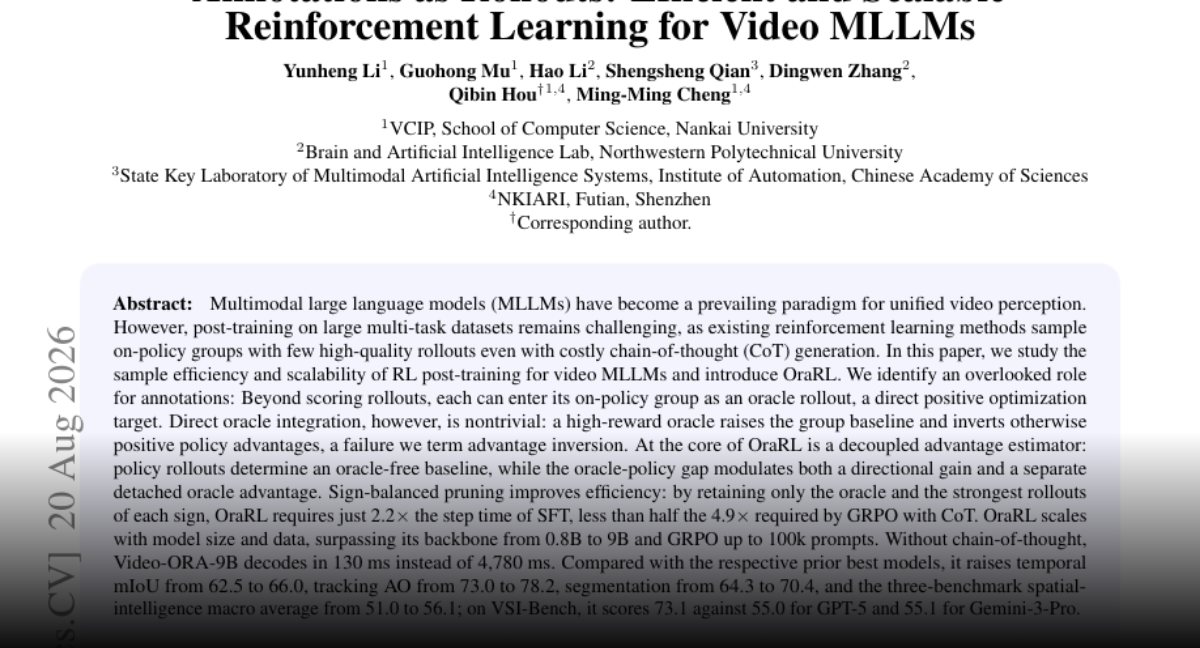
Beyond scoring rollouts, each can enter its on-policy group as an oracle rollout, a direct positive optimization target.
Without chain-of-thought, Video-ORA-9B decodes in 130 ms instead of 4,780 ms.
Reinforcement learning for video models is starved of good on-policy samples, and chain-of-thought makes the shortage expensive. OraRL puts the annotation into the group as an oracle, then has to stop advantage inversion: a high-reward label can lift the baseline and turn other samples negative. A decoupled estimator plus sign-balanced pruning brings step time to 2.2 times supervised fine-tuning, less than half of GRPO with chain-of-thought. Video-ORA-9B moves temporal mIoU from 62.5 to 66.0 and VSI-Bench to 73.1, against 55.0 for GPT-5 and 55.1 for Gemini-3-Pro in the paper. Cheap requests are the front-page story. Training that spends fewer tokens talking to itself is this one.
Source: arXiv
This report is automatically generated by WindFlash AI based on public AI news from the past 48 hours.