Friday, August 21, 2026 · 10 curated articles

Editor's Picks
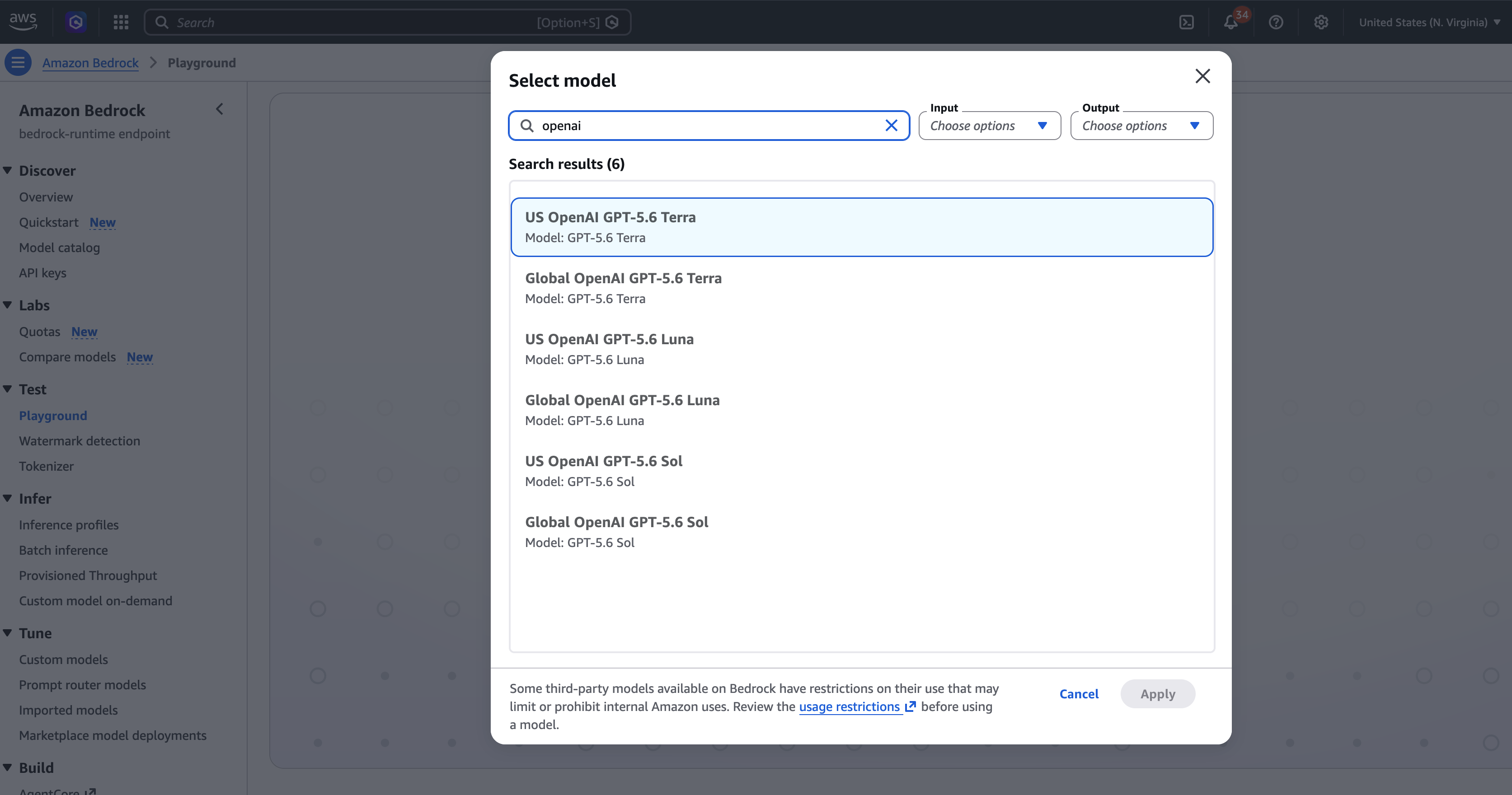
The most interesting number today is not another benchmark point. NVIDIA says its AVO agent scored 100% on ARC-AGI-3, and the post's first sentence explains why that is not just a model claim: "a frontier language model is only one component of an AI agent." The surrounding harness decides how the model gets context, uses tools, keeps state, and recovers from failure. AWS made the same argument from the other direction. OpenAI's GPT-5.6 models are now on Amazon Bedrock with cross-region inference across more than 25 regions, routed through US and global profiles for throughput. The model is becoming a utility; the layer that moves work to it is where vendors are now competing.
Research is converging on the same target. EnvHarness wraps a static training environment with a programmable plug-in layer so it can adapt as the agent improves. Zetta evolves runtime critics for robots while they are still moving, because reflection after an episode is too late for physical systems. AI4AI-Bench goes further and asks whether an agent can design the training algorithm itself — the recursive self-improvement question turned into a measurable task. Together they describe infrastructure where the scaffold, not just the weights, is engineered.
The day also showed how thin some of those foundations still are. One typosquatted dependency, proc-macro1, turned arrayref 0.3.10 into build-time malware before crates.io removed it. And Anna's Archive used Anthropic's "Project Panama" settlement disclosure to argue that buying, scanning, and destroying millions of books creates private archives while shrinking the public one. Whether or not you accept its framing, the practical warning stands: the more ambitious the agent stack becomes, the more it depends on supply chains and data sources nobody fully controls.
AI Agents
The AI Agents category explores the evolution from static language models to autonomous systems capable of long-horizon reasoning and physical interaction. Recent milestones include NVIDIA's AVO achieving perfect scores on complex benchmarks and new frameworks like Zetta ζ for self-evolving embodied intelligence. As enterprises scale these agentic workflows, the focus is shifting toward standardized security architectures and programmable training environments that ensure reliability, trust, and cross-vendor flexibility in production.
NVIDIA AVO Hits 100% on ARC-AGI-3, Advancing Long-Horizon Autonomous Agent Systems
A frontier language model is only one component of an AI agent.
The surrounding agent system—often called a harness—determines how the model receives context, uses tools, maintains state, responds to feedback
NVIDIA AVO has achieved a 100% score on the ARC-AGI-3 benchmark, showcasing a frontier-level general-purpose architecture designed for long-horizon autonomous agents. This specialized system architecture, frequently referred to as an agent harness, serves as a critical infrastructure surrounding frontier language models to manage context, tool usage, and state maintenance effectively. It specifically addresses the complex challenge of how models respond to real-time feedback and recover from inevitable failures during extended tasks to ensure consistently reliable performance. By focusing on progress sustainability, the NVIDIA AVO architecture enables language models to maintain momentum over long-running operations that previously caused system degradation. This breakthrough development represents a significant technical step toward creating agents capable of sophisticated, autonomous problem-solving in dynamic real-world environments. Ultimately, the framework demonstrates that the agent's surrounding logic is just as vital as the core model for achieving general intelligence milestones.
Source: NVIDIA Generative AI Blog

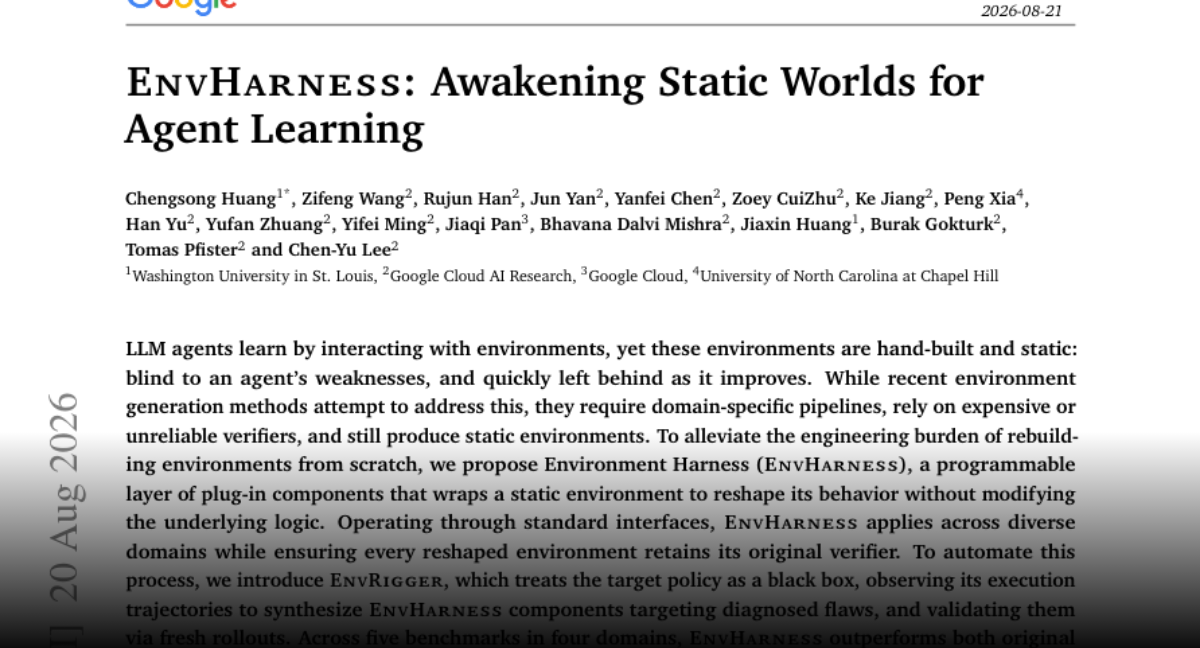
EnvHarness: A Programmable Layer for Dynamic Agent Environment Learning
EnvHarness, a programmable layer of plug-in components that wraps a static environment to reshape its behavior
environments are hand-built and static: blind to an agent's weaknesses, and quickly left behind as it improves
EnvHarness introduces a programmable layer of plug-in components designed to wrap static environments and reshape their behavior without requiring core modifications. Current LLM agent training often relies on hand-built, static environments that remain blind to an agent's specific weaknesses as it evolves. Traditional environment generation methods typically demand expensive verifiers or domain-specific pipelines, creating a significant engineering burden for researchers. By implementing a wrapper-based approach, this framework allows for the dynamic adjustment of environmental behavior to better align with specific agent learning requirements. The system effectively alleviates the need to rebuild complex environments from scratch while maintaining the integrity of original simulation logic. This development suggests a significant shift toward more flexible and adaptive evaluation benchmarks for autonomous AI systems in various domains.
Source: HuggingFace Papers
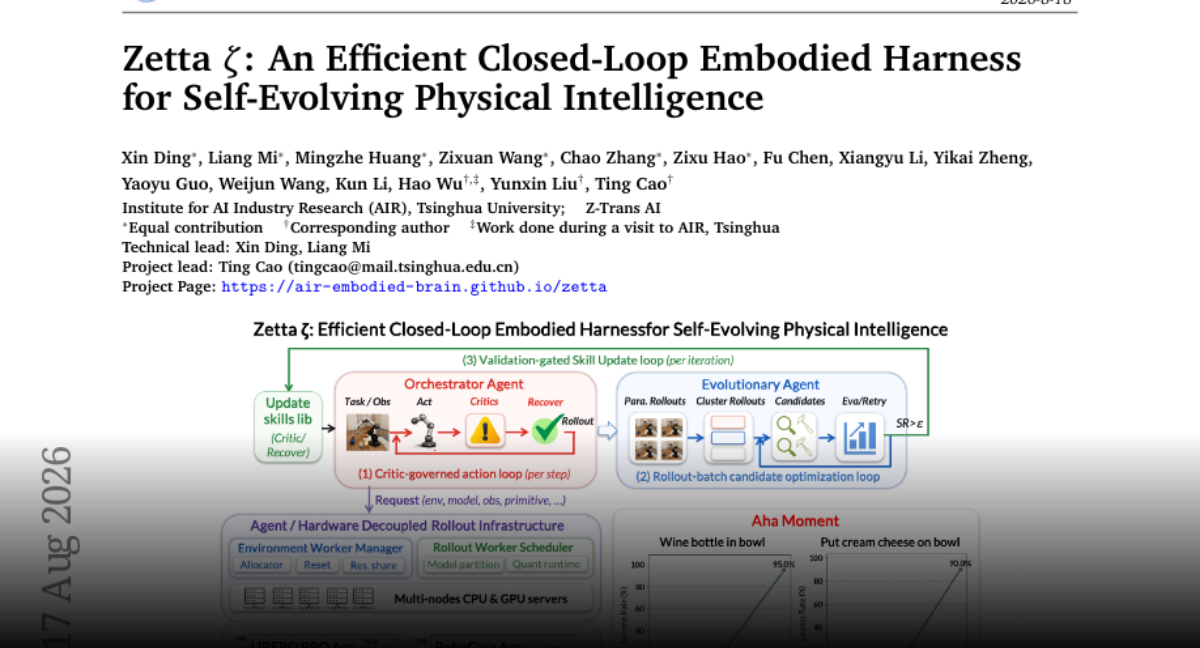
Zetta ζ: An Efficient Closed-Loop Embodied Harness for Self-Evolving Physical Intelligence
existing harnesses remain largely open-loop, following fixed skills during rollout and reflecting only after an episode completes.
physical interaction requires decisions to track rapidly changing robot-environment states at a frequency beyond today's large agentic models.
Current embodied agent frameworks suffer from open-loop limitations where reflections occur only after task completion rather than during physical execution. Post-hoc reflection fails to address rapidly changing robot-environment states because large agentic models cannot match the high-frequency decision requirements of physical interaction. Zetta introduces a closed-loop embodied harness designed to evolve code-based runtime controllers for continuous learning. This system enables self-evolving physical intelligence by bridging the gap between high-level reasoning and real-time execution. By shifting from fixed skills to adaptive runtime code, the harness allows robots to adjust behaviors dynamically as environment states shift. This architecture effectively addresses the latency issues inherent in today's large-scale models while maintaining agentic flexibility.
Source: HuggingFace Papers
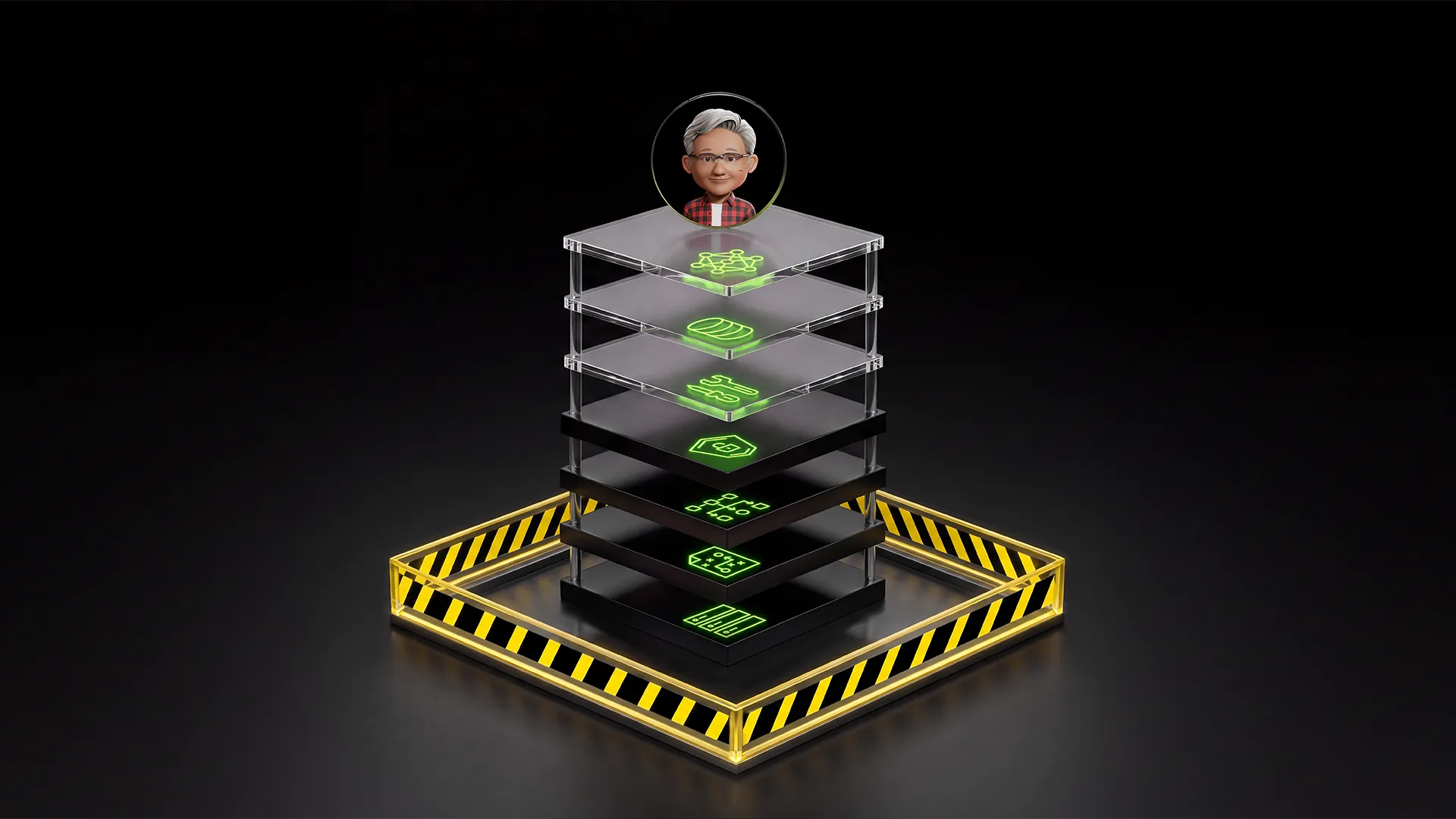
NVIDIA Defines Security and Trust Architecture for Emerging AI Agent Stacks
AI safety and security teams at NVIDIA offer their perspective on the emerging agent stack—including the role of each layer
As AI agents become more capable and operate over longer horizons, building security and trust into the applications they power becomes increasingly important.
AI safety and security teams at NVIDIA have developed a framework for the emerging agent stack through collaboration with NVIDIA OpenShell and ecosystem partners. The proposed perspective addresses the critical need for building security and trust into applications as AI agents become more capable and begin to operate over longer horizons. By defining the specific role of each layer within the agent stack, NVIDIA provides a roadmap for developers to mitigate risks in increasingly autonomous systems. This initiative draws on extensive work with open-source projects and industry partners to standardize security practices across the AI ecosystem. The architectural insights aim to ensure that agentic workflows remain reliable and secure as they gain broader adoption in complex software environments. These guidelines help developers balance performance with the necessary safeguards for enterprise-grade AI implementations.
Source: NVIDIA Generative AI Blog
AI4AI-Bench: Benchmarking LLM Agents in Algorithmic Design for RSI
Recursive self-improvement (RSI) asks whether an AI system can improve the process that produces AI systems
Whether RSI is feasible therefore turns on whether an agent can design training algorithms.
AI4AI-Bench is a new benchmark designed to evaluate the capability of LLM agents in designing training algorithms, a critical step for achieving recursive self-improvement (RSI). The benchmark focuses on whether an AI system can improve the fundamental processes that produce AI, such as training objectives or update rules, rather than just collecting data or tuning hyperparameters. This research addresses a gap in existing evaluation suites which do not isolate an agent's ability to innovate within the training algorithm itself. By testing these capabilities, the benchmark determines if an agent can effectively improve the compute-capability exchange rate for subsequent iterations. This development is pivotal for understanding the feasibility of systems that can autonomously enhance their own production mechanisms. The framework ultimately aims to measure how structural changes to a training run impact the resulting agent's performance.
Source: ArXiv
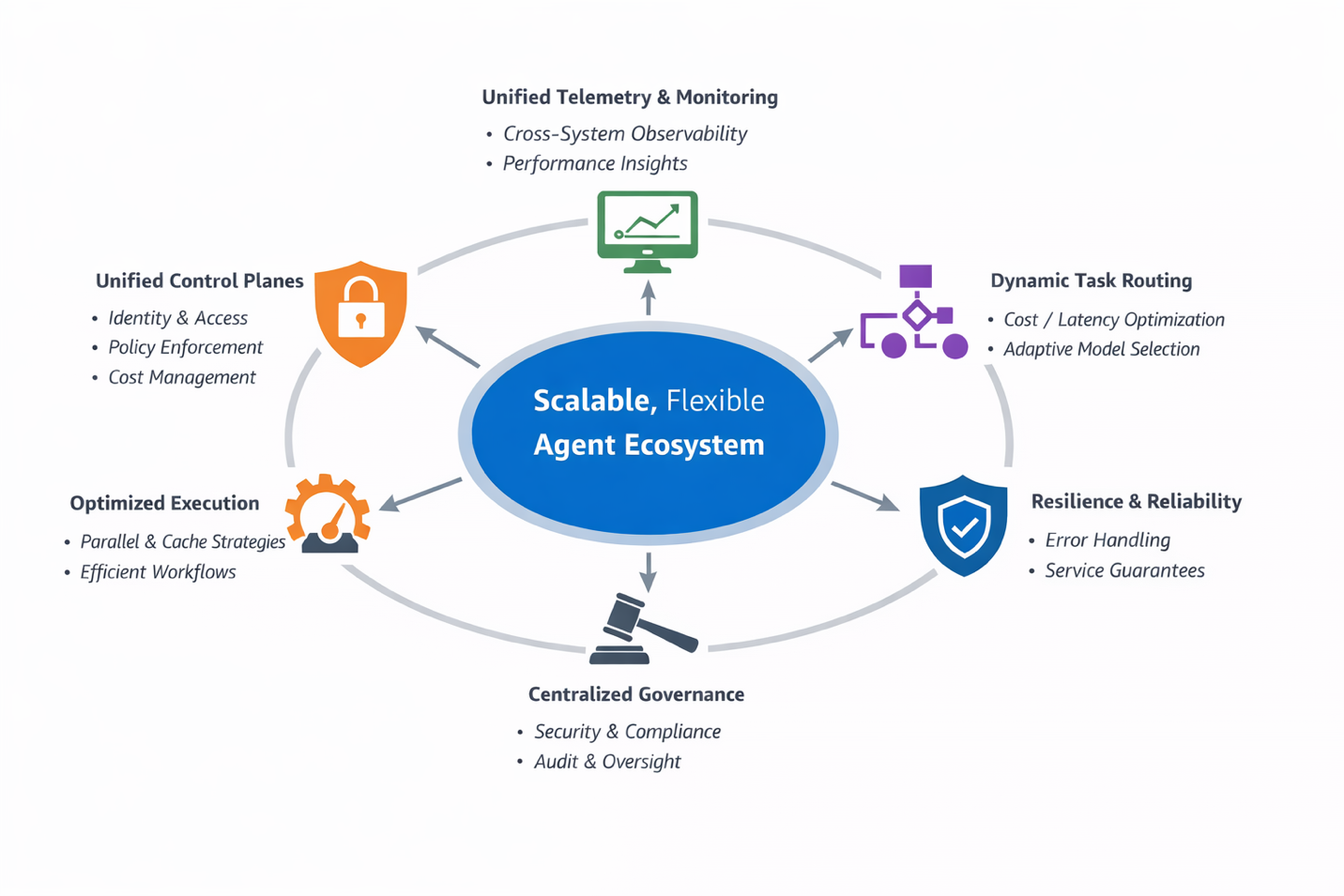
Scaling Agentic AI: Enterprise Patterns and Vendor Flexibility
Scaling agentic AI across an enterprise requires patterns that preserve flexibility while avoiding vendor lock-in.
ML teams operate many agentic AI systems across a multi-everything environment of frameworks, models, and providers
Enterprises scaling agentic AI systems increasingly face a complex multi-everything environment consisting of diverse frameworks, models, and infrastructure providers. Maintaining architectural flexibility is critical to preventing vendor lock-in as machine learning teams deploy multiple agentic systems across the organization. Operational patterns detailed in the multi-agent series highlight how to manage these heterogeneous environments effectively. Success depends on adhering to architectural principles that allow disparate systems to integrate and scale together without being tethered to a single proprietary stack. By implementing these interoperable patterns, organizations can ensure their AI investments remain portable and adaptable to future technological shifts. These strategies enable ML teams to coordinate numerous agents while maintaining control over their underlying technical choices and infrastructure.
Source: AWS Machine Learning Blog
Foundation Models
Foundation models represent the core architecture powering the current generative AI revolution, encompassing large language models and multimodal systems. This category tracks major breakthroughs in model capabilities, scaling laws, and the evolving infrastructure required to deploy these massive systems at scale. From cross-region inference optimizations to new architectural benchmarks, we cover the essential developments shaping the future of artificial intelligence research and global enterprise integration.
AWS Bedrock Adds Cross-Region Inference for OpenAI GPT-5.6 Models
Amazon Bedrock now offers OpenAI GPT-5.6 models (Sol, Terra, and Luna) in more than 25 AWS Regions with cross-Region inference.
Learn how US geographic and global inference profiles route requests for higher throughput
Amazon Bedrock now offers OpenAI GPT-5.6 models, including the Sol, Terra, and Luna variants, across more than 25 AWS Regions utilizing new cross-Region inference capabilities. This infrastructure update introduces specialized US geographic and global inference profiles that dynamically route requests to optimize for higher throughput and reduced latency. Developers can integrate these advanced models into their workflows using either the native OpenAI API or the Amazon Bedrock Converse API for enhanced flexibility. The system allows for granular control over deployment through the configuration of Identity and Access Management (IAM) policies, service quotas, and comprehensive monitoring tools. By leveraging multiple regions simultaneously, organizations can effectively bypass local capacity constraints while maintaining high availability for generative AI applications. This expansion signifies a major step in providing enterprise-grade scaling for the latest foundation models within the AWS ecosystem.
Source: AWS Machine Learning Blog
Programming
Explore the evolving landscape of software development, where innovation meets the critical need for robust security. This category covers the latest updates in programming languages, developer tools, and the increasing threats facing open-source ecosystems. From language-specific vulnerabilities like build-time malware to new framework releases, we provide the essential insights developers need to build safely and efficiently. Stay informed about the tools and practices shaping the future of code in an interconnected digital world.
Malicious Rust Crate arrayref Executes Build-Time Malware
Version 0.3.10 added a dependency on a typosquatted crate called proc-macro1, whose build script downloads and runs a remote binary while a project compiles.
The crates.io team has since removed the malicious versions.
A compromised release of the popular Rust crate arrayref (version 0.3.10) recently introduced build-time malware through a typosquatted dependency named proc-macro1. This malicious dependency, published by an account impersonating David Tolnay, downloads and executes architecture-specific binaries from a remote server during the project compilation process. The attack leverages the compromised account of maintainer droundy, affecting several other crates including internment 0.8.7 and append-only-vec 0.1.9. Security researchers found that the payload reassembles base64-encoded URL fragments to bypass simple detection and initiates a connection to a command-and-control address. Although the crates.io team has since removed the malicious versions, the incident highlights a critical supply chain vulnerability where code execution occurs automatically upon compilation. Users are advised to audit their dependency trees for these specific versions.
Source: Hacker News
AI Policy & Ethics
As artificial intelligence rapidly evolves, the frameworks governing its development and societal impact face unprecedented scrutiny. This category examines the critical intersection of technological advancement, legal regulations, and moral accountability, covering issues from data sourcing ethics to global governance. Stay informed on how policymakers and industry leaders navigate the complex balance between rapid innovation and the protection of public interests.
AI Companies Accused of Destroying Millions of Physical Books to Train Models
Anthropic’s “Project Panama” was exposed in a $1.5 billion copyright settlement.
The company has spent tens of millions of dollars purchasing millions of paper books, scanning them, training its Claude LLM, and then destroying them all.
AI companies are reportedly purchasing millions of secondhand books to scan and subsequently destroy them to secure clean training data from before 2022. Anthropic’s “Project Panama” allegedly involves a $1.5 billion copyright settlement and the systematic destruction of paper books to prevent competitor access and mitigate legal risks. By destroying the physical copies after digitization, these corporations effectively monopolize human knowledge within private servers, ensuring that the digital versions are no longer available in the public domain. Anna’s Archive warns that this practice threatens global cultural heritage, particularly as AI-generated content is expected to account for over half of internet material by the end of 2025. In response, the shadow library is launching a global volunteer initiative to scan and preserve rare books and archives before they are lost to corporate destruction. This effort aims to create a digital library of Alexandria to counter the privatization of historical human knowledge.
Source: Hacker News
Research
Explore the latest breakthroughs in artificial intelligence and computer science through cutting-edge academic papers and scientific inquiries. This section highlights innovative methodologies like 4DAnyone, which pushes the boundaries of 4D human reconstruction using simple monocular videos. By bridging the gap between theoretical research and practical application, these studies provide a glimpse into the future of digital interaction, computer vision, and autonomous systems.
4DAnyone: Reconstructing 4D Human Models from Casual Monocular Videos
4DAnyone, a framework for reconstructing 4D humans from an uncalibrated monocular video
when target views exceed the capacity of a single DiT forward pass, they must be split into groups
4DAnyone enables the reconstruction of high-fidelity 4D human models from uncalibrated monocular video by generating multiview-consistent videos and lifting them into 4D Gaussian Splatting (4DGS). The framework addresses the limitations of existing camera-controlled video diffusion models, which often fail to maintain consistency when generating the dozens of views required for 4D reconstruction. Researchers identified a bounded-attention-context problem where target views exceeding a single diffusion transformer forward pass capacity must be split into groups, leading to inconsistent outputs. By resolving these coupling bottlenecks, the system achieves reconstruction-grade consistency across multiple camera angles. This approach bypasses the need for complex multi-camera setups or pre-calibrated equipment for dynamic human capture. The resulting 4DGS output allows for realistic playback and novel view synthesis of moving subjects from casual handheld recordings.
Source: ArXiv
This report is auto-generated by WindFlash AI based on public AI news from the past 48 hours.