Thursday, August 13, 2026 · 10 curated articles
Editor's Picks
Two flagship models dropped within a day of each other, and together they say more about 2026 than any single benchmark.
xAI's Grok 4.6 posts a 61 on the Artificial Analysis Intelligence Index, matching GPT-5.6 Sol across a nine-benchmark composite, and it is explicitly tuned for long-horizon agent work — research, codebase analysis, turning a rough idea into a working app — with self-testing and verification baked into long trajectories. Almost simultaneously, DeepSeek updated its flagship to V4 Pro 0813: a 1M-context model that sits a step below Sol and Opus 4.8 on raw capability but costs roughly an order of magnitude less. The two releases are the same story from opposite ends: the frontier is no longer one model, it is a price-versus-capability surface, and different teams are colonizing different points on it.
That is why the day's reliability paper lands so hard. It finds that an agent's "main effect" explains under 3% of variance on major benchmarks — leaderboards are measuring specialization and task alignment, not general intelligence. So "matches GPT-5.6 Sol" is a useful signal only if you read it as "matches on this composite," not "is this capable." The honest production question has shifted to deployment decision reliability: which model, on which step, at what cost, with what audit trail.
This is why the architecture is splitting into layers. Grok 4.6, Qwen3.8-2.4T, and DeepSeek V4 Pro 0813 carry the long-horizon thinking. NVIDIA Nemotron 3.5 Lightning, with just 3B active parameters, handles the high-frequency execution — tool calls, validation, subagent handoffs. ComBodied Agents push the goalpost further still: the job is not to transform software or physical state, it is to model the human's state and preserve their agency. And the accountability layer — verifiable agent payments inside AWS Nitro Enclaves anchored to a blockchain, plus UK-sovereign deployments — is what turns all that autonomy into something a regulated enterprise can actually buy.
Foundation Models
This category explores the rapid evolution of large-scale architectures, highlighting massive breakthroughs in parameter scaling and computational efficiency. Recent developments, such as the introduction of trillion-parameter Mixture-of-Experts models and advanced agentic reasoning frameworks, demonstrate a shift toward more specialized yet powerful AI backbones. These foundational advancements are redefining the boundaries of machine intelligence, offering unprecedented performance that rivals the most sophisticated proprietary systems while pushing the frontier of multimodal and long-range capabilities.
Qwen3.8-2.4T: A 2.4 Trillion Parameter MoE Model with 95B Activated Parameters
Number of Parameters: 2.4T in total and 95B activated
Context Length: 262,144 natively and extensible up to 1,010,000 tokens.
Qwen3.8-2.4T is a causal language model featuring a total of 2.4 trillion parameters with 95 billion activated during inference through a Mixture of Experts architecture. This new release utilizes a sophisticated layout of 92 layers combining Gated DeltaNet and Gated Attention mechanisms to enhance performance in coding, research, and long-horizon agentic tasks. The model supports a native context length of 262,144 tokens, which is extensible up to approximately one million tokens to accommodate massive datasets. It achieves competitive results across various benchmarks, including a score of 93.0 on PaperBench and 86.6 on Terminal Bench, rivaling frontier models in agent execution. Artifacts are provided in Hugging Face Transformers format, ensuring compatibility with popular inference frameworks like vLLM and SGLang. Users can also access the Qwen3.8-Max official service for additional features such as vision input and integrated tool support.
Source: Hacker News
xAI Launches Grok 4.6 Featuring Advanced Agentic Reasoning and GPT-5.6 Level Performance
Grok 4.6 achieves frontier intelligence across several agentic coding and knowledge work benchmarks.
It matches GPT-5.6 Sol on the Artificial Analysis Intelligence Index, which is a composite score of nine benchmarks.
Grok 4.6 achieves a score of 61 on the Artificial Analysis Intelligence Index, matching the performance of GPT-5.6 Sol across a composite of nine benchmarks. This updated model focuses on long-running agents capable of sustaining work over many steps, particularly in complex domains like research, codebase analysis, and turning broad product ideas into functional applications. The training process included a longer supplemental run using curated model-generated data for reasoning and technical concepts, alongside an improved optimizer and training recipe. Integration of reinforcement learning across specific environments like kernel optimization and web development has enhanced the model's ability to perform self-testing and verification during long-trajectory tasks. Currently available in Cursor and Grok Build, the release also features improved safeguards calibrated for high-utility scenarios such as vulnerability patching and engineering design cycles.
Source: Hacker News
DeepSeek V4 Pro 0813: Near-Frontier Capability at a Fraction of the Price
the
deepseek-v4-promodel has been updated to DeepSeek-V4-Pro-0813
We plan to raise the overall pricing for DeepSeek API services in the near future, with a significant increase expected.
DeepSeek has updated its flagship deepseek-v4-pro model to the 0813 version while keeping the same model identifier, so existing API calls continue to work unchanged. The 1M-context model posts strong reasoning and coding scores — 88.8% on GPQA Diamond, 96.2% on τ²-Bench Telecom, and 46.2% on Terminal-Bench Hard — placing it near, but not at, the frontier. Its pricing is the headline: $0.435 per million input tokens on a cache miss and $0.87 per million output tokens, with cache hits at $0.003625. The Hacker News discussion characterizes it as competitive with Anthropic's Opus 4.8 class while roughly 20x cheaper, though clearly behind Sol and Fable on raw capability. The release remains text-only, consistent with DeepSeek's stated view that vision is not central to its near-term AGI work.
Source: DeepSeek
AI Agents
AI agents are evolving from simple chatbots into sophisticated autonomous systems capable of complex reasoning and real-world execution. Recent advancements highlight a shift toward high-performance models like NVIDIA’s Nemotron for specialized tasks, alongside a growing focus on human-centric design and rigorous evaluation frameworks. As enterprises deploy these agents at scale across secure infrastructure, new innovations in verifiable payment systems and sovereign cloud hosting are maturing the ecosystem for practical, reliable business automation.
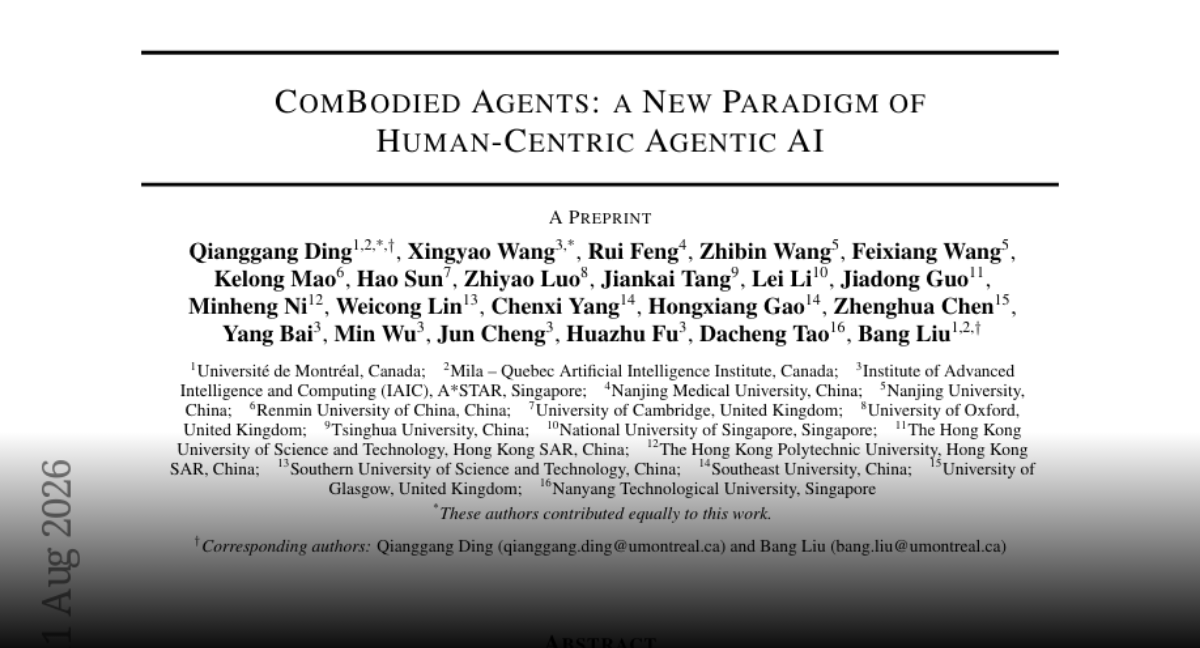
ComBodied Agents: A New Paradigm for Human-Centric Agentic AI
Digital Agents primarily transform software states, while Embodied Agents transform physical states; neither makes a person's evolving state and agency the primary object
We introduce Combodied Agents, a human-centered paradigm that perceives, models, predicts, and supports individual human-state trajectories over time
Combodied Agents introduce a human-centered paradigm that shifts Agentic AI from external task completion toward sustained human benefit by modeling individual human-state trajectories over time. Current systems exhibit a structural gap where Digital Agents transform software states and Embodied Agents transform physical states, yet neither prioritizes a person's evolving state or agency as the primary object of modeling. The proposed framework unifies fragmented capabilities into a closed loop featuring event-based multimodal perception, longitudinal memory, and Personal World Models to estimate future outcomes. These agents utilize sensors, wearables, and robots as action channels to provide proportionate, consent-aware support rather than viewing them as end goals. By employing purpose-bounded and user-correctable representations, the system ensures safety and reversibility without requiring an exhaustive digital twin. This approach allows for scenario-centered evaluation and specific metrics for agency preservation in complex real-world environments.
Source: HuggingFace Papers
Reliability Analysis of AI Agent Evaluations via Generalizability Theory
agent main effect accounts for less than 3% of total variance in every dataset and check type
training-cell reliability negatively correlates with held-out reliability ($r = -0.90$ on $ au^2$)
Agent main effects account for less than 3% of total variance across three major benchmarks, indicating that current leaderboards measure specialization rather than general capability. Analysis of TheAgentCompany, τ²-bench, and AppWorld reveals that agent-by-task interaction explains 7-23% of variance, suggesting that high performance is often a result of specific task alignment. The research introduces Deployment Decision Reliability (DDR), a reporting framework based on a four-facet Generalizability Theory variance decomposition. Reliability often collapses on the most difficult task quartiles, falling from 0.752 to 0.000 in specific test cases. Furthermore, training-cell reliability shows a strong negative correlation with held-out reliability, implying that designs appearing most stable during development may replicate the worst in real-world deployments. This work provides enterprise practitioners with a disciplined approach to defend AI agent purchasing decisions through a one-page reporting discipline.
Source: arXiv cs.AI
NVIDIA Nemotron 3.5 Lightning: A Fast 30B MoE Model for AI Agent Execution
NVIDIA Nemotron 3.5 Lightning is an open 30B mixture-of-experts (MoE) model with 3B active parameters
Using a frontier reasoning model for every execution step adds cost and latency.
NVIDIA Nemotron 3.5 Lightning is an open 30B mixture-of-experts (MoE) model featuring 3B active parameters specifically engineered for the execution layer of always-on agents. High-volume tasks such as tool calling, result validation, and subagent delegation often consume excessive resources when handled by frontier reasoning models. This new architecture addresses the cost and latency challenges inherent in long-running AI operations by providing a specialized alternative to general-purpose frontier models. Developers can leverage this model to handle repetitive, high-frequency execution steps without the overhead of massive parameter counts. The model's design focuses on maintaining accuracy while significantly accelerating the throughput required for complex agentic workflows. By optimizing the balance between parameter efficiency and performance, NVIDIA aims to streamline the deployment of autonomous systems in production environments.
Source: NVIDIA Generative AI Blog
OneAdvanced Deploys 50+ AI Agents on UK-Sovereign AWS Infrastructure
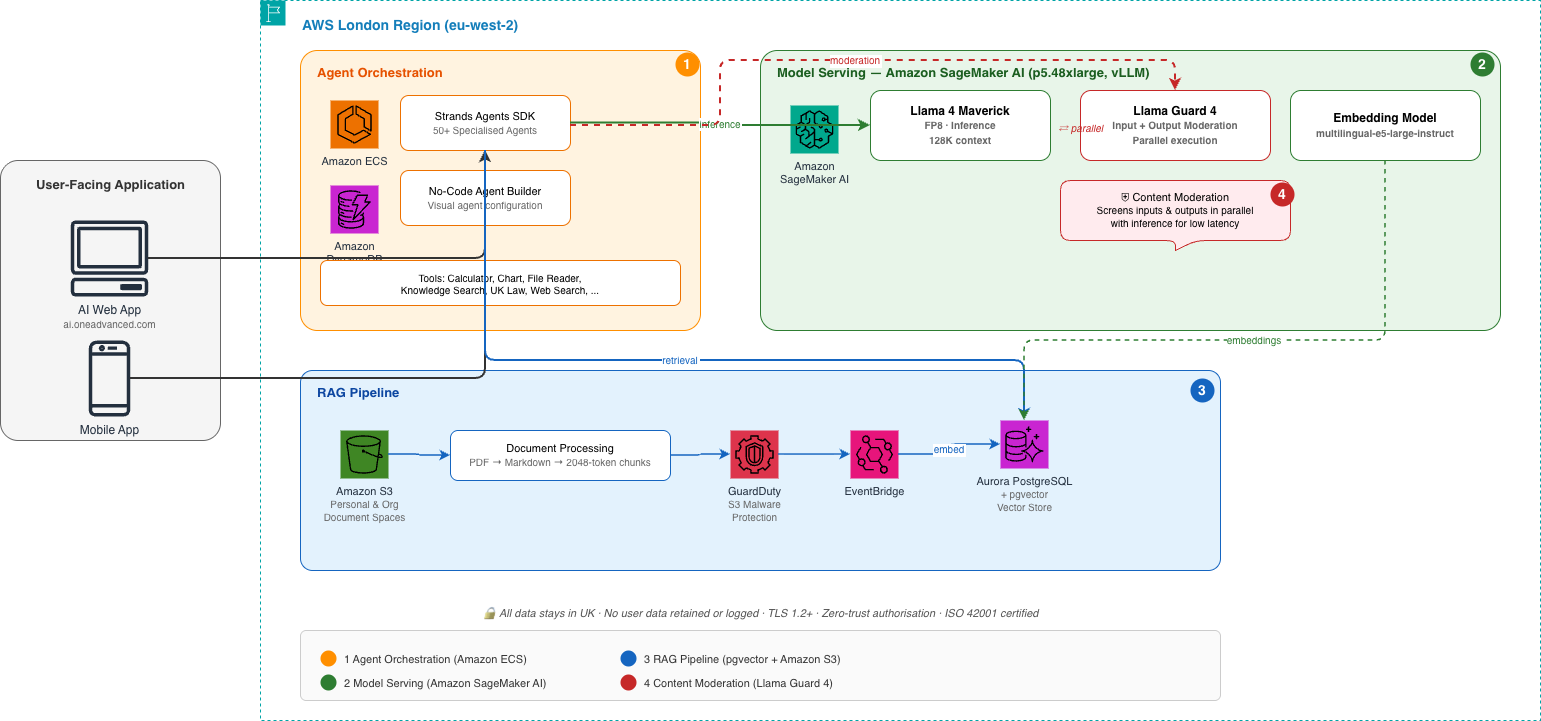
built a UK-sovereign AI platform by self-hosting Llama 4 Maverick and Llama Guard 4 on Amazon SageMaker AI
over 50 agents built with Strands Agents SDK on Amazon ECS
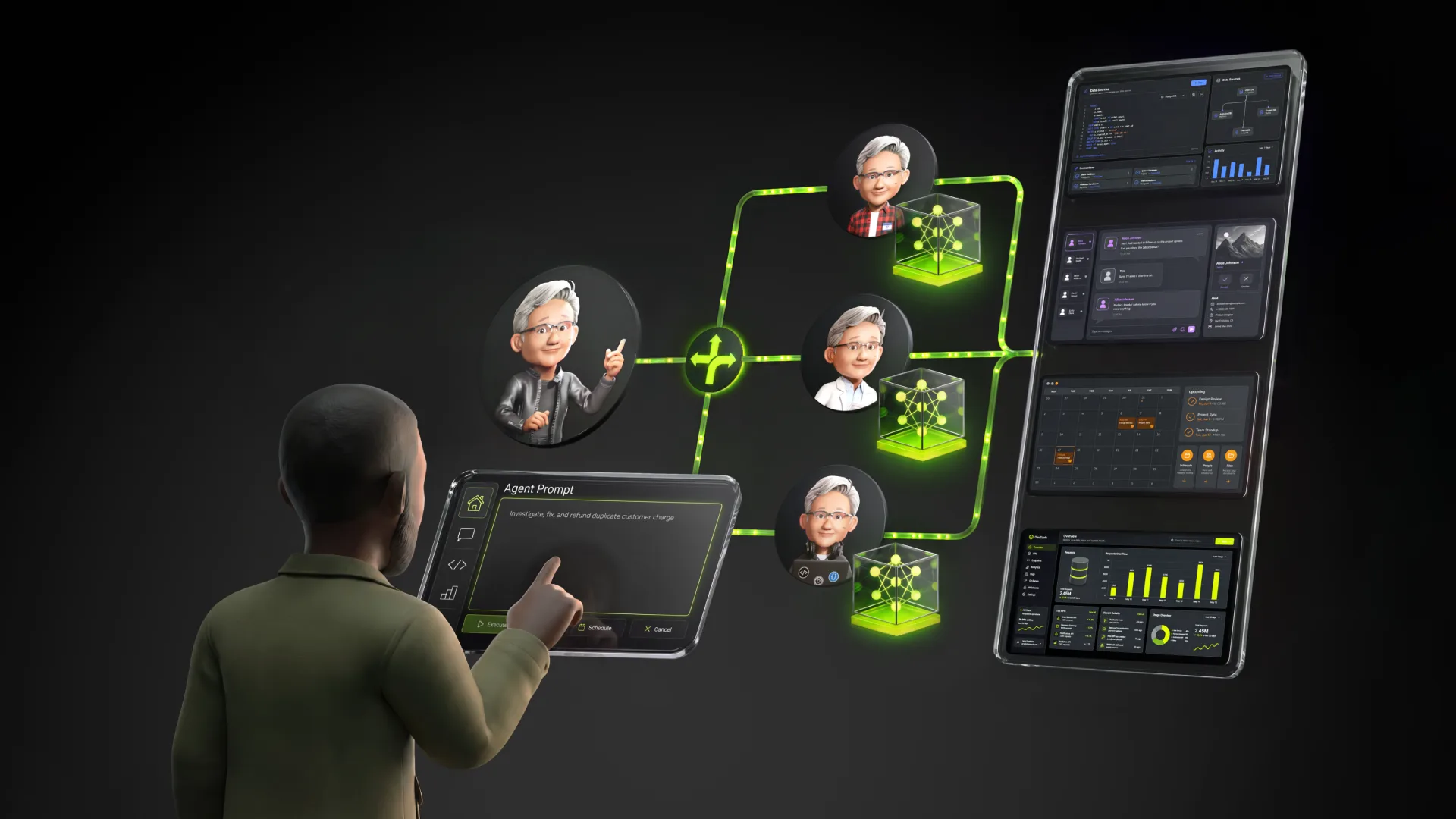
OneAdvanced has successfully deployed over 50 AI agents on a UK-sovereign AWS platform to meet strict regional data residency requirements. The enterprise software provider utilized Amazon SageMaker AI to self-host Llama 4 Maverick and Llama Guard 4 models, ensuring localized control over large language model execution. The technical architecture incorporates a Retrieval-Augmented Generation (RAG) pipeline built on pgvector to enhance data retrieval accuracy and context. These agents were developed using the Strands Agents SDK and are currently hosted on Amazon ECS for scalable performance. This deployment demonstrates a robust framework for organizations requiring sovereign AI capabilities while leveraging public cloud infrastructure. By integrating advanced guardrails and vector databases, OneAdvanced establishes a secure environment for diverse enterprise AI applications within a sovereign boundary.
Source: AWS Machine Learning Blog
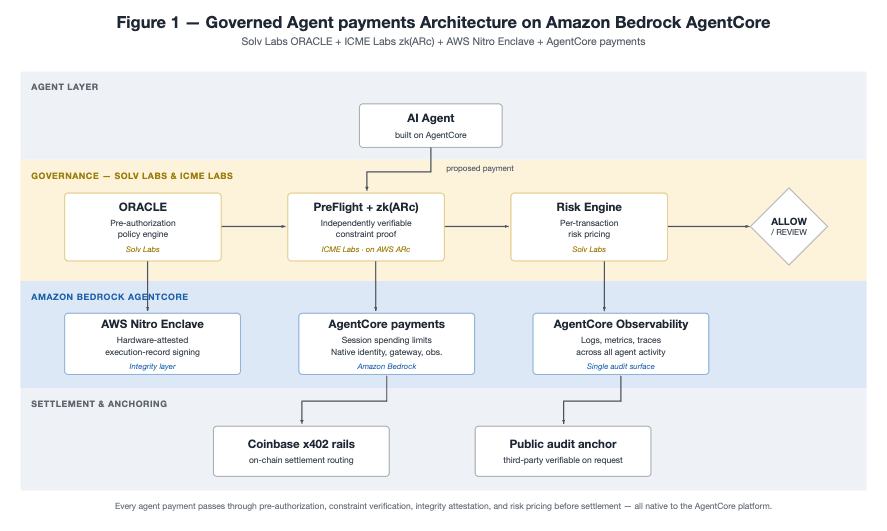
Solv Labs Builds Verifiable Agent Payment Systems Using Amazon Bedrock AgentCore
every transaction is authorized, attested in an AWS Nitro Enclave, priced for risk, and anchored to a public blockchain before settlement.
the pattern gives enterprises a verifiable, auditable trail for autonomous agent payments in regulated environments.
Solv Labs has developed a governed agent-payments workflow on Amazon Bedrock AgentCore payments that ensures every transaction is authorized and attested within an AWS Nitro Enclave. This architecture prices each transaction for risk and anchors the data to a public blockchain prior to settlement, providing a secure foundation for financial interactions. The implementation offers enterprises a verifiable and auditable trail for autonomous agent payments, addressing the transparency requirements of highly regulated environments. By integrating AWS Nitro Enclaves and blockchain technology, the system mitigates risks associated with automated financial actions performed by AI agents. This pattern enables organizations to deploy AI agents that can handle real-world monetary value with confidence and compliance. The solution demonstrates the intersection of generative AI orchestration and secure, decentralized financial settlement layers for enterprise use cases.
Source: AWS Machine Learning Blog
Research
Explore the latest breakthroughs in academic and industry research shaping the future of artificial intelligence. This section highlights innovative frameworks like Apodex Discovery for verifiable AI evaluation and benchmarks like MindTopo that probe the spatial reasoning limits of vision-language models. By formalizing testing environments and challenging existing architectures, these studies provide the critical insights necessary to build more robust, reliable, and intelligent systems capable of complex real-world reasoning and objective discovery.
Apodex Discovery: A Framework for Verifiable Discoverative AI Evaluation
Apodex surpassed the published state of the art by 7% across viability, tropism, structure prediction, and generative design.
a task-specific biomedical environment improved the mean normalized prediction score of GPT-5.5 and GPT-5.6-sol by 2.5 and 7.6 points
Apodex Discovery surpasses published state-of-the-art results by 7% in AAV capsid design metrics including viability, tropism, and structure prediction. The framework utilizes a heavy-duty solver comprising foundation models, tools, and control policies to execute extended, stateful investigations rather than simple task execution. A comprehensive problem-scouting process surveyed 561 industries to curate 423 high-value problems, with 20 selected for the initial release. Task-specific biomedical environments significantly increased the mean normalized prediction scores for GPT-5.5 and GPT-5.6-sol by 2.5 and 7.6 points, respectively, compared to closed-book backbones. The HDS6 protocol evaluates performance through the TRACES interface, measuring factors like coherence, evidence, and repair capabilities independent of final success. This shift moves AI evaluation toward verifiable investigations aimed at genuine scientific and industrial discovery.
Source: arXiv cs.AI
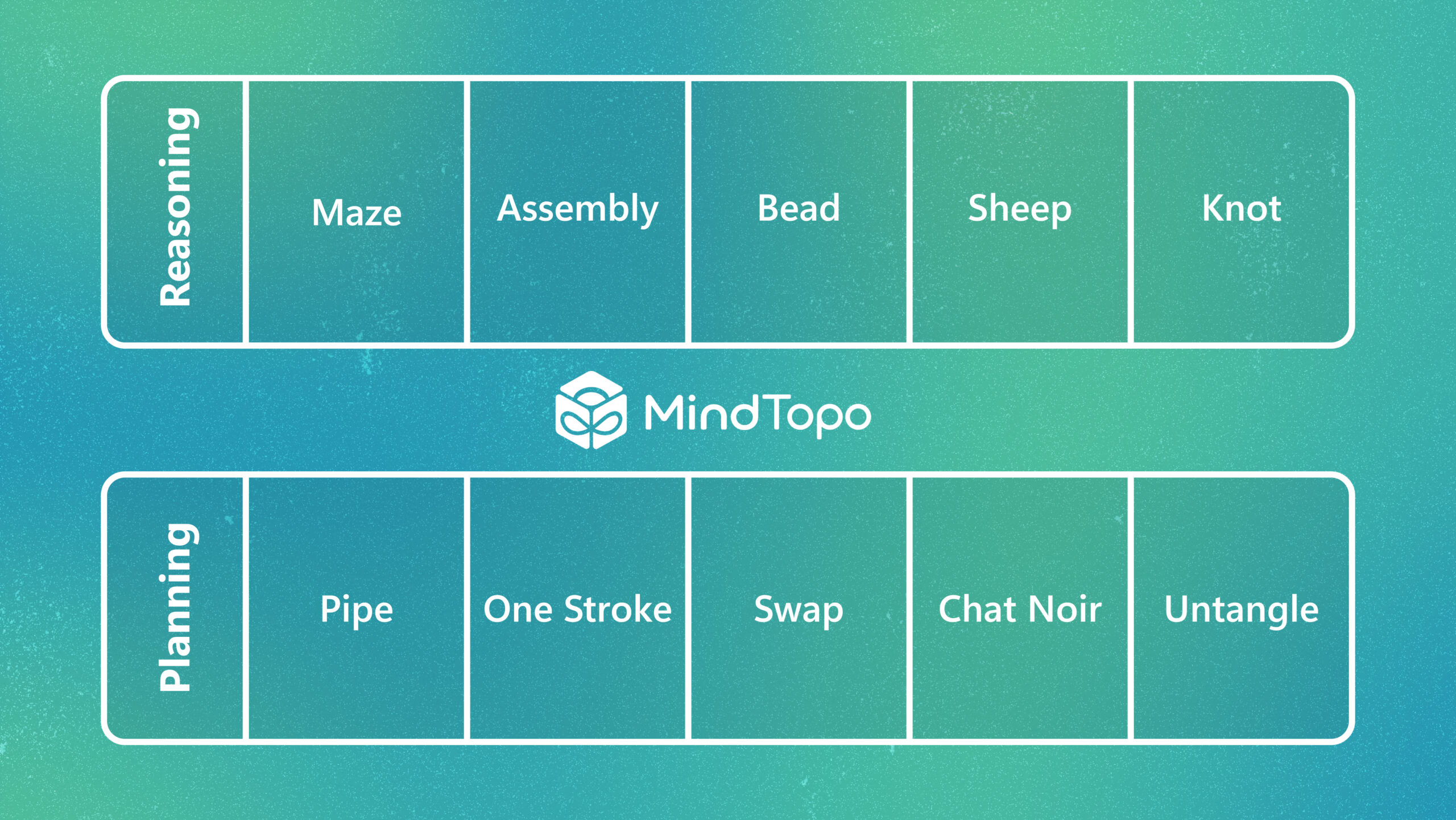
MindTopo Benchmark Unveils Spatial Reasoning Limits in Vision-Language Models
MindTopo sets a new benchmark for testing how AI understands topological relationships
highlights new opportunities to strengthen spatial reasoning and planning
MindTopo serves as a novel benchmark designed to evaluate the proficiency of vision-language models in understanding complex topological relationships such as paths, fences, and knots. These spatial concepts represent fundamental challenges for current AI systems, which often struggle with geometric and structural reasoning in relational contexts. By providing a structured framework for testing, the benchmark highlights significant opportunities for researchers to improve how models navigate and plan within physical or virtual environments. Developing these capabilities is essential for enhancing the performance of AI agents in robotics and autonomous navigation tasks. The evaluation results obtained through this tool reveal current limitations in spatial logic and offer a roadmap for future architectural improvements. Ultimately, MindTopo facilitates a deeper understanding of the gap between visual perception and cognitive reasoning in advanced machine learning models, pushing the boundaries of spatial intelligence.
Source: Microsoft Research Blog (current)
Open Source
Explore the evolving landscape of open-source software, where collaborative development meets cutting-edge innovation. This category tracks major repository updates, licensing shifts, and the growing influence of AI-assisted coding on project sustainability. We analyze how maintainers are adapting their workflows to accommodate AI-first contributors, ensuring community health and code quality in an automated era. Stay informed on the tools and philosophies shaping the future of transparent, decentralized technology development.
Adapting Open Source Maintenance for AI-First Contributors
AI contributors are already in your queue.
Nicholas Tindle shares the repo instructions, gates, and boundaries that keep maintainers in control.
AI contributors are already active within project queues, creating a new set of challenges for open source maintainers. Nicholas Tindle, a maintainer for the AutoGPT project, highlights the necessity for projects to adapt their workflows to manage the influx of AI-generated code and interactions. To maintain control over their repositories, developers are encouraged to implement specific instructions, automated gates, and clear boundaries for these automated contributors. These defensive measures are designed to ensure that maintainers can filter noise effectively while still benefiting from the speed of AI-assisted contributions. By formalizing how AI agents interact with codebases, projects can prevent the burnout that often follows unmanaged automated submissions. This structural evolution is becoming essential as AI-first development becomes the default mode for many modern software contributors.
Source: The GitHub Blog

This report is auto-generated by WindFlash AI based on public AI news from the past 48 hours.