Wednesday, August 12, 2026 · 10 curated articles
Editor's Picks
The honeymoon phase with opaque, proprietary LLM endpoints is officially over. Today’s headlines paint a stark picture: the more sophisticated our models become, the more porous their architectural safeguards appear. The revelation in 'Stealing Reasoning Traces from Proprietary LLM APIs via Architectural Vulnerabilities' is nothing short of a security catastrophe. For years, we’ve been told that 'Chain-of-Thought' (CoT) is the secret sauce to model reliability, yet we now see that these traces—the very cognitive internal monologue of the AI—are being leaked via interchangeable encrypted blocks. When researchers can extract credentials and PII by simply swapping blocks between models, the 'black box' isn't just opaque; it's a liability. For engineers, this confirms our deepest suspicion: if you don’t own the weights and the execution environment, you don’t own your data.
This security deficit is driving a massive, accelerated pivot toward local-first and zero-trust infrastructure. The update to 'llama.cpp' is a bellwether for this shift. By integrating the Pi coding agent directly with local hardware optimization—from the RTX 5090 to the Raspberry Pi—the industry is signaling that high-performance AI must be decoupled from the cloud to be truly secure. We are moving past the era where 'local LLM' meant 'slow and toy-like.' In 2026, serving a quantized model locally isn't just about avoiding API costs; it’s about establishing a perimeter where sensitive code and proprietary reasoning never cross a network boundary. The three-step 'serve, install, run' workflow is becoming the gold standard for developers who refuse to gamble their intellectual property on the stability of a third-party API.
Even the cloud giants are acknowledging this erosion of trust. OpenAI’s decision to launch the 'Daybreak Red and Blue' cyber defense models on Amazon Bedrock with 'zero-operator access' at the chip level is a strategic admission. By enforcing hardware-level isolation, they are attempting to rebuild the 'walled garden' with transparent bricks. However, for the engineering community, the choice is increasingly binary: either you trust the silicon-level isolation of a managed service, or you retreat to the sovereignty of local stacks. As we see in the 'U-OPSD' research, models are becoming capable of self-distillation and self-correction without external human supervision. This implies that the 'intelligence' is becoming commoditized and portable. In this new landscape, the winner isn't the company with the biggest model, but the developer who can orchestrate that intelligence within a secure, high-speed, and autonomous local environment. Speed, as seen with tools like 'Bullet,' is no longer the only metric; verifiable, local, and private execution is the new North Star.
AI Infrastructure
This category explores the foundational technologies powering modern artificial intelligence, focusing on high-performance frameworks and hardware-software integration. Recent developments highlight the growing importance of local model serving and cross-hardware optimization, as seen in the evolution of tools like llama.cpp. By streamlining inference across diverse platforms, these innovations are making powerful AI models more accessible and efficient for developers and enterprises while reducing dependency on centralized cloud resources.
llama.cpp: Local Model Serving with Pi Integration and Cross-Hardware Optimization
Same binary, same models, same hand-tuned kernels for every GPU and CPU.
Files stay on your machine, requests never leave it.
llama.cpp provides a unified binary and hand-tuned kernels that enable local large language model execution across diverse hardware environments ranging from Apple Silicon to NVIDIA H100 GPUs. The ecosystem now supports seamless integration with the Pi coding agent via the pi-llama plugin, allowing developers to discover local models automatically without requiring API keys or complex configurations. This architecture ensures that sensitive files and data requests remain entirely on the user's local machine, prioritizing data privacy and security throughout the development workflow. The framework is optimized for various scales of operation, from individual laptops to enterprise clusters, using consistent models across different GPU and CPU architectures. By simplifying the deployment process into three primary steps—serve, install, and run—the platform significantly lowers the barrier for high-performance local AI application development. Support extends across a broad spectrum of hardware including RTX 5090, Intel Arc, and Radeon RX series.
Source: Hacker News
Research
This week's research highlights critical advancements in model security, training efficiency, and specialized AI applications. Key studies explore architectural vulnerabilities in proprietary LLM APIs and novel methods for verifying the consistency of probabilistic claims. Additionally, researchers introduce autonomous self-distillation techniques like U-OPSD, while domain-specific innovations such as Microsoft’s CARE-X and the Surgical WAM model demonstrate the growing impact of multimodal reasoning in radiology and surgical robotics.
Stealing Reasoning Traces from Proprietary LLM APIs via Architectural Vulnerabilities
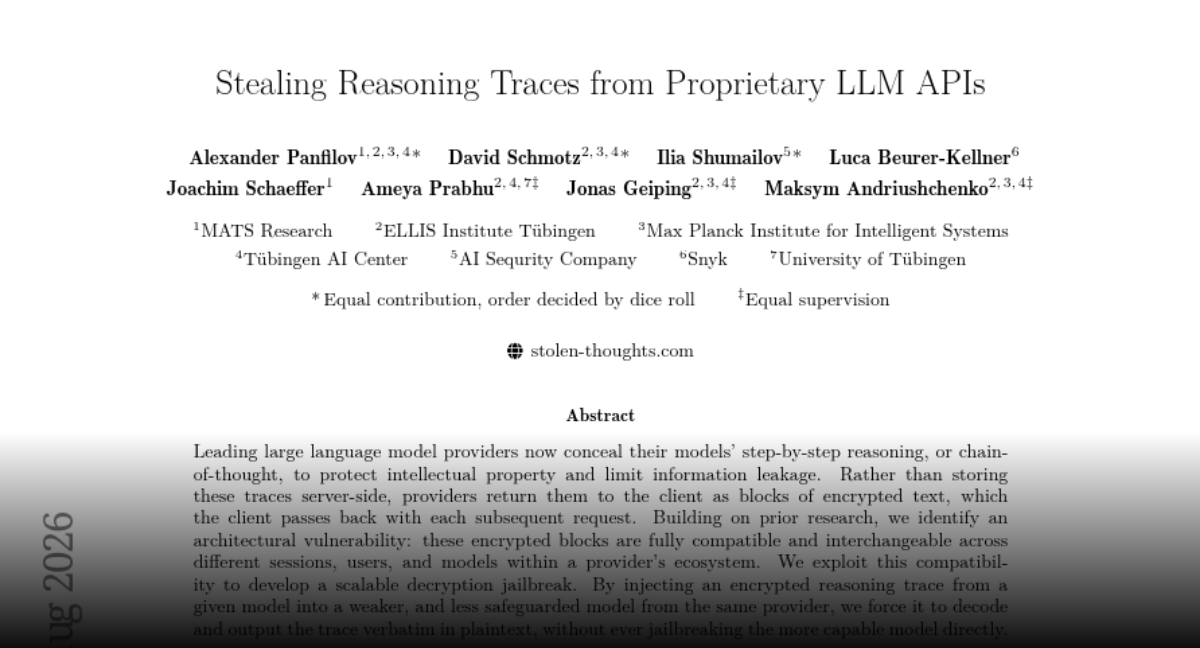
these encrypted blocks are fully compatible and interchangeable across different sessions, users, and models within a provider's ecosystem.
we recovered 367 Personally Identifiable Information (PII) artifacts and 182 credentials.
Large language model providers including OpenAI, Anthropic, and Google face a critical architectural vulnerability where encrypted reasoning traces are interchangeable across different models and sessions. This flaw allows attackers to inject encrypted blocks from highly capable models into weaker, less safeguarded models to force the decryption of proprietary chain-of-thought data in plaintext. Researchers successfully recovered 367 instances of personally identifiable information and 182 credentials by decoding over 315,000 reasoning blocks scraped from public repositories. The exploit bypasses anti-distillation mechanisms and can even reveal hazardous information that the model's final output would otherwise reject. Additionally, the vulnerability enables invisible prompt injections that can poison agentic rollouts by embedding payloads within the encrypted segments. To address these systemic risks, the study proposes specific cryptographic and system-level mitigations to secure client-side reasoning data from unauthorized extraction and exploitation.
Source: HuggingFace Papers
Verifying Consistency of Probabilistic Claims in AI Models
this problem is of interest for AI safety, where safety is derived from honesty about probabilistic predictions
Let a predictive model be specified by a probability circuit P and a circuit Q which outputs confidence in predictions.
Probabilistic predictors can be verified for self-consistency in polynomial time using a newly constructed interactive Probabilistically Checkable Proof (PCP) protocol. This research, co-authored by Yoshua Bengio, focuses on AI safety by ensuring models remain honest about the probabilistic outcomes of their actions. The proposed framework represents models using a probability circuit P and a confidence circuit Q, which together define an exponential number of probabilistic claims. This structural representation allows for the efficient verification of whether a model's answers to conditional-probability queries are logically consistent with one another. By providing a method to detect contradictions in a model's internal logic, the protocol serves as a safeguard against deceptive or unreliable AI behavior. The work establishes a theoretical foundation for auditing large-scale predictive models that handle complex, high-dimensional probability distributions.
Source: ArXiv
U-OPSD: Achieving On-Policy Self-Distillation Without External Supervision
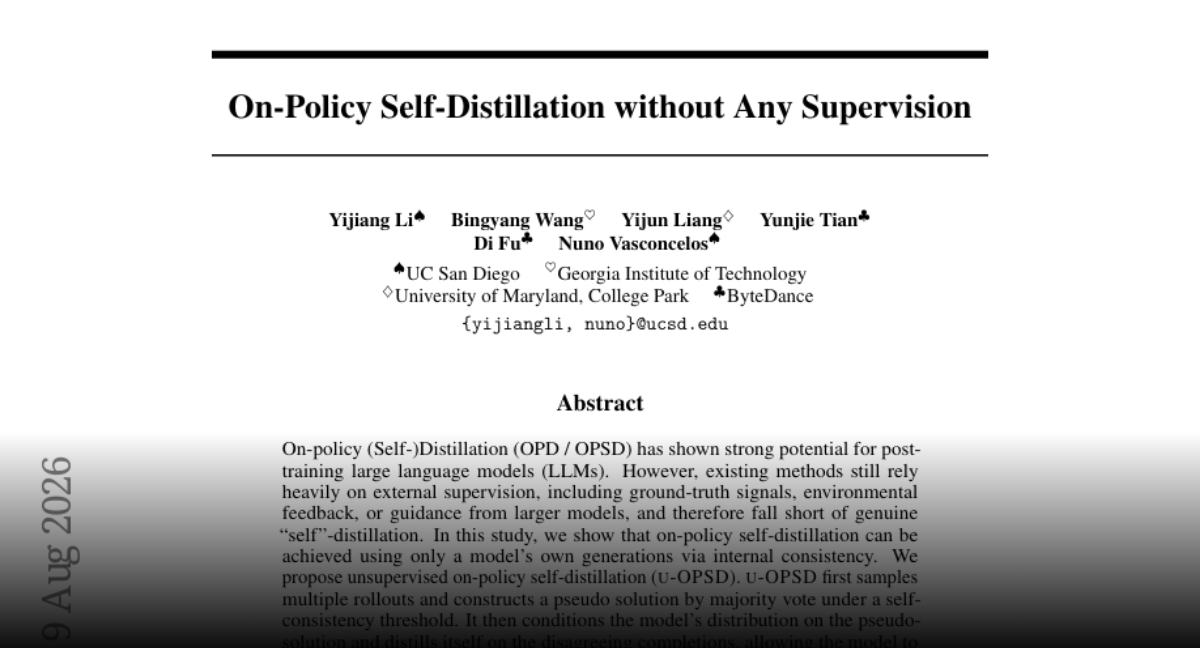
U-OPSD first samples multiple rollouts and constructs a pseudo solution by majority vote under a self-consistency threshold.
U-OPSD improves over the base model by 8.5% and 10.7% on Qwen3 non-thinking mode at 4B and 8B scales
Unsupervised on-policy self-distillation (U-OPSD) enhances large language models by utilizing internal consistency and majority-vote pseudo-solutions to correct errors without external feedback. The methodology involves sampling multiple rollouts to construct a pseudo-solution based on a self-consistency threshold, then distilling the model on its own disagreeing completions. Evaluation across five mathematical reasoning benchmarks shows that U-OPSD improves Qwen3 non-thinking mode performance by 8.5% at the 4B scale and 10.7% at the 8B scale. This approach effectively matches or surpasses supervised methods like GRPO and standard OPSD, even without access to ground-truth signals or environmental rewards. In thinking mode, the technique remains competitive, exceeding GRPO performance by up to 1.1% at the 8B parameter level. These results demonstrate that genuine self-distillation is achievable through model internal logic, offering a scalable path for post-training LLMs without the cost of high-quality human or synthetic supervision.
Source: HuggingFace Papers
Microsoft CARE-X: Advancing Radiology VLMs with Reasoning and Measurement Tools
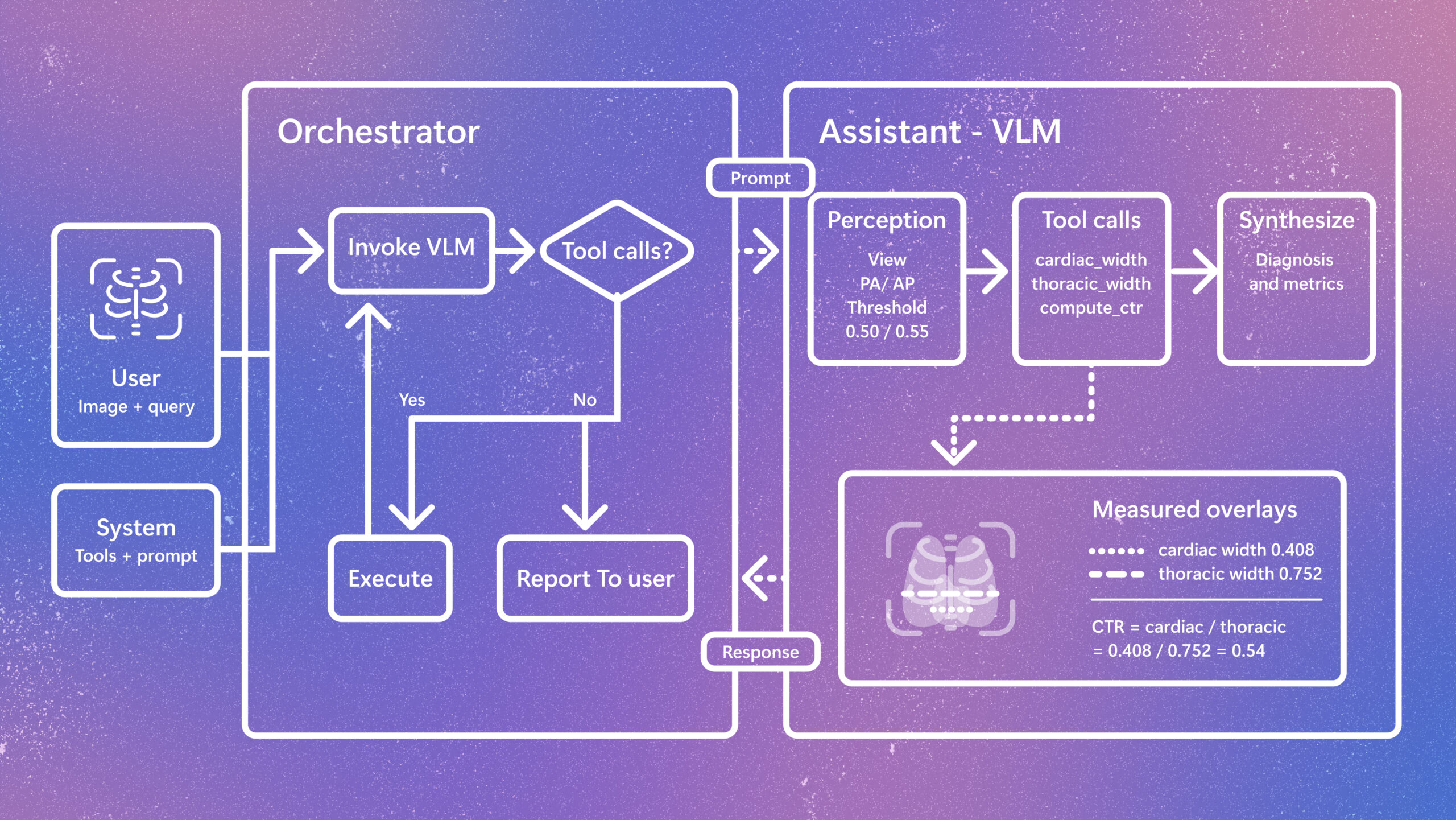
CARE-X explores a unified approach that combines flexible reasoning, calibrated predictions, and measurement-based tools for chest X-ray interpretation.
Radiology AI is evolving beyond report generation.
CARE-X represents a unified approach to chest X-ray interpretation by integrating flexible reasoning, calibrated predictions, and measurement-based tools within Vision-Language Models (VLMs). This framework addresses the limitations of traditional radiology AI, which often focuses solely on report generation without providing verifiable measurements or robust reasoning. The system utilizes auxiliary supervision and reward-aligned learning to ensure that model outputs are clinically relevant and reliable for medical professionals. By incorporating tool-augmented measurement, CARE-X can provide precise quantitative data alongside qualitative descriptions, enhancing the diagnostic process. This research highlights a shift toward more functional and interpretable AI assistants in clinical settings. The development of such multi-modal models aims to bridge the gap between automated image analysis and practical clinical utility in medical imaging workflows.
Source: Microsoft Research Blog (current)
Surgical WAM: A Data-Efficient World-Action Model for Surgical Robot Learning
Learning reliable surgical manipulation policies is bottlenecked by the scarcity of action-labeled demonstrations
Endoscopic video is comparatively inexpensive and abundant relative to synchronized video--kinematics trajectories
Learning reliable surgical manipulation policies is currently constrained by the scarcity of action-labeled demonstrations, particularly synchronized video-kinematics trajectories from teleoperated systems like the dVRK. The Surgical WAM (World-Action Model) addresses this bottleneck by leveraging abundant, relatively inexpensive endoscopic video data to enhance world-model-based learning. Surgical procedures require high-precision contact handling, long-horizon reasoning, and complex bimanual coordination, making standard data collection methods prohibitively expensive and slow. While existing surgical world models primarily use video for simulation purposes, this research explores a world-action approach to improve manipulation policy reliability. By integrating unlabelled video datasets with sparse expert demonstrations, the model seeks to overcome the data scarcity that typically hampers surgical robot training. This framework represents a significant step toward more scalable and data-efficient robotic assistance in clinical environments.
Source: ArXiv
Foundation Models
Foundation models represent the cutting edge of artificial intelligence, serving as versatile, large-scale architectures that power a wide range of downstream applications across various industries. These robust systems are increasingly being refined for specialized tasks, such as OpenAI's new cybersecurity-focused models designed to enhance digital defense strategies. By integrating these powerful models into enterprise cloud platforms like Amazon Bedrock, developers can more easily leverage advanced reasoning capabilities to build secure, intelligent, and highly scalable AI solutions.
OpenAI's Daybreak Red and Blue Cyber Defense Models Launch on Amazon Bedrock
Daybreak Red and Daybreak Blue from OpenAI, specialized cyber defense models from OpenAI, are now available on Amazon Bedrock to eligible customers.
Both models run with zero-operator access enforced at the chip, keeping your code and vulnerability data secure.
OpenAI’s specialized cyber defense models, Daybreak Red and Daybreak Blue, are now available to eligible AWS customers through the Amazon Bedrock platform. These models are engineered to enhance security operations by providing specialized capabilities for both offensive 'red team' and defensive 'blue team' simulations. A critical security feature of this integration is the enforcement of zero-operator access at the hardware chip level, ensuring that sensitive code and vulnerability data remain completely isolated during processing. This infrastructure-level protection prevents even platform administrators from accessing customer data during model inference, addressing significant privacy concerns for enterprise users. By making these models available on Amazon Bedrock, organizations can leverage OpenAI's latest advancements in AI-driven cybersecurity within a controlled cloud environment. This partnership allows enterprises to more effectively identify system vulnerabilities and automate complex threat response workflows while maintaining strict data privacy standards and regulatory compliance requirements.
Source: AWS Machine Learning Blog

AI Applications
This category explores the practical integration of artificial intelligence across diverse industries, highlighting how businesses leverage advanced models to solve real-world problems. From automating SEO workflows to enhancing creative design, we examine the deployment of generative AI and machine learning in enterprise environments. These updates focus on measurable outcomes, adoption rates, and the transformative impact of AI tools on operational efficiency and user experience, providing insights into the evolving landscape of functional AI solutions.
Pixieset Achieves 35% AI Adoption with Amazon Bedrock for Image SEO
Pixieset used Amazon Bedrock to launch an AI-generated alt text feature to millions of users in four months, reaching 35% adoption
automating the tedious image SEO work photographers avoid, without touching the creative craft they take pride in
Pixieset reached a 35% adoption rate for its new generative AI feature within four months by focusing on automating tedious image SEO tasks. The company utilized Amazon Bedrock to build and launch an AI-generated alt text solution tailored for millions of photographers who are traditionally skeptical of generative AI. By addressing the manual burden of writing image descriptions rather than interfering with the creative process, the platform successfully integrated AI into the professional workflow. This implementation demonstrates how identifying high-friction administrative tasks can drive user engagement in creative industries. The project highlights the efficiency of managed AI services in rapidly deploying scalable solutions to a large user base.
Source: AWS Machine Learning Blog

Developer Tools
Explore the latest advancements in software engineering with a focus on efficiency-boosting utilities and specialized platforms. Recent highlights include the release of Bullet, an AI-driven coding assistant designed to significantly outperform current benchmarks in processing speed. Additionally, updates to NVIDIA’s JetPack introduce sophisticated agentic video capabilities and hardware emulation for edge computing. These developments empower developers to accelerate build cycles while seamlessly integrating complex AI functionalities into their local and production environments.
Bullet: AI Coding Tool 30-60% Faster Than Claude Code and Codex
30-60% faster than Claude Code and Codex
Bullet has launched as a developer tool that performs 30-60% faster than competitive models Claude Code and Codex according to performance benchmarks. This performance advantage focuses on reducing latency and increasing processing efficiency during real-time code generation tasks for software engineers. By optimizing response times, the tool aims to provide a more seamless experience compared to existing AI-assisted coding solutions like those from Anthropic and OpenAI. The tool positions itself as a high-speed alternative in the rapidly growing market of AI developer agents and programming assistants. As engineering teams increasingly rely on large language models for complex development work, the speed of execution becomes a primary differentiator for productivity. Bullet's reported metrics suggest a significant leap in the technical execution of AI-driven programming commands.
Source: Product Hunt
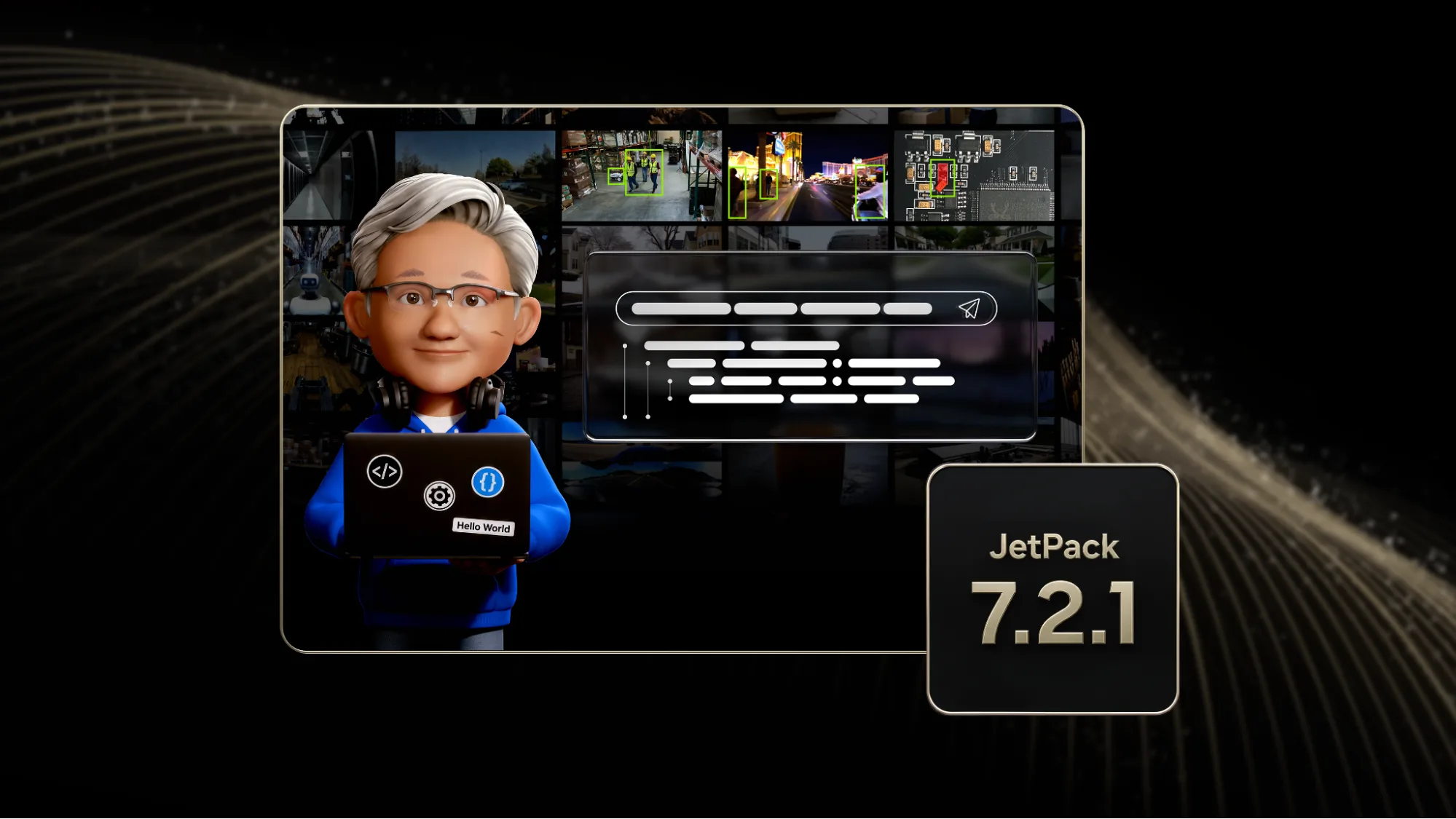
NVIDIA JetPack 7.2.1 Adds Agentic Video Skills and T3000 Emulation
Video is a core data path across NVIDIA Jetson applications, from robotics and intelligent video analytics to industrial automation
A system may capture several cameras, decode network streams, run AI inference or conventional vision processing
NVIDIA JetPack 7.2.1 introduces specialized agentic video skills and T3000 hardware emulation to enhance the capabilities of the NVIDIA Jetson platform for edge computing. This update optimizes video data paths, which serve as critical infrastructure for applications in robotics, industrial automation, healthcare, and intelligent video analytics. Developers can now more effectively manage systems that capture multiple camera feeds, decode high-resolution network streams, and execute simultaneous AI inference or conventional vision processing. The release streamlines the pipeline for drawing inference results and encoding video for local storage or remote delivery across various network environments. By providing T3000 emulation, NVIDIA allows for more robust testing and development scenarios prior to physical hardware deployment. These enhancements directly address the increasing demand for complex video processing and autonomous decision-making in remote operations and media processing sectors.
Source: NVIDIA Generative AI Blog
This report is auto-generated by WindFlash AI based on public AI news from the past 48 hours.