Thursday, July 23, 2026 · 10 curated articles

Editor's Picks
The most surprising item in today's report is not a product launch or a funding round. Terrence Tao published a ChatGPT conversation in which the model independently verified that two polynomial maps are mutually inverse isomorphisms, a step in exploring a potential counterexample to the Jacobian Conjecture. The model handled polynomial reductions modulo defining equations and confirmed a constant-Jacobian composition from C^3 to C^3. This is not a chatbot answering a homework problem; it is a Fields Medalist using an LLM as a symbolic computation partner on an open problem in algebraic geometry.
The same report carries two world-modeling papers that matter for a different reason. AlayaWorld is an open-source 15B video diffusion transformer that generates interactive 24-fps video at 540p and 720p from text, image, or video input. ABot-World-0 streams 720P at 16 FPS on a single RTX 5090 with 1.2-second action-to-first-frame latency and roughly 19 GiB of peak VRAM. Six months ago, interactive world generation was a research curiosity that required a cluster. Now it runs on a desktop GPU. The implications for synthetic training environments, game prototyping, and spatial computing are significant.
On the business side, the numbers have stopped being surprising only because they keep arriving. Anthropic reached a $47 billion revenue run rate by May, up from $9 billion in 2025. Matt Murphy of Menlo Ventures, who led the company's $500 million Series D, calls it the fastest scaling he has seen in twenty-five years of venture capital, faster than the internet wave, mobile era, or first cloud boom. OpenAI, for its part, launched Presence, an enterprise platform that wraps agents in policies, guardrails, and escalation rules for production workflows like billing resolution and insurance claims. The message from both companies is the same: the experimental phase is over, and the governance layer is now the product.
Google's Gemini 3.6 Flash family, with dedicated Lite and Cyber variants, confirms that model specialization is the new default. NVIDIA's TensorRT update adds observable, cancelable engine builds for Python and C++. The infrastructure is maturing. The question for developers is no longer whether these models work, but whether the surrounding tooling, monitoring, and access controls can keep up.
Research
This week's research highlights a diverse array of breakthroughs spanning pure mathematics, world modeling, and theoretical optimization. Notably, Terrence Tao leverages large language models to probe the complex Jacobian Conjecture, while innovative architectures like AlayaWorld and ABot-World-0 advance the frontiers of interactive video generation and efficient world modeling. Furthermore, theoretical progress in bandit convex optimization and self-supervised learning provides deeper insights into the fundamental mechanisms of algorithmic efficiency and unified model training strategies.
Terrence Tao Uses ChatGPT to Explore Jacobian Conjecture Counterexamples
I checked the identities independently, and the two maps are mutually inverse polynomial isomorphisms.
confirm symbolically that one obtains a polynomial from (a,y,z) to C^3 with constant Jacobian?
Terrence Tao engaged in a technical dialogue with ChatGPT to verify algebraic constructions related to a potential counterexample for the Jacobian Conjecture. During the session, the AI independently confirmed that two specific maps are mutually inverse polynomial isomorphisms between the variety X and the affine space A^3. The interaction involved symbolic confirmation of a polynomial map G from C^3 to C^3 derived from a composition that maintains a constant Jacobian. ChatGPT's ability to handle complex polynomial reductions modulo defining equations suggests its utility in assisting high-level mathematical research. The conversation specifically addressed the removal of singularities in preliminary formulas to ensure the maps remained polynomial throughout the domain. This instance underscores a growing trend where leading mathematicians utilize Large Language Models for rigorous symbolic manipulation and formulaic verification, potentially accelerating the validation of complex mathematical proofs.
Source: Hacker News
AlayaWorld: An Open-Source 15B Video Diffusion Transformer for Interactive World Modeling
AlayaWorld, an interactive long-horizon video world model that generates 24-fps video at 540p and 720p.
Built on a 15B video diffusion transformer, AlayaWorld generates short latent chunks autoregressively
AlayaWorld introduces a 15B video diffusion transformer capable of generating interactive 24-fps video at 540p and 720p resolutions for long-horizon world modeling. Unlike traditional game development pipelines, this model generates customized and explorable virtual environments instantly from text, image, or video inputs. The architecture employs an autoregressive generation of short latent chunks combined with a bounded visual context that includes persistent sink frames and geometry-aligned spatial memory. To address long-term drift, the system is trained with corrupted histories and prediction residuals while utilizing a discrete autoregressive distillation formulation to reduce inference steps from approximately thirty to four per chunk. This open-source framework achieves state-of-the-art performance on iWorld-Bench, providing a foundation for future research into stable, efficient, and responsive interactive video world models.
Source: HuggingFace Papers

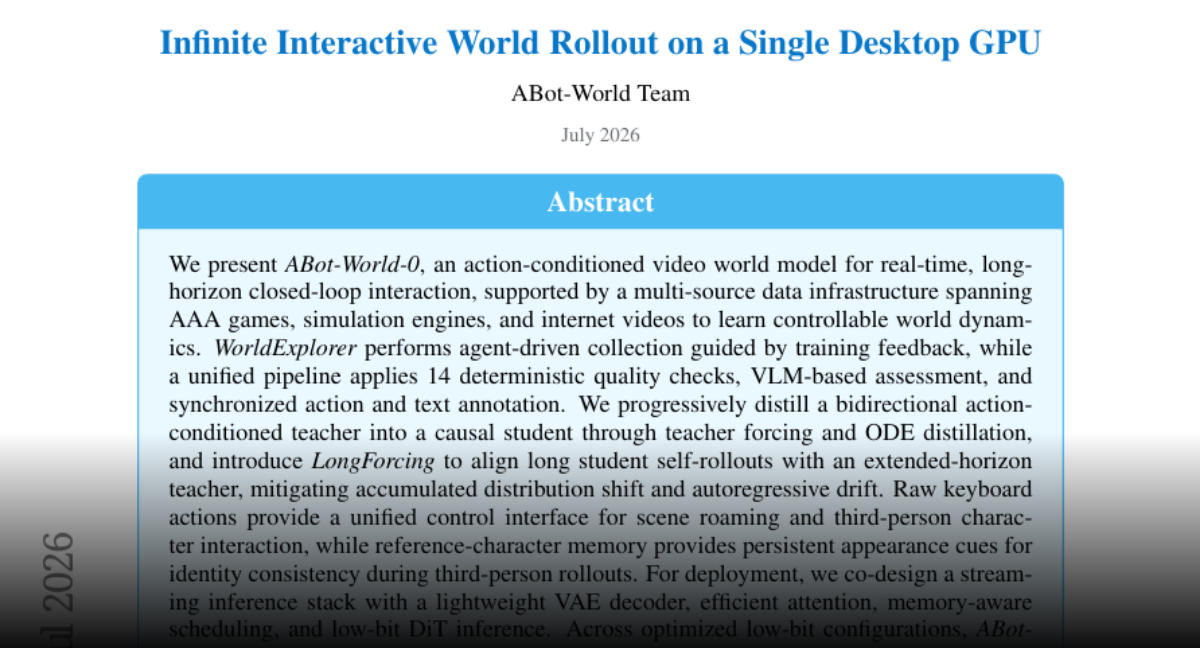
ABot-World-0: Real-Time Interactive World Generation on a Single Desktop GPU
ABot-World-0 streams 720P video at up to 16 FPS on a single NVIDIA RTX 5090 desktop GPU
1.2s action-to-first-frame latency and approximately 19GiB peak VRAM
ABot-World-0 achieves real-time streaming of 720P video at up to 16 FPS on a single NVIDIA RTX 5090 GPU with approximately 19GiB peak VRAM. This action-conditioned video world model leverages a multi-source data infrastructure from AAA games, simulation engines, and internet videos to facilitate long-horizon closed-loop interaction. The development involves distilling a bidirectional teacher model into a causal student through teacher forcing and ODE distillation, alongside a LongForcing technique to mitigate autoregressive drift. By utilizing raw keyboard actions as a control interface, the model supports scene roaming and character interactions while maintaining identity consistency via reference-character memory. The system's inference stack is optimized with a lightweight VAE decoder and low-bit Diffusion Transformer inference, resulting in a 1.2-second action-to-first-frame latency. These results demonstrate the feasibility of deploying complex, controllable world dynamics on consumer-grade hardware for immersive digital experiences.
Source: HuggingFace Papers
New Lower Bounds for Bandit Convex Optimization Prove It Harder Than Linear Bandits
establish a near-Optimal Omega-tilde lower bound scaling as d to the 5/4 power times sqrt(T) on the minimax expected regret of stochastic bandit convex optimization
establishing that stochastic bandit convex optimization is fundamentally harder than linear bandits.
A minimax expected regret lower bound scaling as d to the 5/4 power times sqrt(T), up to logarithmic factors, has been established for stochastic bandit convex optimization of 1-Lipschitz functions on the Euclidean ball. This finding represents the first non-trivial regret lower bound that grows faster than the standard d times sqrt(T) rate, demonstrating that stochastic bandit convex optimization is fundamentally more complex than linear bandits. The researchers constructed a specific hard class of convex functions involving a "tube" mechanism and a squared distance function to analyze the trade-off between exploring unknown linear transformations and minimizing functions. This analysis translates to a sample complexity lower bound scaling as d to the 5/2 power divided by epsilon-squared, up to logarithmic factors, for finding an epsilon-optimal action in both constrained and unconstrained settings. By bounding the posterior spread of Fisher information matrices, the study highlights the "hidden curvature" that complicates the learning process in higher dimensions. These results provide critical theoretical insights into the performance limits of convex optimization under bandit feedback.
Source: arXiv stat.ML
Unifying Self-Supervised Learning via Latent Distribution Matching
We cast SSL as latent distribution matching (LDM): learning representations that maximize their log-probability under an assumed latent model
predictive LDM yields identifiable latent representations under mild assumptions, even with nonlinear predictors
Self-supervised learning (SSL) serves as a powerful mechanism for extracting general-purpose latent representations from complex datasets by casting the process as latent distribution matching (LDM). This novel theoretical framework unifies diverse SSL methodologies, including contrastive, non-contrastive, and predictive approaches, by balancing alignment with latent entropy to prevent representation collapse. Researchers demonstrate that LDM effectively integrates independent component analysis and stop-gradient techniques into a single conceptual model. The study introduces a nonlinear, sampling-free Bayesian filtering model equipped with a Kalman-based predictor specifically designed for high-dimensional timeseries data. Furthermore, the authors provide mathematical proof that predictive LDM achieves identifiable latent representations under mild assumptions even when employing nonlinear predictors. This advancement provides principled guidance for the future design of SSL architectures and clarifies the foundational assumptions of existing state-of-the-art methods.
Source: arXiv stat.ML
AI Agents
AI agents are evolving from simple chat interfaces into sophisticated autonomous systems capable of executing complex workflows and interacting socially. With the launch of enterprise-grade management platforms like OpenAI Presence and specialized plugins like Humalike’s Hermes, the ecosystem is shifting toward scalable deployment and enhanced interpersonal capabilities. These advancements empower organizations to integrate intelligent, socially-aware agents into professional environments, marking a significant milestone in the transition from generative models to proactive digital coworkers.
OpenAI Launches Presence for Enterprise AI Agent Deployment
Presence pairs model reasoning with policies, guardrails, and escalation rules that verify accuracy and performance.
Codex proposes updates that teams can test and approve, helping the agent adapt as customer behavior changes.
OpenAI has introduced OpenAI Presence, a battle-tested product designed to help enterprises deploy and manage trusted AI agents for high-value production workflows. The system integrates model reasoning with specific policies, guardrails, and escalation rules to ensure accuracy and performance across tasks like billing resolution and insurance claim support. Each deployment restricts agents to the specific knowledge and system access required for their designated job, allowing companies to maintain control over actions and handoffs to human staff. After initial launch, the platform uses a Codex-powered improvement process to propose updates based on production sessions and identified performance gaps. Presence currently supports real-time experiences for both voice and chat agents, covering use cases from outbound sales to high-risk internal operations. By combining evaluation tools with simulations and standard operating procedures, OpenAI aims to transition AI agents from experimental prototypes to reliable enterprise tools.
Source: Hacker News
Humalike x Hermes: Social Intelligence Plugin for AI Agents
Social intelligence plugin for Hermes Agent
It decides when to speak, adapts to your group's tone and remembers who said what.
Humalike has launched a social intelligence plugin for Hermes Agent designed to bridge the gap between technical capability and human-like behavioral nuances. The system enables AI agents to autonomously decide when to speak, adapt to the specific tone of a group, and maintain a memory of individual contributors within a conversation. This release functions as behavioral infrastructure, providing APIs and models that integrate social skills and proactiveness into existing agent frameworks. The plugin is compatible with popular messaging platforms including Slack, Telegram, and WhatsApp, allowing for more natural interactions in group settings. By focusing on social intelligence rather than just processing speed or intelligence, Humalike aims to make agents feel more present and contextual within a digital room. This marks the second major launch from the company, which continues to build foundational tools for human-like AI interactions.
Source: Product Hunt

AI Business
Explore the strategic landscape of the artificial intelligence industry, from record-breaking funding rounds and venture capital insights to the commercialization strategies of top startups. We analyze how organizations like Anthropic navigate rapid growth and offer actionable advice for founders building in this competitive market. Stay informed on the economic shifts and business models defining the future of technology as AI transitions from research labs to global enterprise solutions.
Matt Murphy on Anthropic’s Growth and Advice for AI Founders
Anthropic leaped to a $47 billion revenue run rate by May, compared to $9 billion in 2025.
Menlo led Anthropic’s $500M Series D, and Murphy has had a front-row seat
Anthropic achieved a $47 billion revenue run rate by May, representing a massive leap from $9 billion in 2025 according to provided data. Matt Murphy of Menlo Ventures characterizes this expansion as unprecedented within his twenty-five-year career in venture capital, surpassing trends seen during the internet wave, mobile era, and the first cloud boom. Having led Anthropic’s $500 million Series D funding round, Murphy offers a unique perspective on the operational shifts required for founders in the current generative AI landscape. He emphasizes that the velocity of growth for foundation model companies necessitates a different strategic approach compared to previous technological cycles. This transition from pre-revenue stages to massive scale-ups occurs in an incredibly compressed timeframe, forcing leadership to adapt their management styles and capital deployment strategies much faster than previous generations of entrepreneurs.
Source: TechCrunch AI

Foundation Models
Foundation models represent the core architectural layer of modern artificial intelligence, serving as the versatile basis for diverse downstream applications. Recent developments focus on optimizing the balance between computational efficiency and cognitive performance, as seen in the emergence of lightweight yet powerful iterations like Google's latest Gemini Flash family. These advancements signal a shift toward specialized, high-speed models that maintain the reasoning capabilities of their larger predecessors while enabling real-time integration across global platforms.
Google Launches Gemini 3.6 Flash Family Including Flash-Lite and Cyber Models
Gemini 3.6 Flash, 3.5 Flash-Lite, and 3.5 Flash Cyber
Google has expanded its model lineup with the introduction of the Gemini 3.6 Flash family, which includes the 3.6 Flash, 3.5 Flash-Lite, and 3.5 Flash Cyber variants. This release highlights a shift toward tiered model specialization, providing developers with options for varying latency requirements and specific security-focused tasks. The 3.6 Flash serves as the primary update for high-speed performance, while the Flash-Lite version targets resource-constrained environments. Additionally, the Flash Cyber model indicates a targeted approach toward cybersecurity applications within the Gemini ecosystem. These additions aim to optimize AI integration across different hardware and software constraints. The move underscores the competitive landscape of small, efficient language models designed for rapid deployment and specific enterprise needs.
Source: Product Hunt
Developer Tools
This category explores the essential utilities and frameworks that empower engineers to build, optimize, and manage complex software systems. From advanced AI model compilers like NVIDIA TensorRT to sophisticated debugging environments, we cover the latest advancements in cross-platform development and performance monitoring. These tools streamline the development lifecycle, offering improved observability and control to help developers deliver efficient, high-performance applications across diverse hardware architectures and programming languages.
Observable and Cancelable NVIDIA TensorRT Engine Builds in Python and C++
A TensorRT engine build can take seconds to many minutes.
Most NVIDIA TensorRT integrations report nothing during a build or provide no way to abort early.
NVIDIA TensorRT engine builds range from a few seconds to several minutes depending on model complexity, tactic searches, and specific GPU hardware. Most current NVIDIA TensorRT integrations provide no reporting during the build process and lack a mechanism to abort tasks early. This lack of transparency often leaves developers and AI agents unable to determine if a process is frozen or simply progressing through deep tactic searches on a new GPU SKU. By implementing observability, developers can monitor long-running builds instead of relying on a silent terminal. Adding cancelable functionality allows for the early termination of builds to save time and compute resources when parameters need adjustment. These enhancements improve the overall reliability and user experience for those deploying large-scale generative AI models using Python or C++ workflows.
Source: NVIDIA Generative AI Blog
This report is auto-generated by WindFlash AI based on public AI news from the past 48 hours.