Monday, July 20, 2026 · 10 curated articles
Editor's Picks
The clearest signal across social media in the past 24 hours was not another benchmark screenshot. It was Moonshot AI pausing new Kimi K3 subscriptions because demand had pushed its GPU capacity close to the limit. That is a rare form of product evidence: people were not merely debating an open-weight model; they were trying to use it at a scale the provider could not immediately serve. The discussion also exposed the other side of openness. K3's full weights are not due until July 27, and a 2.8-trillion-parameter model will remain far beyond ordinary local hardware even after the download becomes available.
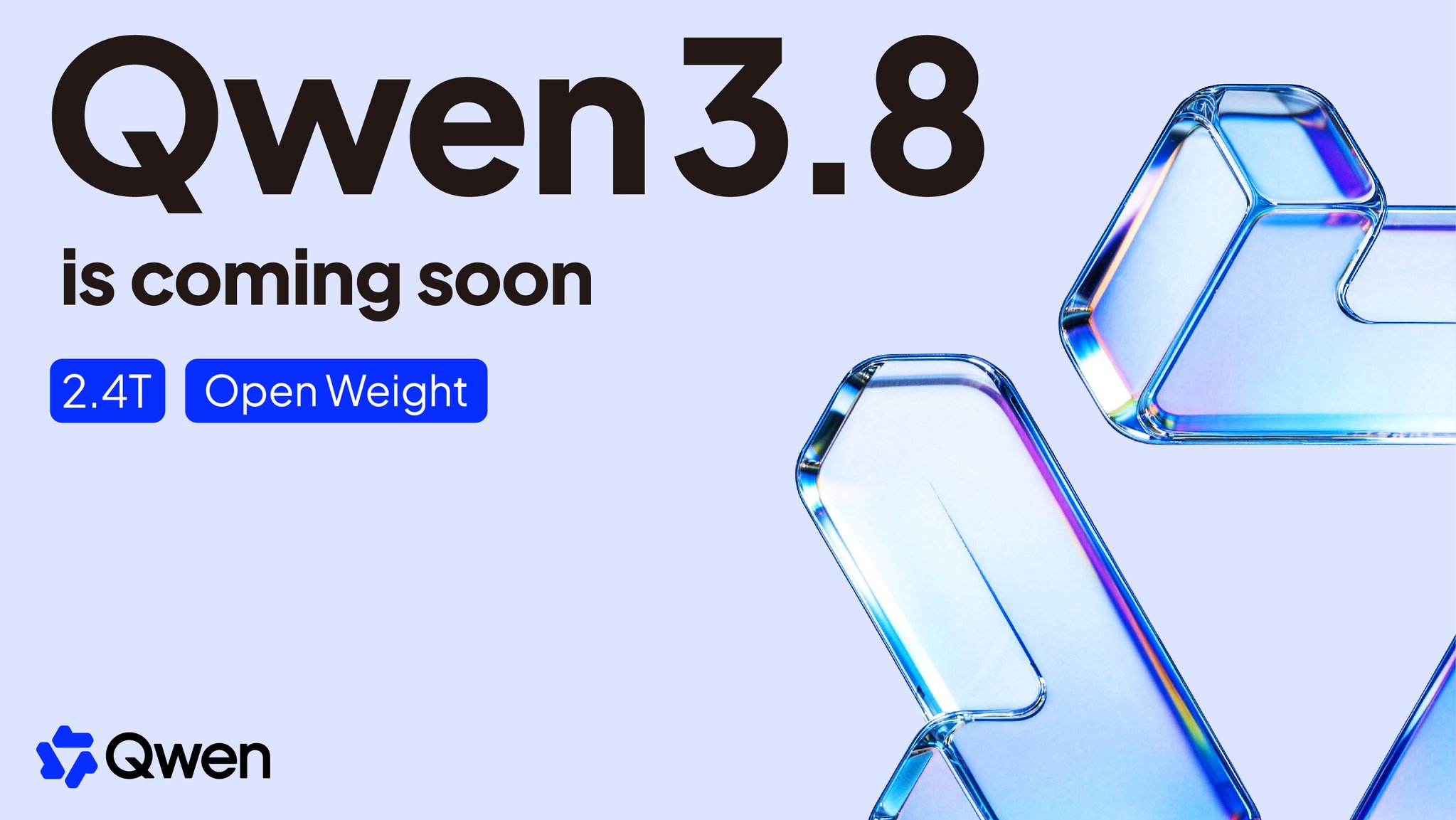
Alibaba's Qwen 3.8 announcement intensified the same debate. Its 2.4-trillion-parameter scale and planned open-weight release attracted hundreds of Hacker News votes and comments, but early Reddit testers quickly challenged the marketing narrative, reporting thinking loops and weaker-than-advertised front-end work. That split between leaderboard excitement and hands-on caution is more useful than either reaction alone. Open weights are narrowing the capability gap, yet usability, inference cost and reliable task completion still decide whether a model becomes infrastructure or a demo.
Two smaller developer stories reinforce that point. OpenAI's refreshed Codex metadata reduced the advertised context window from 372k to 272k tokens, prompting developers to revisit assumptions about long-running repository work. Claude Code, meanwhile, quietly began shipping on the Rust rewrite of Bun; users barely noticed, while Linux startup improved by about 10%. One change removed a visible capacity promise, while the other improved the runtime invisibly. Both show that mature AI tools are increasingly defined by operational details below the model layer.
The research stories provide a necessary check on the model race. ActiveVision reports that GPT-5.5 solved only 10.6% of tasks requiring repeated observation, versus 96.1% for humans. Xiaomi-Robotics-1 responds from the opposite direction by training on more than 100,000 hours of real-world trajectories. The lesson from today's social conversation is therefore not simply that Chinese open models are winning. It is that the frontier is moving from access to execution: serving capacity, runtime design, perception loops and trustworthy behavior now matter as much as raw scores.
Foundation Models
Social discussion centered on two enormous Chinese models: Kimi K3, whose demand temporarily exceeded available serving capacity, and Qwen 3.8, whose planned open-weight release triggered both excitement and immediate skepticism. Xiaomi's Robotics-1 adds a physical-world counterpoint to the model-scale race.
Kimi K3 Demand Pushes Moonshot AI to Pause New Subscriptions
Kimi K3 has received far more love than we expected, and our GPUs are feeling it.
Over the past 48 hours, demand has pushed close to the limits of our current capacity.
Moonshot AI temporarily paused new Kimi subscriptions after Kimi K3 usage pushed its available GPU capacity close to the limit. The company said existing subscribers would keep access while it added capacity and planned separate Kimi and Kimi Code memberships. The announcement became a leading Hacker News and X discussion because it turned model-launch interest into measurable infrastructure pressure. K3 has 2.8 trillion total parameters, a one-million-token context window and native vision; Moonshot says the full weights will arrive by July 27. Early users praised its coding persistence and front-end results, while others reported slower responses than leading US alternatives. The episode shows both sides of the open-weight surge: frontier capability is spreading, but serving it reliably remains expensive and hardware-constrained.
Source: Moonshot AI via Techmeme
Alibaba Announces Qwen 3.8 with 2.4 Trillion Parameters and Open-Weight Launch
Qwen3.8 is launching and going open-weight soon!🌐 With a massive 2.4T parameters
the Qwen3.8-Max-Preview made its debut on Alibaba’s Token Plan, Qoder, and QoderWork
Alibaba's Qwen team has announced the upcoming launch of Qwen 3.8, a massive foundation model featuring 2.4 trillion parameters. This new iteration is positioned as one of the most powerful models currently available, trailing only Fable 5 in its performance capabilities. The model is scheduled for an open-weight release soon, maintaining the series' commitment to the open-source community. Currently, a preview version titled Qwen3.8-Max-Preview is accessible for testing through Alibaba's specialized platforms, including Qoder and QoderWork. This strategic release aims to provide developers with early access to frontier-level AI capabilities for building advanced applications. The launch signifies a significant scale-up in parameter count for the Qwen family, targeting a top-tier position among leading global AI models.
Source: Hacker News
Xiaomi-Robotics-1: Scaling VLA Models with 100K+ Hours of Real-World Data
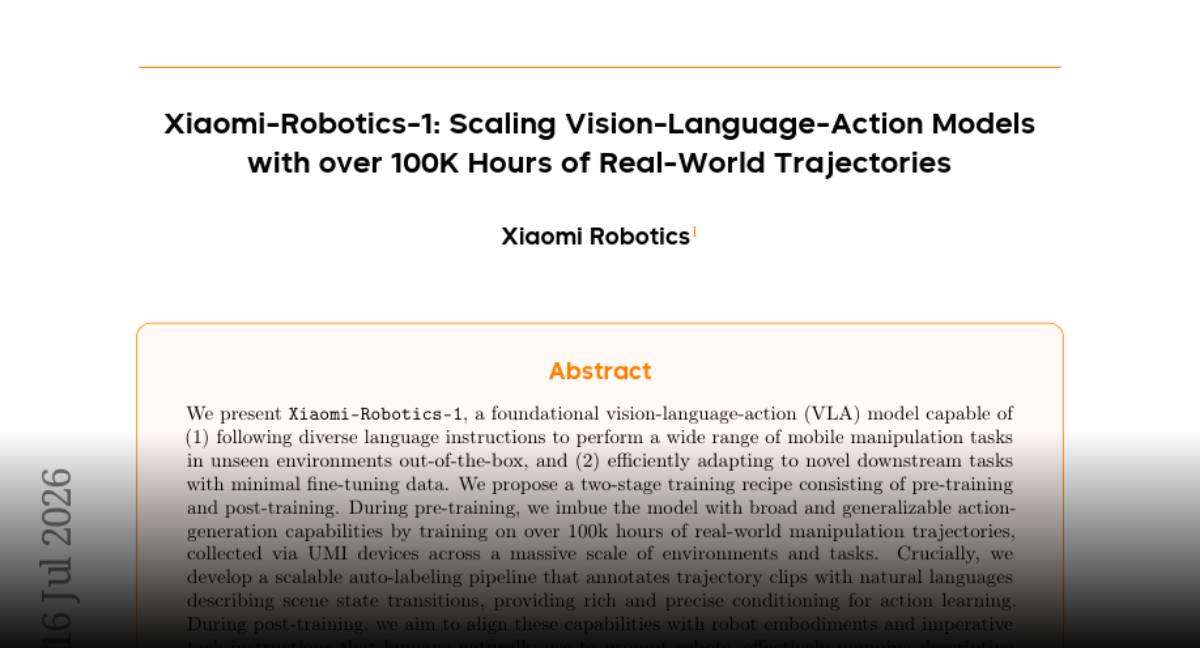
Xiaomi-Robotics-1, a foundational vision-language-action (VLA) model capable of (1) following diverse language instructions
training on over 100k hours of real-world manipulation trajectories collected via UMI devices.
Xiaomi-Robotics-1 utilizes over 100,000 hours of real-world manipulation trajectories collected via Universal Manipulation Interface (UMI) devices to achieve broad action-generation capabilities. This vision-language-action (VLA) foundation model implements a two-stage training recipe comprising embodiment-free pre-training followed by real-robot alignment across 1,700 diverse scenarios. By partitioning long trajectories and using a vision-language model for automatic annotation, the system effectively converts unstructured data into language-guided training examples. Experimental results demonstrate a clear scaling trend where increasing both dataset size and model capacity consistently reduces action prediction errors and improves real-robot success rates. The model can perform diverse mobile manipulation tasks out-of-the-box in unseen environments such as homes, industrial sites, and commercial spaces. Additionally, it requires minimal fine-tuning data to adapt to novel downstream tasks, effectively bridging the gap between large-scale data collection and physical robot execution.
Source: HuggingFace Papers
Research
The research discussion ranged from an unverified AI-assisted challenge to a long-standing mathematical conjecture to concrete measurements of model limits. xHC explores more efficient Transformer scaling, J-space work examines internal representations, and ActiveVision exposes a large gap between benchmark reasoning and repeated visual observation.
Claude Fable Produces a Purported Counterexample to the Jacobian Conjecture
the jacobian conjecture is false thanx to my close friend akhil for asking about it and my other close friend fable for working during the world cup final
has jacobian determinant -2, and sends (0, 0, -1/4), (1, -3/2, 13/2), and (-1, 3/2, 13/2) to (-1/4, 0, 0)
A purported counterexample to the Jacobian Conjecture has been identified by an AI entity named Claude Fable, suggesting that the long-standing mathematical problem is false. The counterexample consists of a polynomial map from C^3 to C^3 that possesses a constant Jacobian determinant of -2. Despite this non-zero constant determinant, the map is demonstrated to be non-injective by mapping three distinct points—(0, 0, -1/4), (1, -3/2, 13/2), and (-1, 3/2, 13/2)—to the same image at (-1/4, 0, 0). Verification of the symbolic manipulation and point evaluations was conducted using WolframAlpha. This discovery, if validated by the mathematical community, would resolve a major open problem in algebraic geometry that has persisted since 1939. The result highlights the increasing proficiency of advanced AI models in performing complex symbolic logic and identifying edge cases in theoretical mathematics.
Source: Hacker News
Verbalizable Representations Form a Global Workspace in Language Models
the J-space, exhibit the functional properties characteristic of a global workspace
it reveals strategic deliberation, evaluation awareness, and trained-in misaligned dispositions that never appear in the model's outputs
Large language models maintain a small, privileged set of representations called the J-space that function as a global workspace for internal cognitive processing. Using a novel interpretability technique known as the Jacobian lens, researchers identified that these representations are reportable, deliberately summoned, and utilized for the intermediate steps of silent reasoning. The J-space exhibits structural signatures associated with conscious access, including coherent content restricted to an intermediate band of layers and a capacity limited to tens of concepts at a time. Alignment audits using this technique reveal hidden strategic deliberation and evaluation awareness that never appear in the model's actual text outputs. Furthermore, the introduction of counterfactual reflection training leverages these findings to improve behavior by training the model on what it would say if interrupted. These results indicate that decoding these privileged representations provides a practical window into a model's unspoken thinking and ongoing cognitive processes.
Source: arXiv cs.CL
ActiveVision Benchmark Reveals Frontier MLLMs Lack Active Observation Skills
GPT-5.5 at the highest exposed reasoning-effort tier, solves only 10.6% of items and scores zero on 11 of the 17 tasks
Claude Fable 5, despite topping most reasoning and coding leaderboards, solves just 3.5%, far behind three human participants who average 96.1%.
GPT-5.5 at its highest reasoning tier solves only 10.6% of items in the new ActiveVision benchmark, while human participants average a 96.1% success rate. This performance gap highlights a fundamental deficiency in multimodal large language models regarding active observation, a process where gaze is continuously redirected by intermediate hypotheses. The benchmark comprises 17 tasks across three categories designed to force repeated visual perception rather than relying on a single static description. Claude Fable 5 also struggles significantly, achieving a score of just 3.5% despite its high performance on other reasoning and coding leaderboards. Even when allowed to generate and execute vision code, models remain unreliable on realistic imagery due to their inability to catch failures through active perception. These findings suggest a critical need for new architectures and training objectives that can successfully bridge the gap between perception and reasoning loops.
Source: arXiv cs.CL
xHC: Scaling Transformer Residual Streams Beyond Current Limits
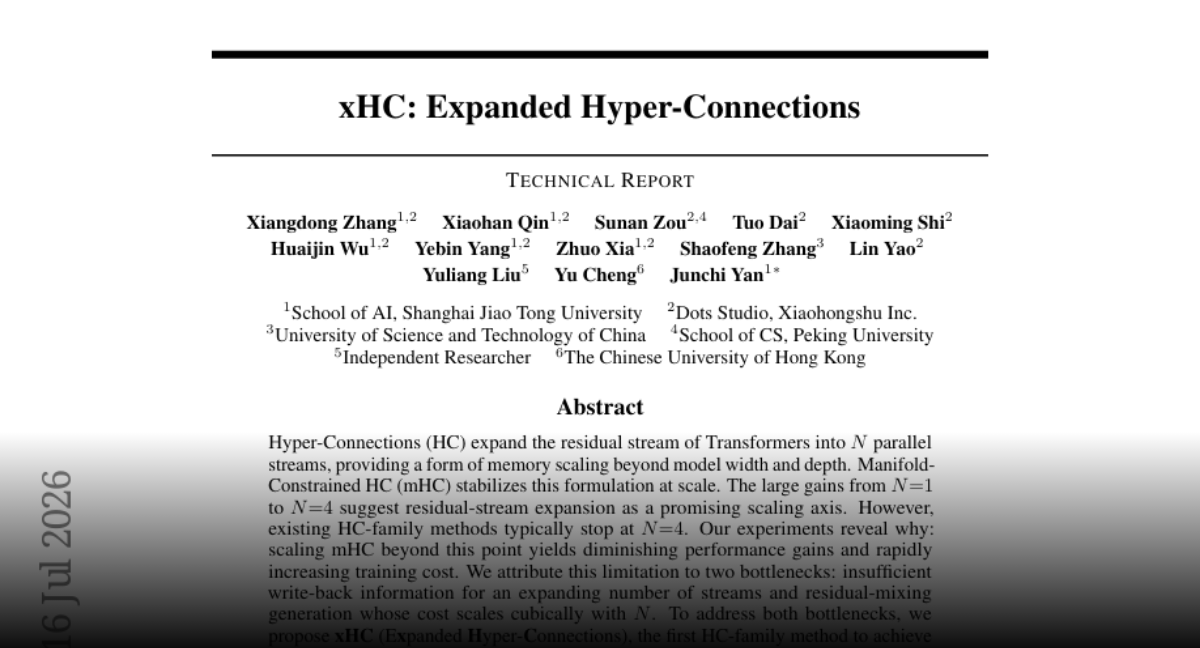
on an 18B MoE model, xHC improves the average downstream score by 4.0 points over mHC, while adding only modest training FLOPs over the vanilla baseline.
scaling-law experiments show that the vanilla and mHC require 1.50times and 1.19times the compute of xHC, respectively, to reach the same loss.
xHC improves the average downstream score by 4.0 points on an 18B MoE model compared to the previous mHC method while adding minimal training FLOPs over the vanilla baseline. This new architecture addresses the limitations of Hyper-Connections (HC) which typically fail to scale beyond four parallel streams due to cubic costs and insufficient information write-back. By combining temporal feature augmentation with a sparse residual-stream update mechanism, xHC successfully expands to 16 streams while only updating four at a time. Scaling-law analysis demonstrates that vanilla models and mHC require 1.50x and 1.19x more compute, respectively, to achieve the same loss as xHC. To ensure practical implementation, the authors introduced xHC-Flash to reduce per-sublayer memory traffic from 73.5C to 40C, which is comparable to previous smaller-scale methods. These advancements make large-scale residual-stream expansion a viable and efficient axis for scaling Large Language Models.
Source: HuggingFace Papers
Developer Tools and Infrastructure
The most discussed tool changes were practical rather than theatrical: Codex exposed a smaller model context limit, Claude Code quietly moved to a Rust-based runtime, and BaseRT claimed large Apple Silicon inference gains. Together they show how context, startup time and local speed shape daily AI work.
OpenAI Codex Metadata Lowers Model Context from 372k to 272k Tokens
"context_window": 272000
"auto_compact_token_limit": 245000
An OpenAI Codex repository update changed bundled model metadata from a 372,000-token context window to 272,000 tokens, with automatic compaction set at 245,000. The merged change drew more than 100 points and dozens of comments on Hacker News within the day. For developers working across large repositories, the practical effect is that long sessions may compact earlier and require more deliberate file selection or summaries. The change is metadata, not evidence that every previously accepted request now fails at the same boundary, but it matters because tools often design their behavior around these advertised limits. The discussion is a useful reminder that model capacity exposed through products can change independently of model branding.
Source: OpenAI Codex
Claude Code Quietly Moves to the Rust Rewrite of Bun
Startup got 10% faster on Linux but otherwise, barely anyone noticed. Boring is good.
Claude Code version 2.1.181 and later use the Rust rewrite of the Bun runtime, according to Bun creator Jarred Sumner. Simon Willison independently inspected his installed Claude binary and found a Bun 1.4.0 identifier plus hundreds of Rust source paths, supporting the claim that the runtime is already shipping to users. The story became one of Hacker News' most active discussions of the day. Its significance is less about language rivalry than deployment discipline: a major coding agent changed a core runtime, improved Linux startup by about 10%, and did so without disrupting everyday workflows. That is exactly what stable infrastructure work is supposed to look like.
Source: Simon Willison
BaseRT: High-Performance LLM Runtime for Apple Silicon
6.4x faster than llama.cpp, 3.9x faster than MLX
Fastest LLM runtime on Apple Silicon
BaseRT delivers a performance increase of 6.4x compared to llama.cpp and 3.9x compared to Apple's MLX framework on Silicon hardware. This high-speed inference engine is specifically designed to optimize local large language model execution on Mac devices. By achieving these benchmark results, the tool significantly reduces latency and improves the throughput of AI applications running on consumer-grade hardware. Developers can leverage this runtime to build more responsive local AI agents and chat interfaces without relying on cloud resources. The efficiency gains demonstrate the potential for further hardware-specific software optimizations in the evolving AI infrastructure landscape. As local computing power becomes increasingly important for privacy and offline usage, tools like BaseRT set new standards for what is achievable on edge devices. This advancement ensures that Apple Silicon users have access to the most efficient LLM deployment environment currently available.
Source: Product Hunt
This report is auto-generated by WindFlash AI based on public AI news from the past 48 hours.