Thursday, July 16, 2026 · 10 curated articles
Editor's Picks
The clearest signal today is not that AI has suddenly become autonomous. It is that autonomy is being assembled one layer at a time. Ring-Zero explores what changes when zero reinforcement learning reaches one trillion parameters. Grok Build turns a coding model into an open terminal runtime that can inspect files, run commands, and work headlessly. NVIDIA’s autoresearch workflow extends the same idea into long-running machine-learning experiments. These are different projects, but they all move the useful unit of AI from an answer toward a managed process.
That distinction matters because capability and independence are not the same thing. Ring-Zero reports stronger sample efficiency and emergent behaviors such as self-verification at scale, but it does not demonstrate a system choosing its own research goals. Anthropic’s account of AI-assisted development makes the boundary explicit: models are increasingly strong at executing a defined experiment, while larger gaps remain in deciding which goals deserve attention. The near-term engineering challenge is therefore less dramatic and more practical—how to specify work, observe it, test it, and stop it when assumptions change.
Grok Build and FlutterFlow Campus show where that challenge will land. One exposes agent actions in a terminal and supports headless workflows; the other puts humans and agents into a shared visual project space. The interface may change, but the durable advantage is the same: clear permissions, inspectable work, and human ownership of consequential decisions. The lawsuit brought by 26 Meta employees adds urgency outside software development. The plaintiffs allege AI-assisted scoring disadvantaged workers on protected leave, while Meta denies that AI made workforce decisions. Whatever the court decides, the case shows why automated processes need an appeal path when they affect people.
Today’s report is best read as a shift from model watching to system design. Bigger reasoning models, searchable generators, coding agents, and 3D creation tools are all becoming components inside workflows. The valuable skill is not merely prompting them or surrendering the work to them. It is building a process in which the model’s speed remains visible, bounded, and correctable.
Emerging Tech
Emerging Tech explores the groundbreaking innovations and strategic shifts that are currently redefining the global digital landscape. This sector highlights advancements in fintech, artificial intelligence, and infrastructure that challenge traditional market norms through significant consolidations and technological breakthroughs. As industry giants pursue unprecedented partnerships and acquisitions, these developments illustrate the rapid evolution of commerce and the foundational technologies that will power the future of the global business ecosystem.
Stripe and Advent International Bid $53 Billion to Acquire PayPal
Stripe and private equity firm Advent International have made a joint offer to acquire PayPal Holdings Inc (PYPL.O)
The offer, submitted earlier this month, is backed by about $50 billion in committed financing from banks
Stripe and private equity firm Advent International have submitted a joint $60.50 per share offer to acquire PayPal Holdings Inc., valuing the payments giant at more than $53 billion. Backed by $50 billion in bank financing, the proposal represents a 28% premium over PayPal's recent closing price and would result in Stripe and Advent holding equal ownership stakes. A merger would create a global payments powerhouse processing approximately $3.7 trillion in annual volume by combining Stripe’s merchant-centric infrastructure with PayPal’s base of 430 million consumer accounts and Venmo. This move follows years of declining market value for PayPal, which saw its capitalization drop from a peak of $360 billion in 2021 to roughly $36 billion earlier this year. While PayPal has yet to officially respond, analysts suggest the offer may be an opening salvo that could potentially reach $70 per share as the companies seek to consolidate the digital payments landscape.
Source: Hacker News

Research
Explore the cutting edge of artificial intelligence through the latest breakthroughs in model scaling, reasoning, and multimodal generation. This section highlights Ring-Zero’s massive reinforcement learning expansion to one trillion parameters and NVIDIA’s insights into reasoning benchmarks. Additionally, we examine how agentic search frameworks like SearchGen are redefining the boundaries of visual synthesis. These papers represent the forefront of optimizing model performance and intelligence through innovative training architectures and search-based evolution.
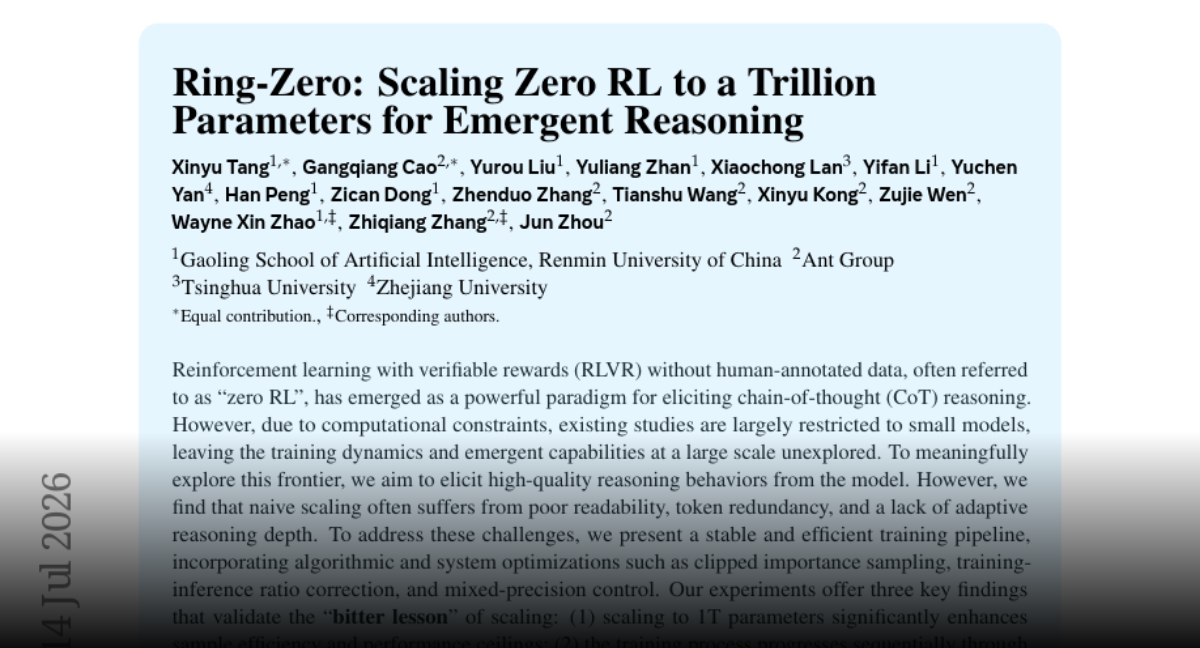
Ring-Zero: Scaling Zero Reinforcement Learning to 1 Trillion Parameters
scaling to 1T parameters significantly enhances sample efficiency and performance ceilings
the model spontaneously develops advanced cognitive behaviors, including anthropomorphism, structured formatting, self-verification
Scaling reinforcement learning to a trillion parameters significantly enhances sample efficiency and performance ceilings while eliciting advanced cognitive behaviors such as self-verification and parallel reasoning. The Ring-Zero framework addresses common scaling issues like token redundancy and poor readability through optimized training pipelines involving clipped importance sampling and mixed-precision control. Experiments demonstrate that the training process for large-scale Zero RL progresses through distinct discovery and sharpening phases, eventually making hand-crafted heuristics redundant. The resulting model, Ring-2.5-1T-Zero, achieves competitive results across seven mathematical benchmarks while producing more structured and concise reasoning traces than smaller counterparts. Researchers also introduced a new evaluation framework to measure Chain-of-Thought quality across comprehensibility, reproducibility, and efficiency. This work validates the "bitter lesson" of scaling, showing that massive model size facilitates the spontaneous development of complex reasoning capabilities.
Source: HuggingFace Papers
Evolving Knowledge Boundaries in Agentic Visual Generation with SearchGen
frontier open generators score only 21 to 28 out of 100, a 40-point collapse invisible to existing benchmarks
we show that it is discoverable through a teach-then-search co-training framework
Frontier open generators score significantly lower on the new SearchGen-Bench, achieving only 21 to 28 out of 100 due to a world-knowledge bottleneck. This performance gap reveals a 40-point collapse invisible to existing benchmarks, highlighting the inability of fixed-corpus models to handle long-tail requests like trending entities or post-cutoff events. To address this, the SearchGen-20K dataset and SearchGen-Corpus-1M are introduced to support offline, reproducible research in tool-augmented generation. The proposed teach-then-search co-training framework helps models identify their specific knowledge boundaries, distinguishing between internal training data and necessary external search context. This approach enables monotonic improvements in visual grounding, allowing generators to meet world-knowledge-grounded requests more accurately through recursive self-improvement.
Source: HuggingFace Papers

Lessons from the NVIDIA Nemotron Reasoning Challenge
more than 5,000 active participants across 4,000 teams had generated thousands of
The NVIDIA Nemotron Model Reasoning Challenge invited the Kaggle community to explore a focused question
More than 5,000 active participants across 4,000 teams joined the NVIDIA Nemotron Model Reasoning Challenge to enhance AI reasoning accuracy. This initiative specifically invited the Kaggle community to explore diverse techniques for improving model performance while adhering to strictly identical open models, benchmarks, and infrastructure constraints. The massive response from the global data science community resulted in the generation of thousands of potential solutions and unique insights into effective reasoning methodologies. By standardizing the development environment, the competition successfully highlighted how specific algorithmic adjustments and prompt engineering strategies can lead to measurable improvements in logical processing. Findings from the final leaderboard provide an incredibly rich dataset for understanding the current limits and possibilities of community-driven artificial intelligence development. These documented lessons are instrumental for researchers and developers looking to optimize complex reasoning capabilities in modern foundation models across various industrial applications.
Source: NVIDIA Generative AI Blog
Foundation Models
Foundation models serve as the bedrock of modern artificial intelligence, rapidly evolving from static processing tools into systems capable of sophisticated reasoning and autonomous refinement. Recent insights from industry leaders like Anthropic emphasize a pivotal shift toward recursive self-improvement without human intervention. Monitoring these architectural advancements is crucial for balancing immense computational potential with the necessary safety guardrails required to govern the next generation of autonomous AI development.
Anthropic Maps the Path—and Remaining Gap—to Self-Improving AI
AI is already accelerating the development of AI systems.
However, large performance gaps persist when it comes to Claude exercising judgement in choosing goals.
Anthropic argues that AI is already accelerating parts of AI development, citing gains in coding output and experiment execution inside the company. Its evidence does not show full recursive self-improvement today. Anthropic says Claude can execute well-specified experiments and increasingly handle open-ended engineering work, but meaningful gaps remain in judgment and goal selection. The company frames a future system that could design and train its own successor as a possibility that would make security, monitoring, and governance more important. That boundary is essential: rapid AI-assisted research is observable now, while a fully self-improving system remains a scenario rather than an accomplished fact.
Source: Anthropic
Developer Tools
This section covers the latest advancements in software development, focusing on tools that enhance coding efficiency and streamline workflows. With the rise of agentic AI, platforms like xAI’s Grok Build are redefining the developer experience by integrating intelligent assistants directly into the terminal. These innovations empower engineers to automate repetitive tasks and navigate complex codebases with greater precision. Stay informed about the evolving landscape of compilers, IDEs, and AI-driven utilities shaping modern engineering.
xAI Open Sources Grok Build Terminal-Based AI Coding Agent
Grok Build is SpaceXAI's terminal-based AI coding agent.
First-party code in this repository is licensed under the Apache License, Version 2.0
SpaceXAI has open-sourced Grok Build, a Rust-based terminal user interface (TUI) and agent runtime designed for interactive and headless AI coding tasks. The tool functions as a full-screen agent capable of understanding local codebases, performing file edits, executing shell commands, and conducting web searches. It supports various operational modes including a standalone interactive TUI, headless execution for CI/CD scripting, and integration into existing editors through the Agent Client Protocol (ACP). The repository contains the complete source code for components such as the agent runtime, tool implementations, and the workspace management system, all licensed under the Apache License 2.0. Developers can install the tool via prebuilt binaries for macOS, Linux, and Windows or build it directly from source using the Rust toolchain. This release also includes support for Model Context Protocol (MCP) servers and a modular plugin system for extending agent capabilities.
Source: Hacker News
AI Agents
AI agents are transforming digital workflows by evolving from simple task-fillers to autonomous systems capable of complex decision-making and collaborative research. Recent developments, such as reinforcement learning integration with NVIDIA NeMo and unified human-AI workspaces like FlutterFlow Campus, highlight a shift toward more sophisticated, multi-agent environments. These innovations enable higher productivity by streamlining automated research and fostering seamless interaction between human users and intelligent digital entities.
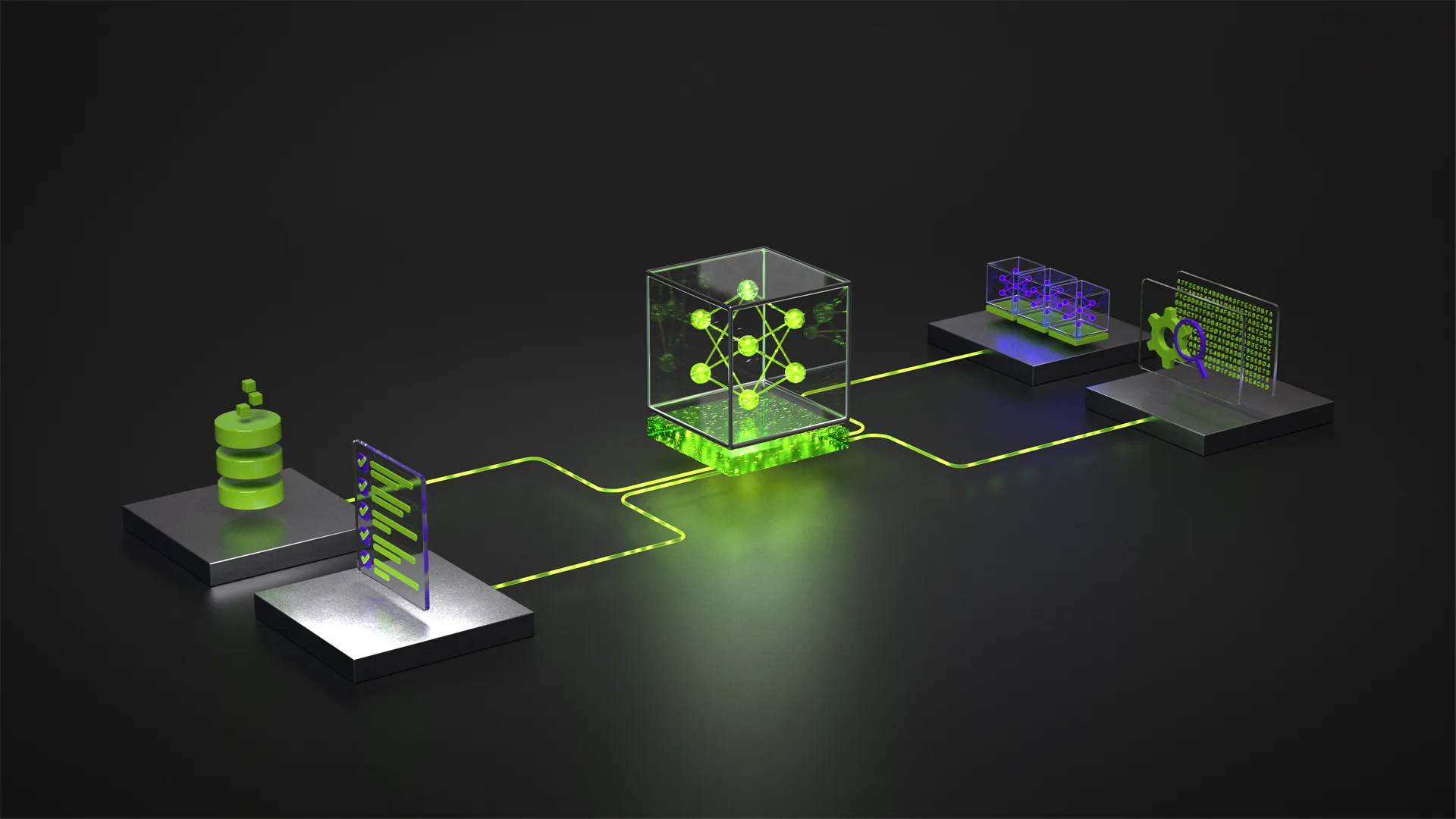
Autoresearch Workflows via RL Agent Skills and NVIDIA NeMo
Coding AI agents are becoming practical operators for long-running machine learning (ML) workflows.
They can inspect repositories, set up runtimes, resolve build issues, launch experiments, monitor execution, analyze metrics, and summarize results.
Coding AI agents are becoming practical operators for long-running machine learning workflows by automating tasks such as repository inspection and runtime setup. These systems possess the capability to resolve build issues, launch experiments, and monitor execution autonomously, which significantly reduces manual overhead. In the context of reinforcement learning research, these agents are particularly valuable because meaningful metrics often emerge only after complex experiment infrastructure is correctly established. By leveraging NVIDIA NeMo, researchers can deploy agents that analyze metrics and summarize results without constant human intervention. This shift toward automated research workflows enables more efficient handling of end-to-end ML tasks and experiment management. The integration of specialized skills allows these agents to navigate the complexities of modern machine learning development cycles effectively.
Source: NVIDIA Generative AI Blog

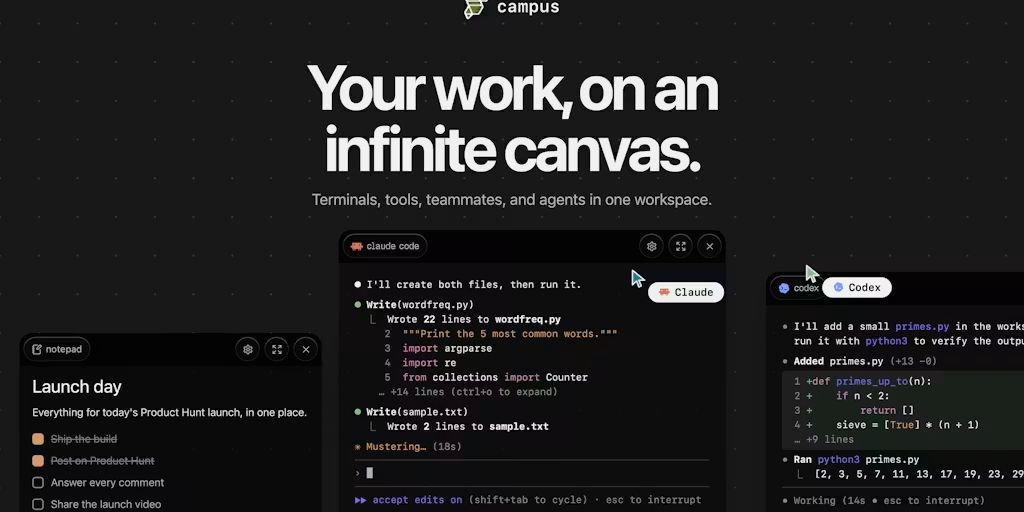
FlutterFlow Campus: A Collaborative Workspace for Humans and AI Agents
One project space for humans and AI agents
Create beautiful UI, generate clean code, and deploy to the app stores or web in one click.
FlutterFlow has launched Campus, a unified project space specifically engineered for collaborative workflows between humans and AI agents. The platform functions as a visual environment for building cross-platform mobile applications, enabling users to generate clean code and deploy to multiple stores with a single click. By introducing a shared workspace for agents and developers, the tool facilitates a more integrated approach to modern software engineering. This release represents the tenth iteration from the FlutterFlow team, building on their established reputation as a leading no-code app builder. The system provides extensive flexibility through custom code support, allowing sophisticated logic to be implemented alongside visual components. Ultimately, the integration of AI agents into the project space represents a shift towards agentic development environments within the low-code ecosystem.
Source: Product Hunt
AI Policy & Ethics
This category explores the complex landscape of artificial intelligence governance, focusing on the regulatory frameworks and moral dilemmas arising from rapid technological adoption. We analyze how organizations balance innovation with accountability, particularly regarding algorithmic fairness in labor practices and decision-making processes. As incidents like the Meta layoff allegations highlight, understanding the intersection of corporate policy and human rights is essential for shaping a future where AI serves society equitably and transparently.
26 Meta Employees Sue Over Alleged AI-Assisted Layoff Decisions
Workforce management and organizational decisions were and are made by people, not AI.
A group of 26 Meta employees has sued the company, alleging that internal AI systems, activity data, token-usage dashboards, and algorithm-assisted performance rankings contributed to layoff selections that disproportionately affected people on medical, parental, or family leave. The plaintiffs are among 8,000 workers Meta said it would lay off, but the lawsuit does not establish that all 8,000 were selected by AI. Meta rejects the allegations and says people, not AI, made workforce decisions. The dispute now turns on evidence about how automated scores entered the process and whether protected leave was properly accounted for. It is a concrete test of accountability when algorithmic tools inform decisions with legal and human consequences.
Source: Associated Press
AI Applications
Artificial Intelligence is revolutionizing professional workflows by automating complex tasks across creative and industrial sectors. This category highlights practical implementations of AI, such as V2Fun’s all-in-one platform for high-resolution 3D modeling, motion capture, and texture generation. These advanced tools empower creators to streamline production cycles while achieving unprecedented levels of detail and efficiency, effectively bridging the gap between conceptual imagination and high-quality digital realization.
V2Fun: Integrated AI Platform for 3D Modeling, 8K Textures, and Motion Capture
V2Fun is an AI 3D creation platform built with self-developed 3D modeling and AI motion capture models.
helps creators turn images, prompts, and videos into high-quality 3D models, enhance assets with advanced 8K texture generation
V2Fun is an integrated AI 3D creation platform utilizing proprietary 3D modeling and motion capture technology to transform images, text prompts, and video files into high-quality assets. The system streamlines the creative workflow by offering advanced 8K texture generation alongside built-in animation capabilities, removing the traditional requirement to switch between disparate software for modeling, texturing, and mocap. Users can leverage integrated image generation models such as Nano Banana to conceptualize visual ideas before immediately converting them into three-dimensional formats. This unified approach aims to accelerate the production pipeline for creators across the gaming, animation, and digital media industries. By centralizing the entire generation process, the platform simplifies the path from initial concept to a motion-ready character. The technology supports a wide range of inputs, ensuring flexibility for various artistic styles and technical requirements.
Source: Product Hunt
This report is auto-generated by WindFlash AI based on public AI news from the past 48 hours.