Wednesday, July 15, 2026 · 10 curated articles
Editor's Picks
The strongest community signal today is not simply that AI is getting smaller. It is that every form of efficiency moves a cost somewhere else. Bonsai 27B compresses 27B-class reasoning into 3.9GB, small enough for a high-end phone, with a 262K context window and structured tool calling. That is a genuine shift in intelligence density: less memory, less cloud dependence, and more private local execution. But once capable agents move onto personal devices and into everyday development tools, security boundaries that used to feel mundane become much more consequential.
The Cursor disclosure makes that trade-off concrete. Mindgard says a Windows project can place a malicious git.exe in its root and have Cursor execute it during ordinary repository loading, without a warning or click. The most disturbing part is not technical novelty; it is that the behavior allegedly remained after months of disclosure attempts. Visual Studio's new built-in agent skills and the task-aware agent research show why the issue matters beyond one IDE. We are giving development agents more structured abilities while asking them to use fewer tokens and less context. Efficiency without a trustworthy execution boundary is only faster exposure.
The human boundary is just as important. A widely discussed essay on cognitive offloading asks whether AI is automating tedious work or quietly replacing the act of forming judgment. That question belongs beside Bonsai and agent-efficiency research, not in a separate philosophical corner. A model that uses fewer bits is technically efficient. An agent that reads only what it needs is operationally efficient. But a system that saves ten minutes while weakening a person's understanding may be inefficient in the only sense that ultimately matters. The mature AI stack will need to budget memory, compute, security risk, and human agency together.
Foundation Models
This category explores the evolution of foundation models, focusing on balancing high performance with efficient deployment. Recent breakthroughs like the Bonsai 27B demonstrate how 1-bit and ternary weights enable large-scale models to run locally on mobile devices and laptops. Additionally, initiatives like the NVIDIA Nemotron Challenge highlight the growing importance of community-driven feedback and complex reasoning tasks in refining AI intelligence. These developments signal a shift toward more accessible yet powerful autonomous systems.
Bonsai 27B: High-Capability 1-Bit and Ternary Models for Mobile and Laptop Deployment
Everything is available today under the Apache 2.0 License.
Local execution changes the equation.
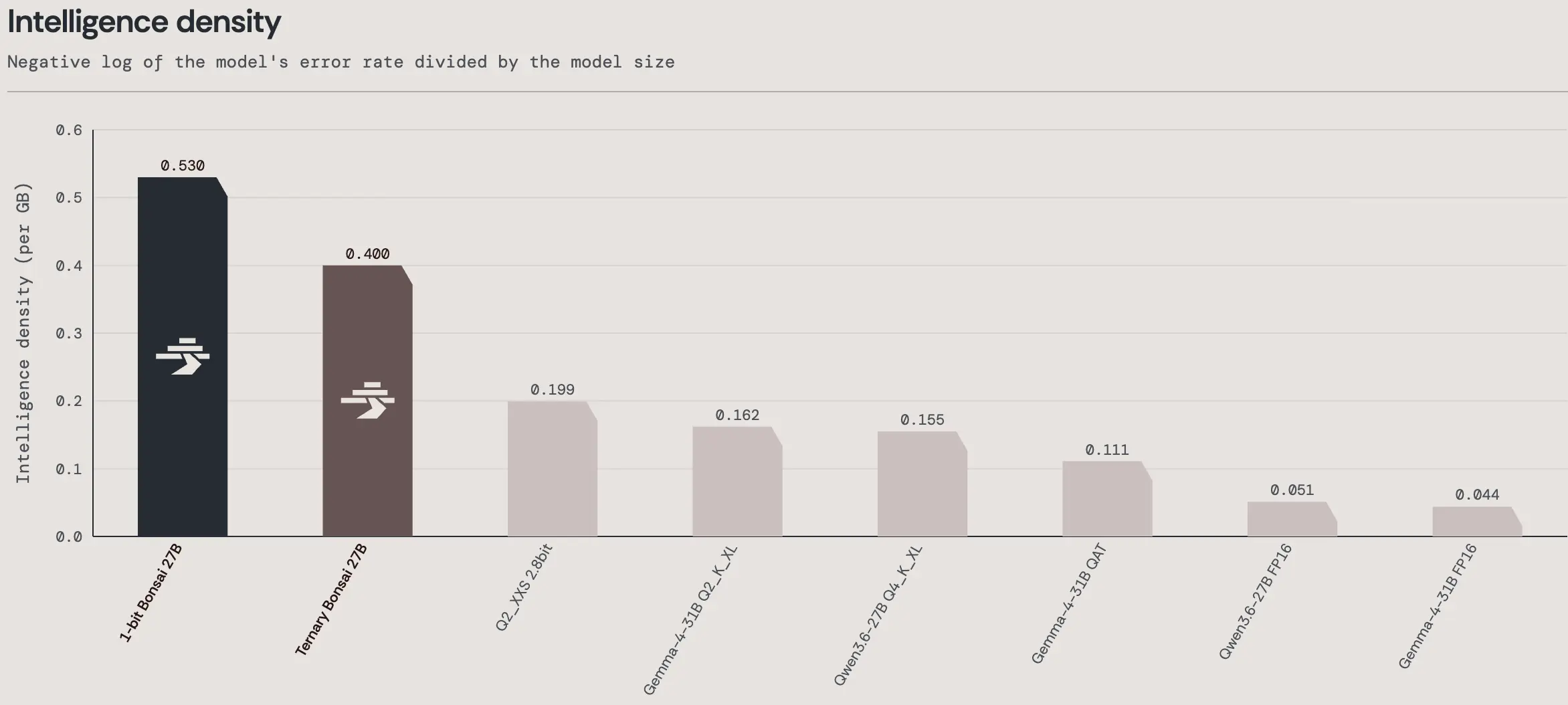
Bonsai 27B utilizes 1-bit and ternary quantization to shrink a 27B-parameter model, originally requiring 54GB, down to as little as 3.9GB. Built on the Qwen3.6 27B architecture, the release includes a Ternary variant at 5.9GB and a 1-bit variant at 3.9GB, the latter specifically designed to fit within the memory constraints of an iPhone 17 Pro. These models support sophisticated capabilities such as multi-step reasoning, structured tool calling, and a 262K-token context window without relying on higher-precision components for core network layers. Benchmark evaluations indicate that Ternary Bonsai 27B retains 95% of its full-precision baseline's performance, while the 1-bit version maintains 90% across coding, math, and vision tasks. By achieving an intelligence density of 0.53 per GB, the models demonstrate a significant Pareto shift, offering 27B-class performance at a footprint smaller than conventional 2B models. Both variants are available under the Apache 2.0 license and include a compact 4-bit vision tower for multimodal on-device workflows.
Source: Hacker News
Lessons from the NVIDIA Nemotron Challenge: Improving AI Reasoning with Kaggle
more than 5,000 active participants across 4,000 teams had generated thousands of
What techniques can improve reasoning accuracy when everyone starts from the same open model, benchmark, infrastructure and evaluation constraints?
More than 5,000 active participants across 4,000 teams competed in the NVIDIA Nemotron Model Reasoning Challenge to identify techniques for enhancing AI reasoning accuracy. The competition required all participants to start from the same open model, benchmark, and infrastructure, ensuring a level playing field for methodological innovation. Participants explored various optimization strategies within these strict evaluation constraints to push the boundaries of what open models can achieve. The massive response from the Kaggle community generated thousands of unique approaches to complex problem-solving. These findings provide critical insights into how standardized environments can foster rapid advancements in model performance and logical consistency. Ultimately, the challenge highlights the power of community-driven research in refining the reasoning capabilities of foundation models for real-world applications.
Source: NVIDIA Generative AI Blog
Research
Research today stretches from a cellular-resolution brainstem atlas to embodied navigation and the limits of video models. The common thread is structure: mapping biological systems precisely, separating cognition from control, and identifying where long causal chains break.
Indian Scientists Map Human Brainstem at Cellular Resolution in 3D
They have produced what they describe as the world's most detailed three-dimensional atlas of the human brainstem at cellular resolution
identifying more than 200 clusters of brain cells and nerve pathways. Eight chemical markers help distinguish different cell types
The Anchor atlas integrates over 500 tissue sections from fetal, childhood, and adult brains to produce the most detailed three-dimensional map of the human brainstem at cellular resolution. Developed by the Sudha Gopalakrishnan Brain Centre at IIT Madras, this digital map identifies more than 200 clusters of brain cells and nerve pathways using eight specific chemical markers. The project successfully bridges the gap between whole-brain medical imaging and high-resolution cellular pathology, allowing researchers to transition seamlessly from MRI scans to individual nerve cells. This breakthrough addresses a critical neuroscience gap, as the brainstem controls vital functions like breathing and heartbeat yet remains difficult to map due to its densely packed architecture. By utilizing high-resolution microscope images instead of costlier molecular techniques, the team has created an unprecedented resource for studying neurological disorders. This visionary program positions India as a major contributor to international neuroscience research and provides a new framework for understanding the human brain's complex landscape.
Source: Hacker News
ABot-N1: Toward a General Visual Language Navigation Foundation Model
boosting POI arrival by 35.0% (to 77.3%) and achieving 95.4%/92.9% SR in complex indoor and outdoor scenes.
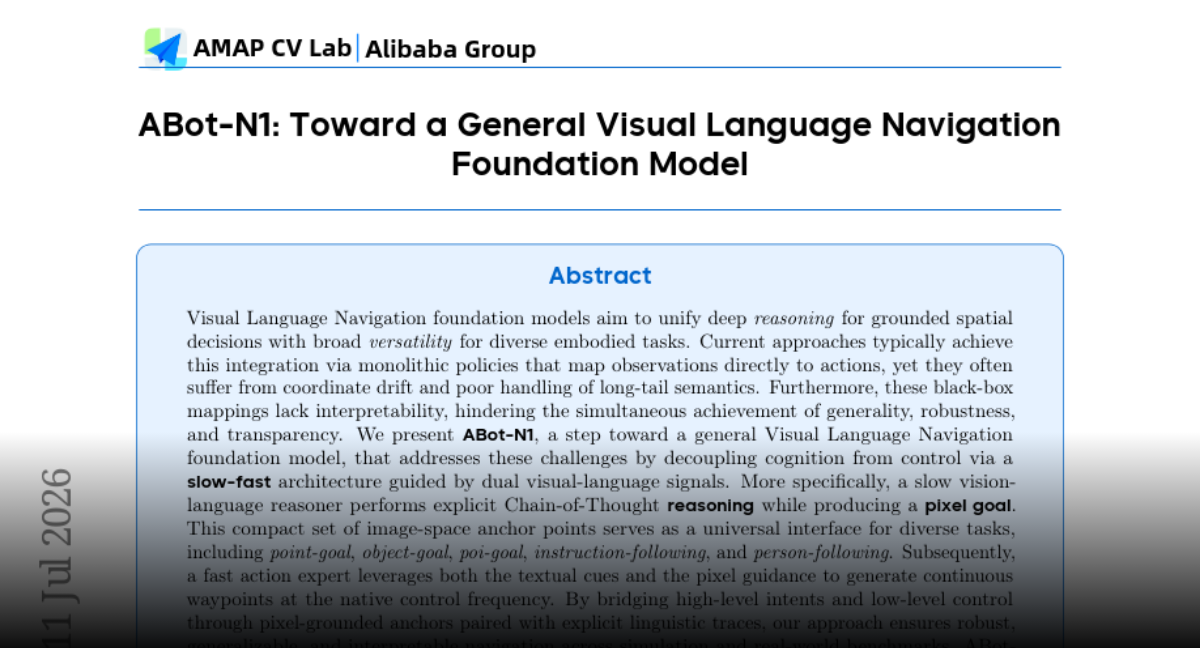
addresses these challenges by decoupling cognition from control via a slow-fast architecture guided by dual visual-language signals.
ABot-N1 establishes new state-of-the-art records in urban-scale navigation by boosting POI arrival rates by 35.0% to reach a total of 77.3%. The model addresses the inherent challenges of coordinate drift and poor long-tail semantics in traditional monolithic policies by decoupling cognition from control through a novel slow-fast architecture. This system utilizes a slow vision-language reasoner to perform explicit Chain-of-Thought reasoning, generating pixel-grounded anchor points that serve as a universal interface for diverse tasks. A secondary fast action expert then processes these visual and textual cues to produce continuous waypoints at native control frequencies. Beyond urban navigation, the architecture achieves high success rates of 95.4% and 92.9% in complex indoor and outdoor scenes, respectively. These results demonstrate significant improvements in robustness, generality, and interpretability across point-goal, object-goal, and instruction-following benchmarks in both simulation and real-world environments.
Source: HuggingFace Papers
The Seriality Gap: Why Video Diffusion Models Struggle with Long Causal Chains
performance of standard bidirectional video diffusion degrades as the causal chain lengthens
isolating dependent-event structure rather than video length as the cause
Performance in standard bidirectional video diffusion models degrades significantly as causal chains lengthen, particularly in scenarios involving complex multi-object interactions like hard-sphere dynamics. Controlled experiments using multi-ball collisions reveal that even providing more denoising steps fails to compensate for this performance drop as the sequence of events becomes more complex. In contrast, length-matched controls featuring a single ball without interactions show minimal degradation, isolating dependent-event structure rather than total video duration as the primary cause of failure. The research identifies a "seriality gap" where models struggle to compute the consequences of sequential events that depend heavily on previous outcomes. Intervention studies demonstrate that methods capable of increasing effective serial computation can mitigate these errors and improve predictive accuracy. This suggests that current diffusion architectures may require fundamental adjustments to better handle physical reasoning and long-term temporal dependencies in dynamic environments.
Source: ArXiv
Programming
Stay ahead with the latest advancements in software development, coding paradigms, and language-specific innovations. This category explores critical updates in systems programming, focusing on memory safety, formal verification, and performance optimization across diverse frameworks. From the implementation of rigorous cryptographic standards in languages like Rust to the evolution of cross-platform toolchains, we cover the essential breakthroughs that help developers build more secure, efficient, and reliable modern software ecosystems.
Verifying Rust Cryptography in SymCrypt: From Standards to Code
a new method helps verify code as developers write it while preserving speed and adaptability
Cryptographic code supports vital protections in modern computing systems.
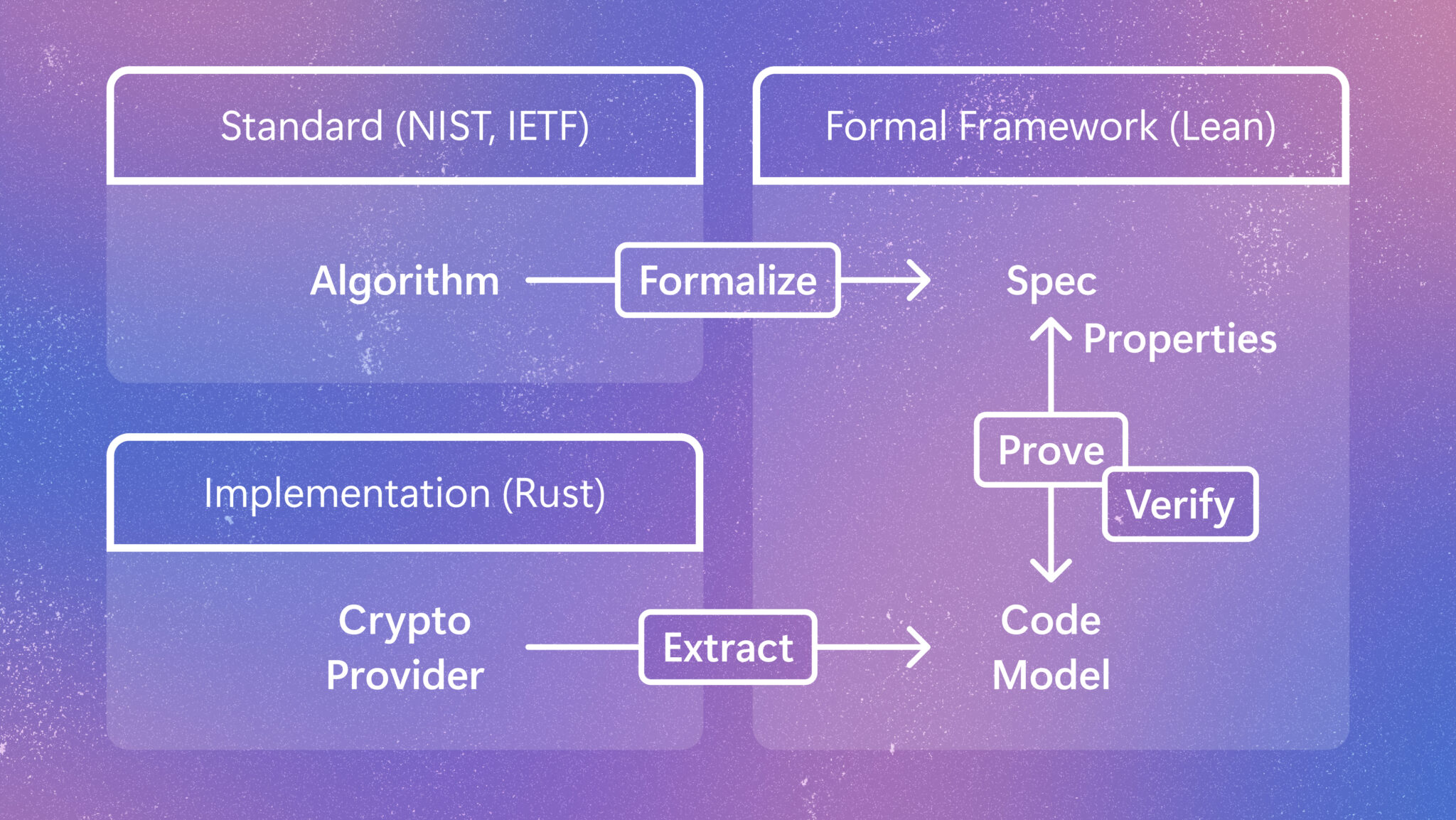
A new verification method for Rust cryptographic code enables developers to validate security properties in real-time during the implementation phase while maintaining high performance. This approach, applied to Microsoft's SymCrypt library, focuses on preserving the speed and adaptability required by modern computing systems as software evolves. By bridging the gap between high-level cryptographic standards and low-level source code, the technique ensures that implementations remain robust and correct. The research demonstrates how formal verification can be integrated into standard development workflows without sacrificing the execution efficiency expected from Rust. This advancement is particularly significant for protecting critical infrastructure against implementation-level vulnerabilities in security protocols. The resulting framework provides a scalable way to ensure correctness across diverse and complex cryptographic primitives used in production environments.
Source: Microsoft Research Blog (current)
AI Agents
AI agents are transitioning from simple command execution to sophisticated reasoning engines capable of autonomous decision-making across complex workflows. Recent developments emphasize improving operational efficiency through task-aware complexity estimation, allowing models to allocate computational resources more strategically based on problem difficulty. This category explores the latest breakthroughs in agentic frameworks, focusing on how adaptive reasoning and refined task evaluation enhance the scalability and performance of next-generation autonomous systems.
Improving AI Agent Efficiency via Task-Aware Complexity Estimation
LLM agents increasingly automate multi-step engineering and informatics workflows, yet they rarely ask how much effort a task actually requires.
They often follow a maximum-context-first strategy--re-reading files and dependencies they have already seen--turning a one-line edit into a small code-base audit.
Large language model (LLM) agents often follow a maximum-context-first strategy that turns minor one-line edits into exhaustive code-base audits due to a lack of effort estimation. This behavioral pattern creates significant computational waste by re-reading files and dependencies unnecessarily throughout multi-step engineering and informatics workflows. To address these inefficiencies, the research introduces the concept of task-aware execution-scope estimation to judge a task's true difficulty and information requirements before committing a computational budget. The framework formalizes two key concepts: minimum-sufficient execution and Agent Cognitive Redundancy, aimed at optimizing resource allocation. By identifying the shortest reliable path for task completion, these complexity-aware agents can avoid the overhead of over-analyzing simple tasks while maintaining precision for complex engineering requirements. This approach shifts the paradigm from brute-force context consumption toward budget-conscious reasoning and execution.
Source: ArXiv
Developer Tools
Developer tools are gaining more autonomous abilities, but the same week also delivered a warning: an agentic IDE is still an executable trust boundary, and old path-resolution mistakes can become silent code execution.
Cursor 0day Disclosure Turns Repository Loading Into a Security Boundary
If an attacker planted a malicious
git.exein the repository root, Cursor will execute it automatically.
More than 70 versions came and went.
Mindgard publicly disclosed a Windows vulnerability after saying seven months of private reporting produced no visible fix or user warning. Cursor searches several locations for Git when opening a project, and one is the workspace itself. A repository containing an attacker-controlled git.exe can therefore cause that file to run automatically under the current user's privileges, with no click or approval; the proof of concept used Windows Calculator and showed repeated execution. Mindgard says the issue was last verified on Cursor 3.2.16 on April 30, 2026, so the practical advice is narrow but urgent: treat untrusted repositories as executable content and open them only in an isolated environment until a fix is confirmed.
Source: Hacker News / Mindgard
Visual Studio Integrates Built-in Agent Skills for .NET and Azure
Visual Studio now includes built-in Agent Skills, created by experts from the .NET and Azure teams
Agent Skills are reusable capabilities that enable your agent to perform structured tasks more reliably
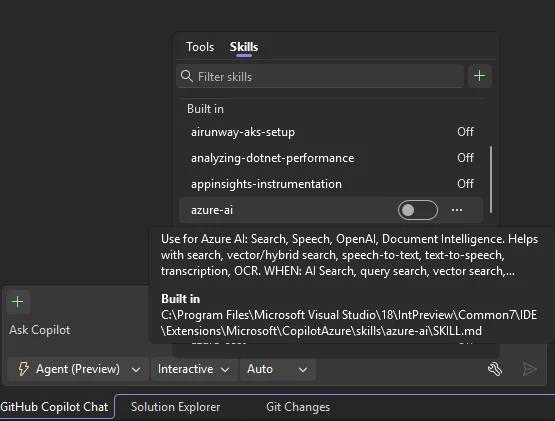
Visual Studio version 18.8 incorporates new built-in Agent Skills designed by the .NET and Azure engineering teams to streamline developer workflows. These skills provide reusable capabilities that allow AI agents to perform structured programming and deployment tasks with increased reliability. By integrating domain-specific expertise directly into the IDE, the update helps developers customize their agentic processes and complete complex tasks more efficiently. This addition marks a shift towards more autonomous and capable AI assistance within the Microsoft development ecosystem. The framework enables agents to move beyond simple text generation into performing actionable, expert-backed operations to enhance overall productivity. Developers can now leverage these specialized skills to automate infrastructure management and code optimization tasks seamlessly.
Source: Visual Studio Blog
AI & Society
As AI removes friction from work and learning, communities are asking whether it amplifies thought or replaces the struggle through which judgment is formed.
Are We Automating Tedious Work or Offloading Human Agency?
AI can support learning, but it can also produce an answer without teaching you how to arrive at it.
What are we automating? Human work or human agency?
An essay discussed on Hacker News draws a useful distinction between delegating drudgery and delegating the formation of one's own desires and opinions. Its strongest example comes from education: students can submit comprehensive AI answers and receive good grades without learning how to solve the problem. The author does not argue for rejecting automation; she describes a moving boundary between using AI to analyze self-collected data and letting it decide what questions or preferences matter. That boundary also applies to coding agents. The right test is not how much output a system produces, but whether the human can still explain, challenge, and own the result.
Source: Hacker News / Art Fish Intelligence
This report is curated by WindFlash AI from public reporting and community discussion published in the past 48 hours.