Tuesday, July 14, 2026 · 10 curated articles
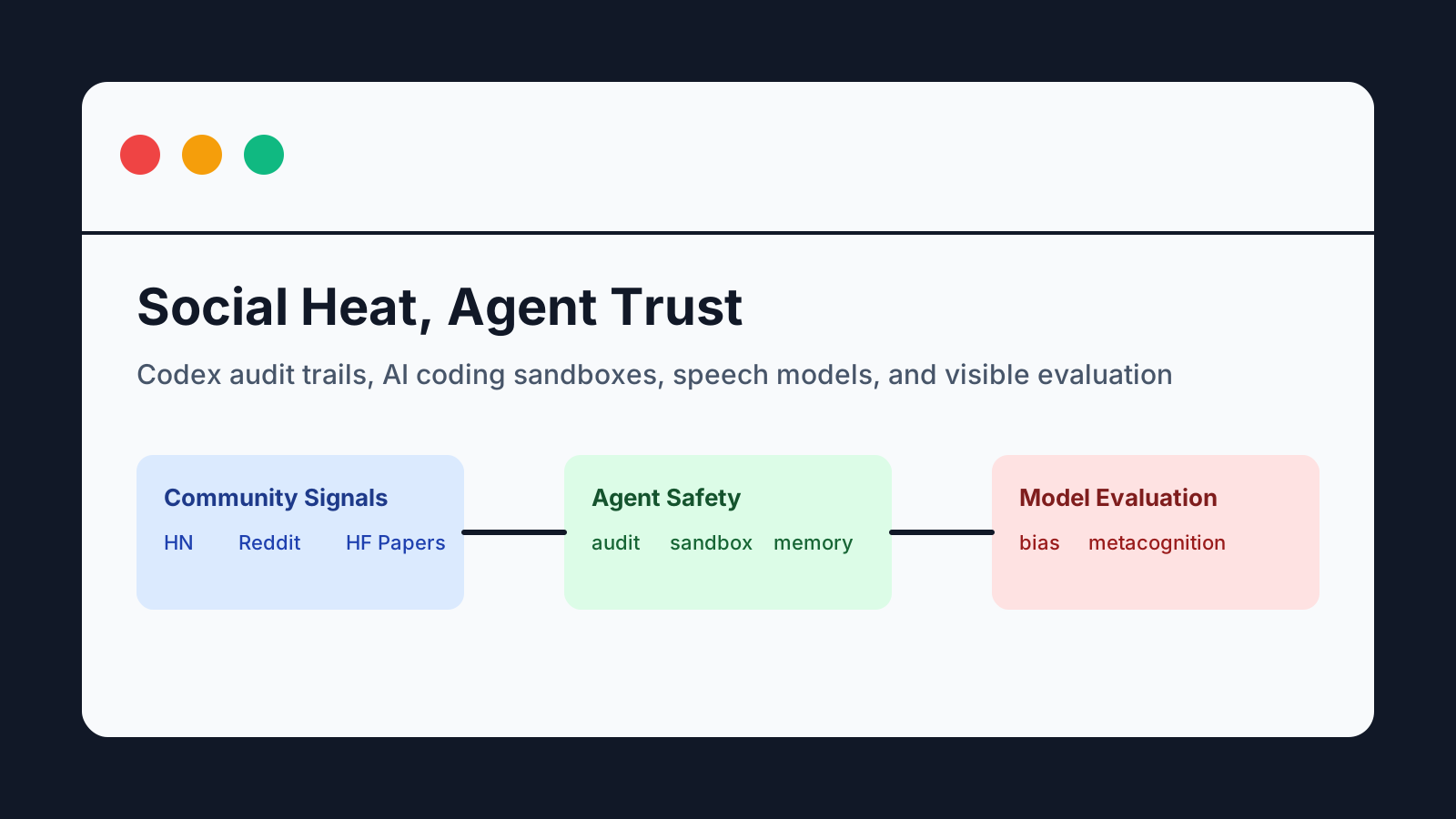
Editor's Picks
The sharpest AI signal today came from developer communities rather than launch stages: people are trying to decide how much of the new agent stack they can actually trust. A Hacker News thread pushed a GitHub issue about Codex sub-agent prompt encryption to the top of the social feed. The issue is not a complaint about encryption itself; it is a complaint that privacy hardening can erase the readable audit trail a user needs when reviewing what was delegated to a child agent. That is a very 2026 problem. The industry wants agents to work more independently, but every step toward autonomy raises a second question: who can reconstruct what happened after the work is done?
The same anxiety explains why Clawk resonated. Its pitch is simple: give the coding agent a disposable Linux machine, not your laptop. That framing turns agent safety from an abstract policy debate into an operating model. If tools can install packages, run tests, start servers, mutate files, and execute untrusted builds, then process-level permission prompts may not be enough. Developers are now asking for stronger boundaries, clearer logs, and environments that assume an agent may make a mess.
At the model layer, the day was less about raw scale and more about calibration. Apple's SpeechAnalyzer benchmark challenged Whisper's default status for English on-device transcription. Thinking Machines argued that useful AI should be shaped by local human judgment, not frozen centrally. Research papers on Direct-OPD, metacognition, agent operating systems, and LLM-as-judge bias all point in the same direction: the next wave of AI progress will be judged by how well systems expose their reasoning, learn from cheaper signals, preserve memory, and admit uncertainty. The hot topic is no longer simply whether AI can do more. It is whether people can inspect, steer, and trust what it does.
Developer Tools
Developer communities are moving from excitement about agent capability to practical questions about audit trails, isolation, and local control.
Codex Sub-Agent Prompt Encryption Sparks Auditability Debate
MultiAgentV2 agent task/message payloads opaque to Codex
The goal is not necessarily to revert encrypted delivery.
A GitHub issue in the OpenAI Codex repository became the strongest Hacker News signal in today's community pull. The issue argues that after the MultiAgentV2 encryption change, sub-agent task and message payloads can become unreadable in rollout history and parent-side audit surfaces. The concern is subtle but important: encrypted delivery can protect model-facing communication, while still leaving users without a readable record of what task was delegated, what message was sent, and why a child thread existed. The issue proposes keeping encryption for model delivery while preserving a separate human-readable audit copy. In practical terms, this is the auditability gap that appears once AI agents begin delegating work to other agents.
Source: Hacker News / GitHub Issue
Clawk Offers Disposable Linux VMs for AI Coding Agents
Give a coding agent its own disposable Linux machine, not yours.
Secrets stay on your machine.
Clawk landed on Hacker News with a concrete answer to the agent-safety problem: run Claude Code, Codex, or a shell inside a disposable Linux VM. The project's README says the agent gets a mounted repo, root access inside the guest, a restricted network, and no access to the user's keychain or unshared host files. That design matters because AI coding agents often need to install packages, run background services, execute tests, and handle untrusted project code. Clawk's model shifts the trust boundary from "please do not touch my laptop" to "this is the machine you are allowed to own." It reflects a broader developer mood: agents are becoming useful enough that people want stronger operational separation, not just better prompts.
Source: Hacker News / GitHub
Apple's SpeechAnalyzer Benchmark Challenges Whisper's Default Position
Apple's new SpeechAnalyzer is the most accurate on-device speech engine we tested.
It beat every Whisper model we ship, including Whisper Small.
An Inscribe benchmark compared Apple's new SpeechAnalyzer and SpeechTranscriber APIs against Whisper models on 5,559 LibriSpeech utterances. The headline result is eye-catching: SpeechAnalyzer reported 2.12 percent word error rate on clean speech and 4.56 percent on harder noisy speech, beating Whisper Small's 3.74 percent and 7.95 percent while running roughly three times faster than Whisper Small. The test also found that Apple's legacy SFSpeechRecognizer came last on clean speech. The benchmark is especially relevant because Apple did not publish accuracy figures for the new API, leaving developers to guess whether migration was worthwhile. For English transcription on current Apple hardware, the report argues that Whisper is no longer the automatic on-device default.
Source: Hacker News / Inscribe
AI Strategy
The social debate around AI companies is drifting from model power to ownership, human judgment, and whether centralized systems absorb too much user knowledge.
Thinking Machines Makes the Case for Human-Shaped AI
The mission of Thinking Machines is to build AI that extends human will and judgment.
Most AI in use today is trained in a handful of places and then frozen.
Thinking Machines' essay, amplified by Hacker News, argues that useful AI should not merely be trained centrally and deployed as a frozen product. The company frames AI as a tool that should extend human will and judgment, shaped by the local knowledge of people and organizations. The post emphasizes customizability, model-weight training, richer interfaces, and decentralized alignment. Its most interesting claim is that intelligence alone is not enough outside domains such as chess and math, because real work depends on tacit knowledge that lives inside teams and changes through practice. In the context of today's agent debates, this reads like a direct counterweight to one-size-fits-all AI: the question is not only how capable a model is, but who gets to shape it.
Source: Hacker News / Thinking Machines Lab
Reddit Turns Apple-vs-OpenAI Drama Into a Deepfake and Trust Thread
Apple vs OpenAI
deepfakes have come so far
A fast-moving r/OpenAI thread used an "Apple vs OpenAI" video post as a jumping-off point for jokes, lawsuit links, and debate over whether viewers were seeing a real clip or a deepfake. The thread mixed two social anxieties that now travel together: OpenAI's reported hardware ambitions and the rising difficulty of recognizing synthetic media at a glance. Commenters debated whether the clip used AI, whether Apple and OpenAI were really in conflict, and whether public research can be "stolen" in the same sense as code or trade secrets. The substance is messy, but the signal is clean: AI product strategy is now argued in public through memes, video artifacts, legal links, and trust questions.
Source: r/OpenAI
Research
Today's research cluster is about making models cheaper to improve, better at self-assessment, and more reliable as evaluators.
Direct-OPD Reuses Small-Model RL Signals for Stronger Students
Qwen3-1.7B from 48.3% to 58.3% on AIME 2024 in just 4 hours on 8 A100 GPUs.
The reusable outcome of an RL run is not only the final checkpoint.
Direct On-Policy Distillation proposes a cheaper route to improving strong models. Instead of running expensive reinforcement learning with verifiable rewards on every target model, the method runs RL on a smaller model and transfers the policy shift learned by comparing the weak model before and after RL. The arXiv paper reports that Direct-OPD boosted Qwen3-1.7B from 48.3 percent to 58.3 percent on AIME 2024 in four hours on eight A100 GPUs. A Hugging Face community note adds another striking example: a 7B student that started above the post-RL 1.5B teacher improved to 63.1 with Direct-OPD, while vanilla distillation made it worse. The broader idea is powerful: the useful artifact from an RL run may be the direction of improvement, not the final model itself.
Source: Hugging Face Papers / arXiv
Metacognition in LLMs Becomes a Research Program
Metacognition is a foundational component of intelligence
the first comprehensive overview of the current state of knowledge
A new arXiv survey frames metacognition as a core capability for more reliable AI systems. The paper argues that while LLMs have advanced across many tasks, researchers still lack a complete account of when models can monitor their own knowledge, evaluate uncertainty, revise strategy, and apply self-assessment to problem solving. The survey organizes methods and benchmarks for measuring metacognition, techniques for eliciting or improving it, and open questions for future work. This topic fits today's community mood because agent trust is not only about logs and sandboxes. It is also about whether the model can know when it is guessing, ask for help, or flag a weak answer before a human discovers the failure.
Source: arXiv cs.CL
LLM-as-Judge Bias Gets a Mechanistic Explanation
seven judges, seven bias types, and nine benchmarks
Reading bias as activation geometry
LLM-as-judge systems are now common in AI evaluation, but this paper argues that their biases can be understood inside model representations, not only by perturbing prompts and observing score changes. Across seven judges, seven bias types, and nine benchmarks, the authors report that biased inputs move hidden states along low-dimensional, type-specific subspaces. Steering along those subspaces can reproduce or reduce biased scoring, while random directions have much smaller effects. The practical implication is important for anyone using AI to grade AI: prompt fixes may not be enough. If judge failures have stable internal geometry, evaluation systems may need representation-level detection and control, not just better rubrics.
Source: arXiv cs.LG
AI Agents
Agent research is shifting toward long-horizon execution, persistent memory, and visual tool use under realistic conditions.
ABot-AgentOS Adds Persistent Multimodal Memory to Robotic Agents
a general robotic Agent Operating System
over 200 tasks involving navigation, object search, NPC dialogue, dynamic events, and trace-grounded scoring.
ABot-AgentOS proposes a general runtime layer for robotic agents, sitting above low-level controllers and adding scene-conditioned planning, skill execution, verification, multimodal memory, and edge-cloud collaboration. The paper also introduces EmbodiedWorldBench, with 16 scenes, four difficulty levels, and more than 200 tasks across navigation, object search, dialogue, dynamic events, and trace-grounded scoring. Its Universal Multi-modal Graph Memory converts dialogue, visual observations, spatial context, temporal relations, and task traces into typed graph nodes and edges. The reported memory benchmark scores suggest that persistent, auditable memory can improve long-horizon embodied execution. In plain language: the agent needs not only eyes and hands, but a structured memory of what it saw, did, and verified.
Source: Hugging Face Papers / arXiv
MM-ToolSandBox Shows Visual Tool-Calling Agents Still Struggle
stateful execution environment spanning 500+ tools across 16 application domains
even the best model achieves below 50% success rate.
MM-ToolSandBox evaluates visually grounded tool-calling agents in a stateful environment with more than 500 tools across 16 application domains. The benchmark includes multi-image and multi-turn tasks, goal revisions, error corrections, and changing state. The results are sobering: among 12 evaluated models, even the best model stayed below 50 percent success. The failure analysis found that 53 percent of failures came from incorrect information extraction from images, even when the task workflow was otherwise correct. This is a useful corrective to agent hype. Long-horizon planning matters, but visual precision can still break the entire chain.
Source: arXiv cs.CV
This report is auto-generated by WindFlash AI based on public AI news and community discussion from the past 48 hours.