Monday, July 13, 2026 · 10 curated articles
Editor's Picks
The clearest AI signals today came from social media and developer communities, where trust, efficiency, and useful reasoning mattered more than launch-day spectacle. The era of the 'magic black box' is ending, replaced by a dual-track evolution focusing on extreme architectural efficiency and the sobering reality of data sovereignty. Today’s landscape is no longer about throwing more compute at a problem; it’s about the surgical application of intelligence. This is exemplified by Mach-Mind-4-Flash, which manages to punch into the 100B-parameter class while activating a mere 3B parameters. This 17% training speedup via Multi-Teacher On-Policy Distillation signals a shift where the 'flash' models of the world are no longer just toys for low-latency tasks, but serious contenders for complex reasoning. For developers, the message is clear: the most valuable models in 2026 aren't the largest, but the most efficiently routed. We are moving toward a 'lean AI' stack where performance is measured by the ratio of reasoning capability to energy consumed.
However, this drive for efficiency and capability has a dark underbelly—the erosion of the developer’s local 'sanctum.' The analysis of xAI’s Grok Build CLI reveals a startling disregard for data privacy, effectively turning local development environments into data-harvesting telemetries. When a CLI tool exfiltrates unredacted .env files and entire 12 GB git bundles by default, we have moved past 'telemetry' into the realm of digital strip-mining. This behavior, occurring even when 'Improve the model' settings are disabled, poses an existential threat to corporate IP. It forces a reckoning for engineering leaders: as AI becomes more integrated into our terminal workflows, we must treat our CLI tools with the same zero-trust scrutiny we apply to third-party dependencies. The convenience of an 'AI-native' dev-loop is not worth the risk of leaking a firm’s entire version history to a cloud bucket named 'grok-code-session-traces.'
Looking ahead, the solution to this trust gap and the complexity of long-horizon tasks lies in the 'persistent memory' layer. While tools like Second Brain for AI v2 attempt to decentralize this context via the Model Context Protocol (MCP), the research from Yuji Tachikawa suggests that the true breakthrough occurs when the model finally 'clicks' on a six-month-old problem. We are seeing a move away from the 'one-step trap' toward models that can handle temporal abstractions. As we bridge the gap between 2D semiconductor hardware breakthroughs and high-level algorithmic refinement like HALO, the industry is pivoting. We are no longer just building better predictors; we are building systems that can reason through time, respect (or disrespect) our boundaries, and finally solve the problems that human experts couldn't crack alone.
Developer Tools
Explore the evolving landscape of developer tools, from AI-powered CLI utilities to integrated development environments that streamline complex workflows. This category covers significant updates in software engineering, including performance optimizations and critical security vulnerabilities that could compromise proprietary source code. As emerging tools like xAI’s Grok Build demonstrate, understanding the underlying mechanics and potential privacy risks is essential for maintaining a secure and efficient development pipeline for modern engineering teams.
Analysis of xAI’s Grok Build CLI Reveals Unredacted Secret and Repository Exfiltration
It transmits the contents of files it reads — including a .env secrets file — to xAI, verbatim and unredacted.
Grok packages the workspace and uploads it via POST /v1/storage. Proven directly: on a real codebase, with the prompt "reply OK, do not read any files", Grok uploaded the entire repo as a git bundle
xAI’s official Grok Build CLI (version 0.2.93) transmits unredacted file contents, including .env secrets, to xAI servers via a session state archive. A wire-level analysis demonstrates that the tool packages and uploads entire repositories as git bundles, including full history and files the AI agent was explicitly told not to read. Large-scale tests showed a 12 GB repository resulted in over 5 GB of data movement to a Google Cloud Storage bucket named grok-code-session-traces. These uploads occur by default even when users have disabled the "Improve the model" setting in their account preferences. The data collection mechanism is driven by a first-party Rust crate within the binary and lacks clear disclosure in standard installation or quickstart documentation. This behavior poses significant risks to sensitive intellectual property and credentials stored within local development environments.
Source: Hacker News
Research
Explore the cutting edge of scientific discovery and artificial intelligence methodology through these latest research highlights. This section covers foundational AI philosophies from industry pioneers alongside practical applications of large language models in solving complex physical problems. Stay informed on significant advancements in scalable visual pretraining and hybrid reasoning frameworks that enhance model efficiency. These updates provide essential insights into the evolving academic and industrial landscape driving the next generation of intelligent systems.
Rich Sutton on Avoiding the One-Step Trap in AI Research
The one-step errors compound and accumulate into large errors in the long-term predictions.
the computational complexity of computing a long-term prediction from one-step predictions is exponential in the length of the prediction
One-step world models in artificial intelligence research frequently fail because minor prediction inaccuracies compound exponentially when iterated for long-term forecasting. This phenomenon, known as the "one-step trap," assumes that a model of the world can be effectively "rolled out" similarly to a physics simulator to predict future consequences. However, in stochastic environments, the computational complexity of calculating these long-term predictions grows exponentially as the agent must account for a tree of possible future trajectories. This approach remains widely used in POMDPs and Bayesian analyses despite its inherent infeasibility for complex, real-world tasks. To address these limitations, researchers should adopt temporally abstract models utilizing options and General Value Functions (GVFs) rather than relying on granular step-by-step iterations. These high-level abstractions allow for more robust knowledge representation and avoid the error accumulation typical of granular transition models.
Source: Hacker News
Physicist Yuji Tachikawa Uses Claude Fable to Solve 6-Month Research Block
Claude Fable solved a problem that he and his collaborators had gotten stuck on for the past 6 months
Yuji Tachikawa, one of the world’s leading theoretical physicists
Theoretical physicist Yuji Tachikawa recently reported that the AI model Claude Fable successfully resolved a complex theoretical problem that had stymied his research team for six months. This breakthrough highlights the increasing proficiency of advanced large language models in assisting with high-level scientific discovery and complex mathematical reasoning. Tachikawa, recognized as a leader in his field, noted that the model provided a solution where multiple human experts had previously reached a standstill. This instance serves as a significant case study for the utility of frontier AI models in specialized, abstract research environments that demand precise logic. The success of the model suggests a shifting landscape in theoretical physics where AI-human collaboration can accelerate findings in areas once considered too difficult for automated tools. The integration of such technology into scientific workflows marks a pivotal step toward AI-driven academic advancement.
Source: r/singularity
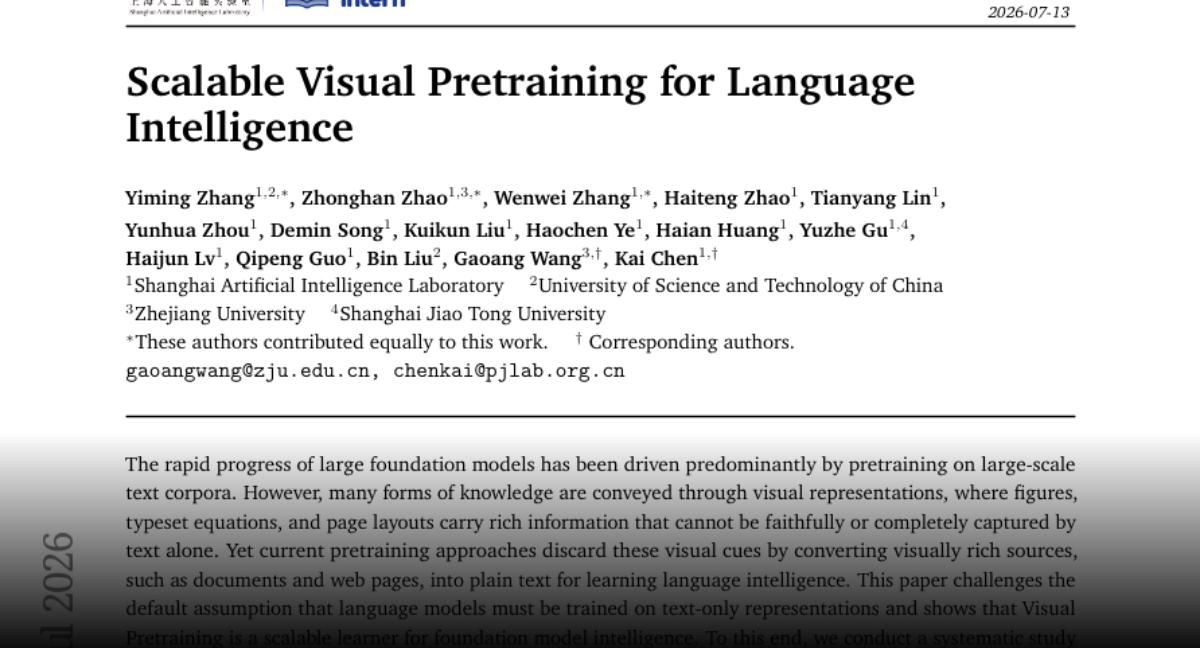
Scalable Visual Pretraining for Language Intelligence
figures, typeset equations, and page layouts carry rich information that cannot be faithfully or completely captured by text alone
current pretraining approaches discard these visual cues by converting visually rich sources, such as documents and web pages, into plain text
Large foundation model progress relies heavily on large-scale text corpora, yet many critical forms of knowledge reside in visual representations such as figures and page layouts. Current pretraining methodologies typically discard these visual cues by converting visually rich sources like documents and web pages into plain text, leading to a loss of contextual information. This research challenges the default assumption that language intelligence must be derived solely from text-based training protocols. By incorporating visual cues, models can capture typeset equations and complex formatting that text alone cannot faithfully represent. This approach aims to bridge the gap between pure language models and the visually structured information found in real-world documentation. Integrating visual pretraining allows for a more comprehensive understanding of human knowledge encoded in visual-spatial formats, potentially leading to more capable and intelligent foundation systems.
Source: HuggingFace Papers
HALO: Hybrid Adaptive Latent Reasoning for Efficient Language Model Refinement
HALO achieves the best overall average among the paper-facing methods, outperforming the frozen backbone, fixed-1, and fixed-2.
HALO reaches nearly the same token-accuracy level as fixed-2 while using fewer average applied refine steps than fixed-1
HALO achieves the highest overall average performance on MMLU-Pro and GPQA-Diamond benchmarks among compared methods by optimizing computational allocation for frozen pretrained language models. This hybrid adaptive latent-refinement method integrates a coarse refinement stage with a selective second-stage refinement triggered by token scoring and monotonic token halting. Unlike fixed refinement approaches that apply uniform computation across all sequences, this architecture dynamically decides where to apply extra processing steps based on token necessity. Internal analysis demonstrates that the system reaches token-accuracy levels comparable to fixed-2 models while utilizing fewer average refinement steps than even the fixed-1 baseline. By significantly reducing controller compute requirements while maintaining high accuracy, the framework suggests that intelligent allocation of refinement is more effective than simply increasing raw compute. This approach addresses the inefficiency inherent in adding fixed refinement steps to backbone hidden states.
Source: arXiv cs.CL
Foundation Models
Foundation models continue to evolve toward greater efficiency, with Mixture-of-Experts (MoE) architectures leading the charge in balancing performance and computational cost. Recent breakthroughs demonstrate that smaller, highly optimized models can now match the capabilities of dense 100B-parameter giants through sparse activation and advanced training techniques. This category tracks the latest releases and structural innovations shaping the next generation of large language models and multimodal systems.
Mach-Mind-4-Flash: A 35B MoE Model Matching 100B-Class Performance
Mach-Mind-4-Flash, a 35B-parameter Mixture-of-Experts (MoE) agentic model with 3B activated parameters.
HMPO, a single-stage token-efficiency method that compresses reasoning chains by 19--46% with no more than 0.7 percentage-point accuracy loss.
Mach-Mind-4-Flash is a 35B-parameter Mixture-of-Experts agentic model that utilizes only 3B activated parameters to match or exceed the performance of models in the 100B-parameter class. The training pipeline integrates a unified reinforcement learning and on-policy distillation infrastructure with dynamic multi-teacher scheduling, resulting in a 17% end-to-end training speedup. A key innovation, Multi-Teacher On-Policy Distillation (MOPD), uses a routed reverse-KL objective to fuse domain-specific experts while preventing the performance degradation often seen in mixed-reward RL. Furthermore, the model employs Hybrid Median-length Policy Optimization (HMPO) to compress reasoning chains by up to 46% with minimal impact on accuracy. Scoring 92.70 on AIME'26 and 75.80 on BFCL-v4, the model demonstrates significant efficiency gains for real-world agentic tasks. This approach achieves state-of-the-art results at a fraction of the inference cost associated with much larger dense models.
Source: arXiv cs.CL
Emerging Tech
This section explores groundbreaking advancements in foundational technologies that are set to redefine the future of industry and computing. Current highlights include China’s launch of the world’s first 2D semiconductor pilot production line, a critical step toward overcoming the physical limits of traditional silicon. By transitioning from laboratory concepts to scalable manufacturing, these emerging innovations represent a significant shift in global hardware development and material science capabilities.
China Establishes World's First 2D Semiconductor Pilot Production Line
China claims world’s first 2D semiconductor pilot production line
China has reportedly launched the world's first pilot production line dedicated to 2D semiconductors, marking a significant milestone in the global race for post-silicon electronics. These advanced materials, characterized by their atomic-scale thickness, offer superior electrical properties that could potentially overcome the physical limitations of traditional silicon-based chips at sub-nanometer nodes. The move signals China's strategic push to achieve self-sufficiency and technological leadership in the next generation of semiconductor manufacturing. By transitioning from laboratory research to a pilot production environment, the facility aims to bridge the gap between experimental breakthroughs and large-scale industrial application. This development could reshape the competitive landscape of the global chip industry, particularly as traditional Moore's Law scaling faces increasing challenges. The initiative underscores a broader trend of investing in alternative materials to sustain long-term growth in computing power and efficiency.
Source: r/singularity
AI Agents
AI agents are evolving from simple chatbots into sophisticated autonomous systems capable of executing complex, long-horizon tasks through improved reasoning and persistent memory. Recent developments emphasize enhancing creative workflows with interactive interfaces and establishing rigorous benchmarks to evaluate agent performance via dense reward structures. These advancements enable more reliable decision-making and multi-step planning, bridging the gap between theoretical models and practical, goal-oriented applications in diverse digital environments.
Long-Horizon-Terminal-Bench: A Dense Reward Benchmark for AI Agents
Long-Horizon-Terminal-Bench, a terminal benchmark of 46 long-horizon tasks spanning nine categories
existing terminal benchmarks largely focus on simple problems that finish within minutes and are evaluated only by their final outcome
Long-Horizon-Terminal-Bench incorporates 46 long-horizon tasks across nine categories to evaluate AI agents using dense reward-based grading instead of sparse final outcomes. Traditional terminal benchmarks predominantly focus on short-duration problems that conclude within minutes and rely solely on final outcomes for grading. Such sparse reward signals fail to capture intermediate progress or partial solutions, leading to an incomplete understanding of an agent's true operational capability. The new framework encompasses diverse domains including experiment reproduction, software engineering, multimodal analysis, interactive games, and scientific inquiry. By employing dense reward-based grading, the benchmark provides a more granular assessment of how agents navigate complex workflows over extended periods. This systematic approach aims to push the boundaries of autonomous agent performance beyond simple, well-specified tasks toward more sophisticated real-world applications.
Source: HuggingFace Papers

Miora: Scaling Creativity with Editable Canvas and Agent Memory
Scale your creativity on editable canvas with agent memory
Miora integrates an editable canvas interface with AI agent memory to streamline creative workflows and scale production capabilities for digital creators. The platform allows users to leverage persistent agent memory to maintain context across various design and content creation tasks over extended periods. By utilizing a spatial canvas environment, creators can organize visual and textual elements while interacting with AI agents that specifically remember previous iterations, style preferences, and user-defined instructions. This architectural integration aims to significantly reduce repetitive manual effort and foster more complex creative projects by providing a structured environment for advanced human-AI collaboration. Furthermore, the tool is strategically positioned within Product Hunt's categories for AI workflow automation and generative media, highlighting its utility in the modern design stack and the evolving landscape of creative technology.
Source: Product Hunt
Open Source
The open-source landscape continues to redefine software development by democratizing access to high-performance tools and collaborative frameworks. This category highlights innovative projects that empower developers to customize their workflows, such as persistent memory layers designed to enhance the long-term reasoning of popular AI models. By fostering transparency and community-driven improvement, these initiatives ensure that the next generation of technological breakthroughs remains accessible and adaptable for creators and organizations worldwide.
Second Brain for AI v2: Persistent Memory Layer for Claude, ChatGPT, and Cursor
It is a self-hosted memory layer that works with Claude, ChatGPT, Cursor, and any MCP client.
Built on Cloudflare, it offers a free tier and your data remains yours. MIT licensed.
Second Brain for AI v2 provides a self-hosted, MIT-licensed memory layer designed to eliminate the "start from zero" problem in AI conversations by persisting context across different tools. The system integrates seamlessly with major platforms like Claude, ChatGPT, and Cursor, as well as any client supporting the Model Context Protocol (MCP). Users can store project details, decisions, and preferences once and recall them via semantic search rather than keyword matching. Built on the Cloudflare ecosystem, the tool includes features such as duplicate detection and a dedicated web UI while offering a free tier for individual users. By decentralizing context storage, it ensures that personal data remains under the user's control rather than being trapped within specific AI chat histories. This release focuses on connecting dots across fragmented workflows to create a unified intelligence experience.
Source: Product Hunt
This report is auto-generated by WindFlash AI based on public AI news from the past 48 hours.