Sunday, July 12, 2026 · 10 curated articles
Editor's Picks
The most important shift today is not another leap in model size. It is the growing realization that useful AI depends on memory, control, and infrastructure. AgenticSTS shows why: an agent can perform better with structured memory while spending fewer tokens, directly challenging the assumption that a larger context window is always the answer. Block’s Goose makes the same argument at the product level. Developers increasingly want to choose where an agent runs, which model powers it, and what it is allowed to touch. Intelligence is becoming one interchangeable layer inside a larger system.
That system is increasingly constrained by physical reality. Meta plans to double its computing capacity while Gartner expects AI servers to consume more electricity than conventional data-center equipment by 2027. Hugging Face and AWS are reducing the friction between model discovery and production deployment, but easier deployment also means faster growth in demand for power, chips, cooling, and governance. The next phase of AI competition will be decided as much by operational discipline as by benchmark scores.
Institutions are responding. The Federal Reserve is formally studying AI’s effect on productivity and jobs, while CMS is positioning AI against one of the largest and most sensitive public-data environments in the United States. These moves signal that AI is leaving the innovation lab and entering systems where mistakes have economic and human consequences. The winners will not simply build the smartest model. They will build systems that remember the right things, expose meaningful controls, use infrastructure efficiently, and earn trust under real scrutiny.
AI Agents
Today’s agent news centers on a practical question: how can autonomous systems remain effective over long tasks without endlessly expanding prompts and costs? The strongest answers combine structured memory with user control over models, tools, and data.
Structured Memory Helps an AI Agent Beat Slay the Spire 2 with Fewer Tokens
Researchers behind AgenticSTS report that structured memory helped an AI agent complete the strategy game Slay the Spire 2 while reducing token use. The result matters beyond gaming because long-running agents often suffer from “context rot”: important facts become buried as conversation history expands. Instead of feeding the model an ever-growing transcript, the system preserves compact, task-relevant state that can be retrieved when needed. The experiment suggests that memory design may deliver more reliable planning than simply buying a larger context window. For builders, this points toward agents that summarize decisions, track goals, and maintain explicit world state rather than repeatedly rereading their full history.
Source: Creati.ai

Block’s Open-Source Goose Challenges the Economics of Coding Agents
Block’s Goose is attracting renewed attention as developers compare its local, open-source approach with paid coding agents such as Claude Code. Goose can edit files, execute commands, run tests, connect through MCP, and work with multiple hosted or local models. That flexibility separates the agent interface from the model provider and lets teams optimize for privacy, price, or deployment requirements. The trade-off is that local operation shifts cost into hardware, setup, and maintenance, while top proprietary models may still perform better on difficult work. Even so, Goose demonstrates that coding agents are becoming modular systems rather than tightly bundled subscriptions.
Source: Creati.ai

Nvidia’s NemoClaw Points Toward Governed Enterprise Agents
Nvidia’s NemoClaw is being framed as a sign that enterprise agents are moving beyond demonstrations into governed environments. The central promise is not merely autonomy, but the ability to place boundaries around what an agent can access and do. Enterprises need observable actions, controlled tool access, repeatable deployment, and clear responsibility when workflows fail. Nvidia’s involvement also highlights how agent platforms are converging with accelerated computing infrastructure. As agent adoption broadens, the competitive advantage may come less from a clever chat interface and more from providing a dependable operating layer for identity, permissions, monitoring, and model choice.
Source: TechRadar
Models & Open Source
Model releases remain important, but distribution and production access increasingly determine their real impact. The focus is shifting from a model announcement to the full path between experimentation and dependable use.
GPT-5.6 Sol Begins Rolling Out in ChatGPT
OpenAI has begun rolling out GPT-5.6 Sol to eligible paid ChatGPT users, describing it as its flagship reasoning model for coding, research, science, cybersecurity, computer use, and design. Availability varies by plan and managed workspace, and free users are not included in the initial Sol rollout. The release reinforces a broader trend toward models designed for multi-step professional work rather than isolated question answering. For teams, the practical questions now concern reliability across tools, cost, access policy, and the ability to supervise longer tasks. A stronger reasoning model matters most when the surrounding product can make its actions visible and recover safely from errors.
Source: OpenAI Model Release Notes

Hugging Face and AWS Shorten the Route from Model Hub to Production
Hugging Face and AWS have expanded their integration with a one-click handoff into SageMaker Studio and additional deployment support through HyperPod. The goal is to reduce the operational work between discovering a model and serving it at scale. This matters because many enterprise AI projects stall after promising prototypes: teams must still configure compute, permissions, observability, scaling, and inference endpoints. A tighter path between the Hugging Face ecosystem and AWS infrastructure lowers that barrier, especially for organizations already standardized on AWS. It also intensifies competition among cloud providers to become the default production home for open models.
Source: Creati.ai

AI Infrastructure
AI infrastructure is entering an era where custom silicon, power availability, and deployment efficiency matter as much as model quality. Capacity plans are becoming strategic commitments measured in gigawatts.
Meta Plans September Production for New AI Chip as Compute Doubles
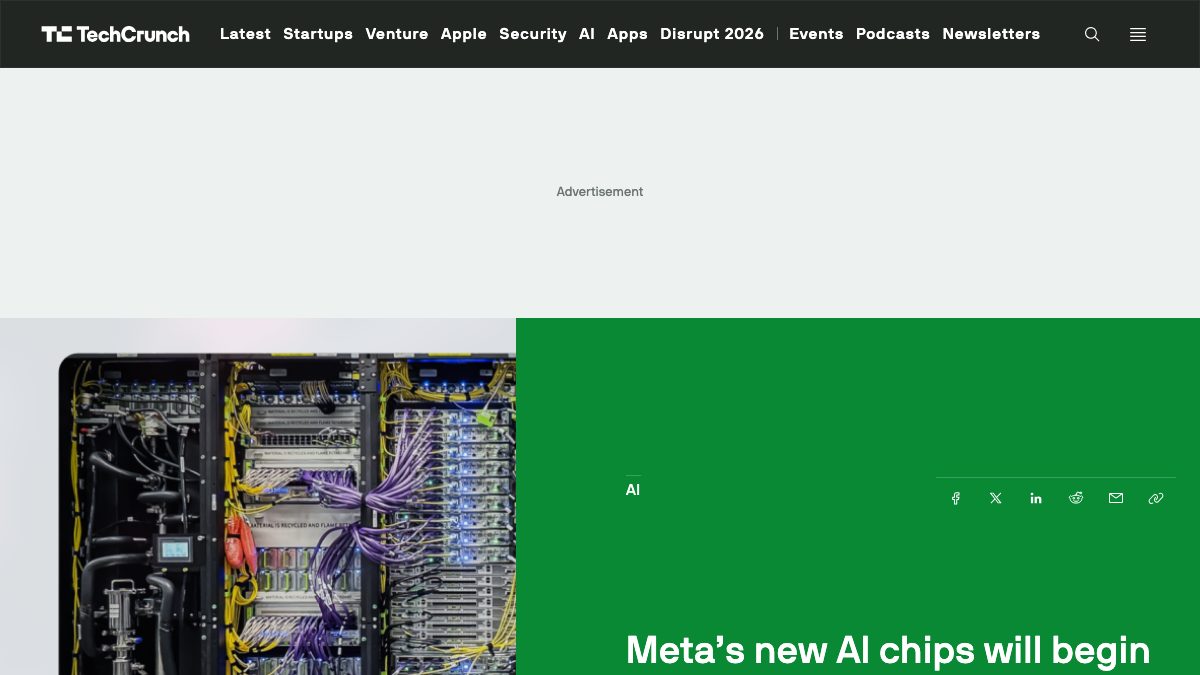
Meta plans to begin manufacturing a new in-house AI chip in September as it works toward roughly 14 gigawatts of computing capacity in 2027, about double its planned 2026 level. Custom silicon can reduce dependence on general-purpose accelerators and tune cost and power use for Meta’s own workloads. The scale of the plan shows that major AI companies are no longer treating infrastructure as a supporting expense; it is a core product capability and a long-term constraint. Execution will depend on manufacturing yield, software compatibility, data-center construction, and access to power, making the chip only one part of a much larger industrial program.
Source: TechCrunch
AI Servers Could Use More Power Than Conventional Data-Center Hardware by 2027
Gartner forecasts that AI servers will consume more electricity than all conventional data-center hardware combined by 2027, while global data-center electricity use is expected to rise sharply this year. The forecast turns energy efficiency from an environmental talking point into a direct capacity limit. Grid connections, cooling systems, power contracts, and regional permitting can now determine when AI services launch and how much they cost. Hardware and infrastructure teams will need to optimize utilization rather than assume new capacity can always be added. The most valuable efficiency gains may come from better scheduling, smaller fit-for-purpose models, improved cooling, and software that keeps expensive accelerators productively occupied.
Source: Tom's Hardware
Policy, Work & Society
AI is now being evaluated by institutions responsible for employment, public spending, and essential services. At the same time, workers are showing that adoption cannot be forced through technology alone.
Federal Reserve Creates a Task Force on AI, Productivity, and Jobs
The Federal Reserve’s Productivity and Jobs Task Force will assess how general-purpose technologies, including AI, affect employment, productivity, inflation, and the broader economy. Its leadership includes figures from technology, economics, and business, reflecting an effort to bring outside expertise into monetary-policy analysis. The initiative matters because AI’s economic effects remain difficult to measure: companies report productivity gains while workers face disruption, uneven adoption, and uncertain job redesign. Better evidence could help the Fed distinguish durable productivity improvements from short-lived investment booms. It also shows that AI has become relevant to the institutions shaping economy-wide policy, not only technology regulation.
Source: Federal Reserve

CMS Treats AI as Infrastructure for Serving 150 Million Americans
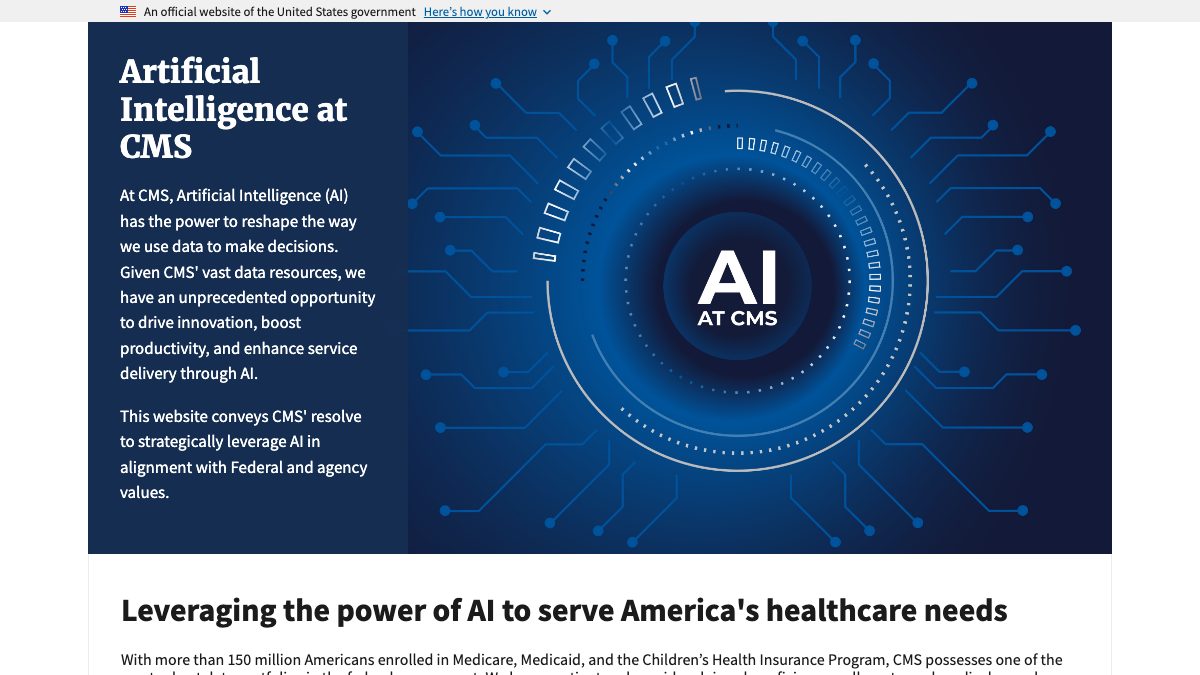
The Centers for Medicare & Medicaid Services is presenting AI as a way to improve services across programs covering more than 150 million people. CMS holds one of the federal government’s largest and most sensitive data portfolios, so any deployment must balance efficiency with privacy, security, fairness, and accountability. Potential uses range from administrative support and fraud detection to helping staff navigate complex policy and data. The scale makes CMS a crucial test of whether public-sector AI can produce measurable value without weakening public trust. Success will require careful human oversight, clear guidance, transparent evaluation, and strong controls over how health information is accessed and used.
Source: CMS Artificial Intelligence
Silicon Valley Workers Confront AI Fatigue and Resistance
Reporting from Silicon Valley describes growing anxiety and resistance among workers as companies accelerate AI adoption. Some employees question whether the tools improve their work, while others worry about job security, surveillance, and pressure to demonstrate constant AI use. The tension is a warning that adoption metrics can hide weak outcomes. Giving every employee access to an AI tool does not guarantee better decisions or more meaningful work. Organizations need to redesign workflows, explain how performance will be judged, and give workers a voice in implementation. Without that social layer, ambitious AI strategies can produce quiet resistance, wasted spending, and declining trust even when the underlying technology improves.
Source: Le Monde

This report is curated by WindFlash AI based on public AI news and primary sources from the past 48 hours.