Wednesday, July 8, 2026 · 10 curated articles
Editor's Picks
As we hit mid-summer 2026, the industry is finally admitting a hard truth: raw inference speed is no longer the primary bottleneck for the next generation of AI. We are shifting from the 'Age of Inference' to the 'Age of Orchestration.' This transition is most visible in the launch of the NVIDIA Vera CPU. For years, the industry obsessed over GPU FLOPs, but as agentic workflows become the standard, the latency hidden in the 'glue'—the CPU-managed tasks like tool calling, state management, and retrieval—has become the new enemy. NVIDIA’s pivot to optimizing the infrastructure between model steps is a clear signal to developers: stop optimizing for the model, and start optimizing for the workflow. If your agentic system is stalling, it's likely not the B200's fault; it's the architectural overhead of the 'thinking' process.
This architectural shift is mirrored at the edge with the emergence of local-first, persistent knowledge systems like Rowboat. For the developer community, Rowboat represents a necessary rebellion against the ephemeral nature of current chat interfaces. By moving away from on-demand context reconstruction to a permanent, local-first knowledge graph, we are seeing the birth of AI that actually 'remembers' in a way that is both useful and, crucially, private. This privacy aspect cannot be overstated, especially as we witness the EU's desperate, last-minute attempts to resurrect 'Chat Control' messaging surveillance. The tension is palpable: while regulators move to strip away the sanctity of the private message, the most innovative developer tools are moving in the opposite direction, toward hardened, local-first sovereignty.
Furthermore, we are seeing a massive leap in 'Spatial Intelligence' that goes beyond simple text-to-video. The research into Multiplayer Interactive World Models, specifically the real-time simulation of complex physics environments like Rocket League, proves that we are close to solving the 'physical coherence' problem that has plagued world models for years. When a 5-billion-parameter model can attribute specific scene changes to individual agents in a shared physics space at 20 FPS, the barrier between 'digital twin' and 'reality' dissolves. For engineers, this means the next frontier isn't just building smarter chatbots, but building systems that can reason through the physical consequences of their actions in a multi-agent world. The 'AI Factory' of 2026 is no longer just processing data; it is simulating reality to predict and execute the next best action.
AI Policy & Ethics
As artificial intelligence and digital communications evolve, global governments are increasingly grappling with the complex balance between public safety and individual privacy. This category examines the shifting landscape of AI regulations, focusing on the ethical implications of mass surveillance and automated content moderation. We explore how proposed legislative frameworks, such as the EU’s controversial surveillance initiatives, impact user rights and set precedents for the future of global digital governance.
EU Moves to Resurrect Expired Chat Control Messaging Surveillance Regulations
Regulation (EU) 2021/1232 creates a temporary exception to the ePrivacy Directive, giving providers a legal basis to voluntarily scan private messages
Because an expired regulation cannot be extended, the Council proposes a formally new law with identical content via an expedited procedure.
Regulation (EU) 2021/1232, known as Chat Control 1.0, provided a temporary legal basis for providers to voluntarily scan private messages for child sexual abuse material before expiring on April 4, 2026. Despite the European Parliament's rejection of an extension in March 2026, the EU Council moved in June 2026 to resurrect the expired law through an unprecedented expedited procedure. Concurrently, the permanent Chat Control 2.0 proposal remains deadlocked as the European Parliament maintains a protective mandate against scanning end-to-end encrypted services. Major technology providers including Google, Meta, and Microsoft have indicated they will continue scanning practices regardless of the legal expiration. The Council's current push involves a formally new law with identical content to the expired derogation, skipping responsible committees for a fast-track vote. This ongoing legislative battle highlights the fundamental tension between law enforcement's desire for access to encrypted communications and civil liberties protections for digital privacy.
Source: Hacker News
Research
This section highlights groundbreaking developments in AI research, ranging from multiplayer interactive world models for complex physics environments to standardized benchmarks for optimization algorithms. Recent studies introduce frameworks like OmniOpt for systematic optimizer evaluation and Lift3D-VLA for spatially-aware robotic manipulation. By bridging the gap between theoretical modeling and physical interaction, these papers pave the way for more robust, dynamic, and efficient artificial intelligence systems across diverse domains.
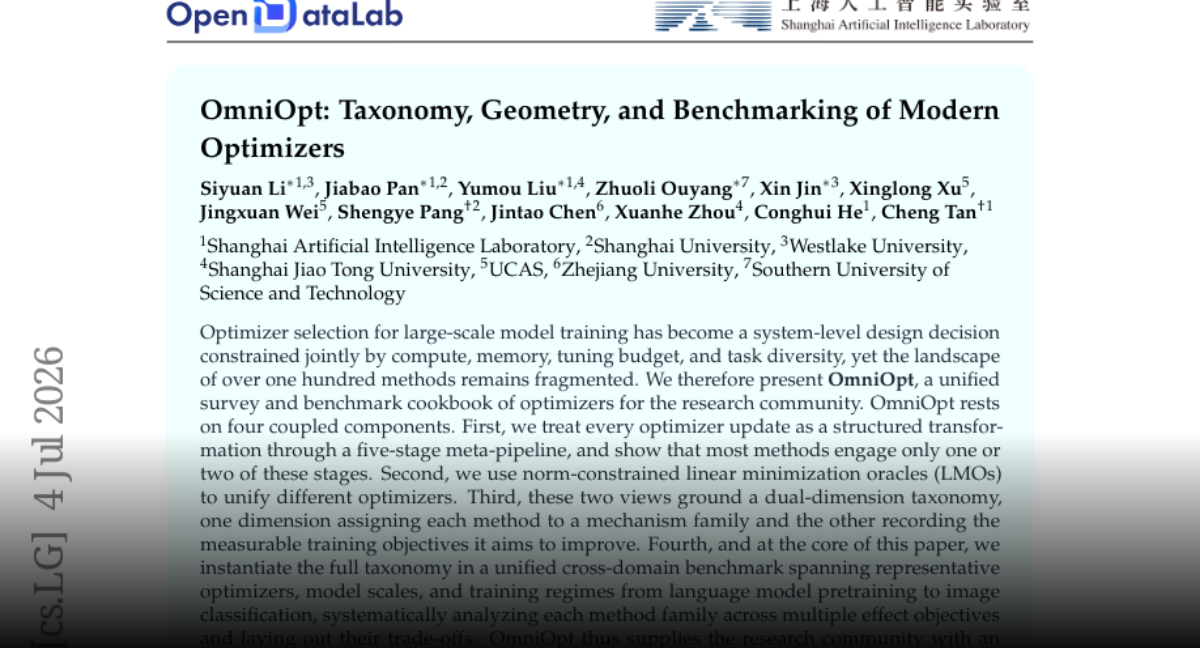
Multiplayer Interactive World Models for Dynamic Physics Environments
our 5-billion-parameter latent diffusion model generates four-player matches in real time, producing 20 frames per second on a single Nvidia B200 GPU.
Whereas single-player world models treat the other agents as part of the environment, ours conditions on the action streams of multiple agents
A 5-billion-parameter latent diffusion model trained on 10,000 hours of gameplay data enables real-time generation of four-player Rocket League matches at 20 frames per second on a single Nvidia B200 GPU. This research introduces the first multiplayer world model capable of conditioning on action streams from multiple agents simultaneously to maintain physical coherence. Unlike traditional single-player models that treat others as environment noise, this architecture learns to attribute specific scene changes to individual players. The model demonstrates remarkable stability, producing rollouts that remain distributionally consistent for over five minutes despite being trained only on short video clips. Systematic evaluations show that the system understands complex physical interactions and avoids collapse even during hour-long simulations. This work includes the release of a comprehensive dataset, training codebase, and live demo to support further development in interactive world modeling.
Source: HuggingFace Papers
OmniOpt: A Unified Taxonomy and Benchmark for Modern AI Optimizers
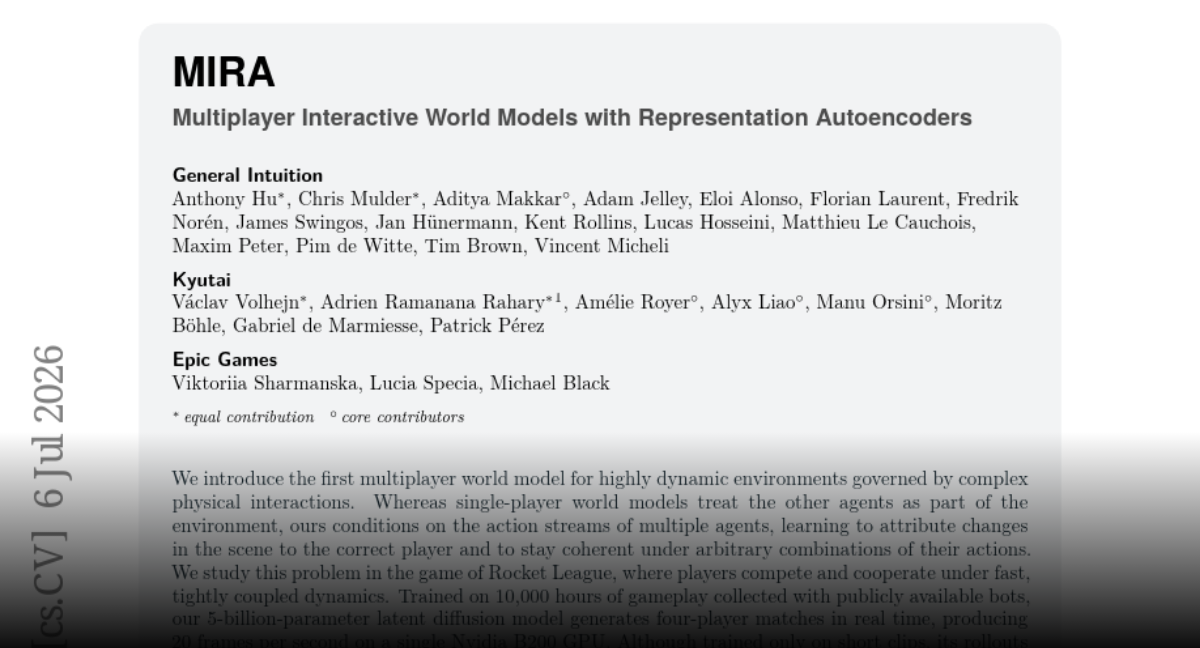
we treat every optimizer update as a structured transformation through a five-stage meta-pipeline
the landscape of over one hundred methods remains fragmented
OmniOpt treats every optimizer update as a structured transformation through a five-stage meta-pipeline to address the fragmentation of over one hundred existing optimization methods. This unified framework employs norm-constrained linear minimization oracles to unify different optimizers and establishes a dual-dimension taxonomy based on mechanism families and measurable training objectives. By instantiating this taxonomy in a comprehensive cross-domain benchmark, the research analyzes optimizer trade-offs across language model pretraining, image classification, and varying model scales. Findings reveal that most current methods only engage one or two stages of the five-stage pipeline, highlighting significant gaps in contemporary optimizer design. This operational coordinate system allows researchers to select optimizers under explicit mechanism and objective assumptions, moving beyond ad-hoc selection processes. The benchmark provides a systematic evaluation of how compute, memory, and tuning budgets interact with task diversity in large-scale model training environments, charting a new direction for future algorithmic development.
Source: HuggingFace Papers
Lift3D-VLA: A Unified Framework for 3D Geometry and Dynamics-Aware Manipulation
VLA approaches attempt to incorporate 3D information, they are constrained by limited data availability and geometric information loss
fail to jointly capture 3D geometry and temporally structured actions in dynamic environments
Vision-Language-Action (VLA) models face significant hurdles in physical environments due to limited 3D data availability and geometric information loss within existing encoding pipelines. The proposed Lift3D-VLA framework introduces a unified approach designed to capture both 3D geometry and temporally structured actions in dynamic settings. Current robotic manipulation systems often fail to reason spatially, which compromises their effectiveness in complex real-world tasks. This research addresses these deficiencies by lifting traditional VLA models into a more comprehensive 3D-aware architecture. By integrating spatial reasoning directly into the action pipeline, the framework aims to improve generalization across diverse robotic tasks. The work highlights the necessity of dynamics-aware manipulation to ensure reliable performance in environments that change over time, providing a more robust foundation for autonomous agents operating in the physical world.
Source: ArXiv
AI Applications
This category explores the rapidly evolving landscape of AI-powered software, highlighting innovative tools like Rowboat that prioritize user privacy through local-first architectures. We delve into open-source alternatives to mainstream platforms, offering insights into how these applications transform daily workflows and enhance productivity. From desktop assistants to collaborative environments, discover the latest advancements in practical AI implementations that empower users with greater control over their data and creative processes.
Rowboat: Open-Source Local-First AI Coworker and Claude Desktop Alternative
Rowboat indexes your work into a living knowledge graph and uses that to get work done on your machine.
everything lives on your machine as plain Markdown
Rowboat functions as a local-first desktop AI coworker that indexes work communications into a persistent knowledge graph rather than reconstructing context on demand. The platform integrates an email client, a built-in browser for collaborative web tasks, and a meeting note-taker that produces live transcripts. Users can deploy background agents to handle automated tasks like drafting emails or executing code via Claude Code and Codex integrations. Unlike standard chat apps, it stores all information on the user's machine as plain Markdown files, allowing context to accumulate and relationships to remain inspectable over time. The application supports cross-platform deployment on Mac, Windows, and Linux while offering extensibility through Model Context Protocol (MCP) servers and various API integrations. By maintaining long-lived knowledge, Rowboat enables users to build custom work surfaces that leverage deep historical context for improved productivity.
Source: Hacker News
Foundation Models
Foundation models are advancing through task unification and refined alignment strategies. The emergence of SenseNova-Vision signals a shift toward treating computer vision as a multimodal generation challenge, while innovations like Reverse DPO enable more precise control over model knowledge through selective unlearning. Additionally, the integration of diverse models like MiniMax into major cloud platforms like Amazon Bedrock highlights the expanding accessibility and maturing infrastructure supporting today’s global artificial intelligence ecosystem.
SenseNova-Vision: Formulating Computer Vision as Unified Multimodal Generation
We formulate computer vision as unified multimodal generation, where heterogeneous visual tasks are expressed in the native text and image generation spaces
SenseNova-Vision uses natural-language instructions and optional visual prompts to specify tasks, target regions or views
SenseNova-Vision reformulates computer vision tasks as unified multimodal generation by mapping heterogeneous visual requirements into native text and image generation spaces. This approach eliminates the need for task-specific architectures, instead utilizing natural-language instructions and optional visual prompts to define target regions or decoding conventions. The model generates diverse outputs including text for symbolic results, images for dense spatial predictions, and mixed-mode content for complex compositional tasks. To facilitate large-scale training, the system converts various computer vision datasets into a compatible format for unified processing. This unified formulation represents a significant shift toward general-purpose visual intelligence that leverages the flexibility of generative models. By integrating multiple modalities into a single framework, the research demonstrates a streamlined path for handling complex visual understanding and generation tasks simultaneously within a single model architecture.
Source: ArXiv
Selective Unlearning with Amazon Nova Using Reverse DPO
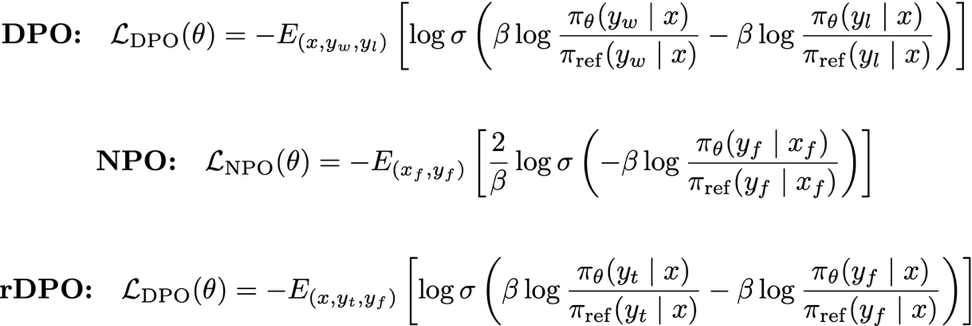
Reverse Direct Preference Optimization (rDPO), the novel unlearning technique behind Amazon Nova Customizable Content Moderation Settings (CCMS)
it reduces over-deflection while preserving model quality.
Reverse Direct Preference Optimization (rDPO) enables selective unlearning within Amazon Nova’s Customizable Content Moderation Settings (CCMS) to reduce over-deflection. This novel technique addresses the fundamental challenge of making models forget specific data points while maintaining high overall output quality. By applying preference optimization strategies, the system can more accurately distinguish between content requiring moderation and safe generation requests. The implementation allows developers to fine-tune moderation boundaries more effectively than standard fine-tuning methods. AWS provides specific pointers for customers interested in applying these preference optimization techniques to their proprietary machine learning experiments.
Source: AWS Machine Learning Blog
AWS Integrates MiniMax Models into Amazon Bedrock for Advanced AI Workloads
customers can build agentic applications, long-context document analysis pipelines, and software engineering workflows
backed by the security and operational guarantees of AWS
Amazon Bedrock has officially integrated MiniMax models to provide developers with enhanced capabilities for building agentic applications and long-context document analysis pipelines. These advanced foundation models support complex software engineering workflows while leveraging the robust security and operational guarantees inherent to the AWS infrastructure. Developers can now access these models through multiple service tiers, including on-demand inference that scales automatically to handle varying workload requirements across different industries. The integration allows for the seamless deployment of sophisticated AI solutions using various APIs within the standardized Amazon Bedrock environment. By utilizing MiniMax models on AWS, organizations can effectively optimize their AI infrastructure for high-performance tasks involving large-scale data processing and autonomous agent development. This strategic addition significantly expands the diverse ecosystem of foundation models available to AWS customers for addressing specialized enterprise needs and driving innovation in generative AI applications.
Source: AWS Machine Learning Blog

AI Infrastructure
AI infrastructure represents the critical backbone enabling high-performance computing through optimized hardware, networking, and data center architectures. Recent breakthroughs, exemplified by NVIDIA's Vera CPU, focus on maximizing throughput within AI factories to support the increasing complexity of agentic workloads. These foundational advancements ensure that computational resources scale efficiently, providing the necessary power to drive generative AI development and large-scale enterprise automation at unprecedented speeds.
NVIDIA Vera CPU Boosts AI Factory Throughput for Agentic Workloads
Agentic systems turn model reasoning into action through multi-step workflows that combine inference, tool use, code execution, retrieval, orchestration, and result handling.
performance depends not only on GPU acceleration, but also on the CPU work that happens between model steps.
Agentic systems transform model reasoning into practical action through multi-step workflows that integrate inference, tool use, code execution, retrieval, and orchestration. Performance in these complex environments depends significantly on the CPU-managed tasks occurring between discrete GPU-accelerated model steps. NVIDIA Vera CPU specifically addresses these throughput bottlenecks within the AI factory infrastructure to sustain high-performance requirements for scaling agentic systems. By optimizing result handling and system-level orchestration, the hardware ensures that the transition from reasoning to execution remains seamless across large-scale deployments. This architectural shift focuses on the critical non-inference compute tasks that often create latency in multi-agent environments. Consequently, the Vera platform enables more efficient deployment and creation of autonomous systems that require high degrees of reasoning and tool interaction.
Source: NVIDIA Generative AI Blog

AI Business
Explore the intersection of artificial intelligence and the global marketplace, focusing on how enterprises leverage cutting-edge technology to drive growth and operational efficiency. This category covers emerging business models, strategic investments, and innovative solutions like AI search optimization that redefine brand visibility. Stay informed on the commercial trends, startup ecosystems, and corporate strategies shaping the future of the AI-driven economy.
Scribble Network: Optimizing Brand Visibility for AI Search and Recommendations
audit where you're invisible across every AI engine, create content that closes the gap
amplify it through 50,000 creators who only get paid when AI cites them
Scribble Network enables brands to audit visibility across multiple AI engines and close identification gaps through a network of 50,000 specialized creators. Unlike traditional SEO tools that provide simple visibility scores, this platform manages the entire optimization loop by generating targeted content designed to influence Large Language Model outputs. The platform’s unique incentive model ensures creators are only compensated when their contributed content successfully leads to a brand being cited by an AI system. This approach addresses a significant shift in consumer behavior where users increasingly consult AI assistants before traditional search engines like Google. By combining technical gap analysis with incentivized content amplification, Scribble ensures brands transition from being invisible to becoming the authoritative cited answer. Ultimately, the tool provides a performance-based framework for brand management within the rapidly expanding generative search ecosystem.
Source: Product Hunt

This report is auto-generated by WindFlash AI based on public AI news from the past 48 hours.