Monday, July 6, 2026 · 10 curated articles

Editor's Picks
The era of 'AI vibes' is officially over. Today’s landscape, dominated by Monotonic Inference Policy Improvement (MIPI) and the staggering performance of Fable’s GPU Megakernel, signals the transition from experimental curiosity to industrial-grade engineering. For years, developers have struggled with the 'inference gap'—the frustrating delta between training-side success and deployment-side failure. MIPI/MIPU finally addresses this head-on, treating the discrepancy between training and inference engines not as an edge case, but as a primary optimization constraint. When combined with the ultra-portable Embodied.cpp runtime, we are seeing the emergence of a unified, high-performance stack for embodied AI that values deterministic reliability over sheer parameter count. This is the 'C++ moment' for robotics; we are finally abstracting away the messy Python fragmentation that has historically gatekept progress in VLA and world-action models.
However, this technical optimization carries a brutal economic price tag. The data regarding Anthropic’s $47 billion revenue run-rate—surpassing Salesforce and Adobe in a fraction of the time—should be a wake-up call for every legacy software firm. We are witnessing a total value migration where the 'Frontier Company' isn't just an experimental unit; it is the new center of gravity. Microsoft’s layoff of 4,800 staffers is the inevitable shadow cast by this growth. While leadership may frame these cuts as 'restructuring,' the reality is that the 'Remote Labor Index' jumping to a 16.1% success rate means the barrier to automating complex digital labor has been breached. When Fable 5 can outperform human-crafted kernels and complete 3D CAD projects autonomously, the 'human-in-the-loop' becomes a bottleneck rather than a safeguard.
For the individual developer, the 'Code Cleanliness' study offers a pragmatic, if slightly ominous, directive: maintainability is no longer just about your teammates; it’s about your token budget. The 34% reduction in file revisitations on clean repositories proves that 'messy code' is now a literal tax on AI agent efficiency. As we move toward a world where agents like Claude Code or Fable are the primary consumers of your codebase, technical debt transitions from a management headache to a direct operational cost. In 2026, the most successful engineers won't just be those who can prompt models, but those who build the leanest, most 'agent-readable' environments for the autonomous workforce to inhabit.
AI Business
The AI business landscape is witnessing a massive financial realignment as companies aggressively pivot resources toward emerging technologies. While rising stars like Anthropic are projected to surpass traditional software giants in revenue, industry leaders like Microsoft are undergoing significant structural changes, including large-scale layoffs, to prioritize AI development. These strategic shifts highlight a broader industry trend where operational efficiency and long-term investment in artificial intelligence are redefining corporate success and market hierarchies.
Anthropic Projected to Out-Earn Every Public Software Firm Except Microsoft by Year-End
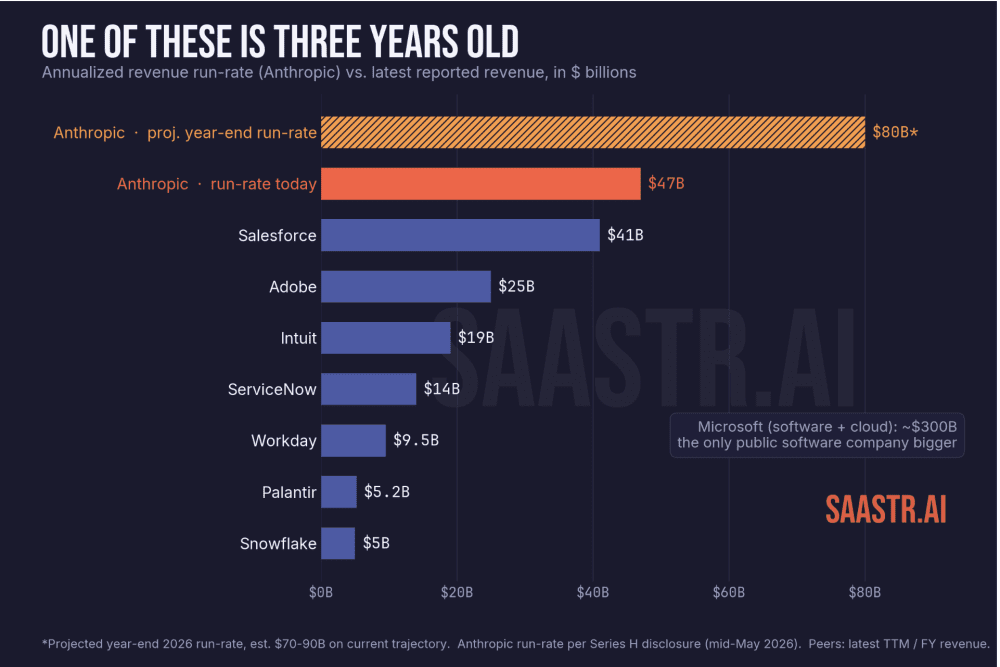
Anthropic’s run-rate today is bigger than all ten of them put together.
On its current trajectory the run-rate is tracking toward $70 to $90 billion by December.
Anthropic reached an annualized revenue run-rate of $47 billion by mid-May 2026, marking an unprecedented growth trajectory from its $9 billion exit at the end of 2025. This growth has allowed the three-year-old startup to surpass major software incumbents including Salesforce at $41 billion, Adobe at $25 billion, and Intuit at $19 billion. While Oracle and IBM report higher total revenues, their pure software segments remain below Anthropic’s current scale when excluding infrastructure and consulting services. On its current path, Anthropic is tracking toward a run-rate between $70 billion and $90 billion by December, which would place it second only to Microsoft’s $300 billion software and cloud business. Notably, Anthropic's current revenue now exceeds the combined trailing revenue of ten top-tier next-generation software companies, including Palantir, Snowflake, and CrowdStrike.
Source: SaaStr
Microsoft Lays Off 4,800 Staffers as Xbox and Sales Restructure for AI Transition
Microsoft cut around 4,800 roles, or 2.1% of its global workforce, on Monday — the latest in a series of layoffs that’s stoking fears of AI replacing jobs.
The layoffs build on Microsoft’s recent launch of its Frontier Company business unit, which is focused on delivering enterprise AI deployments
Microsoft has eliminated approximately 4,800 roles, representing 2.1% of its global workforce, with the Xbox and commercial sales divisions bearing the brunt of the cuts. The Xbox division alone is losing 1,600 employees as part of what CEO Asha Sharma describes as the most significant restructuring in the brand's history. While Chief People Officer Amy Coleman stated that these specific roles are not being directly replaced by AI, she emphasized that the company must adjust resources to reflect how automation is transforming the nature of work. This downsizing coincides with a $2.5 billion investment into Microsoft’s new Frontier Company business unit, which focuses on deploying enterprise AI tools using forward-deployed engineers. Gaming studios Compulsion Games and Double Fine Productions will return to independent status as Microsoft attempts to stabilize Xbox’s struggling margins and navigate a severe hardware crisis.
Source: TechCrunch AI
Research
Explore the latest breakthroughs in artificial intelligence research, from architectural optimizations like Fable’s custom GPU megakernels to the broader implications of rising AI automation in the global labor market. This section also highlights critical algorithmic advancements, such as the Monotonic Inference Policy Improvement (MIPI) framework designed to stabilize large language model reinforcement learning. These studies provide essential insights into both the technical efficiency and the real-world deployment challenges of next-generation AI systems.
Import AI 464: Fable's GPU Megakernel and Rising AI Automation in Online Labor
Fable achieved an 18.71X speedup by writing Cuda code on an RTX PRO 6000 Blackwell, compared against an optimized PyTorch baseline.
rise in the success rate of AI systems from 2.5% at launch in October 2025 to 16.1% in July 2026 on the “Remote Labor Index“.
Fable has developed the fastest megakernel ever submitted to KernelBench-Mega, achieving an 18.71X speedup using CUDA code on an RTX PRO 6000 Blackwell. This performance significantly outperforms benchmarks set by Claude Opus 4.8 and GPT 5.5, which achieved 14.4X and 4.34X respectively. The breakthrough suggests AI systems are becoming increasingly proficient at fundamental research tasks like kernel design, potentially signaling the start of recursive self-improvement loops. Simultaneously, the success rate of AI systems on the Remote Labor Index has jumped from 2.5% in October 2025 to 16.1% in July 2026. High-end models like Fable 5 are now successfully completing complex, end-to-end freelance projects in categories such as 3D CAD and video animation. These advancements highlight a rapid expansion in the economic capabilities of frontier AI agents within a mere eight-month period, challenging human comparative advantage in digital labor markets.
Source: Import AI
Monotonic Inference Policy Improvement for LLM RL Stability
standard LLM RL methods optimize training-side surrogates, which do not necessarily translate into improvements of the deployed inference policy
MIPU achieves both improved reasoning performance and significantly enhanced training stability across Qwen3-1.7B and Qwen3-4B.
Reinforcement learning for large language models frequently suffers from instability and training collapse due to engine-level inconsistencies between training and inference environments. This mismatch occurs because models adopt separate engines for generation efficiency and training precision, leading to inconsistent probabilities for the same trajectories even with synchronized parameters. To resolve this, researchers introduced Monotonic Inference Policy Improvement (MIPI) and its implementation MIPU, which explicitly separates the optimization process into training-side updates and inference-gap-aware acceptance filtering. This two-step framework ensures that policy updates translate into actual improvements in the deployed inference policy by accounting for real-world deployment factors like FP8 quantization or backend inconsistencies. Experimental results using Qwen3-1.7B and Qwen3-4B demonstrate that MIPU significantly enhances reasoning performance and stability compared to standard reinforcement learning methods that optimize only training-side surrogates.
Source: HuggingFace Papers
AI Infrastructure
AI Infrastructure encompasses the foundational technologies and hardware-software integrations necessary for building and deploying advanced machine learning models. This sector is evolving with specialized inference runtimes like Embodied.cpp for robotics and high-performance search engines like AnySearch that facilitate real-time data retrieval for autonomous agents. Such innovations streamline the development workflow, ensuring that complex AI systems remain portable, scalable, and responsive across diverse computational environments.
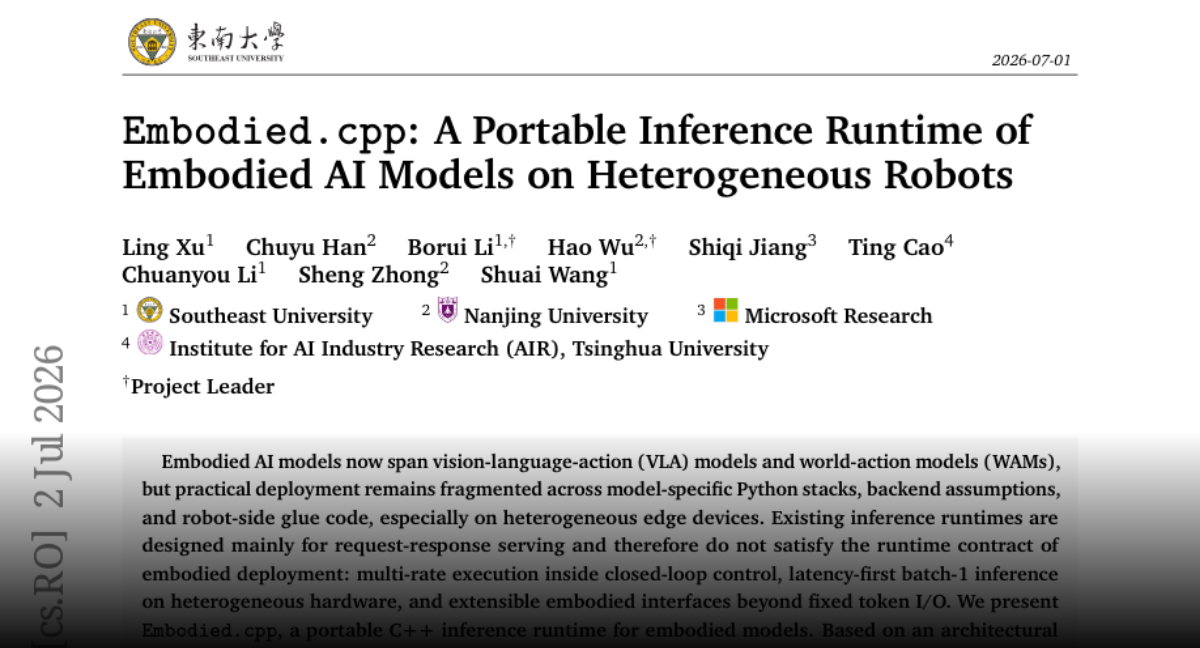
Embodied.cpp: A Portable C++ Inference Runtime for Embodied AI Models
Embodied.cpp captures a shared execution path and organizes it into five layers: input adapters, sequence builders, backbone execution, head plugins, and deployment adapters.
The VLA deployments achieve successful closed-loop execution with 100.0% and 91.0% task success rates, respectively.
Embodied.cpp achieves a 100.0% task success rate on HY-VLA and a 91.0% success rate on pi0.5 while reducing LingBot-VA Transformer block memory usage from 312.2 MiB to 88.1 MiB. This portable C++ runtime addresses the fragmentation of model-specific Python stacks and backend assumptions that often hinder practical deployment on heterogeneous edge devices. The architecture organizes the execution path into five modular layers including input adapters, sequence builders, backbone execution, head plugins, and deployment adapters. It specifically targets the unique requirements of embodied AI, such as multi-rate execution for closed-loop control and latency-first batch-1 inference on varied hardware. By providing a single backend abstraction, the system enables seamless transitions across different robots, simulators, and platforms without sacrificing performance or accuracy. These advancements offer a unified solution for scaling VLA and world-action models in real-world robotics environments.
Source: HuggingFace Papers
AnySearch: Real-time Structured Search for Agents and Developers
Real-time structured search trusted by agents and developers
AnySearch provides a real-time structured search platform specifically designed for integration by AI agents and software developers. The tool enables high-speed data retrieval that allows agents to access organized information instantly to improve their decision-making capabilities. It bridges the gap between raw web data and the structured requirements of modern AI systems by offering a reliable search API. Developers can leverage this infrastructure to build more responsive and accurate AI-driven applications without managing complex web crawling or data parsing. By focusing on real-time capabilities, AnySearch ensures that the information served to autonomous agents remains current and actionable. This infrastructure layer is critical for the evolving landscape of agentic workflows and automated productivity tools, providing a seamless way to ingest web-scale intelligence.
Source: Product Hunt
AI Agents
AI agents are evolving from simple chatbots into autonomous systems capable of executing complex workflows and solving technical challenges. This category explores the latest advancements in agentic design, focusing on how factors like code cleanliness and architectural patterns influence their operational efficiency. By examining minimal-pair studies and real-world implementations, we track the shift toward more reliable, self-correcting AI entities that can navigate sophisticated software environments with increasing precision and autonomy.
How Code Cleanliness Impacts AI Agent Efficiency: A Minimal-Pair Study
agents working on cleaner code use 7 to 8% fewer tokens and reduce file revisitations by 34%
code cleanliness does not change the agent's pass rate. However, it substantially alters the agent's operational footprint
Coding agents working on cleaner repositories utilize 7% to 8% fewer tokens and demonstrate a 34% reduction in file revisitations compared to those working on messy codebases. This study evaluates Claude Code using a minimal-pair protocol involving 33 tasks across six repository pairs matched for architecture and behavior but differing in static-analysis violations. While code cleanliness does not significantly alter the overall task pass rate, it materially impacts the operational footprint and navigational efficiency of the autonomous systems. These findings indicate that traditional software maintainability principles remain critical for managing the computational costs of AI-driven development. Code cleanliness joins model selection and prompting as a primary factor influencing agent behavior in real-world engineering environments. The researchers utilized automated pipelines to either degrade clean repositories or refactor messy ones to isolate the specific effects of structural quality.
Source: Hacker News
Open Source
This category explores the dynamic world of open-source software, highlighting community-driven projects that prioritize transparency, security, and collaborative innovation. From privacy-focused utilities like Organic Maps to robust enterprise frameworks, we track the latest updates shaping the digital commons. By showcasing accessible code and decentralized development models, we provide insights into how global developer communities are challenging proprietary standards to build a more open, user-centric internet for everyone.
Organic Maps: Privacy-Focused Offline Maps Powered by OpenStreetMap
In December 2025, Organic Maps reached 6M installs.
Organic Maps is one of the few applications nowadays that supports 100% of features without an active Internet connection.
Organic Maps reached 6 million installs in December 2025, establishing itself as a leading privacy-focused offline mapping solution for hiking, cycling, and driving. Developed by the original creators of Maps.Me and the open-source community, the application leverages OpenStreetMap data to provide detailed navigation without an active internet connection. The project operates under the Apache License 2.0 and maintains a strict policy against advertising, tracking, data collection, and mandatory registration. It supports advanced features such as turn-by-turn voice guidance, CarPlay/Android Auto integration, and contour lines for outdoor enthusiasts. By eliminating network telemetry and background data sync, the app significantly extends battery life during long-distance trips. Users can contribute to the community-driven project through donations or by participating in beta programs across multiple platforms including iOS, Android, and Linux.
Source: Hacker News

AI Applications
Explore how artificial intelligence is moving beyond general models to power specialized real-world solutions across diverse industries. From Google Cloud’s collaboration with Valtech to revolutionize software-defined vehicles to the launch of Typeahead 2.0 for private, system-wide macOS autocomplete, these advancements highlight the seamless integration of AI into daily workflows and modern infrastructure. These developments demonstrate a clear shift toward privacy-focused, task-specific tools that enhance both professional efficiency and transport safety.
Google Cloud and Valtech Launch Nexus SDV for AI-Powered Software-Defined Vehicles
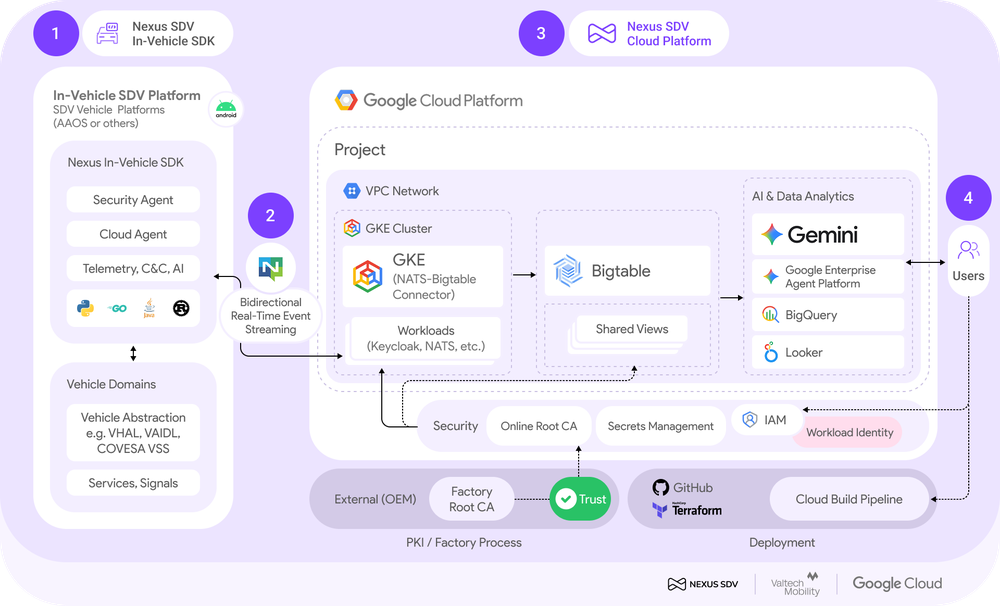
This modular, developer-friendly and open-source solution is designed to manage up to 100 million devices, and features deep integration with Android Automotive OS
By using high-efficiency Arm-based compute and Bigtable-optimized data storage, the platform lowers the operational costs associated with processing massive data volumes.
Nexus SDV is a modular, open-source connected vehicle platform developed by Google Cloud and Valtech to manage up to 100 million devices through deep integration with Android Automotive OS. The platform's first open-source core release utilizes Arm-based compute and Bigtable to significantly reduce the total cost of ownership for manufacturers while enabling real-time telemetry analysis. By leveraging Gemini models and the Gemini Enterprise Agent Platform, Nexus AI transforms vehicles into proactive partners capable of autonomous decision-making and hyper-personalized driver assistance. The architecture bridges the gap between vehicle edge and data center using a cloud-native foundation for high-fidelity data synchronization. Security is addressed through a defense-in-depth model featuring mutual TLS, public key infrastructure, and Zero Trust architecture to protect the entire vehicle lifecycle and ensure regulatory compliance in a rapidly evolving automotive landscape.
Source: Google Cloud Blog
Typeahead 2.0: Private AI Autocomplete for Every macOS Application
Private AI autocomplete for every app on your Mac
Typeahead 2.0 provides system-wide AI-powered autocomplete capabilities specifically designed for every application running on the macOS platform. The tool focuses on user privacy by processing autocomplete suggestions locally rather than relying on external cloud-based servers. By integrating directly into the operating system's workflow, it allows users to experience predictive text features across diverse software environments ranging from text editors to professional design suites. This local execution model ensures that sensitive data remains on the device while maintaining the high-speed performance expected from modern productivity tools. The application represents a growing trend in desktop-first AI utilities that prioritize data sovereignty without sacrificing utility. Its universal compatibility makes it a versatile addition for professionals seeking to streamline their writing and coding tasks across multiple disparate Mac applications.
Source: Product Hunt

This report is auto-generated by WindFlash AI based on public AI news from the past 48 hours.