Thursday, July 2, 2026 · 10 curated articles
Editor's Picks
Today's most interesting signal is not a single model release. It is the shape of the conversation across X, Hacker News, Product Hunt, and AI research leaderboards: people are less excited by abstract capability claims and more interested in whether agents can actually work inside messy real-world systems. Dockerless (article 2) fits that mood exactly. It turns code verification for coding agents into an environment-free process, which is the kind of practical bottleneck developers discuss because it directly affects whether agent workflows can scale beyond demos.
Product Hunt's agent tools point in the same direction from the product side. Humalike (article 4) argues that AI agents need social intelligence, not just task completion. Tabstack Browser Automation (article 10) packages web interaction as infrastructure for autonomous agents. Together, they show why the community conversation has moved from "can an AI answer?" to "can it behave, browse, verify, and collaborate without creating operational drag?"
The research-heavy stories explain what might feed the next wave of these products. Orca (article 1) pushes a unified world latent space built from large-scale video and event annotations. BlockPilot (article 5), GEAR (article 7), and Evolution Fine-Tuning (article 8) all attack efficiency or learning dynamics rather than headline-friendly chatbot polish. That is why they matter to builders: they make the next generation of AI systems cheaper, faster, and more adaptable.
The X-linked Anthropic export-control update (article 3) adds the policy angle. If advanced models are becoming shared infrastructure, access rules will be debated in the same places where developers discuss benchmarks and product launches. Today's feed is therefore less a conventional news list than a snapshot of what the AI community is trying to resolve: agents need better infrastructure, products need better behavior, and model access is now part of the developer stack.
Foundation Models
Focus on foundational advancements in AI models trained on vast, diverse datasets to enable cross-domain adaptability. These models, like Orca's unified world latent space via next-state prediction, serve as versatile bases for specialized applications through transfer learning.
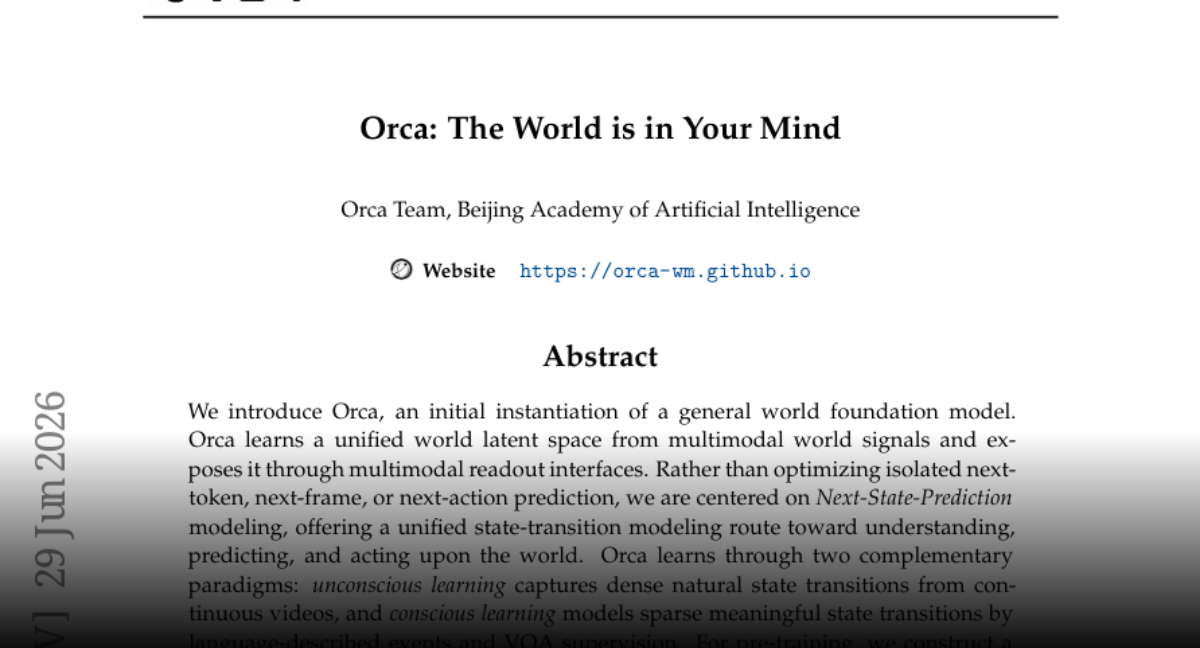
Orca: Unified World Latent Space via Next-State Prediction
Orca learns a unified world latent space from multimodal world signals and exposes it through multimodal readout interfaces
125K hours of video data and 160M event annotations
Orca introduces a general world foundation model using next-state-prediction modeling with multimodal data, outperforming specialized baselines. The model learns a unified world latent space through 125K hours of video data and 160M event annotations, combining unconscious learning (dense natural state transitions) and conscious learning (language-described events). It supports downstream tasks like text generation, image prediction, and embodied action generation with frozen backbones and lightweight decoders. Experiments show scalability and improved performance across modalities.
Source: HuggingFace Papers
AI Agents
AI Agents explores innovations in autonomous software systems that execute complex tasks independently. This category highlights tools like Dockerless, which streamlines code verification without environment setup, and Humalike, which enhances AI agents with social reasoning capabilities. These advancements aim to improve agent reliability, collaboration, and real-world adaptability through technical optimization and behavioral intelligence integration.
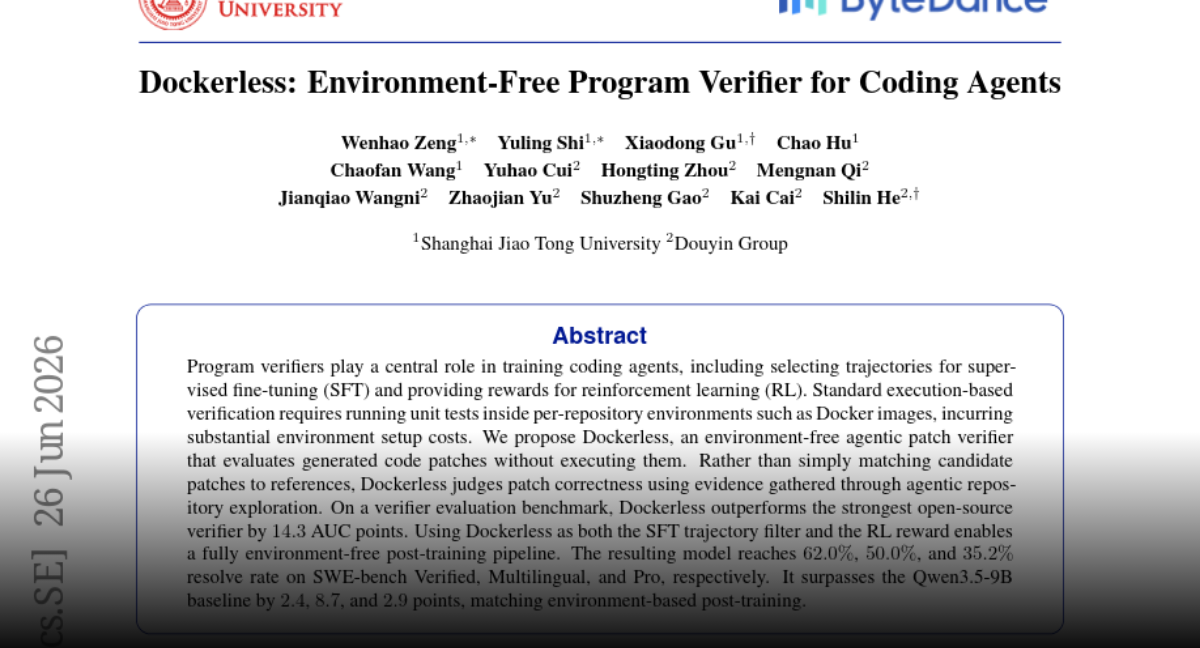
Dockerless: Environment-Free Code Verifier for Coding Agents
Dockerless outperforms the strongest open-source verifier by 14.3 AUC points
resulting model reaches 62.0%, 50.0%, and 35.2% resolve rate on SWE-bench Verified, Multilingual, and Pro
Dockerless improves code patch evaluation accuracy by 14.3 AUC points over open-source verifiers while eliminating execution-based verification costs. This environment-free agentic patch verifier evaluates generated code patches without execution through repository exploration, enabling a fully environment-free post-training pipeline. The resulting model achieves 62.0%, 50.0%, and 35.2% resolve rates on SWE-bench Verified, Multilingual, and Pro benchmarks, surpassing Qwen3.5-9B baseline by 2.4-8.7 points. It matches environment-based post-training effectiveness without Docker image dependencies.
Source: HuggingFace Papers
Humalike: Give your AI agents the social intelligence they're missing
Give your AI agents the social intelligence they're missing
Humalike enhances AI agents with social intelligence capabilities previously lacking in automated systems. The platform enables context-aware interactions by analyzing emotional cues, cultural norms, and conversational dynamics. Developers can integrate these social reasoning layers to improve user engagement in customer service, virtual assistants, and collaborative tools. The solution addresses persistent limitations in AI agent adoption across enterprise and consumer applications.
Source: Product Hunt
AI Policy & Ethics
The US Commerce Department's decision to lift export controls on advanced AI models like Claude Fable 5 and Mythos 5 highlights evolving regulatory approaches to AI governance. This move reflects efforts to balance national security concerns with fostering global innovation, while raising questions about ethical deployment and cross-border data flows. The policy shift underscores the need for updated frameworks to address emerging risks in AI development and international collaboration.
US Commerce Department lifts export controls on Claude Fable 5 and Mythos 5
We’ve received notice that the Department of Commerce has lifted export controls on Claude Fable 5 and Mythos 5.
We'll begin restoring access tomorrow, and will share an update soon.
The US Department of Commerce has removed export restrictions for Claude Fable 5 and Mythos 5 AI models. Anthropic will restore access to these models starting tomorrow following the regulatory change. The company expressed appreciation for user patience and collaborative efforts during the redeployment process. This policy shift marks a significant adjustment in US export control regulations for advanced AI technologies.
Source: Hacker News
Research
Research highlights cutting-edge advancements in AI and machine learning, focusing on innovative methods like diffusion models, 3D tokenization, and end-to-end auto-regression. This category explores breakthroughs in optimization tasks, policy learning, and image synthesis, emphasizing technical rigor and transformative potential across diverse applications.
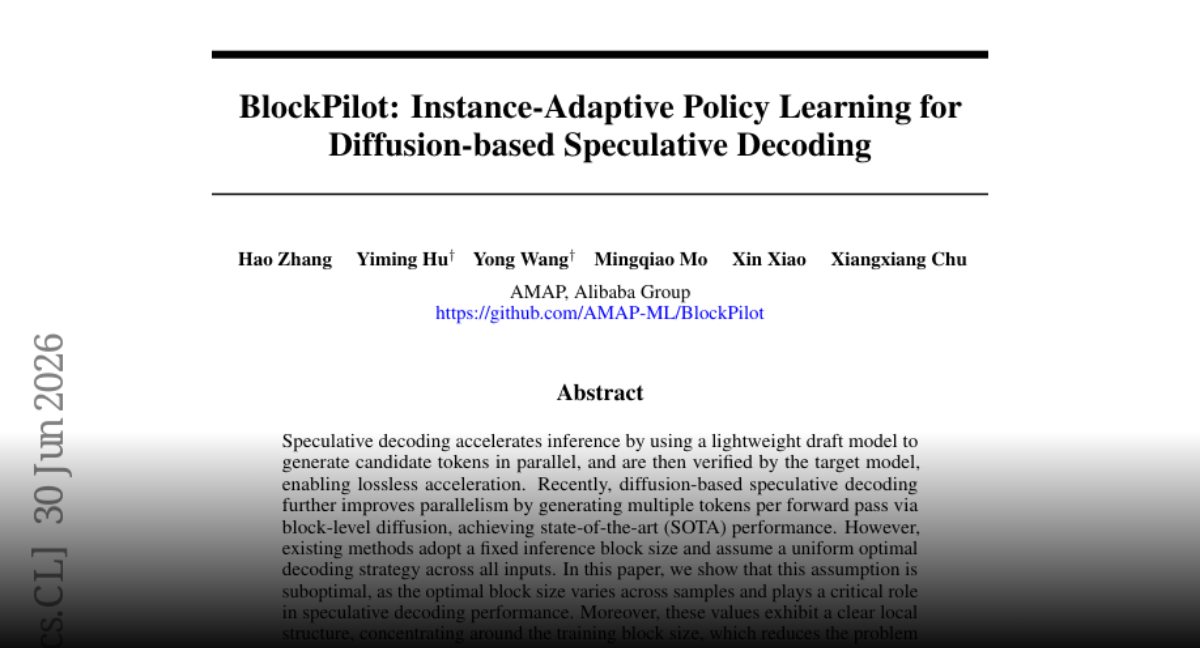
BlockPilot: Instance-Adaptive Policy Learning for Diffusion-based Speculative Decoding
existing methods adopt a fixed inference block size and assume a uniform optimal decoding strategy across all inputs
achieving an acceptance length of 5.92 and a 4.20times speedup on Qwen3-4B under temperature T=1
Existing diffusion-based speculative decoding methods with fixed block sizes achieve suboptimal performance due to varying optimal block sizes across samples. BlockPilot introduces an adaptive policy learning framework that predicts optimal block sizes from prefilling representations, achieving 4.20x speedup on Qwen3-4B while maintaining lossless acceleration. The method leverages local structure in block size distributions to reduce decision space complexity and adds minimal overhead through single-prediction integration. Experimental results show improved acceptance length (5.92) and parallelism efficiency compared to fixed-block approaches.
Source: HuggingFace Papers
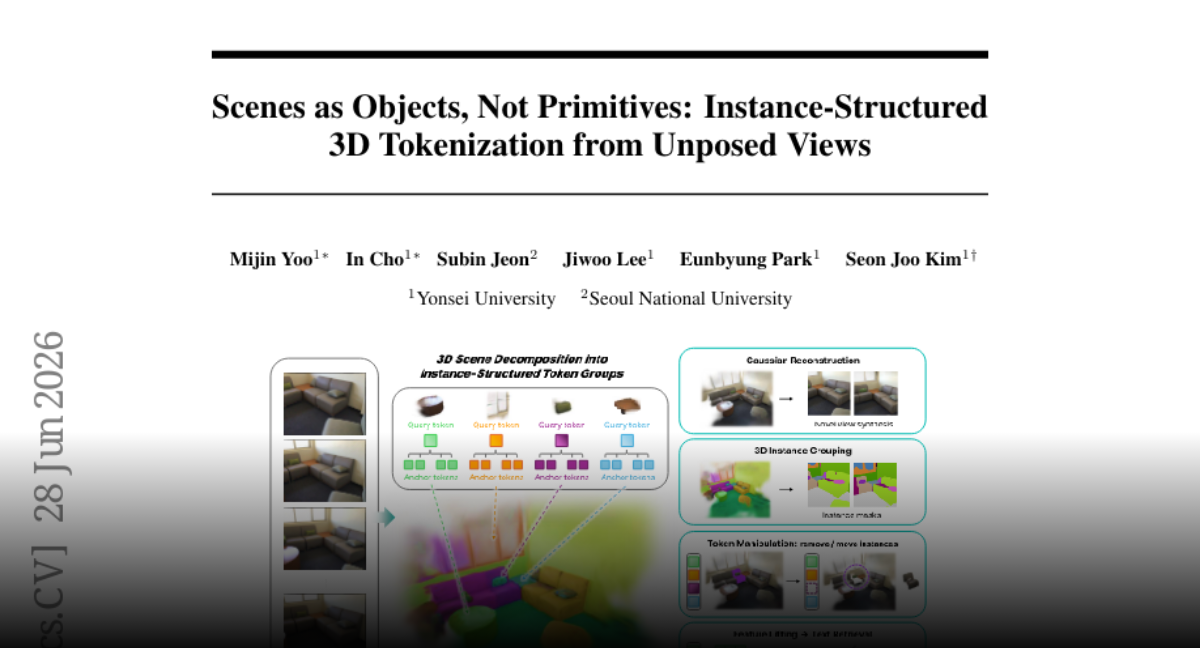
Instance-Structured 3D Tokenization from Unposed Views
We propose a feed-forward framework that decomposes a scene into instance-structured 3D token groups directly from unposed multi-view images
This two-level factorization decouples object identity from local appearance, making object instances a native interface of the representation
A feed-forward framework decomposes 3D scenes into instance-structured token groups directly from unposed multi-view images, enabling object-level reconstruction and manipulation without 3D annotations. The method uses instance tokens paired with anchor tokens to encode local geometry and appearance, achieving class-agnostic instance segmentation while supporting novel view synthesis and open-vocabulary 3D retrieval. Token groups enable direct instance-level editing through removal, translation, or insertion operations.
Source: HuggingFace Papers
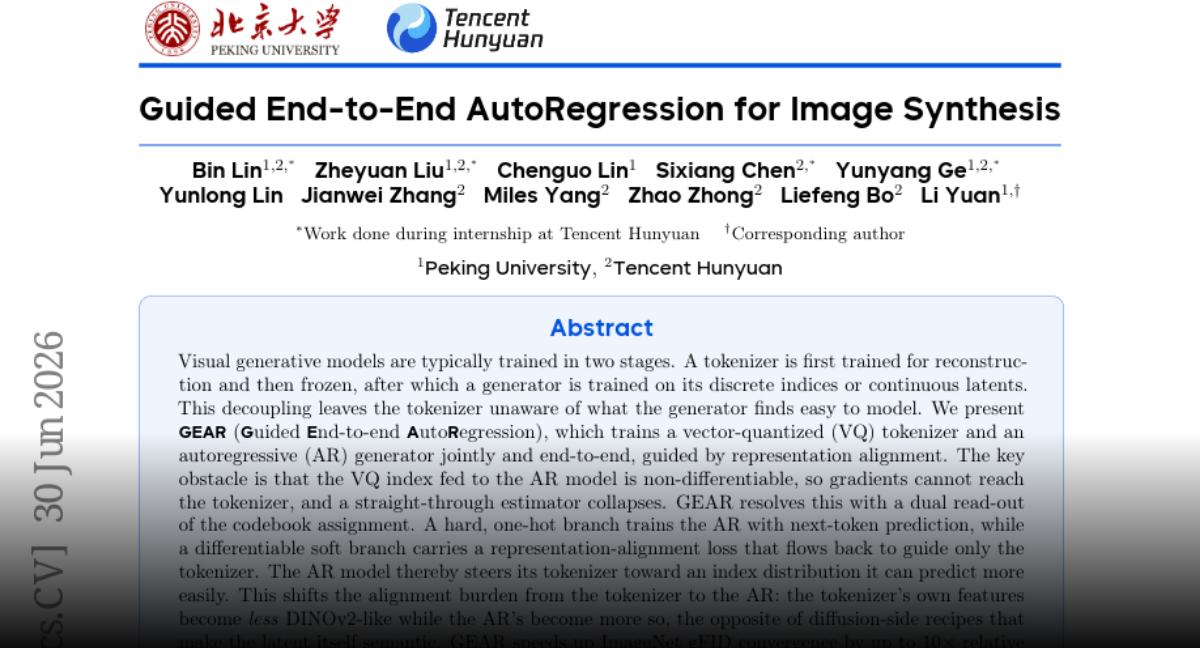
GEAR: Guided End-to-End AutoRegression for Image Synthesis
GEAR trains a vector-quantized tokenizer and autoregressive generator jointly end-to-end using representation alignment
GEAR speeds up ImageNet gFID convergence by up to 10x relative to the strong LlamaGen-REPA baseline
GEAR introduces an end-to-end training framework for vector-quantized tokenizers and autoregressive generators through representation alignment, achieving 10x faster ImageNet gFID convergence than LlamaGen-REPA. Traditional two-stage training decouples tokenizer and generator optimization, causing misalignment in feature distribution. The dual read-out approach uses a hard branch for token prediction and a soft branch for gradient propagation, enabling the generator to guide the tokenizer toward predictable index distributions. This method improves patch-level coherence and spatial consistency across multiple quantizers (VQVAE, LFQ, IBQ) and extends to text-to-image generation.
Source: HuggingFace Papers
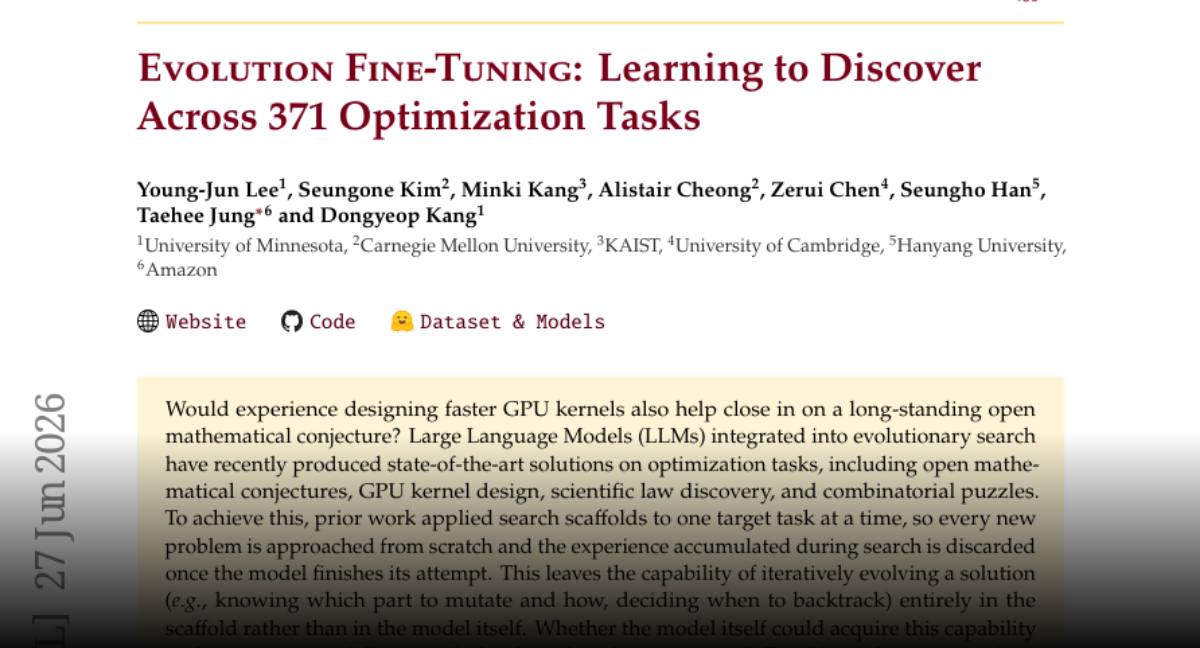
Evolution Fine-Tuning: Learning to Discover Across 371 Optimization Tasks
Evolutionary fine-tuning enables large language models to develop cross-task problem-solving capabilities by learning from search trajectories, demonstrating improved performance on mathematical conjectures and optimization tasks
our models surpass their base counterparts by 10.22% on average
Evolutionary fine-tuning (EFT) enables large language models to achieve 10.22% average performance improvement across 22 held-out optimization tasks by learning from 156K evolutionary search trajectories. This method converts search trajectories into supervision data, allowing models to iteratively evolve solutions rather than relying on task-specific scaffolds. The Finch Collection dataset spans 10 domains including mathematical conjectures, GPU kernel design, and combinatorial puzzles. When combined with test-time reinforcement learning, EFT matches state-of-the-art performance on circle-packing tasks and outperforms base models on the Erdős minimum-overlap problem.
Source: HuggingFace Papers
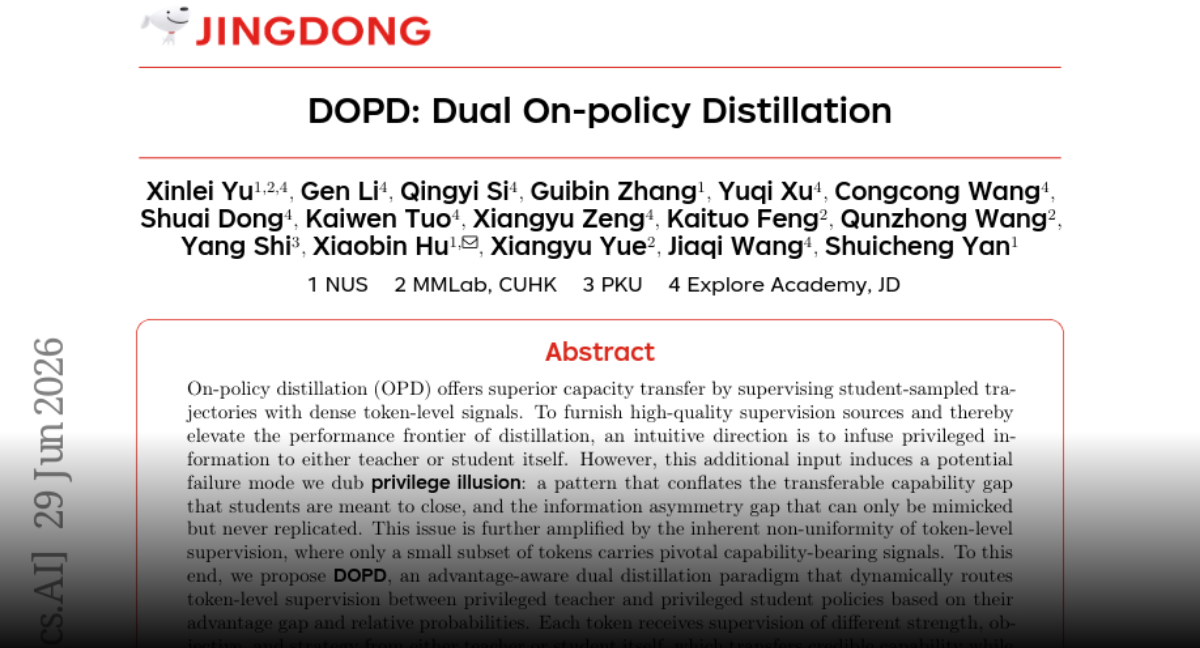
DOPD: Addressing Privilege Illusion in On-policy Distillation
DOPD addresses privilege illusion in on-policy distillation by dynamically routing token-level supervision between teacher and student policies based on advantage gaps and probabilities
this additional input induces a potential failure mode we dub privilege illusion: a pattern that conflates the transferable capability gap that students are meant to close, and the information asymmetry gap that can only be mimicked but never replicated
DOPD mitigates privilege illusion in on-policy distillation by dynamically routing token-level supervision between teacher and student policies based on advantage gaps and probabilities. This method improves capability transfer in large language and vision-language models by addressing information asymmetry gaps that hinder traditional distillation approaches. Experiments show DOPD outperforms Vanilla OPD in stability, robustness, and out-of-distribution tasks while maintaining credible capability transfer through adaptive supervision strategies.
Source: HuggingFace Papers
Developer Tools
Developer Tools empower modern software creation through automation, collaboration, and streamlined workflows. This category highlights solutions like Tabstack Browser Automation that eliminate infrastructure overhead while enhancing productivity, enabling developers to focus on innovation rather than operational complexities.
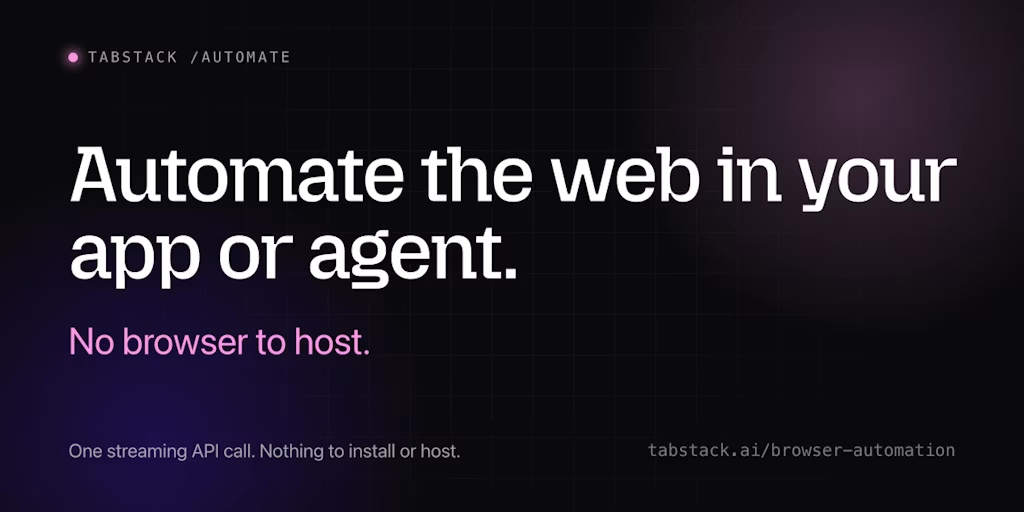
Tabstack Browser Automation: Web Automation Without Hosting
Extract structured data to a schema you define, convert pages to Markdown, run cited multi-source research, and automate browser tasks
Built for developers shipping autonomous agents and those adding web interaction to an existing app or stack
Tabstack offers browser automation through a developer-facing API without requiring teams to host browser infrastructure themselves. It supports structured extraction, page-to-Markdown conversion, cited multi-source research, and browser task automation. The product is aimed at builders shipping autonomous agents or adding web interaction to existing apps, where hosted browser orchestration can otherwise become a heavy operational dependency.
Source: Product Hunt
This report is auto-generated by WindFlash AI based on public AI news from the past 48 hours.