Wednesday, June 24, 2026 · 10 curated articles
Editor's Picks
The era of the 'AI subsidy' is officially hitting its terminal velocity. Today’s report on 'AI's Affordability Crisis: The Massive Economic Gap in Token Subsidies' is a sobering cold shower for an industry drunk on venture-backed compute. When OpenAI is hemorrhaging $38 billion in a single year to support a revenue stream that covers less than a third of its costs, we aren't looking at a scaling law; we're looking at a structural deficit. For the developer community, the implication is stark: the 'drug dealer’s algorithm' of cheap, high-performance inference is about to be replaced by a brutal focus on unit economics. If you’ve built your startup on the assumption that frontier model pricing will continue to trend toward zero, you are building on quicksand. The future belongs to those who can extract maximal value from every single token.
This economic reckoning is precisely why the shift toward 'World Models' and agentic autonomy is no longer just a research curiosity—it’s a survival mechanism. 'Qwen-AgentWorld' represents the first real push to move beyond simple text-prediction into building foundation models that actually understand environment trajectories. By simulating agentic environments across seven domains, we are finally seeing the 'cognitive scaffolding' required for agents to act independently. The goal here isn't just better chat; it's creating agents that can reason through complex tasks without a human holding their hand (and paying for every misguided inference step). To survive the coming price hikes, agents must become more efficient thinkers, using long chain-of-thought reasoning to solve problems in fewer, more impactful turns.
Perhaps most importantly, we are seeing the birth of the 'Agentic Economy' infrastructure. Platforms like 'Bluerails Discovery' and Ampersend’s 'Pay-Per-Intelligence' model are the necessary rails for a world where machines must justify their own existence. Bluerails’ visibility score for brands interacting with autonomous agents marks a pivotal shift: we are moving from SEO for humans to 'Agent Optimization' for machines. Meanwhile, Ampersend’s use of Amazon Bedrock for budget-constrained routing proves that the next layer of the stack isn't a better LLM—it's a financial governor. As developers, our job is shifting from prompt engineering to building autonomous economic entities that can find, negotiate, and pay for their own services. The 'affordability crisis' isn't the end of AI; it's the end of the amateur hour. Only the agents that can pay their own way will survive the 2026 cull.
AI Business
The AI Business category explores the complex economic landscape of artificial intelligence, focusing on the sustainability of current market models. Recent discussions highlight a growing affordability crisis as companies grapple with the massive financial subsidies required to keep token costs low for users. This section examines the widening economic gap between operational costs and revenue, providing critical insights into how the industry manages long-term profitability amidst significant capital expenditures.
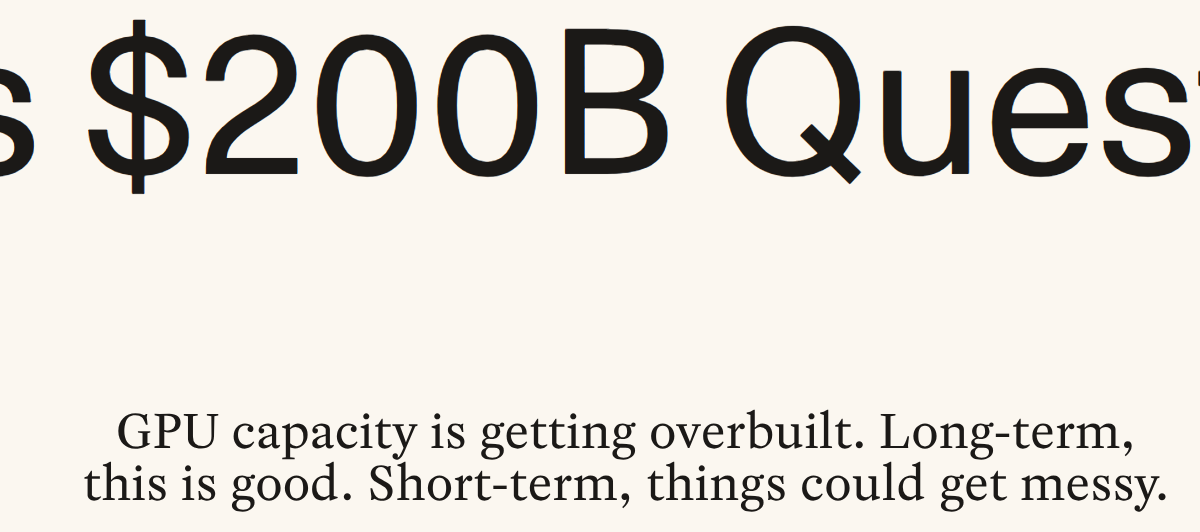
AI's Affordability Crisis: The Massive Economic Gap in Token Subsidies
For $200 A Month, You Can Burn $8000 in Anthropic Tokens or $14,000 In OpenAI Tokens
OpenAI Had $13.07 Billion In Revenue, $34 Billion In Costs and Expenses, and $20.92 Billion In Losses
AI platforms are currently subsidizing enterprise customers by up to 70 times the cost of their subscription fees, with $200-a-month users potentially burning $14,000 worth of tokens. These massive subsidies have created an artificial surge in demand, where platforms reportedly spend between $8 and $14 to generate just $1 in revenue. Financial data for 2025 shows that OpenAI recorded $13.07 billion in revenue against $34 billion in costs, resulting in a net loss of $38.53 billion. While Anthropic has seen soaring adoption despite smaller subsidies, OpenAI's business growth has remained flat even with more aggressive pricing. Analysts warn that this 'drug-dealer's algorithm' of providing cheap access to expensive compute is unsustainable and will eventually require significantly higher prices. This fiscal gap highlights a growing crisis in the economic viability of foundational AI models.
Source: Hacker News
Foundation Models
Foundation models serve as the backbone of modern artificial intelligence, providing large-scale pre-trained capabilities that enable a vast array of downstream applications. Recent developments focus on evolving these systems from simple text processors into sophisticated world models capable of simulating complex environments for autonomous agents. By integrating multimodal understanding and long-context reasoning, these architectures are paving the way for more general, versatile AI systems that can interact with the physical and digital worlds more effectively.
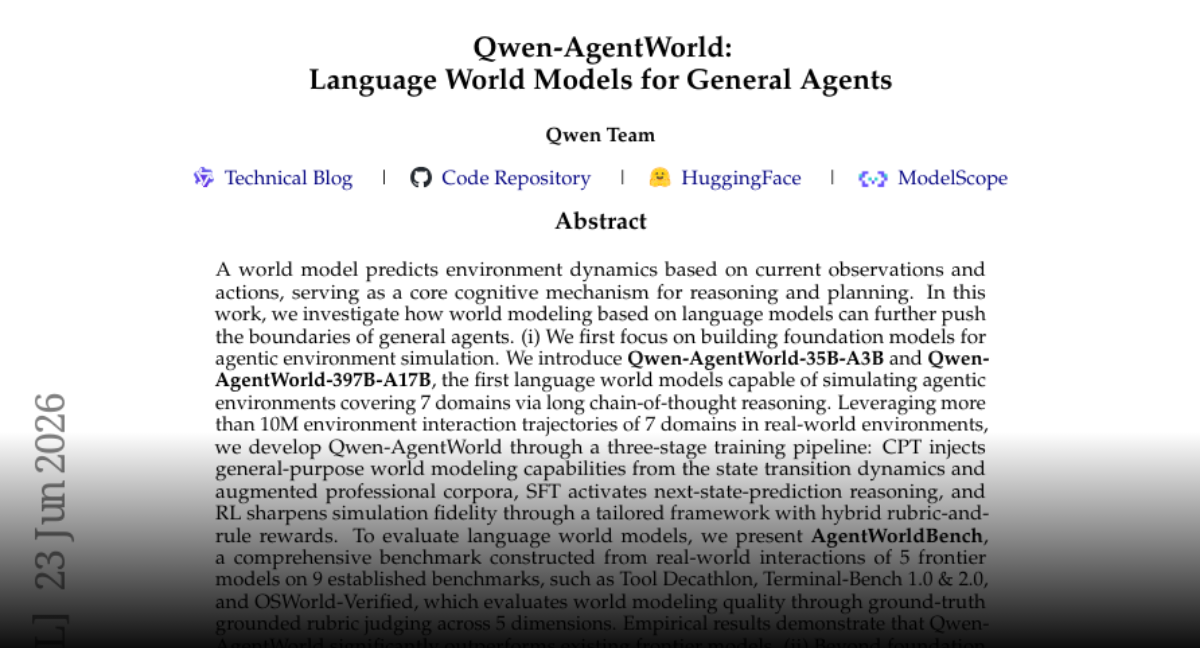
Qwen-AgentWorld: Building Foundation Language World Models for General Agents
We introduce Qwen-AgentWorld-35B-A3B and Qwen-AgentWorld-397B-A17B, the first language world models capable of simulating agentic environments covering 7 domains
Leveraging more than 10M environment interaction trajectories of 7 domains in real-world environments, we develop Qwen-AgentWorld through a three-stage training pipeline
Qwen-AgentWorld-35B-A3B and Qwen-AgentWorld-397B-A17B are the first language world models capable of simulating agentic environments across seven domains using long chain-of-thought reasoning. These models were developed using a massive dataset of over 10 million environment interaction trajectories through a three-stage training pipeline involving continual pre-training, supervised fine-tuning, and reinforcement learning. To evaluate these systems, researchers introduced AgentWorldBench, a comprehensive benchmark derived from real-world interactions of five frontier models. Empirical results demonstrate that Qwen-AgentWorld significantly outperforms existing frontier models when acting as a decoupled environment simulator, enabling scalable and controllable simulation for agentic reinforcement learning. Furthermore, integrating world-model training as a unified foundation model acts as a highly effective warm-up, boosting downstream performance across seven distinct agentic benchmarks. This work establishes language-based world modeling as a core cognitive mechanism for enhancing reasoning and planning in general-purpose agents.
Source: HuggingFace Papers
AI Agents
AI agents are rapidly evolving into autonomous systems capable of executing complex tasks across diverse domains, from mobile interface navigation to telecommunications management. New frameworks like MobileForge enable seamless adaptation to GUI environments without manual annotations, while industry applications focus on building self-operating networks. As these agentic capabilities mature, innovative monetization strategies like pay-per-intelligence models are emerging to support the infrastructure behind agent-driven ecosystems and automated decision-making processes.
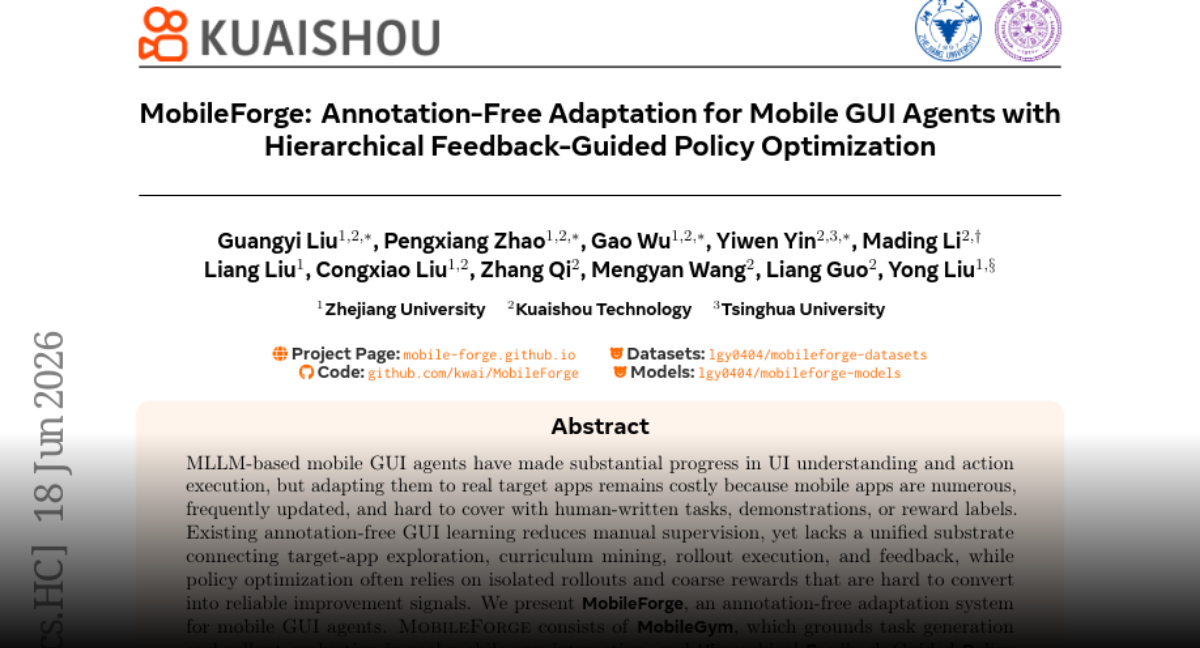
MobileForge: Annotation-Free Adaptation for Mobile GUI Agents via HiFPO
MobileForge adapts Qwen3-VL-8B to 67.2% Pass@3 on AndroidWorld
The MobileForge-adapted ForgeOwl-8B further reaches 77.6% Pass@3 on AndroidWorld
MobileForge achieves a 67.2% Pass@3 score on AndroidWorld by adapting the Qwen3-VL-8B model using only automatically generated, annotation-free data. This system addresses the high cost of manual supervision in mobile GUI agent training by integrating real-app interaction grounding with a novel hierarchical feedback-guided policy optimization (HiFPO). The architecture features MobileGym for task generation and rollout evaluation, alongside HiFPO which transforms trajectory outcomes and step-level process feedback into hint-contextualized updates. When applied to ForgeOwl-8B, the framework reaches 77.6% Pass@3 on AndroidWorld and 41.0% success on the out-of-domain MobileWorld benchmark. These results establish the framework as a powerful open-data solution for navigating numerous and frequently updated mobile applications without requiring human-written demonstrations or reward labels. The release of code, data, and trained models aims to lower the barrier for developing robust mobile-centric multimodal large language models.
Source: HuggingFace Papers
Building Autonomous Telecom Networks with Agentic AI
automation typically sits in the Level 2–3 band of TM Forum’s autonomous networks levels taxonomy
streamlining execution of predefined solutions in selective network domains
Telecom operators are currently operating within the Level 2–3 range of the TM Forum autonomous networks taxonomy, focusing on automating predefined solutions in specific domains. The industry is now shifting toward agentic AI to bridge the gap toward Level 4 and Level 5 autonomy, which requires more advanced decision-making capabilities. These autonomous systems aim to transform network operations, customer service, and back-office workflows by reducing manual intervention. By integrating generative AI agents, providers can move beyond simple execution to proactive network management. This transition represents a significant step in the evolution of telecommunications infrastructure toward fully self-managing environments. Ultimately, the adoption of these technologies seeks to optimize performance and operational efficiency across global communication networks.
Source: NVIDIA Generative AI Blog

Ampersend's Pay-Per-Intelligence Model Using Amazon Bedrock AgentCore Payments
AI agents autonomously route tasks to the most effective model, pay per request, and operate within spending budgets.
Ampersend built a pay-per-intelligence routing layer on top of Amazon Bedrock AgentCore Payments.
AI agents now autonomously route tasks to the most effective models while operating strictly within predefined spending budgets through a specialized routing layer. This architecture utilizes Amazon Bedrock AgentCore Payments to facilitate a pay-per-request system for distributed intelligence. By implementing a two-hop payment pattern, the system ensures secure and efficient financial transactions between agents and model providers. This framework allows developers to scale agentic workflows without manual intervention in payment processing or budget management. The solution emphasizes cost-efficiency by matching task complexity with the appropriate model capability on a granular level. Integrating these components provides a blueprint for building commercially viable, autonomous AI services that manage their own operational expenses.
Source: AWS Machine Learning Blog

AI Infrastructure
This category explores the foundational technologies powering the next generation of artificial intelligence, from hardware acceleration to service discovery frameworks. Recent breakthroughs include NVIDIA's Blackwell architecture leveraging DFlash speculative decoding to significantly boost inference performance for large language models. Additionally, the emergence of specialized infrastructure like Bluerails Discovery highlights the shift toward enabling AI agents with integrated commerce and visibility, ensuring that the underlying hardware and software layers evolve to support autonomous digital ecosystems.
Accelerating LLM Inference on NVIDIA Blackwell via DFlash Speculative Decoding
Speculative decoding helps mitigate this bottleneck by using a lightweight model to draft future tokens
Autoregressive LLMs generate tokens sequentially, which can limit GPU utilization
NVIDIA Blackwell GPUs achieve up to a 15x increase in inference performance through the implementation of DFlash speculative decoding techniques. This optimization addresses the inherent sequential token generation limitations of autoregressive large language models, which often result in suboptimal GPU utilization and constrained throughput. By employing a lightweight draft model to predict future tokens, the system significantly reduces the latency required for complex AI workflows. As the industry shifts toward coordinated multiagent environments, low-latency serving becomes a critical requirement for maintaining real-time responsiveness. This advancement allows for more efficient resource allocation across high-demand serving scenarios without compromising model accuracy. The DFlash approach specifically targets bottlenecks in latency-sensitive applications to maximize the hardware capabilities of the Blackwell architecture.
Source: NVIDIA Generative AI Blog

Bluerails Discovery: Infrastructure for AI Agent Commerce and Visibility
Discovery: a peer-reviewed AI-visibility score from 400 samples, not a one-off guess.
We make you discoverable to AI agents and ready to get paid by them
Bluerails Discovery provides a peer-reviewed AI visibility score derived from 400 distinct samples to quantify how effectively brands are being identified by autonomous agents. The platform offers specialized infrastructure that enables businesses to become discoverable and transactable within the emerging agentic economy. By integrating agent-ready checkout systems with global settlement and built-in compliance, it addresses the fundamental technical and regulatory hurdles of machine-to-machine commerce. Users can currently access free discovery reports without signing up, while full agent payment capabilities are scheduled for a subsequent rollout. This infrastructure functions as a standardized set of rails for AI agents to find, interact with, and compensate service providers across global marketplaces. The tool represents a significant shift from simple sentiment monitoring to enabling direct autonomous economic interactions between software agents and commercial entities.
Source: Product Hunt
AI Applications
AI applications bridge the gap between theoretical research and practical utility, transforming how we interact with complex data and creative media. This category explores real-world implementations, such as leveraging multimodal models for large-scale aerial imagery analysis and intuitive chat-based interfaces for cinematic video production. By integrating advanced machine learning into specialized workflows, these tools enhance efficiency and accessibility across diverse industries ranging from geospatial intelligence to digital entertainment.
Multimodal AI for Scalable Semantic Search in Aerial Imagery
Amazon Nova Multimodal Embeddings delivered the highest F1 scores across both benchmark queries in our evaluation.
The work described here evolved into Vexcel Intelligence, a searchable imagery product.
Amazon Nova Multimodal Embeddings achieved the highest F1 scores across benchmark queries for geospatial semantic search in a comparative evaluation of embedding models and fusion strategies. This architecture utilizes Amazon Bedrock and Amazon OpenSearch Serverless to transform raw aerial imagery into searchable vectors validated against OpenStreetMap ground truth. The system evaluation methodology involved four distinct experiments focusing on captioning, search methods, and embedding fusion to optimize retrieval accuracy at scale. These design choices directly informed the development of Vexcel Intelligence, a commercial searchable imagery product. Practical guidance derived from these experiments highlights how specific multimodal design choices significantly impact performance in large-scale aerial data processing. This implementation provides a robust framework for organizations looking to implement semantic search across massive geospatial datasets.
Source: AWS Machine Learning Blog

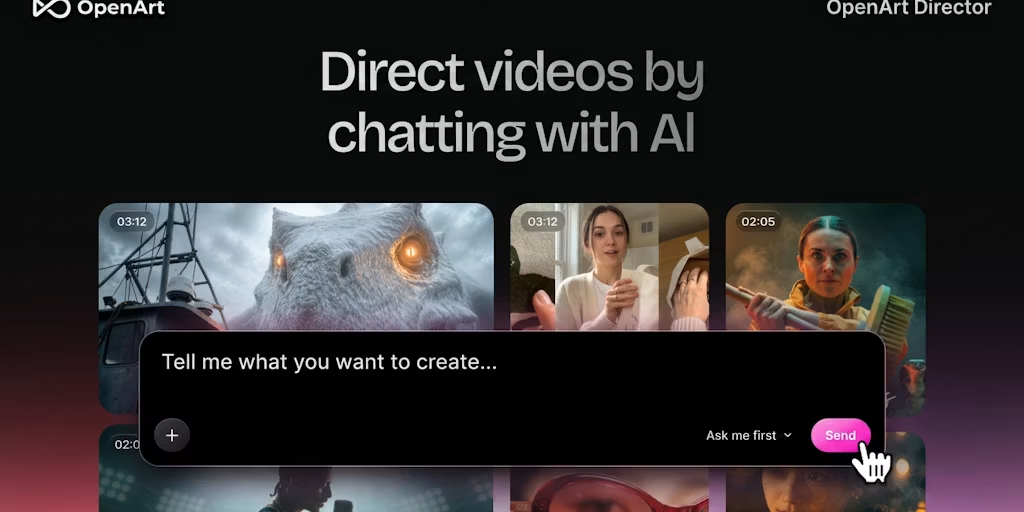
OpenArt Director: Directing Cinematic Videos via Chat Interface
OpenArt gives you the power to turn any idea into a captivating visual story within minutes.
Direct cinematic videos through chat
OpenArt Director allows users to generate cinematic-quality videos and visual stories using a conversational chat-based interface. The platform enables the rapid transformation of abstract ideas into production-quality short films, viral social media content, and professional brand advertisements within minutes. This release marks the sixth major launch from the OpenArt AI team, an entity that has sustained a 4.2-star rating from its community and accumulated over 4,300 followers on Product Hunt. The tool focuses on democratizing high-end visual production by removing the need for complex technical video editing skills. By leveraging advanced generative media technology, users can explain difficult concepts or construct complete marketing campaigns through simple text interaction. This development represents a significant step in making professional-grade video storytelling accessible to individual creators, marketers, and independent filmmakers who seek to streamline their creative workflows.
Source: Product Hunt
Research
This category explores groundbreaking academic studies and technological breakthroughs that redefine the boundaries of artificial intelligence and robotics. Recent highlights include the InSight framework, which leverages steerable Vision-Language-Action (VLA) models to enable autonomous skill acquisition in robotic systems. By integrating advanced perception with automated decision-making, these research papers provide the theoretical and practical foundations necessary for developing more capable, adaptable, and intelligent machines across various industrial and scientific applications.
InSight Framework Enables Autonomous Robot Skill Acquisition via Steerable VLAs
InSight, a framework that unlocks autonomous skill acquisition by rendering VLAs steerable at the primitive-action level
InSight consists of two primary stages: (1) an automated segmentation pipeline that partitions demonstrations into labeled primitives via VLM plan decomposition
Vision-language-action (VLA) models often face performance plateaus because their manipulation capabilities remain strictly bounded by the specific skills contained within their initial training datasets. The InSight framework addresses this bottleneck by rendering VLAs steerable at the primitive-action level, allowing for granular control over movements such as moving a gripper to a bowl or lifting objects upward. This approach utilizes an automated segmentation pipeline that partitions demonstrations into labeled primitives using vision-language model plan decomposition and end-effector poses. By enabling primitive steerability, the system facilitates autonomous skill acquisition that moves beyond the limitations of fixed demonstration data. The framework essentially bridges the gap between high-level task planning and low-level execution through a multi-stage automated process. These advancements suggest a significant shift toward robotic systems that can independently refine and expand their functional repertoire in dynamic environments.
Source: ArXiv
This report is auto-generated by WindFlash AI based on public AI news from the past 48 hours.