Monday, June 22, 2026 · 10 curated articles
Editor's Picks
The era of 'vibe engineering' is officially dead. As we look at the headlines for June 22, 2026, a singular truth emerges: the industry has shifted from building chatbots that mimic human prose to architecting autonomous agents that command physical and digital reality. NVIDIA’s introduction of ENPIRE—a framework where AI agents conduct their own robotics research—is a watershed moment. It signals that the next leap in intelligence won't come from larger text corpora, but from agents iterating in the physical world at speeds humans cannot match. When an AI can take a robot from 0% to 99% success in a complex task like pin insertion in just three hours, the bottleneck is no longer human ingenuity; it is the availability of robotic fleets and high-fidelity environments. This is the 'Physical Scaling' era, where the GPU cluster meets the factory floor.
However, this leap toward agency is hitting a massive wall of geopolitical and structural friction. The Trump administration’s export order forcing Anthropic to pull Fable 5 and Mythos 5 offline is a devastating blow to the 'open science' ethos that built this field. By targeting models based on the nationality of the developers who built them, the administration is effectively balkanizing the AI ecosystem. For engineers, this creates a nightmare scenario where your tech stack is subject to the whims of a trade war. This regulatory aggression, combined with the 'Brain-First' boom in China’s embodied AI sector, suggests that the gap MiniMax CEO Yan Junjie described is not just a matter of 10x compute, but a fundamental divergence in how Eastern and Western markets are scaling intelligence. While the US focuses on security-driven containment, China is pouring billions into 'world models' to give robots a physical intuition that bypasses traditional vision-language constraints.
For the developer on the ground, the takeaway is clear: the 'wrapper' era is over. Samsung Electronics’ global deployment of ChatGPT and Codex across its entire DX division proves that AI is now the base layer of the enterprise, not a peripheral tool. As highlighted in 'How Responsible AI Becomes Critical Infrastructure,' the focus for 2026 must be on runtime controls and agentic guardrails. We are moving from 'prompt engineering' to 'trajectory engineering.' If you aren't building systems that can handle multi-step, autonomous tool-use with built-in safety nets, you are building legacy software. The departure of Nobel laureate John Jumper from Google DeepMind to Anthropic only underscores the stakes; the talent isn't just chasing higher valuations, they are chasing the labs that can provide the most unencumbered path to AGI-level agency. The winners of 2026 won't be those with the best chat interface, but those who can successfully navigate the volatile intersection of physical scaling, autonomous safety, and nationalistic policy.
AI Business
This section tracks the evolving landscape of artificial intelligence in the corporate world, highlighting large-scale enterprise deployments like Samsung’s global rollout of generative tools. We examine the massive capital influx into sectors like embodied AI, where brain-first unicorns are reshaping the industrial robotics market. Additionally, the movement of top-tier talent, such as Nobel laureate John Jumper’s shift to Anthropic, underscores the intensifying competition and shifting strategic alliances between major AI laboratories.
Samsung Electronics Launches Major Global Enterprise Deployment of ChatGPT and Codex
Samsung Electronics deploys ChatGPT Enterprise and Codex to employees worldwide, marking one of OpenAI’s largest enterprise AI rollouts.
Codex weekly active users in Korea have grown nearly 800% since February 1, 2026.
Samsung Electronics has initiated one of OpenAI’s largest enterprise rollouts to date by deploying ChatGPT Enterprise and Codex to its global workforce. The deployment covers all employees based in Korea and the entire Device eXperience (DX) division worldwide, integrating these AI tools into core operations such as R&D, manufacturing, and marketing. By utilizing ChatGPT Enterprise, Samsung aims to enhance employee productivity and problem-solving through secure, enterprise-grade capabilities like advanced data protection and access management. Furthermore, the company is leveraging Codex to streamline technical workflows, such as writing and debugging code, while also enabling non-technical teams to automate workflows and develop internal tools. This partnership extends beyond software, as Samsung Electronics simultaneously collaborates with OpenAI to supply the advanced memory semiconductors necessary for next-generation AI infrastructure. The initiative signals a strategic shift toward treating AI as a central platform for corporate innovation rather than a limited departmental tool.
Source: OpenAI News
China's Embodied AI Boom 2026: The Rise of Brain-First Unicorns
In the first half of 2026 (as of June 12), the domestic embodied intelligence sector raised a total of approximately 43.8 billion yuan.
Among them, more than half of the money flowed into 'brain' companies.
Domestic investment in China's embodied AI sector reached approximately 43.8 billion RMB in the first half of 2026, nearly matching the total funding for the entire previous year. Over half of this capital has flowed into "Brain-First" startups that prioritize software and large models over traditional hardware components. These companies are commanding unprecedented valuations at early stages, with Pre-A rounds averaging 700 million RMB and B-rounds reaching 2.25 billion RMB. Approximately 80% of recently funded brain-focused startups are prioritizing the development of world models, a significant shift from the previously dominant Vision-Language-Action (VLA) frameworks. The talent pool is primarily composed of academic teams from top-tier universities like Tsinghua and Peking University, alongside veterans from the autonomous driving industry. Leading players like Qianxun Intelligence have seen their valuations soar to 20 billion RMB, signaling a market shift where intelligence is viewed as the primary driver of robotic value.
Source: 量子位
Nobel Laureate John Jumper Departs Google DeepMind for Anthropic
John Jumper, who shared a recent Nobel Prize in chemistry, announced Friday that he’s making the leap to Anthropic after “nearly 9 years” at Google DeepMind.
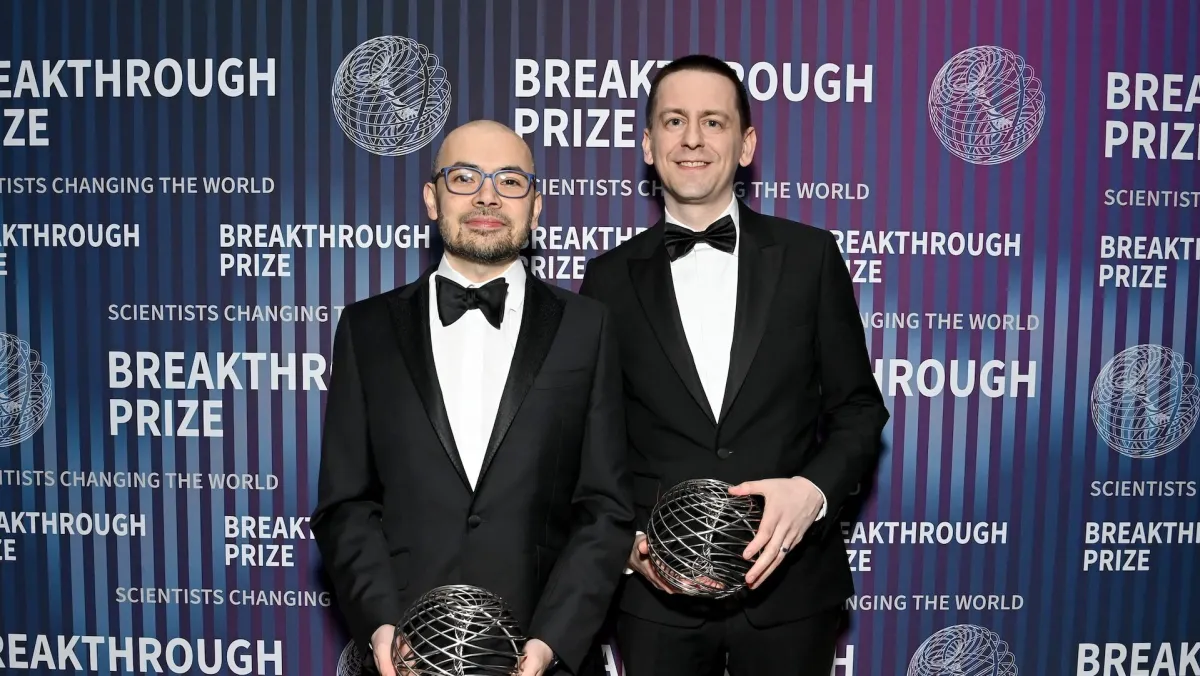
Jumper and Hassabis won the Nobel Prize in 2024 for their work on AlphaFold, an AI model that can predict the 3D structure of proteins
John Jumper, the Nobel Prize-winning scientist who led the AlphaFold team at Google DeepMind, has announced his departure to join rival AI firm Anthropic after a nearly nine-year tenure. This high-profile transition follows Jumper's recent contribution to Google’s coding tool development, a sector where the company has reportedly struggled to gain commercial traction. Jumper famously shared the 2024 Nobel Prize in chemistry with DeepMind CEO Demis Hassabis for creating AlphaFold, a revolutionary model capable of predicting the 3D structures of proteins based on genetic sequences. His move coincides with other significant talent shifts, including Character AI co-founder Noam Shazeer’s recent decision to leave DeepMind for OpenAI. This sequence of high-level departures underscores the intensifying competition for top-tier research talent among the industry’s leading artificial intelligence laboratories. The loss of a Nobel laureate represents a notable shift in the strategic landscape between Google and its primary generative AI competitors.
Source: TechCrunch AI
Foundation Models
This category explores the rapid evolution of foundation models, focusing on breakthroughs in scaling laws, architectural innovations, and multi-modal capabilities. As the industry pushes toward 10-trillion parameter benchmarks, we examine how leading developers are navigating the competitive landscape and narrowing the performance gap between global leaders. Stay informed on the fundamental technological shifts driving the next generation of artificial intelligence and its complex development hurdles.
MiniMax CEO on M3 Breakthroughs, 10T Scaling, and the US-China Model Gap
American models are 'basically 10 times larger,' and 10 times means exactly two generations.
Every domestic company must first do 3T well, then 10T—but a 10T model requires 200T of data, and 'there isn't that much in the whole world'.
MiniMax's M3 model marks a significant breakthrough in objective performance metrics, with the company now setting its sights on training a 10T-scale model. Current estimates place the gap between Chinese and American models at a factor of 10 in scale, representing roughly two generations of technological advancement. To reach the 10T milestone, an estimated 200T of training data is required, prompting a strategic shift in data acquisition toward the 10X expert collaboration project involving physicists and economists. AI coding is also reaching a critical inflection point, moving from "vibe engineering" to structured engineering where the foundation model's strength dictates the ceiling of agent capabilities. Future development focuses on using AI to understand the "black box" nature of models and aligning them through mechanisms that mirror the human hippocampus. This evolution necessitates a transition from simple data labeling to high-level expert feedback for complex task reasoning.
Source: 十字路口Crossing
AI Policy & Ethics
This category explores the evolving landscape of global governance and the technical frameworks ensuring safe model deployment. Recent developments highlight how stringent export controls are directly impacting the availability of frontier models, while the industry shifts toward treating responsible AI as a foundational infrastructure for autonomous agents. These stories underscore the growing tension between geopolitical trade policies and the necessity of embedding ethical guardrails within the core architecture of emerging AI systems.
Trump Administration Export Order Forces Anthropic to Pull Fable 5 and Mythos 5 Offline
Anthropic recently took its two newest AI models offline due to an export control order from the Trump administration
the White House got tipped off to this because of some Amazon researchers that allegedly found a way to bypass Fable 5’s guardrails.
Anthropic recently removed its newest AI models, Fable 5 and Mythos 5, from public access following a strict export control order issued by the Trump administration. The White House cited unspecified national security concerns after Amazon researchers allegedly discovered methods to bypass the safety guardrails of the Fable 5 model. This sudden regulatory move requires the company to ensure no foreign nationals can access the technology, a task complicated by the fact that many of Anthropic's own employees are foreigners. Cybersecurity experts have responded by signing an open letter urging the administration to revoke the order, arguing that pulling these advanced capabilities weakens U.S. network defense. Analysts suggest the crackdown stems partly from a strained relationship between Anthropic and the current administration, raising questions about whether rivals will face similar scrutiny. This disruption to the AI ecosystem highlights growing tensions between rapid technological advancement and national security policy.
Source: TechCrunch AI

How Responsible AI Becomes Critical Infrastructure for AI Agents
Responsible AI is moving from principles and output review to infrastructure for AI agents: runtime controls, policy-as-tests, monitoring, accountability
Once an AI system can call tools, cross into files, operate through APIs, and perform multi-step workflows, the output may become action.
Responsible AI is transitioning from passive output review to active infrastructure involving runtime controls, policy-as-tests, and system accountability. The traditional chat interface provided a built-in pause for human review, but autonomous agents now perform multi-step workflows that can directly trigger actions through tools and APIs. Microsoft is leading this shift by integrating safety measures directly into developer runtime environments, while Google DeepMind approaches agent safety as a complex security challenge. Effective governance now requires defining specific boundaries for what systems can access and determining which critical tasks must remain under direct human control. This evolution necessitates a shared safety net across organizations to ensure alignment as agents operate in a globally connected ecosystem. Moving safety closer to action is the only way to manage machines that operate at speeds exceeding human review capacity.
Source: Turing Post

AI Agents
AI agents are evolving from simple assistants into autonomous entities capable of conducting complex scientific research and robotic iterations. Recent advancements, such as NVIDIA’s ENPIRE framework, highlight a shift toward self-improving systems that operate independently in specialized domains. By leveraging sophisticated open-source reinforcement learning frameworks, these agents are becoming increasingly adept at high-level decision-making. This category explores the cutting-edge frameworks and autonomous capabilities defining the next generation of goal-oriented, intelligent systems.
NVIDIA Introduces ENPIRE: A Framework for AI Agents to Conduct Autonomous Robot Research
NVIDIA, CMU and Berkeley jointly launched the embodied intelligence Autoresearch framework — ENPIRE.
In just 3 hours, the success rate of the robot inserting a needle into a 4mm hole went from 0 to 99%.
NVIDIA, CMU, and Berkeley have introduced ENPIRE, a specialized framework that allows AI agents to autonomously conduct embodied intelligence research without human intervention. The system employs eight coding agents that manage dual-arm robots to perform tasks such as reading papers, modifying algorithms, and training policies. In the Pin Insertion task, the framework successfully increased success rates from 0% to 99% within just three hours of continuous self-improvement. A critical component of ENPIRE is the Environment module, which automates physical resetting and scoring, effectively turning the messy physical world into an iterative experimental platform. These agents demonstrate the ability to evolve research strategies, transitioning from behavior cloning to reinforcement learning and system architecture design as tasks grow in complexity. This shift toward physical scaling suggests that future AI progress may depend as much on expanding robotic fleets as on increasing GPU clusters.
Source: 量子位
10 Essential Open-source Frameworks for Training AI Agents with RL
Agent RL training frameworks help improve AI agents through trajectories, rewards, tool use, and environment interaction.
Agent Lightning trains AI agents via RL without rewriting the agent itself.
Reinforcement learning (RL) frameworks for AI agents are evolving to support complex multi-step trajectories, reward modeling, and tool-use optimization. Open-source tools like OpenPipe ART and verl-agent now offer specialized harnesses for Group Relative Policy Optimization (GRPO) and long-horizon tasks such as web browsing or GUI automation. Microsoft’s Agent Lightning enables developers to integrate RL into existing stacks like LangChain and AutoGen without rewriting the underlying agent logic. Additionally, Unsloth provides consumer-GPU-friendly local fine-tuning and GRPO-based training to significantly reduce memory requirements through custom kernels. Other frameworks such as OpenRLHF and NVIDIA Polar focus on distributed scaling and rollout orchestration respectively, facilitating robust end-to-end agent development. These tools collectively lower the barrier for building autonomous systems that can reason and interact with environments through iterative feedback loops.
Source: Turing Post
Emerging Tech
This category explores the cutting edge of technological evolution, where industry leaders redefine their strategies and core products. From Apple's internal design team restructuring to WeChat's innovative testing of native AI assistant 'Xiao Wei,' these updates highlight a shift toward deeply integrated intelligence. Additionally, OpenAI's latest financial projections offer crucial insights into the economic sustainability of the generative AI boom, shaping how we perceive the future of global innovation and corporate structures.
Tech Daily: Apple Restructures Design Team, WeChat Tests Native AI, and OpenAI Financials
John Ternus, who will take over as Apple CEO this September, is restructuring the industrial design team which has suffered from talent loss.
OpenAI recently raised its five-year revenue forecast, expecting revenue from ChatGPT subscriptions, AI models, advertising, and hardware to be about 27% higher than previously predicted.
Apple's incoming CEO John Ternus is restructuring the company's industrial design team to restore its central decision-making status and mitigate ongoing talent loss. WeChat has expanded the grey-scale testing of its native AI assistant "Xiao Wei," which allows users to manage Moments, mini-programs, and music through conversational commands. OpenAI has adjusted its financial outlook, projecting annual revenue to reach $30 billion this year while anticipating a total cash burn of $111 billion by 2030 due to high training costs. Elon Musk has successfully completed his 2018 compensation package, resulting in a book gain of approximately $116 billion through Tesla stock options. Additionally, JD.com founder Liu Qiangdong announced the "Nirvana Plan" to retrain 700,000 blue-collar employees for technical roles as autonomous robots begin taking over delivery logistics.
Source: 爱范儿

Open Source
Explore the evolving landscape of open-source software, focusing on the latest breakthroughs in large and small language models. This category covers essential tools and frameworks that drive transparency and community collaboration in artificial intelligence. Stay informed about the future of decentralized development as we compare model architectures and highlight the most promising projects set to redefine the tech industry by 2026.
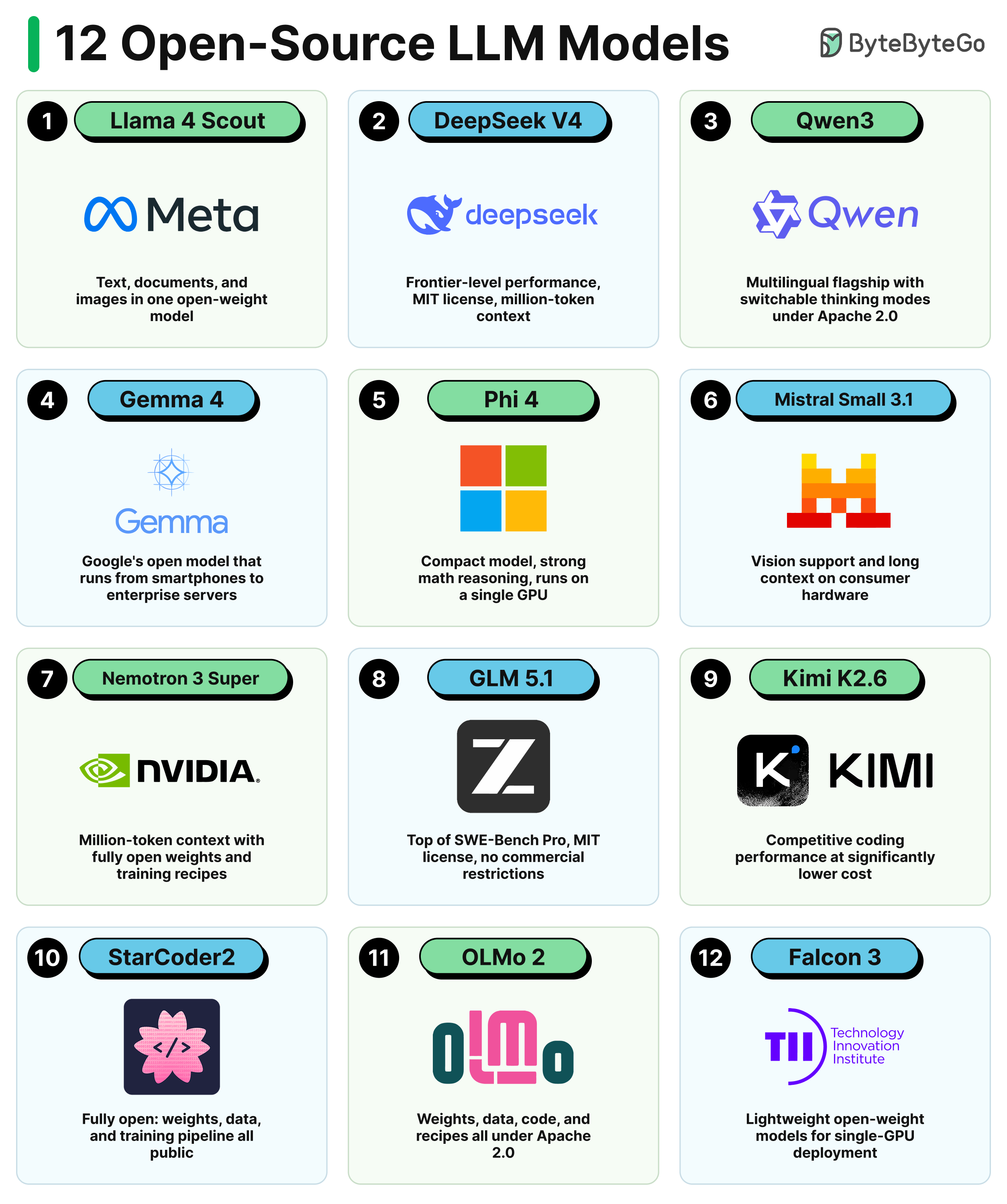
ByteByteGo EP219: 12 Open-Source LLMs for 2026 and SLM vs. LLM Comparison
AI shows up in 60% of engineering work. But only about a fifth of it can be handed off without someone babysitting the output.
DeepSeek V4: A Mixture-of-Experts model under MIT license with a native million-token context window.
AI currently participates in 60% of engineering workflows, yet only 20% can be completed without human supervision because of context gaps. The landscape of open-source models in 2026 features diverse options ranging from Meta's natively multimodal Llama 4 Scout to NVIDIA's hybrid MoE Nemotron 3 Super. Specialized models like GLM 5.1 now lead benchmarks like SWE-Bench Pro, while others such as Phi 4 focus on synthetic data for edge deployment. DeepSeek V4 and Nemotron 3 Super provide native million-token context windows to support complex agentic tasks. These advancements highlight a clear distinction between Small Language Models under 10 billion parameters for on-device use and larger models built for broad reasoning. Successfully deploying these agents requires a dedicated context layer to ensure quality, efficiency, and cost-effectiveness in production environments.
Source: ByteByteGo Newsletter
This report is auto-generated by WindFlash AI based on public AI news from the past 48 hours.