Sunday, June 14, 2026 · 10 curated articles

Editor's Picks
In mid-2026, we are witnessing the definitive transition from AI as a 'co-pilot' to AI as a 'primary operator.' The most significant trend surfacing today is the emergence of the 'Autonomous Flywheel'—systems that don't just suggest code or summarize text, but independently execute, verify, and iterate within complex environments. This isn't just a marginal improvement in productivity; it is a fundamental re-architecting of how software and security systems function. For developers, the message is clear: the era of manual checkpoints is ending, and the era of 'automated verifiers' has begun.
Microsoft’s Project Ire is the most aggressive manifestation of this shift. By allowing an LLM agent to autonomously perform reverse engineering and malware classification, Microsoft has effectively replaced the human security analyst in the 'triage' phase. The fact that it successfully identified the LOTUSLITE variant—which bypassed elite EDR tools like CrowdStrike—proves that agentic reasoning based on TTPs (Tools, Tactics, and Procedures) is now superior to static signature matching. This highlights a critical shift for engineers: we are moving away from writing detection rules toward building environments where agents can safely perform forensic 'experiments' to reach a verdict.
However, the technical bottleneck is no longer the intelligence of the model, but the infrastructure it inhabits. As noted in 'The Flywheel: Transitioning to Closed-Loop AI Workflows,' the real challenge for 2026 is replacing human intuition with automated feedback loops. If an agent can move at machine speed but still requires a human to sign off on every PR or security report, the system collapses. We are seeing companies like Databricks respond to this by launching Lakehouse Federation, which provides the 'plumbing' for these agents. By enabling agents to query across AWS, Snowflake, and BigQuery without manual migration, they are removing the friction that previously kept AI trapped in a single silo.
For the engineering community, this shift implies a massive reallocation of talent. We are moving from being 'builders of logic' to 'architects of objective functions.' In an agentic world, your primary job is to define the 'done' state and build the automated verifiers that ensure the agent hasn't hallucinated its way into a security breach. The 'MANGOS' era isn't just a change in ticker symbols; it’s the financial recognition that the winners will be those who provide the compute and the frameworks for this autonomous agency. If you are still building linear pipelines in 2026, you aren't just behind—you're obsolete.
AI Agents
AI agents are evolving from basic conversational tools into autonomous systems capable of managing complex workflows and enhancing cybersecurity. This shift toward closed-loop automation allows agents to execute multi-step tasks, such as identifying sophisticated malware or managing private cloud data, with minimal human intervention. As organizations integrate these agents into core infrastructure, balancing operational efficiency with robust security protocols and privacy safeguards becomes a critical priority for the next generation of AI deployment.
Microsoft Project Ire Uses LLM Agents to Identify Undetected LOTUSLITE Malware
Project Ire identifies a LOTUSLITE variant that shares TTPs (tools, tactics, procedures) with the public family but none of its indicators of compromise (IOC).
The LLM-driven agent produces a function-by-function behavioral report on the sample without any user interaction to determine whether it is malicious.
Project Ire, Microsoft’s autonomous malware-classification agent, successfully identified a variant of the LOTUSLITE Windows DLL backdoor that bypassed detection from major EDR tools including CrowdStrike Falcon and SentinelOne. The LLM-driven system generated a comprehensive behavioral report covering installation routines, command-and-control (C2) packet layouts, and persistence mechanisms without requiring any human interaction or prior context. While the specific sample’s hash was not present in existing indicators of compromise (IOC) lists, the agent correctly identified malicious intent by analyzing shared tools, tactics, and procedures (TTPs) through autonomous static analysis. This demonstration highlights how agentic reverse engineering can surface novel malware variants that rely on signature-evasion techniques. By invoking decompilers and binary-analysis tools independently, Project Ire builds an auditable chain of evidence to reach definitive verdicts where traditional signature matching fails. The system even declined to attribute the malware based on cleartext strings, focusing instead on objective, verifiable behavioral evidence.
Source: Microsoft Research Blog (current)
#6: The Flywheel: Transitioning to Closed-Loop AI Workflows
A closed loop is a workflow that feeds itself: the output of one run becomes the input of the next, with no human in between.
A flywheel has three beats, not one: generate, measure, decide what to try next – then generate again.
AI flywheels are defined as closed-loop systems that generate, measure results, and decide subsequent actions based on an objective without human intervention. While a traditional pipeline follows fixed mechanical logic and a workflow incorporates human judgment, a flywheel uses measurement to steer its own course. Transitioning to these autonomous systems requires replacing human checkpoints with automated verifiers, such as test suites or schema validations, rather than simply removing oversight. As workflows mature, the human role migrates from the center to the edges, focusing on setting initial parameters and reviewing final exceptions. Organizations currently lack the necessary infrastructure to absorb these machine-speed verification processes, which often creates a review bottleneck. Successful implementation depends on identifying which specific loops can be safely closed using objective performance metrics to achieve AI-native operations.
Source: Turing Post
The Security Implications of Apple's Private Cloud Compute and AI Agents
Apple looks like it will use some combination of Google Gemini models, combined with Google’s Confidential Inference
The goal of this system is to ensure that your data never leaves Apple’s hardware
Apple is integrating Google Gemini models with its Private Cloud Compute (PCC) infrastructure to enable advanced AI capabilities within the Siri ecosystem. This system utilizes Apple Silicon and hardware security modules to process deeply private user data like schedules and emails while attempting to ensure data remains inaccessible to both Apple and Google. While the stateless design of PCC aims to prevent data retention, the complexity of managing private agent tasks—such as coordinating schedules or accounting for dietary restrictions—introduces significant technical friction. The expansion of PCC to include Google's data centers relies on confidential compute layers to verify the integrity of the models being executed. However, the transition from simple inference to autonomous agents highlights a growing tension between personalized utility and data sovereignty. This shift necessitates a rigorous evaluation of whether current technical security measures can sufficiently protect user context in an increasingly interconnected agentic landscape.
Source: Lobsters AI

Emerging Tech
This category explores transformative breakthroughs and experimental advancements reshaping the global technological landscape. Recent innovations, such as the repurposing of retired smartphones into low-carbon cloud infrastructure by Google and UC San Diego researchers, exemplify the growing shift toward sustainable and circular computing. By focusing on frontier solutions that balance processing power with environmental responsibility, we highlight the technologies defining the next generation of resilient digital ecosystems.
Google Research and UC San Diego Build Low-Carbon Cloud from Retired Phones
Note that the motherboard is responsible for the largest fraction of embodied carbon (approximately 50% based on internal carbon footprinting assessments)
university plans to deploy a datacenter built from 2,000 Pixel smartphones that will provide hundreds of researchers and students with low-cost, low-carbon cloud computing
The manufacturing phase of a smartphone's motherboard accounts for approximately 50% of its total embodied carbon footprint. Researchers at the University of California San Diego are addressing this sustainability challenge by extracting motherboards from retired Pixel smartphones to create general-purpose computing clusters. This initiative plans to deploy a datacenter featuring 2,000 devices to provide researchers and students with low-cost, low-carbon cloud computing resources. By replacing the mobile-oriented Android userspace with general-purpose Linux distributions, these decommissioned devices can handle server-side applications efficiently. This approach directly reduces the environmental impact of computing by extending the lifecycle of high-performance hardware and avoiding the need for new raw material extraction. Modern smartphone processor cores often provide single-threaded performance that is comparable to or better than traditional multicore server processors.
Source: Google Research Blog

AI Business
This category examines the evolving commercial landscape of artificial intelligence, highlighting how major private players like OpenAI and Anthropic are restructuring the IPO market and venture capital strategies. We explore the rise of AI-native revenue tools and platforms that are currently dominating market share and lead generation. Additionally, we cover critical initiatives aimed at enhancing corporate AI fluency, ensuring that organizations can effectively integrate automated workflows into their daily operations to drive long-term business value.
The MANGOS Era: How OpenAI, Anthropic, and SpaceX are Reshaping the IPO Market
Half of that bunch is heading to public markets in the same window, and it’s a stress test for investors
What a $920 million-per-month compute deal between Google and SpaceX says about who’s leading the AI infrastructure race
The tech sector is witnessing a shift from the traditional FAANG dominance to a new "MANGOS" acronym comprising Meta, Anthropic, Nvidia, Google, OpenAI, and SpaceX. Half of these companies are reportedly preparing to enter the public markets within the same window, creating a significant stress test for global investor valuations. A major highlight in the current AI landscape is a $920 million-per-month compute deal between Google and SpaceX, signaling an intense race for infrastructure dominance. Additionally, Waymo is emerging as a leader in the autonomous vehicle space, effectively capitalizing on Apple's abandoned self-driving initiatives. The current IPO surge projected for 2026 reflects a fundamental change in what investors expect from public technology companies compared to previous market cycles. This shift highlights the growing influence of foundation model providers and specialized hardware manufacturers in the broader financial ecosystem.
Source: TechCrunch AI

SaaStr AI 2026 Lead Rankings: Replit and AI-Native Revenue Tools Lead the Market
Replit — 1,423 leads (Vibe Coding / AI Dev Tools)
Lightfield, an AI-native CRM, beat Salesforce by 35 leads.
Replit secured the top spot at SaaStr AI Annual 2026 with 1,423 leads, significantly outpacing the runner-up by 361 leads and signaling a major shift toward vibe coding and democratized software development. The engagement leaderboard reveals that B2B budgets are gravitating toward three core themes: building, selling, and running companies, with sales-related software accounting for nearly half of the top 15 spots. AI-native solutions are beginning to disrupt established incumbents, as evidenced by AI-native CRM Lightfield outperforming Salesforce in lead generation during the event. This trend highlights a growing demand for AI sales agents and outbound automation as companies prioritize distribution over mere product creation. The shift toward building internal tools rather than purchasing off-the-shelf software is further evidenced by the high performance of platforms like Lovable and Relevance AI. Ultimately, the data confirms that revenue teams are aggressively reallocating budgets toward AI-first products to solve complex pipeline and closing challenges in the 2026 market.
Source: SaaStr

OpenAI Launches Academy Courses to Build Workforce AI Fluency and Workflows
OpenAI introduces three Academy courses that help people build practical AI skills, create repeatable workflows, and apply agents in everyday work.
OpenAI has introduced three new Academy courses—AI Foundations, Applied AI Foundations, and Agents and Workflows—to help organizations transition from basic AI usage to sophisticated agent-assisted automation. These educational programs are designed in collaboration with global partners like BCG, Accenture, and BBVA to provide practical skills grounded in real-world business deployment. The AI Foundations course covers fundamental concepts such as prompting and output review, while the Applied AI Foundations module focuses on building structured, repeatable workflows that balance quality and cost. For advanced users, the Agents and Workflows course teaches how to direct autonomous agents within defined boundaries while maintaining necessary human oversight. Upon completion, learners receive certificates to recognize their progress in achieving AI fluency across their respective workforces. This initiative reflects OpenAI's strategy of integrating learning directly into the deployment process to shorten the distance between technology adoption and tangible business value.
Source: OpenAI News
Data & Analytics
Explore the evolving landscape of data management where business intelligence meets advanced AI integration. This category covers critical advancements in data architecture, such as lakehouse federation and real-time processing, that empower organizations to unify siloed information. By streamlining how AI agents and analysts query multi-platform data, these innovations drive deeper insights and more efficient decision-making across the modern enterprise.
Databricks Lakehouse Federation Enables AI Agents to Query Multi-Platform Data
Lakehouse Federation connects to over 20 of the most popular data platforms.
Permissions, lineage, and access controls work consistently across every connected system
Databricks Lakehouse Federation now connects directly to over 20 data platforms, including AWS Glue, Snowflake, and BigQuery, to enable cross-source reasoning for AI agents. This architecture allows business users to query unified data in natural language through Genie without performing manual data migrations or building complex pipelines. By syncing metadata in-place to Unity Catalog, the system preserves existing table descriptions and business glossary terms automatically. Security and governance are centralized, ensuring that permissions and access controls work consistently across every connected external system. The platform currently supports foreign table comments for Glue and BigQuery, with expanded preview support for Redshift, MySQL, and PostgreSQL. These advancements address the growing demand for agentic AI tools that can derive insights from data estates spread across multiple clouds and legacy formats.
Source: Databricks
Research
Stay ahead of the curve with our curated selection of groundbreaking research papers and technical investigations into the evolving cybersecurity landscape. This section explores critical findings such as the identification of Advanced Persistent Threats (APTs) targeting custom Linux gateways, offering deep dives into infrastructure vulnerabilities and sophisticated exploit methodologies. By bridging academic rigor with practical security implications, these studies provide essential insights for professionals aiming to harden network perimeters against next-generation cyberattacks.
Investigating Advanced Persistent Threats in Custom Linux Gateways
The gateways run a custom Linux stack: basically a monolithic compiled kernel (without any modules), and a static GOlang application on top.
The 100+ machines have no internal storage, but rather boot from an external USB media that has the kernel and the application.
A security assessment of a custom Linux-based gateway cluster revealed a unique system architecture utilizing a monolithic kernel and a static Go application acting as both the init system and reverse proxy. These 100+ machines operate without internal storage, booting instead from external USB media and mounting configuration via hardcoded NFS shares. The investigation transitioned from a routine compliance check into an incident response scenario focused on detecting unauthorized access to personally identifiable information within decrypted HTTP traffic. To analyze potential data leaks, researchers developed a methodology involving mirrored port traffic capture and a Python-based mapping tool to correlate encrypted TLS four-tuples with decrypted HTTP content. Early forensic steps included examining the custom GOlang stack's initialization process and the 'X-Orig-Connection' headers added to internal requests to identify specific user connections.
Source: Igor Blue
Developer Tools
Developer tools are evolving to meet the demands of massive scale and sophisticated security requirements in modern cloud environments. Recent breakthroughs demonstrate how optimizing infrastructure and scanning capabilities can lead to tenfold performance increases, enabling teams to identify vulnerabilities more efficiently than ever before. This section explores the latest innovations in software delivery, cloud integration, and automated security insights that empower developers to build robust and resilient applications.
Scaling Cloudflare Security Insights: Achieving 10x Scanning Capacity
Cloudflare Security Insights system now processes over 120 scans per second
scaled our throughput 10x without adding hardware.
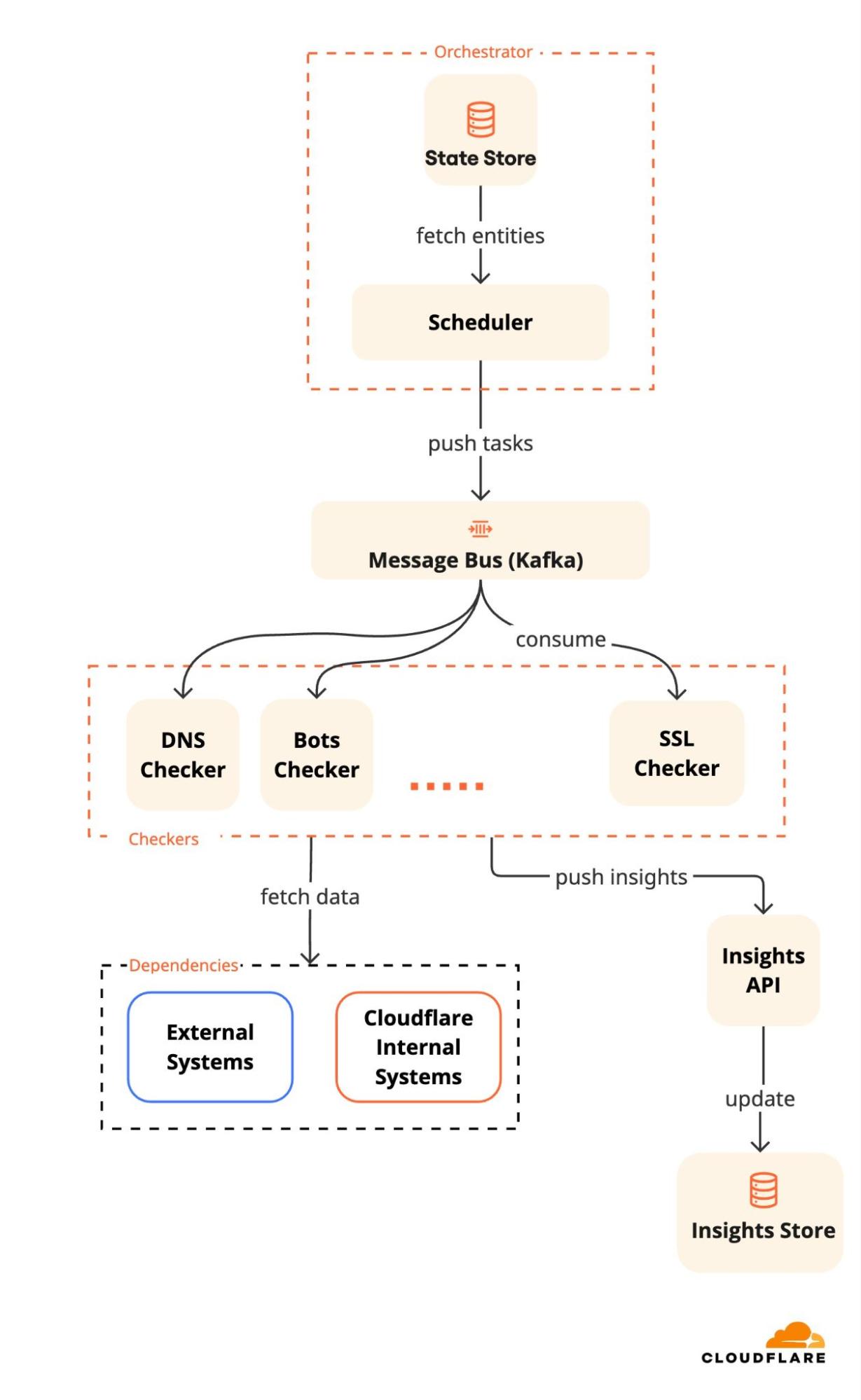
Cloudflare Security Insights now processes over 120 scans per second, representing a tenfold increase in throughput achieved without additional hardware. This architectural overhaul addresses previous limitations where scans were performed only every week or two, leaving customers vulnerable to rapidly accelerating automated attacks. Engineers optimized the system by refining Kafka consumer patterns, improving Postgres query efficiency, and streamlining API interactions to handle millions of events. These improvements allowed Cloudflare to double scanning frequency for all customers and enable automatic scanning for millions of free accounts that were previously opt-in only. By shifting from a partitioned event stream to more efficient processing models, the team eliminated systemic backlogs and API timeouts. This transition ensures that newly introduced security risks and misconfigurations are detected within a much shorter window, significantly enhancing the overall security posture of the global Internet.
Source: The Cloudflare Blog
This report is auto-generated by WindFlash AI based on public AI news from the past 48 hours.