Monday, June 8, 2026 · 10 curated articles
Editor's Picks
The mid-point of 2026 has arrived, and the narrative has shifted from 'AI as a feature' to 'AI as the workforce.' We are witnessing the definitive decoupling of revenue from headcount, a trend epitomized by Anthropic's staggering $9.4 million revenue-per-employee metric. As highlighted in 'Anthropic's Record Pace to $1 Trillion,' the traditional SaaS model—where value was derived from software seats—is being cannibalized by foundational models that 'sell labor' directly. For developers, the implications are stark: if a company can scale to a trillion-dollar valuation with just 5,000 people, the era of the massive engineering org is officially over. We are entering the age of the 'Lean Leviathan,' where intelligence delivered via API replaces entire departments.
This shift is being codified at the architecture level. Mario Rodriguez’s discussion on 'GitHub’s Shift to Agent-Native Engineering' signals a fundamental transition from Micro-Correction to Macro-Delegation. We’ve moved past the 'toddler' phase of AI; we are now building for Agent Experience (AX). This isn't just about better autocomplete; it’s about rethinking systems to support autonomous agents that can navigate complex codebases independently. However, as the 'Amazing Digital Dentures' failure demonstrates, we aren't at the finish line yet. The gap between generating a simple HTML clock and orchestrating complex 3D logic remains significant. Agents are currently hitting a ceiling in high-entropy creative environments, proving that while they can automate the 'labor,' they haven't yet mastered the 'craft' of complex systems integration.
Perhaps most exciting is the research into 'Nested Learning and Sleep Paradigms' by Ali Behrouz. The 'catastrophic forgetting' that has long hobbled LLMs is finally being addressed through multi-frequency updates. By giving AI a 'sleep phase' to distill fast-updating knowledge into stable parameters, we are moving toward agents with persistent identities and long-term memory. This is the missing link for true collaboration. If an agent can remember your architectural preferences across years of projects, it ceases to be a tool and becomes a peer. For the engineers reading this: your value no longer lies in domain expertise or bug-fixing—which, as HackerNews notes, are being commoditized—but in your ability to design the high-level loops that govern these evolving, self-modifying systems. You are no longer the builder; you are the architect of the builders.
Developer Tools
The landscape of software development is undergoing a paradigm shift toward 'agent-native' engineering, where AI agents move beyond simple code completion to autonomous task management. Tools like GitHub are pioneering macro-delegation, allowing developers to oversee complex workflows rather than focusing solely on manual coding. This evolution is supported by emerging plugin ecosystems, such as Datasette’s agentic manipulation tools, which empower developers to integrate intelligent automation directly into their existing data environments and specialized engineering workflows.
Mario Rodriguez on GitHub’s Shift to Agent-Native Engineering and Macro-Delegation
What changed in that December timeframe was that you could actually say, “Go ahead and play – it’s safe,” and you would get an output with very high quality.
Record acceleration across commits, PRs, Actions, and security scans – and a fundamental rethink of what GitHub even is.
Model capabilities reached a significant milestone in December 2025, enabling developers to shift from constant correction to high-quality macro-delegation. GitHub Chief Product Officer Mario Rodriguez describes this transition as an evolution from treating AI like a toddler to engaging in productive iterative creation loops. This capability jump has triggered record acceleration across commits, pull requests, and security scans, necessitating a fundamental rethink of GitHub's core architecture. The focus of development is now moving beyond traditional UI and UX toward Agent Experience (AX), prioritizing how engineering systems support autonomous agents. Rodriguez emphasizes that while agents can now handle larger tasks independently, human-agent collaboration remains central to the creative process. GitHub aims to serve the entire spectrum of users, from first-time builders to elite craftsmen, within this new agent-native ecosystem.
Source: Turing Post
Datasette-Agent-Edit 0.1a0: A Base Plugin for Agentic Text Manipulation
I decided to create this base plugin, datasette-agent-edit, which implements the core tools in a way that allows them to be adapted for other plugins.
Agentic editing of text is a little tricky to get right. My favorite published design for this is for the Claude text editor
Simon Willison has released datasette-agent-edit 0.1a0 as a base plugin designed to handle the complexities of agentic text editing within the Datasette ecosystem. This tool implements a specific set of patterns inspired by the Claude text editor, including capabilities for viewing file sections with line numbers, performing unique string replacements, and inserting text at specified line positions. By centralizing these core functionalities, the plugin enables other tools to more easily perform collaborative Markdown editing, update large SQL queries, and modify SVG files. Willison developed this base plugin to avoid recreating these patterns across multiple specialized plugins currently in development for Datasette Agent. The design specifically addresses the difficulty of making reliable edits to existing text by ensuring that string replacements only occur if the target string is unique. This release marks a foundational step in building more sophisticated agent-driven editing capabilities for developers using the Datasette platform.
Source: Simon Willison's Weblog
Research
This section explores the latest frontiers in academic AI research, focusing on architectural innovations that push the boundaries of machine intelligence. This week, we examine groundbreaking studies on long-term memory, highlighting how nested learning and biomimetic sleep paradigms allow models to retain information more effectively. These theoretical advancements are essential for developing autonomous agents capable of continuous improvement and more sophisticated human-like reasoning across extended periods.
#573. How AI Achieves Long-Term Memory via Nested Learning and Sleep Paradigms
Allowing different modules within the model to update at different frequencies, letting fast modules handle immediate adaptation and slow modules handle long-term abstraction and stable memory.
Models should not just have training and testing phases; they should act like continual learners, receiving information during active phases and organizing, compressing, and consolidating knowledge during sleep.
Current large language models suffer from catastrophic forgetting and fixed knowledge cutoffs, preventing them from incorporating new information into their parameters as humans do. Researcher Ali Behrouz proposes "Nested Learning," a framework where internal modules update at varying frequencies to balance immediate adaptation with long-term memory stability. This paradigm introduces a "sleep" phase for AI, where models organize, compress, and distill knowledge from fast-updating layers into slow-updating stable parameters. Architectural innovations like HoPE and self-modifying Titan models leverage multi-frequency MLP blocks and recursive processes to filter noise and facilitate knowledge transfer. By moving beyond static training and testing cycles, these systems aim to create persistent, evolving AI collaborators capable of maintaining a stable identity and personalized memory. Such advancements could fundamentally reshape AI user experiences, alignment strategies, and privacy frameworks.
Source: 跨国串门儿计划

AI Business
This category explores the commercial landscape of artificial intelligence, focusing on the strategic moves of industry giants and the financial dynamics of high-growth startups. From Anthropic’s rapid valuation surge to Apple’s evolving ecosystem strategies and Google’s massive infrastructure investments, we analyze how AI is redefining corporate efficiency and market competition. It provides essential insights into model wars, investment trends, and the real-world opportunities for entrepreneurs navigating this multi-trillion-dollar technological shift.
Anthropic's Record Pace to $1 Trillion and the New Era of AI Efficiency
Anthropic raised $65 billion at a $965 billion valuation and filed confidentially for an IPO.
Anthropic is doing somewhere around $47 billion in annualized revenue with about 5,000 employees.
Anthropic is projected to reach a $1 trillion valuation within five years of its 2021 founding, having already raised $65 billion at a $965 billion valuation. This rapid growth significantly outpaces historical benchmarks, as Apple required 42 years and Google 21 years to reach the same milestone. The company currently generates approximately $47 billion in annualized revenue with only 5,000 employees, resulting in an unprecedented $9.4 million in revenue per person. This efficiency represents a major decoupling of revenue and headcount compared to legacy tech giants like Salesforce or Alphabet, which required tens of thousands more employees to reach similar revenue levels. As Anthropic and OpenAI prepare for potential 2026 IPOs, their lean operational models suggest that intelligence delivered via APIs has fundamentally altered the scale and pace of company building for the next generation of software businesses.
Source: SaaStr

Tech Digest: Apple Rebuilds AI Strategy; Google to Rent $920M Monthly Compute
Apple will hold WWDC 2026 on the early morning of June 9, Beijing time, bringing the largest Siri and AI function updates in its history.
Google will pay SpaceX $920 million per month from October 2026 to June 2029 to use the computing power corresponding to approximately 110,000 Nvidia GPUs.
Apple is reportedly overhauling its AI strategy for WWDC 2026, shifting from a previously fragmented approach to a centralized initiative led by Craig Federighi and Mike Rockwell. The company plans to introduce a standalone AI assistant to compete with ChatGPT, supported by a partnership with Google to utilize Gemini models and cloud infrastructure for Siri. Google has also signed a massive $920 million monthly agreement with SpaceX to lease compute power from 110,000 Nvidia GPUs starting in late 2026. Meanwhile, OpenAI is preparing to merge Codex into ChatGPT to create a more comprehensive agentic experience for its users. Additionally, ByteDance clarified that it has no internal plans to manufacture vehicles, while Nvidia and SK Hynix announced a strategic partnership to develop next-generation memory and digital twin technology for AI factories.
Source: 爱范儿

Vol.121: 2026 Mid-Year AI Review - Revaluation, Model Wars, and Startup Strategies
The entire industry is welcoming a turning point year where valuation surges and value revaluation coexist.
Startups are no longer selling software (SaaS) or tools, but are directly selling work results or 'digital employee services' delivered by AI.
The first half of 2026 represents a pivotal turning point for the AI industry characterized by simultaneous valuation surges and fundamental value reassessments. Jinqiu Fund partners identify three primary competitive fronts: the foundation model rivalry between OpenAI, Anthropic, and Google; the emergence of video models reaching a 'GPT-3 moment'; and the strategic divergence between Vision-Language-Action (VLA) and World Model approaches in embodied intelligence. Vertical AI applications face existential pressure as foundational models increasingly absorb software functionalities, forcing a shift toward 'selling labor' through digital employees rather than traditional SaaS models. Entrepreneurs must navigate critical dilemmas regarding regional market selection between China and the US while evaluating whether specific sectors are destined to become battlegrounds for tech giants. Despite the absence of a breakout AI hardware hit, the evolution toward agentic capabilities and unified end-to-end models suggests a transition from simple tools to autonomous digital agents.
Source: 开始连接LinkStart

Programming
This edition explores the evolving landscape of software engineering as large language models begin to reshape core development paradigms and traditional engineering pillars. We examine the profound shifts in how developers build and maintain systems, alongside a critical analysis of recent security vulnerabilities, including the Meta data breach. These stories highlight the dual nature of modern programming: the rapid integration of AI-driven tools and the persistent, high-stakes challenges of maintaining robust security infrastructure in an increasingly automated world.
2026 06 08 HackerNews: LLM Impact on Engineering and Meta Security Breach
Large language models are eroding the three professional pillars of senior software engineers: domain knowledge, bug-fixing ability, and architectural taste.
Meta admitted that an AI chatbot vulnerability led to at least 20,225 Instagram accounts being hijacked via bypassed password verification.
Large language models are undermining the three professional pillars of senior software engineers—domain expertise, bug-fixing capability, and architectural taste—as specialized developers transition toward an oversupplied pool of generalists. Meta recently confirmed that an AI chatbot vulnerability allowed attackers to hijack at least 20,225 Instagram accounts by bypassing password reset verifications. In geopolitical news, the U.S. Defense Intelligence Agency raised the Israeli counter-intelligence threat level to "Critical" amid concerns over surveillance of high-level officials regarding Middle East policy. Technical developments include a widespread request for an official Linux version of Anthropic's Claude Desktop and the release of ntsc-rs for real-time retro video artifacts. Additionally, the 29th International Obfuscated C Code Contest announced winners featuring creative projects like a GameBoy emulator, while authors are increasingly replacing Figma design workflows with direct Claude-generated code prototypes for faster feedback.
Source: SuperTechFans
AI Infrastructure
AI infrastructure forms the critical backbone of modern machine learning, encompassing high-performance hardware and optimized networking architectures. This category explores the technical intricacies of specialized processing units like Google’s TPU v8 and the fundamental metrics—latency, throughput, and bandwidth—that define system performance. Understanding these hardware innovations and performance trade-offs is essential for scaling complex AI models and managing the massive data demands of the current generative AI era.
ByteByteGo EP217: Decoding Latency vs Throughput vs Bandwidth and Google TPU v8
Throughput is always less than bandwidth.
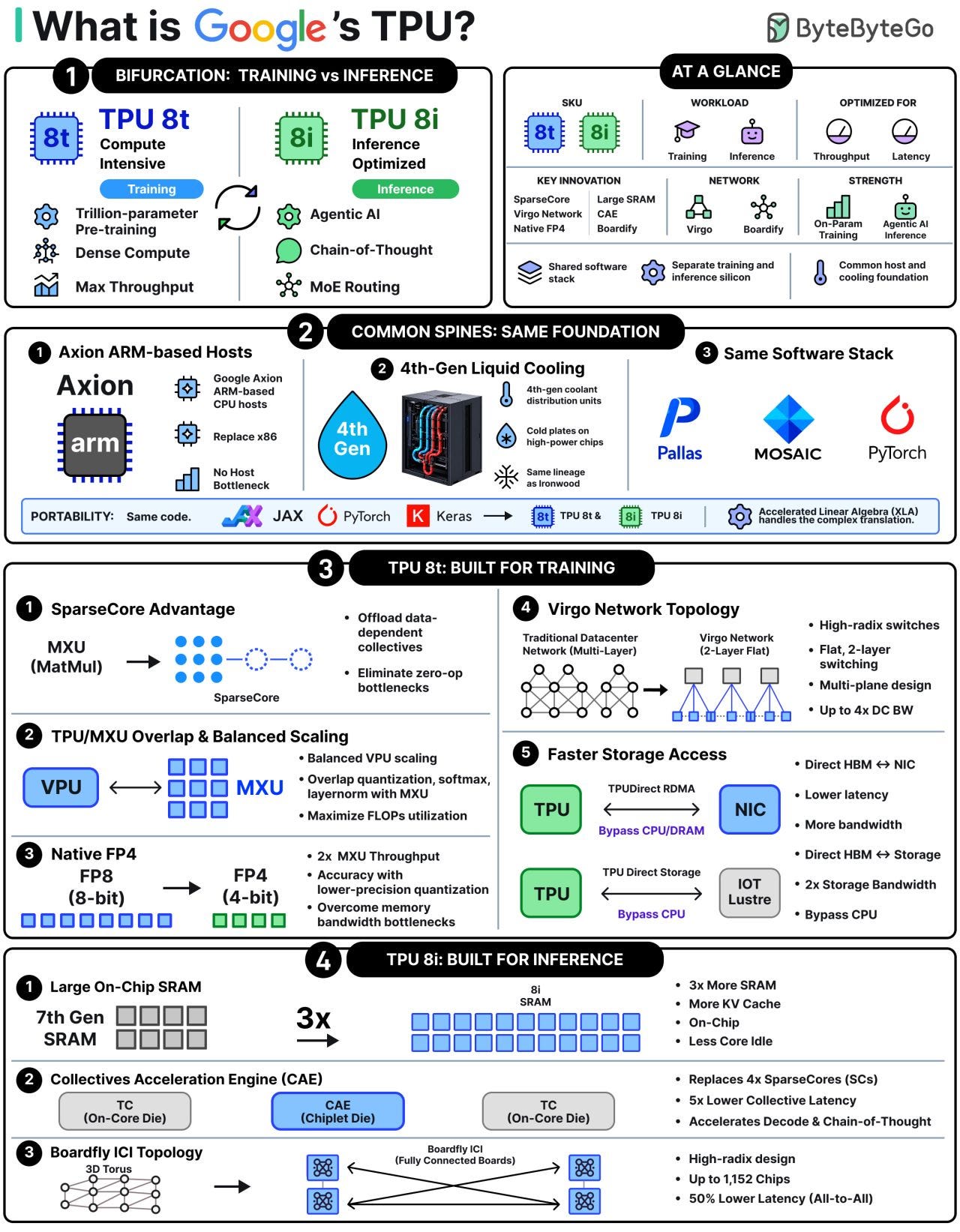
TPU 8t is built for training, where raw throughput wins. TPU 8i is built for inference, where latency and chip-to-chip speed matter most.
Throughput is always less than bandwidth because network congestion, packet loss, and protocol overhead prevent reaching the theoretical maximum capacity. While latency represents the delay for a single packet to travel between endpoints, bandwidth defines the upper limit of the link, and throughput measures the actual data successfully transferred per second. In specialized AI hardware, Google’s 8th-generation Tensor Processing Units now ship in two distinct flavors to address different performance needs. The TPU 8t is optimized for training where raw throughput is the priority, while the TPU 8i is designed for inference where latency and chip-to-chip speed are critical. These infrastructure components are increasingly vital as AI agents like QA Wolf automate complex user flows and testing at speeds up to 12x faster than manual methods. Understanding the interplay between these three metrics remains essential for system designers predicting when applications will fail under load.
Source: ByteByteGo Newsletter
Data & Analytics
In the rapidly evolving landscape of data and analytics, organizations leverage sophisticated APIs and processing frameworks to transform raw information into actionable market intelligence. This section explores the latest advancements in data sourcing, real-time analytics, and the integration of high-fidelity datasets into AI-driven ecosystems. From selecting robust financial APIs to optimizing big data pipelines, we provide the essential technical insights needed to power next-generation fintech solutions and autonomous intelligent agents.
Selecting the Right Stock Market API for FinTech and AI Agent Development
A backtester needs adjusted historical prices, splits, dividends, and stable time series.
An AI agent needs structured data that it can retrieve and use without guessing.
Choosing a stock market API for financial technology requires evaluating specific data requirements such as adjusted historical prices for backtesting or highly structured metadata for AI agents. Development workflows dictate the necessary features, as dashboards prioritize real-time quote freshness while screeners rely on deep fundamental ratios and company metadata. AI assistants specifically demand structured data that enables precise retrieval and utilization without the need for probabilistic guessing during autonomous workflows. A robust technical implementation involves integrating prices, technical indicators, and fundamental data into a unified Python environment to ensure consistency across research tasks. Alpha Vantage serves as a practical reference for building these comprehensive systems by providing a centralized source for diverse financial data points within a single project framework.
Source: freeCodeCamp.org
AI Applications
This category explores the practical integration of artificial intelligence across various industries, highlighting both groundbreaking successes and instructive failures. By examining real-world case studies like LLM-powered game development, we analyze how theoretical models perform when faced with complex, user-facing environments. Stay informed on the evolving landscape of AI deployment as developers navigate the technical and ethical challenges of bringing advanced algorithms into everyday software and digital experiences.
Amazing Digital Dentures: A Case Study in LLM-Powered Game Development Failures
I was using the Nemotron 30b I wanted it to create full on games with three js
anything more complex like tetris breaks it
The Amazing Digital Dentures project failed to achieve its goal of creating a complex adventure-based productivity tool using the Nemotron 30b model and Three.js. Initially inspired by the show "The Amazing Digital Circus," the developer attempted to generate full-scale 3D games through various prompting techniques, including long-form instructions and skill card integration. Despite implementing Retrieval-Augmented Generation (RAG) over distilled skill sets using Codex to manage context window constraints, the model consistently produced non-functional code resulting in blank screens. The project eventually pivoted into a simpler HTML toymaker capable of generating basic applications like clocks, snake, and breakout games in a single shot. However, the system remains limited by complexity, as even games like Tetris cause the current implementation to fail. This case study highlights the significant gap between generating simple HTML scripts and orchestrating complex 3D logic with current small-to-mid-sized language models during hackathon environments.
Source: Hugging Face Blog
This report is auto-generated by WindFlash AI based on public AI news from the past 48 hours.