Sunday, May 31, 2026 · 10 curated articles
Editor's Picks
The era of the 'clever demo' is officially dead. As we hit the midpoint of 2026, the industry has pivoted from chasing raw parameter counts to building the boring, necessary, and incredibly complex infrastructure of accountability. Today’s news cycle highlights a critical convergence: AI is finally growing up, and it’s doing so by swallowing the traditional engineering virtues of verification, liability, and deterministic testing. For the modern developer, the focus has shifted from 'How do I get this model to work?' to 'How do I prove this AI workflow will behave under pressure?'
DoorDash’s 'Evaluation Flywheel' is the perfect case study for this transition. By building a simulation-first architecture to catch hallucinations before they hit production, they’ve admitted what many were afraid to say two years ago: non-deterministic systems require a massive, deterministic shadow-infrastructure to be viable. It’s no longer enough to 'vibe check' a prompt. If you’re handling hundreds of thousands of daily interactions, you need an automated grading framework that mirrors the rigor of a compiler. This is the new 'CI/CD' for the agentic age. Engineers who aren't building their own evaluation flywheels today are simply technical debt collectors for tomorrow.
But the most provocative move comes from the hardware sector. BYD’s announcement of the 4nm Xuanji A3 chip is impressive, but its pledge of 'unlimited, full liability' for its smart driving system is the real earthquake. This is the ultimate benchmark of AI maturity. When a company is willing to stake its balance sheet on model-assisted decisions, the 'hallucination' excuse evaporates. Google Cloud’s May customer round-up points to the same direction from a different angle: BASF using AlphaEvolve for chemical synthesis, Ocado improving product discovery with Vertex AI Search, and Monks building generative animation workflows all show AI being pulled into accountable operating systems rather than isolated demos.
For the engineers reading this, the message is clear: the 'Vibe Coding' era mentioned in our latest podcast is a luxury for the prototyping phase. The production-grade future belongs to those who can build the simulators, checklists, and data feedback loops that make AI behavior measurable. Whether it’s DoorDash’s offline evaluation, BYD’s liability promise, or Google Cloud customers pushing AI into supply chains and media workflows, the value in 2026 isn't in the model itself. It is in the verifiable control of that model.
AI Infrastructure
AI Infrastructure explores the foundational systems and frameworks required to build, deploy, and scale machine learning models in production environments. This category focuses on the underlying architecture behind Large Language Models (LLMs), including evaluation pipelines, automated simulation systems, and performance monitoring tools. By examining how industry leaders optimize their workflows through iterative feedback loops, we gain insights into creating robust, reliable, and efficient AI ecosystems that support complex real-world applications.
How DoorDash Built an Evaluation Flywheel for Customer Support LLMs
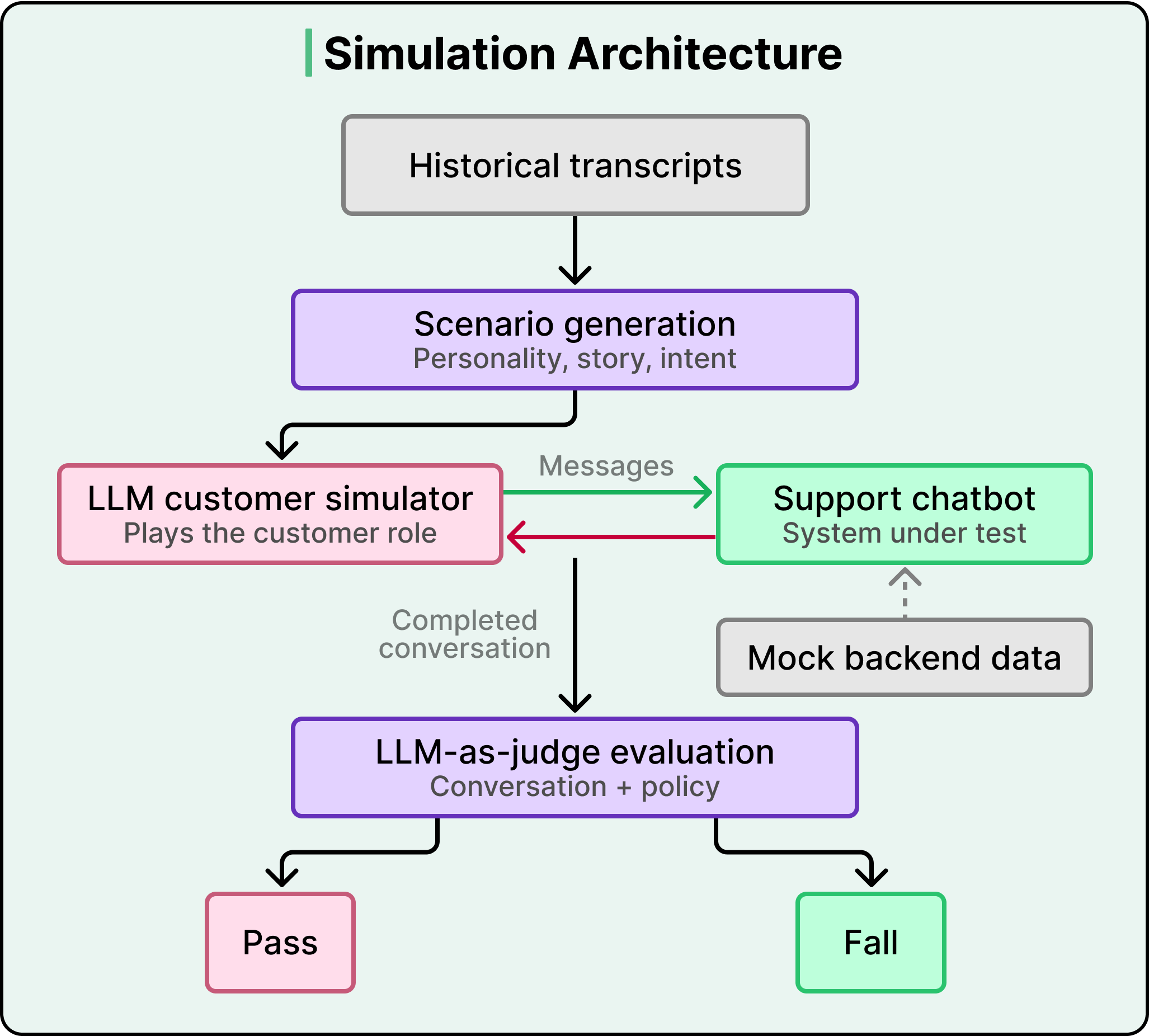
DoorDash’s answer to this problem wasn’t a better chatbot. It was a better system for improving the chatbot, something they call the simulation and evaluation flywheel.
The first is an offline simulator that generates realistic multi-turn customer conversations without involving any real customers.
DoorDash developed a simulation and evaluation flywheel to address non-deterministic hallucination issues in its large-scale customer support chatbot. The system replaces manual testing and risky production deployments with an offline simulator that generates realistic multi-turn conversations and an automated grading framework. By orchestrating test scenarios from historical transcripts, the pipeline allows engineers to capture specific failure modes and iterate on prompts without manual intervention. This infrastructure move shifted the support system from traditional decision trees to a flexible yet verifiable LLM-based architecture. The platform handles hundreds of thousands of daily contacts across customers, merchants, and drivers, making automated verification essential for maintaining service quality. This closed-loop system ensures that improvements to reduce hallucinations in one area do not inadvertently degrade performance in another, maintaining a stable experience across the entire logistics network.
Source: ByteByteGo Newsletter
Research
This section highlights the latest breakthroughs in academic and industrial research, focusing on theoretical advancements and novel architectures. Recent highlights include the development of Gamma-World by NVIDIA and Tsinghua, a pioneering multi-agent generative world model designed for complex interactive environments. These studies push the boundaries of how AI understands physics and multi-entity dynamics, paving the way for more sophisticated simulations and autonomous systems.
Gamma-World: NVIDIA and Tsinghua Unveil Multi-Agent Generative World Model
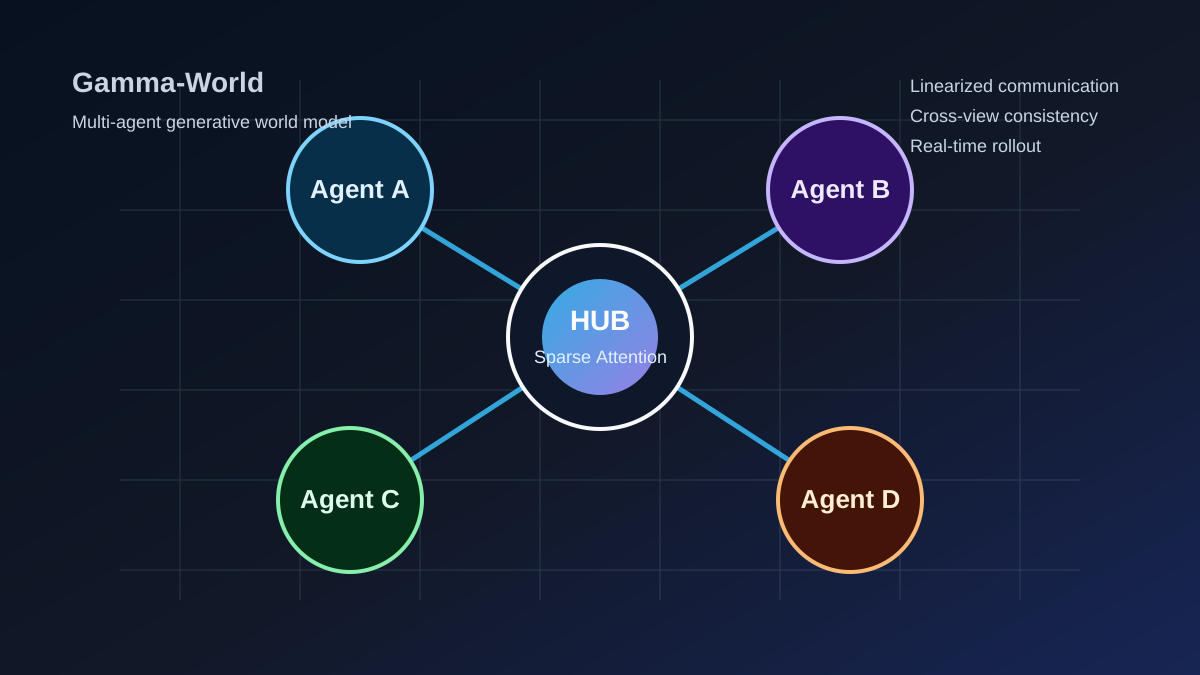
Gamma-World (γ-World) provides a systematic answer by starting with two underlying components: RoPE expansion and attention topology.
This structure compresses the computational cost from quadratic complexity to linear complexity.
Gamma-World introduces a scalable architecture for multi-agent world modeling, addressing the structural limitations of existing single-agent frameworks in maintaining cross-view and interaction consistency. The system utilizes Simplex Rotary Agent Encoding, which positions agents at the vertices of a regular simplex to ensure identity symmetry and zero-shot scalability to larger groups without retraining. To overcome computational bottlenecks, the researchers implemented Sparse Hub Attention, which reduces attention complexity from quadratic to linear by using latent hub tokens as a bottleneck for information exchange. The model undergoes a rigorous three-stage training process involving distribution matching distillation, enabling it to achieve real-time 24 FPS performance with just 4-step sampling during inference. This methodology ensures that actions performed by one agent are accurately reflected across all participants' perspectives while maintaining strict temporal coherence across the shared environment.
Source: 量子位
AI Business
Explore the strategic intersection of artificial intelligence and corporate growth, from Dan Loeb's investment lens to SaaStr's experience running AI customer-success agents. This section also examines BYD's 4nm smart-driving chip and liability commitment, showing how AI is shifting from software capability into operational and financial responsibility.
Dan Loeb on AI, Credit Strategy, and Third Point’s $25 Billion Investment Evolution
Third Point is an investment firm managing approximately $25 billion in assets.
AI is not just an industry theme, but a foundational variable affecting energy, power, chips, software, applications, corporate organization, and capital expenditure.
Third Point founder Dan Loeb manages approximately $25 billion in assets across hedge funds, credit, and private equity while identifying AI and oil prices as the two most critical variables in the current market. Modern investors cannot avoid technology, as the AI stack—spanning electricity, chips, models, and applications—is fundamentally reshaping the global economy and corporate quality. Loeb emphasizes a transition from deep value to quality investing, noting that even high-quality companies may lose their competitive edge if they fail to adapt to rapid technological disruptions. Third Point leverages cross-asset capabilities, integrating credit and equity strategies to navigate complex environments like the restructuring of Sony or investments in xAI debt. Internal investment workflows at the firm now mandate the use of AI tools like Claude and agents to enhance research efficiency and handle information overload. Human judgment remains irreplaceable for restructuring, negotiations, and capital allocation during periods where market sentiment diverges from fundamental values.
Source: 跨国串门儿计划

SaaStr's QBee Shows Why Neutral AI Agents Can Improve Customer Operations
It’s that customers treat agents better than they treat humans.
QBee checked the submission. Between QBee and Claude reviewing the asset, we caught the placeholder instantly.
SaaStr's production use of QBee, an AI VP of Customer Success built on Replit, shows a practical pattern for enterprise agents: repetitive deadline enforcement may work better when handled by a neutral system. The agent tracks sponsor deliverables, reviews submitted assets with Claude, catches placeholders, and sends calm factual follow-ups without emotional escalation. SaaStr argues that customers often comply faster with an agent because there is no human relationship to pressure or negotiate against. This does not replace judgment-heavy customer work, but it does move tedious accountability loops away from overloaded teams. For B2B companies with onboarding tasks, deployment checklists, training steps, or partner deliverables, the lesson is that agent value can come from consistency and coverage, not just from advanced reasoning.
Source: SaaStr

BYD Launches 4nm Xuanji A3 Chip and Full Liability Coverage for Smart Driving
As China's first self-developed 4nm smart driving chip, it represents the highest level of Chinese smart driving chips.
Implementing an unlimited, full-amount liability guarantee for traffic accident losses caused by city pilot assisted driving.
BYD has launched the Xuanji A3, China’s first self-developed 4nm automotive-grade chip designed for L3 and L4 autonomous driving, featuring a cumulative R&D investment exceeding 100 billion RMB. The company operates five wafer manufacturing plants and a research team of over 7,000 employees, achieving full-process manufacturing capabilities across seven key stages from design to packaging. Beyond hardware, BYD announced an unprecedented policy to assume unlimited, full liability for traffic accident losses caused by its city pilot assisted driving system. This strategic move aims to eliminate user anxiety and accelerate the collection of complex road data to refine its AI algorithms. Currently, BYD's automotive chips are utilized by 46 domestic and international brands, signaling its transition from a traditional vehicle manufacturer to a core technology supplier.
Source: 爱范儿
Developer Tools
Explore the cutting edge of software engineering with insights into the latest programming language updates like Zig 0.17 and innovative uses for proven technologies like SQLite in persistent workflows. As the industry scales, the massive valuations of AI giants highlight the increasing intersection between massive infrastructure investment and developer productivity. This section provides the essential tools and architectural trends necessary for modern developers to remain competitive in an ever-evolving technical landscape.
2026-05-31 HackerNews: SQLite for Workflows, Anthropic's $1T Valuation, and Zig 0.17
SQLite is sufficient for building persistent workflows due to its transactionality, zero network latency, low maintenance, and availability of Litestream for asynchronous backup.
Anthropic pushed its valuation close to one trillion with its Series H round, saw a surge in revenue, and released new models, temporarily surpassing OpenAI as the most valuable AI startup.
SQLite provides a sufficient foundation for durable workflows through transactional state management and zero network latency when combined with Litestream for asynchronous S3 backups. Anthropic has pushed its valuation toward $1 trillion following a Series H funding round and significant revenue growth, positioning itself as a leading AI startup while preparing for an IPO. The Zig programming language project announced a self-developed ELF linker for version 0.17, designed to achieve zero-performance-loss incremental linking and a refactored build system with lower latency. Danish pension fund Akademikerpension recently blacklisted SpaceX due to concerns over Elon Musk’s concentrated voting power and a market valuation exceeding $1.8 trillion that lacks internal consistency. Critics within the developer community are questioning the utility of the Model Context Protocol (MCP), citing issues with context bloat and permission opacity. Additionally, security researchers are in a standoff with Microsoft over the handling and disclosure of several Windows zero-day vulnerabilities.
Source: SuperTechFans
AI Agents
The landscape of artificial intelligence is rapidly shifting from static chat interfaces to proactive systems embedded in customer operations, cloud workflows, and creative production. Recent examples from Google Cloud customers and AI-native podcasts show the same trend from two angles: enterprises are operationalizing AI, while builders are rethinking markets around humans and agents as distinct users.
Google Cloud Customers Push AI Into Chemistry, Search, and Media Workflows
BASF is working with Google Cloud to use AlphaEvolve to help discover new chemical reactions more efficiently.
Ocado’s AI-powered shopping assistant is expanding to more consumers across Europe, powered by Vertex AI Search.
Google Cloud's May customer round-up shows applied AI spreading across scientific research, retail search, media production, and developer workflows. BASF is using AlphaEvolve to explore chemical reactions more efficiently, while Ocado is extending an AI-powered shopping assistant based on Vertex AI Search to more European consumers. Monks is applying Google Cloud AI and Gemini to create animated brand characters with reduced manual effort, and Upscale AI uses Gemini Code Assist to speed up development work. The common thread is not a single model launch, but the movement of AI into concrete production contexts where the output must affect customer experience, research throughput, or creative delivery. For developers, this reinforces the shift from AI demos toward integrated systems that sit inside real business processes.
Source: Google Cloud Blog

Podcast E237: Navigating the Shift to an AI Agent-Driven Future and New Work Paradigms
The future market will no longer be divided into to B or to C, but rather to Agent or to Human.
Vibe coding refers to writing code with the help of AI Agents—users don't need to understand the code, but only describe requirements in natural language.
The distinction between "to B" and "to C" markets is dissolving as AI Agents become both producers and consumers capable of making autonomous purchasing decisions. Modern technology shifts like "Vibe Coding" allow individuals to build software using natural language without needing to understand underlying code, effectively lowering the barrier to creation while increasing productivity. Recent developments in "Coding Agents" such as Claude Code and Codex demonstrate a transition where AI systems can autonomously plan and execute complex programming tasks from start to finish. Despite rapid advancements, the penetration of AI into the physical world remains slower than digital adoption, creating a disconnect in public perception. Experts emphasize that while AI can optimize tasks through reinforcement learning, it lacks the intrinsic human capacity for emotional resonance and creative judgment. Ultimately, the focus is shifting toward "To Human" and "To Agent" service models, redefining how value is captured in the emerging digital landscape.
Source: 知行小酒馆

Data & Analytics
In the rapidly evolving landscape of modern enterprise, data and analytics serve as the fundamental pillars for informed decision-making and strategic growth. This category explores the transformative power of data intelligence, highlighting how organizations leverage advanced metrics to optimize operational efficiency and drive innovation across sectors like value-based healthcare. By synthesizing complex datasets into actionable insights, businesses can navigate competitive challenges and unlock sustainable value through precision-driven strategies.
Winning CMS TEAM: Leveraging Data Intelligence for Value-Based Healthcare
top-performing health systems could capture $4M-$30M annually in shared savings
two-thirds of hospitals will lose revenue under TEAM based on current spending patterns
Starting January 1, 2026, over 700 U.S. hospitals must manage total costs and quality across five high-volume surgical episodes under the CMS Transforming Episode Accountability Model (TEAM). Top-performing health systems stand to gain between $4 million and $30 million annually in shared savings, while unprepared organizations face potential repayments exceeding $10 million over the five-year term. Currently, industry data indicates that two-thirds of hospitals are on track to lose revenue under TEAM due to existing spending patterns and inefficient traditional analytics infrastructure. To succeed, hospitals must transition to a unified data lakehouse architecture that integrates clinical EHR data, claims, post-acute care data, and social determinants. This modern foundation allows for AI and machine learning integration to provide real-time risk stratification and complication prediction. By implementing these intelligent data foundations, healthcare providers can move beyond retroactive dashboards to enable proactive clinical interventions before costs exceed targets.
Source: Databricks
Programming
Dive into the evolving landscape of software development, where browser-native tools and lightweight JavaScript libraries continue to turn everyday workflows into local, privacy-preserving applications. This section focuses on practical document automation and the engineering choices behind tools that run entirely in the user's browser.
Building a Browser-Based PDF Page Numbering Tool with JavaScript
Instead of manually editing every page, modern JavaScript libraries let you add page numbers directly inside the browser.
Everything runs locally inside the browser for better privacy and faster processing.
freeCodeCamp published a practical tutorial for building a browser-based PDF page numbering tool with JavaScript. The workflow uses PDF-lib to load an uploaded PDF, inspect its pages, draw page numbers at configurable positions, and export the updated document without a backend server. Users can choose page ranges, skip cover pages, customize numbering formats, adjust font styling, preview the result, and download the final file locally. The implementation is a good example of client-side document automation: sensitive files never leave the user's device, while the browser handles processing, preview, and export. For developers, the useful lesson is that small browser-native utilities can deliver real productivity gains when they combine simple UI controls with robust local file processing.
Source: freeCodeCamp.org

This report is auto-generated by WindFlash AI based on public AI news from the past 48 hours.