Friday, May 29, 2026 · 10 curated articles
Editor's Picks
By May 2026, the 'API Wrapper' era hasn't just ended; it has been unceremoniously buried. Today’s headlines from WindFlash signal a violent shift toward what I call the 'Sovereign Edge.' For years, we’ve been told that frontier models are the exclusive domain of cloud-scale compute. ModelBest’s Open Source Week just shattered that narrative. When you can run a 60-billion-parameter model on a mobile device using 1.58-bit quantization (BitCPM-CANN), the architectural gravity of the industry shifts from centralized data centers to the palm of the user’s hand. This isn't just about latency; it’s about the economic survival of the developer.
The economics of inference are reaching a breaking point. As 'Protecting AI Endpoints Against High-Margin Inference Theft' highlights, a single prompt can cost a million times more than a standard HTTP request. This high-margin risk is forcing a divergence: enterprise workflows are moving toward heavily governed, agentic frameworks like Google Cloud’s Gemini Enterprise Platform, while the most innovative 'Little Tech' founders are following Garry Tan’s 'G Brain' philosophy. Tan’s focus on personal agents and local data sovereignty is the spiritual successor to the personal computing revolution of the 70s. For the modern engineer, the challenge is no longer just 'making it work'; it’s about making it run locally, securely, and without a $2-per-prompt tax.
We are also seeing the 'Industrialization of Intent.' The SaaStr 2026 data—where the Amelia agent booked 614 meetings from 400k chats—proves that agents are moving beyond chat interfaces into autonomous revenue engines. However, the rise of the 'AI Forward Deployed Engineer' (FDE) tells us that these agents aren't 'set and forget.' They require deep, bespoke integration. The future doesn't belong to the developer who can call an API; it belongs to the engineer who can build a full-stack, on-device ecosystem that treats AI not as a service, but as a local, private, and hyper-efficient extension of human agency.
Foundation Models
Foundation models represent the core architecture driving the current AI revolution, transitioning from massive cloud-based systems to highly efficient, on-device deployments. This category explores the latest advancements in large language models, including open-source breakthroughs that democratize access to cutting-edge capabilities. As developers focus on systematic layouts for edge computing, these models are becoming increasingly specialized to balance performance with hardware constraints, ultimately shaping the future of personalized and private artificial intelligence experiences.
ModelBest Open Source Week: Defining the End Game for On-Device AI
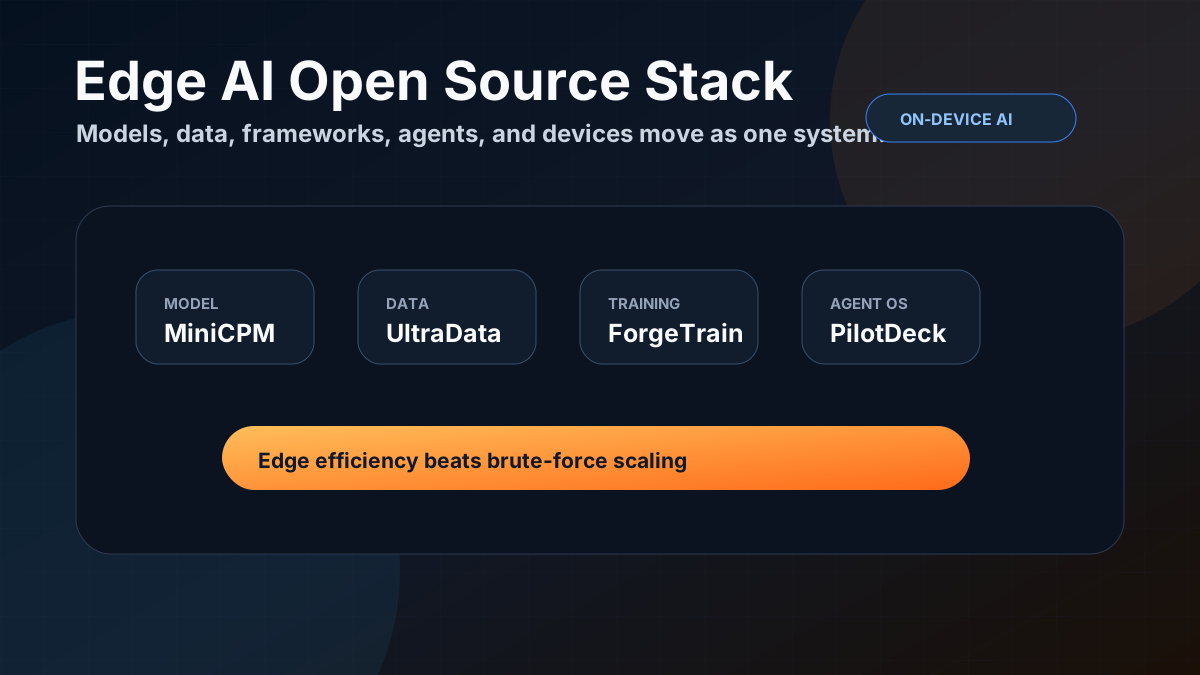
MiniCPM5-1B, which outperforms models with twice its parameters and is the best in its class globally.
ForgeTrain, which is faster than NVIDIA's own large model training framework Megatron on H100.
ModelBest and OpenBMB released five key technological achievements during their May 2026 Open Source Week, highlighting on-device AI as a complex systemic engineering feat. The releases include BitCPM-CANN, a 1.58-bit training model capable of running 60-billion-parameter models on mobile devices, and MiniCPM5-1B, which outperforms some versions of GPT-4o despite its compact size. The AI-authored training framework ForgeTrain reportedly surpasses NVIDIA's Megatron in performance by 10% on H100 GPUs. These developments, alongside the UltraData series and the PilotDeck Agent OS, form a full-stack ecosystem spanning data, algorithms, and infrastructure. This strategic move positions ModelBest as a frontrunner in the transition from cloud-based AI to localized, high-performance edge computing. By open-sourcing the entire production line rather than just model weights, the company aims to foster a transparent technical ecosystem for AGI development.
Source: 量子位
AI Business
Explore the rapidly evolving intersection of artificial intelligence and global commerce, from ByteDance’s industrial-scale growth engines to the shifting pricing strategies of foundational models like Gemini. This category examines how enterprises are integrating AI to redefine user acquisition, the rise of specialized roles like forward-deployed engineers, and the impact of open-source innovation on startup ecosystems. Stay informed on the strategic shifts and leadership philosophies driving the next wave of AI-powered business transformation and economic value creation.
ByteDance’s Growth Engine: Building an Industrial-Scale User Growth Platform
During that year and a half, TikTok's DAU increased by 400 to 500 million.
Calculating LTV for 730 days or even full life cycles, building predictive attribution models, and distilling ad optimizers into robots.
ByteDance transformed user growth from traditional channel buying into a centralized middle-office platform capable of predicting 730-day Lifetime Value (LTV) and automating creative production. During a critical period starting in 2019, the TikTok growth team successfully added approximately 400 to 500 million Daily Active Users (DAU) by leveraging these industrial-scale systems and predictive models. The company's methodology relies on a distillation process where manual ad optimizers are replaced by automated robots, supported by massive internal tools like the Beidou creative system and specialized risk control frameworks. These systems prioritize a 15% market penetration threshold as a tipping point where organic traffic begins to surpass paid acquisition. While the framework has powered major successes from Douyin to TikTok, its application in the AI era with products like Doubao faces new challenges as large language models redefine the traditional relationship between retention and capital expenditure. Ultimately, ByteDance's competitive advantage lies in treating growth as a rigorous, automated science rather than a marketing art.
Source: 乱翻书

#558. Garry Tan on AI Revolution: Open Source, Personal Agents, and YC’s Core Philosophy
How YC works: investing $500,000, and why community is more important than money
AI's Apple II moment: from institutional AI to everyone owning their own Agent
Y Combinator CEO Garry Tan identifies AI as the next personal computing revolution where individual agency and open-source models like DeepSeek and Qwen challenge centralized institutional control. Y Combinator continues to invest $500,000 in early-stage startups, emphasizing its core directive to "make something people want" while shifting focus toward founders who utilize "vibe coding" and personal AI agents. Tan advocates for the "G Brain" concept, a personal knowledge system that reads local emails and notes to ensure users maintain sovereignty over their data. The current technological landscape allows smaller, highly efficient teams to build massive revenue streams by leveraging rapid advancements in code generation and open-source AI infrastructure. Successful founders distinguish themselves through a combination of sincere obsession, subjective agency, and the ability to transform personal challenges into creative output. This shift toward "Little Tech" marks a departure from closed-source dominance, favoring permissionless innovation and builder-led communities.
Source: 跨国串门儿计划

Gemini Flash Pricing and the Rise of AI Forward Deployed Engineers: The Batch 355
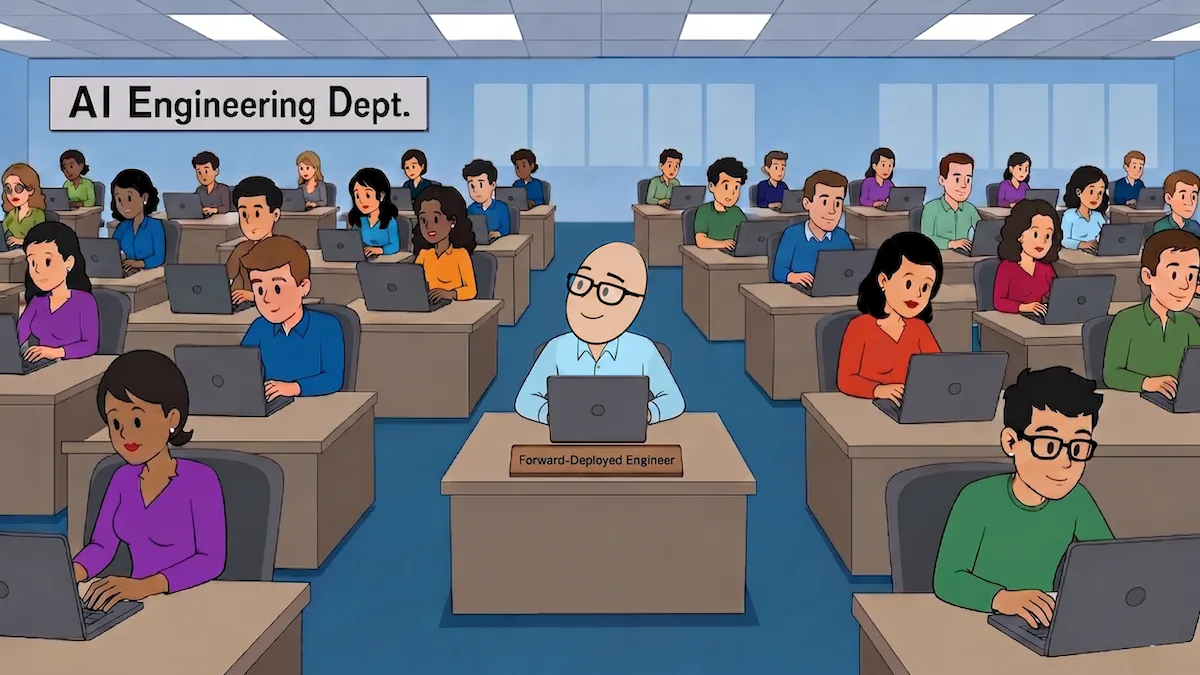
One of the new, buzzy jobs in Silicon Valley is the AI Forward Deployed Engineer (FDE), an engineer who is embedded within a client organization to help customize solutions
I’ve heard from people who are wondering anew about the FDE career path since OpenAI and Anthropic started building new teams to place FDEs within client organizations.
Silicon Valley is witnessing a resurgence of the AI Forward Deployed Engineer (FDE) role as major labs like OpenAI and Anthropic build dedicated teams to embed technical staff within client organizations. These engineers specialize in customizing agentic workflows and integrating proprietary large language models into specific business environments, requiring a mix of technical proficiency and strategic communication skills. While FDEs provide deep vendor integration, the broader AI Engineer role is expected to see significantly higher demand due to the corporate need for vendor-neutral solutions and internal project control. As the field matures, the generalist AI Engineer position will likely fragment into specialized sub-roles such as LLMOps, Evals, and AI Data Engineering. This shift underscores a growing job market for professionals who can leverage tools like Claude Code and agentic frameworks to build complex AI-driven applications rather than just calling simple APIs.
Source: deeplearning.ai
AI Infrastructure
This category explores the foundational systems and tools essential for deploying, monitoring, and securing large-scale artificial intelligence models. Recent highlights include advanced observability frameworks for Amazon SageMaker LLM inference using Managed Grafana to ensure performance reliability and operational transparency. Additionally, we delve into critical security measures designed to protect AI endpoints from high-margin inference theft, ensuring that compute resources and intellectual property remain safeguarded throughout the model deployment lifecycle in production environments.
Observability for Amazon SageMaker AI LLM Inference Using Managed Grafana
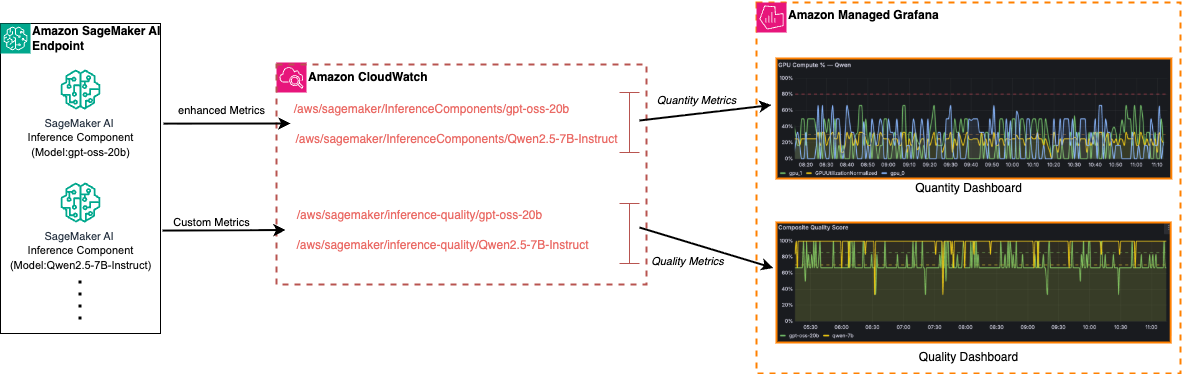
A single SageMaker AI endpoint can host multiple inference components, each running a different LLM (for example, gpt-oss-20b and Qwen2.5-7B-Instruct
The first stage establishes visibility into core operational metrics such as latency, errors, and resource utilization.
Amazon SageMaker AI endpoints utilize inference components to host multiple models like Qwen2.5-7B-Instruct on shared infrastructure while tracking both operational quantity and model quality. This observability solution integrates Amazon CloudWatch and Amazon Managed Grafana to provide a holistic view of GPU utilization, memory pressure, and request throughput alongside model-specific evaluations. Infrastructure monitoring focuses on operational health and resource right-sizing to control costs, while quality monitoring detects model drift and response degradation. The workflow allows teams to correlate infrastructure signals with generative AI performance to ensure consistent output accuracy. By establishing thresholds and automated alerts, the system transitions from basic visibility to automated optimization across diverse model configurations. This dual-dimension approach ensures that endpoints remain operationally efficient while delivering safe and reliable responses for production-scale generative AI workloads.
Source: AWS Machine Learning Blog
Protecting AI Endpoints Against High-Margin Inference Theft
a single prompt to an agent on a frontier model can cost $2, making AI a million times more expensive
Inference theft is the unauthorized use of someone else's paid AI inference, either for free consumption or downstream resale.
Frontier model prompts can cost up to $2 each, making them approximately one million times more expensive than standard HTTP requests which cost roughly $2 per million. This economic disparity has created a high-margin market for inference theft, where attackers steal paid AI calls through exposed endpoints for free consumption or downstream resale. Sophisticated actors utilize residential proxies and custom adapters to bypass traditional security measures like IP-based rate limiting and authentication walls that typically only verify sessions. For instance, the Chipotlai Max project demonstrates how attackers can turn a simple customer support chatbot into an OpenAI-compatible endpoint for unauthorized usage. Effective protection requires deep analysis and verification for every individual AI request rather than relying on amortized checks performed at the start of a user session. Vercel's internal data shows that even fixed-system-prompt assistants are targets, as attackers have learned to manipulate models into serving general-purpose requests cheaply.
Source: Vercel News

AI Agents
AI agents are rapidly evolving from conceptual experiments into high-performance tools capable of managing complex enterprise workflows at scale. Recent breakthroughs showcased at events like SaaStr AI Annual 2026 highlight their ability to drive real-world results, such as automating thousands of sales interactions to secure hundreds of meetings. Meanwhile, major cloud providers like Google Cloud are prioritizing robust governance frameworks and integrating advanced models like Claude Opus 4.8 to ensure these autonomous systems remain secure and efficient.
How AI Agents Booked 614 Meetings and Other Learnings from SaaStr AI Annual 2026
Our Amelia AI (Qualified) Agent Booked 614 Meetings From 442K Chats. Itself.
We would have needed 3-10+ BDRs who would turn over every 3-6 months.
The Amelia AI agent successfully booked 614 qualified meetings from 442,000 individual chats during the SaaStr AI Annual 2026 event. This performance highlights the efficiency of autonomous agents compared to human business development teams, which would require significant staffing and overhead to handle over 2.2 million website sessions. Successful enterprise agents typically evolve from simple internal tools through iterative development and deep integration with existing CRM data via headless Salesforce implementations. Real-world applications from companies like Owner.com show that scaling to $100M ARR is achievable by pivoting entirely to AI-driven processes. However, evidence suggests that maintaining continuous human interaction and context building is essential for agent performance, contradicting the common fire-and-forget narrative. Utilizing development environments like Replit or v0 to build custom dashboards outside native CRM interfaces provides the necessary data context for these agents to excel in lead scoring and customer engagement.
Source: SaaStr
Google Cloud Update: Claude Opus 4.8 and AI Agent Governance
Anthropic’s Claude Opus 4.8 is now available on Gemini Enterprise Agent Platform.
Google AI Edge Portal bridges this gap, giving GCP developers the ability to test AI performance on 120+ Android devices
Anthropic’s Claude Opus 4.8 is now integrated into the Gemini Enterprise Agent Platform to support complex, multi-stage enterprise workflows and advanced agentic coding tasks. Google Cloud is introducing the Model Context Protocol (MCP) to standardize how AI agents interact with external data sources and legacy REST APIs safely. New security frameworks, such as the Extended Agent Gateway pattern, help prevent unauthorized API calls and enforce fine-grained authorization for autonomous agents at the gateway layer. Developers can now utilize the Google AI Edge Portal to benchmark fine-tuned LLMs across over 120 different Android devices to optimize performance for fragmented hardware. These updates prioritize secure orchestration, allowing organizations to transform existing digital ecosystems into governed AI-driven environments with robust audit logs and access control policies. Together, these tools enable the transition from experimental AI pilots to core enterprise functions through centralized management.
Source: Google Cloud Blog

AI Applications
Artificial intelligence is rapidly evolving from general-purpose assistants into specialized tools designed for specific human activities, including personalized education and interactive physical training. These emerging applications leverage advanced machine learning models to provide real-time feedback, adaptive learning paths, and immersive coaching experiences. By bridging the gap between digital intelligence and real-world skills, the latest AI prototypes demonstrate how integrated software can enhance personal development and institutional productivity across diverse sectors.
Google and University of Waterloo Unveil AI Prototypes for Education and Training
University of Waterloo students develop AI prototypes like sign language tutors to reshape the future of education and work.
Each lab is an eight-week intensive AI and user experience prototyping workshop.
University of Waterloo students in the Google-funded Futures Lab have developed functional AI prototypes including sign language tutors and immersive language learning tools. These projects emerged from an eight-week intensive workshop focused on artificial intelligence and user experience prototyping across diverse fields like computer science and natural sciences. Notable applications include Kanji Garden, which utilizes AI-generated stories to teach Japanese, and SignFluent, a system providing real-time feedback for American Sign Language learners. Another prototype, MuscleMemory, uses AI camera tracking to provide instant audio feedback during calisthenics training to help prevent physical injuries. Led by Dr. Edith Law, the Google Chair in the Future of Work and Learning, this partnership aims to move beyond theoretical research into practical co-creation. These tools demonstrate how multimodal AI can be integrated into daily learning and physical activities to define the future of education and work.
Source: The Keyword (blog.google)
Data & Analytics
This category explores the evolving landscape of data management and advanced analytics, specifically focusing on how organizations leverage information to drive strategic decision-making. We delve into modern data architectures, such as data lakes and warehouses, that are essential for meeting regulatory requirements and achieving operational excellence in specialized sectors like healthcare. By establishing robust data foundations, businesses can unlock predictive insights and successfully transition to performance-driven, value-based models in an increasingly complex digital ecosystem.
CMS TEAM: Building Data Foundations for Mandatory Value-Based Care Success
Starting January 1, 2026, over 700 hospitals across the United States faced a new reality in value-based care.
top-performing health systems could capture $4M-$30M annually in shared savings
Starting January 1, 2026, over 700 U.S. hospitals must manage the total cost and quality for five high-volume surgical episodes under the CMS Transforming Episode Accountability Model (TEAM). Top-performing health systems stand to capture between $4M and $30M in annual shared savings, while unprepared organizations risk repayments exceeding $10M over the five-year term. Current industry data indicates that approximately two-thirds of hospitals will lose revenue under this model based on existing spending patterns, with individual episode variations ranging from $3,000 gains to $5,500 losses per case. To succeed, hospitals must transition from traditional monthly dashboards to unified data lakehouse architectures that integrate EHR, claims, and post-acute care data. This modern infrastructure enables real-time AI and machine learning integration for proactive risk stratification and clinical decision-making. By consolidating structured and unstructured data, organizations can identify cost-saving interventions before episodes exceed their targets.
Source: Databricks
This report is auto-generated by WindFlash AI based on public AI news from the past 48 hours.