Thursday, May 28, 2026 · 10 curated articles
Editor's Picks
The era of the 'AI assistant' is officially dead, replaced by the 'Age of Async Agents.' Cognition’s staggering $26B valuation and its 10x growth in enterprise usage underscore a fundamental shift: we are no longer interested in chatbots that help us write code; we want agents that ship it. As detailed in 'Cognition's Rise and the Transition to the Age of Async AI Agents,' the workflow has evolved from line-by-line completion to spec-to-PR automation. For the senior engineer, the job description is pivoting from 'primary contributor' to 'fleet commander.' If you aren't building the infrastructure to host these autonomous entities—complete with the shells, browsers, and virtual machines they require—you are already behind the curve.
This shift toward autonomy is being fueled by a desperate need for architectural consolidation. Cloudflare’s development of 'Town Lake' and its 'Skipper' agent, as seen in 'Cloudflare Builds Town Lake Unified Data Platform and Skipper AI Agent,' demonstrates that the bottleneck for agentic performance isn't just model logic—it's data sprawl. Agents are only as effective as the context they can access. By unifying disparate systems like ClickHouse and Kafka into a single SQL interface, Cloudflare isn't just cleaning up its tech stack; it’s building a sensory nervous system for its AI. Similarly, Databricks’ move to unify Iceberg governance in 'Databricks Advancements for Apache Iceberg' signals that the winners of the next decade won't be those with the best models, but those who provide the most seamless, governed access to the data those models consume.
However, the financial stakes are reaching a boiling point. With Gartner forecasting AI software spending to hit $638B by 2027, the era of 'experimental AI' is over. Boards are demanding clear ROI, and the market is responding with a ruthless focus on outcomes. The report 'Why AI Success in China Requires Result-Based Pricing Over Traditional SaaS Models' is a prophetic warning for the West: as agents begin to replace human supervision and coordination, the traditional SaaS per-seat license becomes obsolete. We are moving toward a world where you pay for the result—the resolved AML alert or the completed feature—not the software used to get there. For developers, this means the 'factory model' of software is here. Your value is no longer in the code you write, but in the efficiency and reliability of the agentic systems you orchestrate.
AI Agents
The landscape of artificial intelligence is rapidly shifting from interactive chat interfaces to autonomous AI agents capable of long-term planning and independent execution. With the rise of specialized systems like Cognition’s Devin, we are entering an era of asynchronous productivity where agents handle complex workflows without constant human oversight. This category explores the technological breakthroughs and practical applications of these proactive digital entities as they redefine how we approach software development and enterprise automation.
Cognition's Rise and the Transition to the Age of Async AI Agents
We’ve raised over $1B at a $26B valuation, led by @Lux_Capital, @generalcatalyst, and @8vc.
Our enterprise usage has grown >10x since the start of this year, and our run-rate revenue grew to $492 M.
Cognition recently announced a $1B Series D funding round at a $26B valuation, with enterprise usage growing over 10x since the start of 2026. This financial milestone highlights a paradigm shift from local AI coding assistants toward the Age of Async Agents, where autonomous entities like Devin handle end-to-end development tasks. Unlike the first wave of tools like Copilot that kept developers in a constant feedback loop, these new agents operate independently within full virtual machines, shells, and browsers to deliver spec-to-PR workflows. The industry is moving toward a factory model of software development, where developers manage fleets of agents rather than just writing code line-by-line. Cognition’s run-rate revenue has reportedly reached $492 million, underscoring the massive enterprise demand for background agents that can perform complex engineering work without constant human supervision.
Source: Latent Space
Data & Analytics
This category explores the evolving landscape of data management and business intelligence, highlighting a shift toward unified platforms and AI-driven automation. Recent updates from industry leaders like Databricks and Cloudflare emphasize the importance of open table formats and streamlined data governance for enterprise scalability. Meanwhile, advancements in AI-powered tools like Microsoft's Data Formulator are revolutionizing how organizations transform raw information into actionable insights, making complex analytics more accessible than ever before.
Databricks Advancements for Apache Iceberg: Iceberg v3 GA and Unified Governance
Iceberg v3 (GA): Native support for deletion vectors, row tracking, and the new VARIANT type
Managed Iceberg (GA): Create, read, write, optimize, govern, and share Iceberg tables directly in Unity Catalog
Databricks has announced the general availability of Managed Iceberg and Iceberg v3 support within its Unity Catalog to enhance interoperability across open lakehouse environments. The update introduces native support for deletion vectors, row tracking, and a new VARIANT type, alongside Credential Vending for secure external storage access. Organizations can now create, optimize, and govern Iceberg tables directly while leveraging Predictive Optimization and Liquid Clustering to maintain performance. The expansion also includes new catalog federation connectors for Google Cloud Lakehouse and Palantir, positioning Unity Catalog as a centralized management layer. Additionally, the platform now supports sharing live data with Iceberg REST-compatible clients via the Delta Sharing protocol. These features aim to provide a single pane of glass for multi-engine workloads involving Spark, Trino, Snowflake, and other Iceberg-compatible clients without requiring data duplication.
Source: Databricks
Cloudflare Builds Town Lake Unified Data Platform and Skipper AI Agent
Cloudflare processes more than a billion events every second.
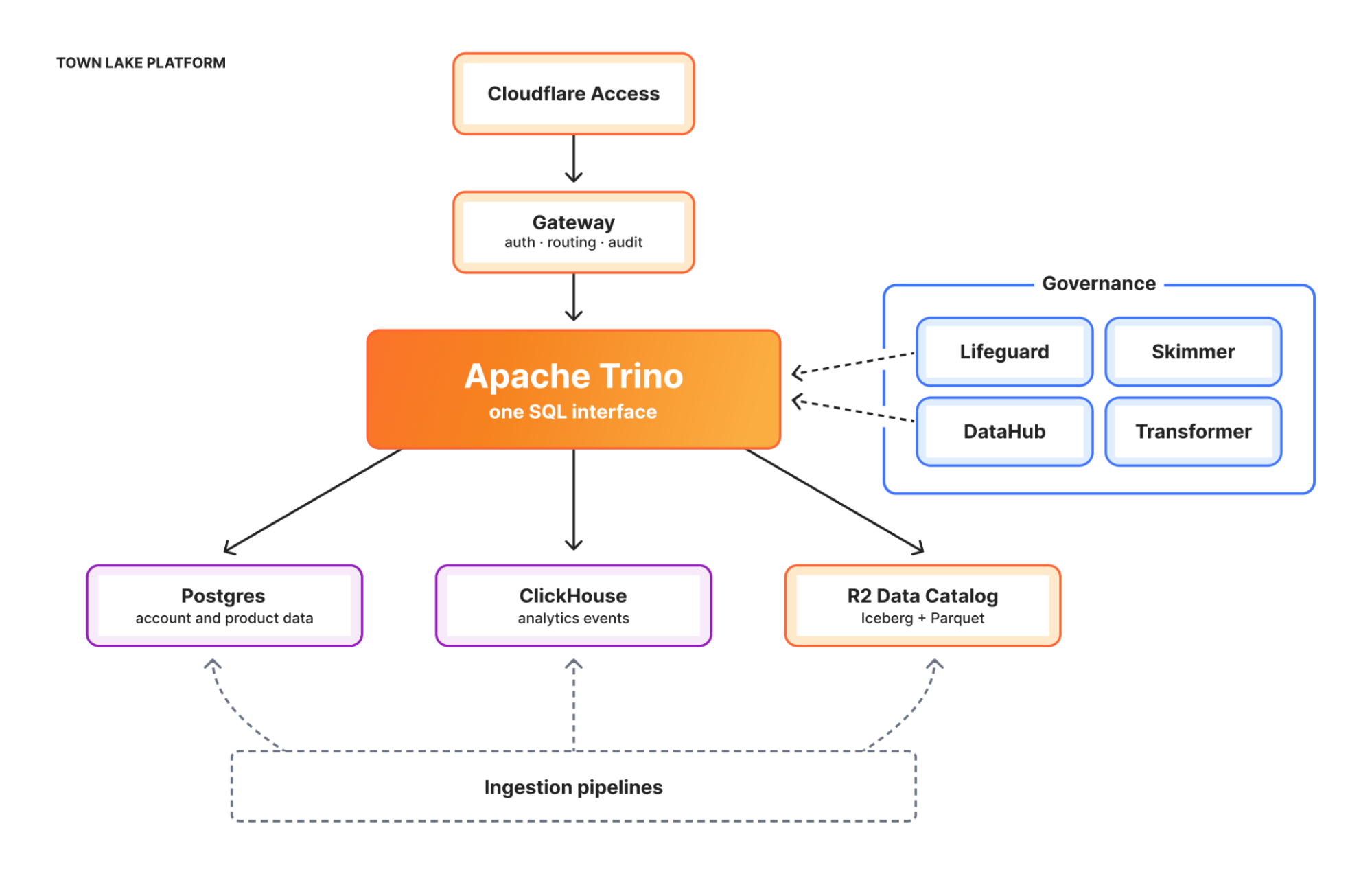
Town Lake is a single SQL interface to everything Cloudflare knows, and Skipper is how anyone at Cloudflare can ask questions in plain English
Cloudflare processes more than one billion events every second across a network spanning over 330 cities and 120 countries. To address significant data sprawl resulting from disparate systems like ClickHouse, Kafka, and BigQuery, the company developed Town Lake, a unified data analytics platform providing a single SQL interface. Running atop this infrastructure is Skipper, an internal AI data agent that allows employees to query complex datasets using natural language to receive auditable answers in seconds. This architecture eliminates the need for manual joins across various production databases and provides access to fresh, unsampled data critical for billing and operational insights. Previously, analysts faced challenges with tribal knowledge requirements and external dependencies for internal reporting. By centralizing its data infrastructure, Cloudflare has transformed data management from a back-office function into a core pillar of its network operations.
Source: The Cloudflare Blog
Microsoft Research Releases Data Formulator 0.7 for AI-Powered Enterprise Analytics
Data Formulator 0.7 is an open-source AI-powered system for enterprise data analytics that combines data connectivity, agent-guided exploration, and visualization refinement
The Data Connectors feature supports authentication, persistent connections, previews, metadata, and a unified workspace model across databases
Data Formulator 0.7 establishes an open-source, AI-powered workspace that integrates data connectivity, agent-guided exploration, and visualization refinement for enterprise environments. The system features a Data Connectors capability that supports persistent, governed connections across databases, warehouses, BI systems, and object stores, significantly reducing the manual integration work required by platform teams. Context-aware AI agents assist users in preparing data and navigating branching analytical workflows without requiring deep SQL or programming expertise. This release specifically addresses the fragmentation of enterprise data workflows by providing a centralized environment for iterative analysis rather than relying on isolated chat interactions. By combining multimodal interfaces with persistent access to workflow history and visualization context, the platform allows teams to transform raw data into actionable insights through collaborative exploration and automated metadata management.
Source: Microsoft Research Blog

AI Business
As global AI software spending is projected to surge toward $638 billion by 2027, the enterprise landscape is undergoing a fundamental shift in both strategy and monetization. Companies are moving beyond experimentation, leveraging advanced models like Gemini to redefine marketing foundations while navigating regional market pressures. In competitive territories like China, this evolution is driving a transition from traditional SaaS subscriptions toward performance-based pricing models that prioritize tangible results over software access.
Gartner Forecasts AI Software Spending to Reach $638B by 2027
AI Software spending is growing to $453 billion in 2026. Up 60% YoY. And on pace for $638 billion in 2027.
AI Cybersecurity is growing 98% in 2026. If you’re a cyber vendor at 50%, you’re getting outflanked.
Global AI software spending is projected to reach $453 billion in 2026, marking a 60% year-over-year increase, and will continue climbing to $638 billion by 2027. This growth represents the largest single-year jump in B2B software spending history, eventually surpassing the entire global SaaS market size from 2022. Specific sub-sectors are experiencing even more aggressive expansion, with AI Data growing at 278% and AI Cybersecurity at 98% for the 2026 period. Vendors growing at rates below these category benchmarks are effectively losing budget share as CIOs prioritize AI investments over traditional software segments. Success in this environment requires helping CIOs demonstrate clear ROI to boards through robust deployment playbooks rather than just raw product features. Startups currently raising capital are entering the most significant software market expansion cycle in history as enterprises prepare to flex their full spending power.
Source: SaaStr

How Gemini and AI Models are Rebuilding Modern Marketing Foundations
Gemini models are supporting businesses across Search and YouTube.
integrating advanced AI models into Asset Studio will allow advertisers to create optimized assets at scale.
Gemini models are now actively supporting business operations across Google Search and YouTube to drive performance in the AI era. During the season one finale of Ads Decoded at Google Marketing Live 2026, leadership teams highlighted a shift toward AI-driven search experiences and advanced measurement solutions. Chris Monkman detailed how businesses must reimagine their advertising strategies for an AI-centric Search environment. Furthermore, Christine Turner emphasized the importance of data strength and new metrics in improving overall marketing performance. To support creative workflows, advanced AI models are being integrated into Asset Studio to allow advertisers to generate optimized assets at scale. This comprehensive approach aims to streamline the entire marketing funnel from discovery to conversion through specialized AI tools that leverage Google's latest foundation models.
Source: The Keyword (blog.google)
Why AI Success in China Requires Result-Based Pricing Over Traditional SaaS Models
Budgets are cut by 90% while clients demand source code for free; SaaS has completely collapsed because bosses don't pay a cent for the process.
Aligning AI with business results through job-based SLAs allows it to truly enter core production systems and produce quantifiable value.
Chinese enterprise AI markets demand a shift from traditional SaaS models toward outcome-based pricing because clients frequently refuse to pay for process-oriented software. Bairong Intelligence founder Zhang Shaofeng highlights that middle management represents the most vulnerable group in the AI era as automated agents begin to replace human supervision and coordination roles. Many Chinese firms currently demand source code access and steep budget cuts while expecting free consulting services before committing to a contract. To survive, AI providers must adopt a "Job-Oriented x Collaborative Evolution x Result-Based Pricing" framework that aligns AI capabilities with Service Level Agreements (SLAs). This model forces AI to integrate directly into core production systems rather than acting as a peripheral tool. Ultimately, the survival of enterprise AI in China hinges on delivering quantifiable value that bypasses the structural barriers of the traditional software industry.
Source: 人民公园说AI

AI Applications
AI Applications focuses on the practical integration of artificial intelligence across various industries to solve complex operational challenges and enhance efficiency. This section highlights real-world use cases, such as leveraging Amazon Q and Snowflake Cortex AI to automate compliance workflows like anti-money laundering alert triage. By examining these implementations, readers can understand how generative AI and advanced analytics are being deployed to streamline business processes and improve decision-making accuracy in enterprise environments.
Automating AML Alert Triage with Amazon Q and Snowflake Cortex AI
automated workflows built using Amazon Quick reduced alert investigation time from 30-90 minutes to under 5 minutes.
financial institutions typically find that 90-95% of AML alerts are false positives, making efficient triage critical.
Automated workflows built using Amazon Quick reduced anti-money laundering alert investigation times from 30–90 minutes to under 5 minutes in testing environments. This integration leverages the Model Context Protocol (MCP) to connect Amazon Quick Flows with Snowflake Cortex, orchestrating complex multi-step processes into streamlined actions. Financial institutions currently struggle with a high volume of false positives, which account for approximately 90–95% of all AML alerts. By utilizing over 50 native integrations between AWS and Snowflake, organizations can maintain data security while accelerating the transition from manual data gathering to automated disposition narratives. The implementation of MCP-based workflows extends beyond compliance to other repeatable tasks such as FinOps cost triage and SRE incident response.
Source: AWS Machine Learning Blog
Programming
Stay ahead in the rapidly evolving landscape of software development by mastering complex architectural patterns and robust system designs. This section covers critical insights into distributed systems, exploring essential failure modes and the strategic defense mechanisms required to build resilient, high-performance applications. These resources provide the deep technical knowledge necessary to navigate the challenges of modern programming and engineering excellence.
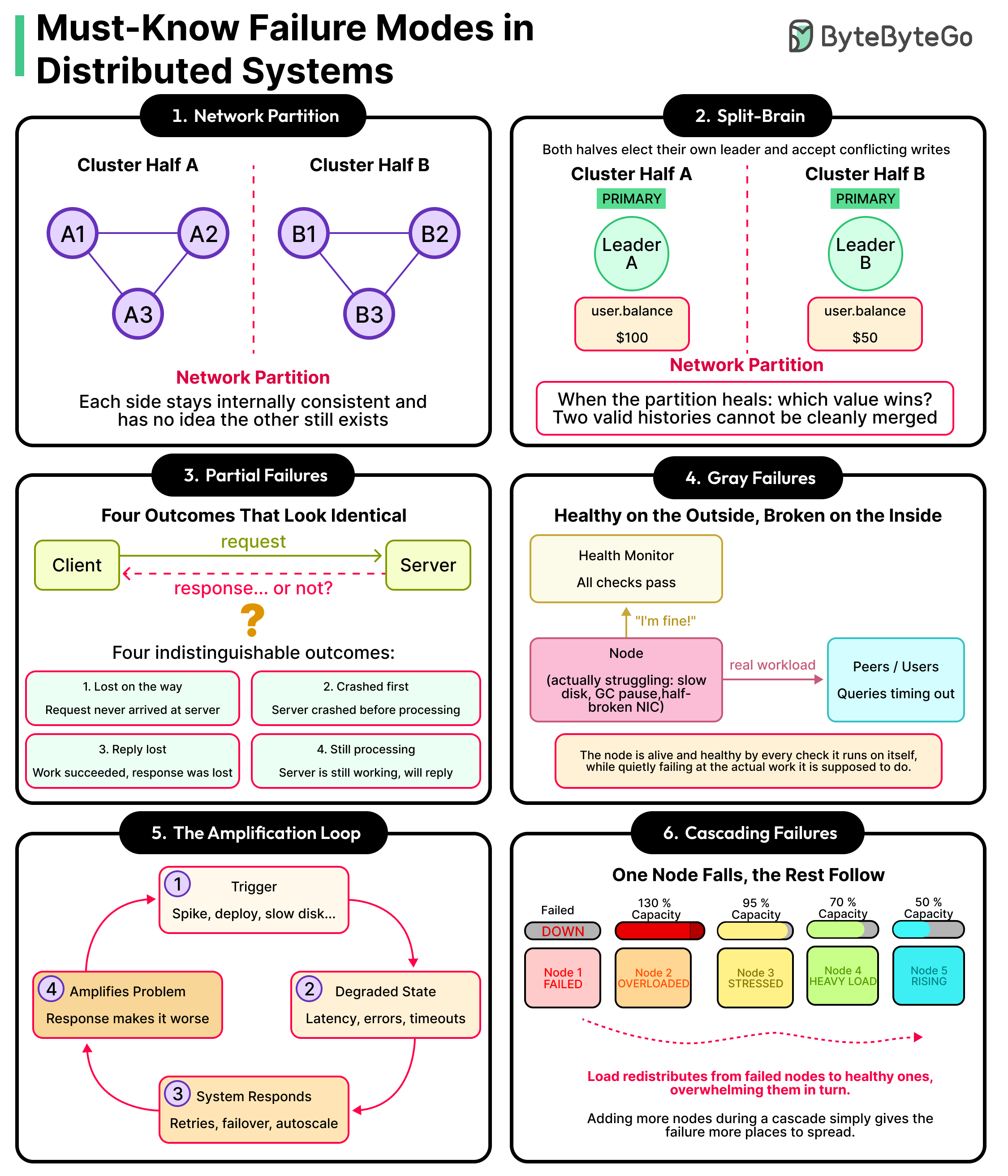
Essential Failure Mode Patterns and Defenses in Distributed Systems
Every server can report healthy while users are seeing errors, the whole system can be technically working but stuck in a state it cannot recover from on its own
They are recurring failure patterns that have been showing up across systems for decades, with names, mechanisms, and standard ways of defending against them.
Distributed systems can experience scenarios where servers report healthy status while users simultaneously encounter errors or the system serves incorrect data despite positive dashboard readings. Unlike single-machine environments where failures are binary—either running or crashed—distributed architectures involve complex, non-obvious states that often lack clear stack traces. These recurring failure patterns have persisted across technical landscapes for decades, manifesting as systems that become stuck in unrecoverable states or silently fail without the presence of traditional code bugs. Modern engineering practices have identified specific names, mechanisms, and defensive strategies to mitigate these risks and ensure operational resilience. Understanding these common failure modes is critical for maintaining uptime and data integrity in large-scale infrastructure environments. Identifying these patterns early allows developers to implement standard approaches to handle partial failures effectively.
Source: ByteByteGo Newsletter
Emerging Tech
This section tracks the rapid evolution of artificial intelligence and its transformative impact on professional workflows and digital content integrity. From high-performance models like Opus 4.8 to new standards in AI productivity, we explore how these breakthroughs are reshaping industry benchmarks. We also highlight critical platform updates, such as YouTube’s content labeling, addressing the rise of synthetic media in our daily digital interactions.
2026-05-29 HackerNews: AI Productivity, Opus 4.8, and YouTube Content Labeling
Opus 4.8 achieved a full pass rate of over 10% for the first time, enhancing credibility in legal and tax professional work.
YouTube's internal systems will automatically identify significant realistic AI-generated content through signals and add labels if creators fail to disclose it.
Anthropic's Claude Opus 4.8 release demonstrates a breakthrough in legal agent benchmarks with a 10% pass rate alongside enhanced multi-step reasoning capabilities. While AI significantly boosts white-collar productivity, current socioeconomic structures often result in capital owners capturing these gains rather than employees receiving shorter work weeks. YouTube is responding to transparency concerns by implementing automated labeling for realistic AI-generated videos, targeting content that could mislead vulnerable audiences. Technical discussions highlight a growing shift toward optimizing small models between 6 to 9 billion parameters, as the marginal utility of massive model training begins to diminish. Additionally, frontier large language models continue to struggle with fact-checking consistency, frequently lacking the necessary nuance to admit uncertainty in complex queries.
Source: SuperTechFans
This report is auto-generated by WindFlash AI based on public AI news from the past 48 hours.