Sunday, May 24, 2026 · 10 curated articles
Editor's Picks
The industry is currently split between a frantic, gigawatt-fueled pursuit of AGI and a pragmatic, architectural shift toward agentic utility. Anthropic’s reported $900 billion valuation, as detailed in the '20VC x SaaStr' report, is a staggering bet on the 'Scale is All You Need' hypothesis. However, when you look at the simultaneous commitment to 5-6 gigawatts of compute—costing up to $50 billion per gigawatt—you realize we are no longer just building software; we are building the most expensive industrial infrastructure in human history. This 'God-model' path is increasingly diverging from the reality on the ground for most engineers. While Salesforce is dropping $300 million on tokens, the smarter money in the developer community is looking at the 'Specialization Beats Scale' findings. The fact that a 3B parameter model can outperform a frontier API at 50x lower cost isn't just a win for efficiency; it’s a death knell for the 'one model to rule them all' philosophy.
This tension is forcing a massive strategic pivot. The era of the 'Foundation Model' as a standalone product is effectively over. As noted in '[AINews] All Model Labs are now Agent Labs,' the industry has realized that raw intelligence is rapidly becoming a commodity. DeepSeek’s aggressive price cuts on V4 Pro—making it nearly 20 times cheaper than Claude Opus—prove that the race to the bottom in token pricing is won by those who treat intelligence as a utility. The real value has moved up-stack. We are seeing labs shutter model teams to focus on 'Agentic Labs,' where the product is no longer the brain, but the nervous system: the workflows, the tool-calling harnesses, and the long-running state management patterns discussed in '5 Design Patterns for Building Long-Running AI Agents.' For developers, the message is clear: stop waiting for GPT-6 to solve your logic problems and start building the scaffolds that make even a small, specialized model unstoppable.
Furthermore, the physical constraints of this AI boom are starting to cannibalize the broader tech ecosystem. The 'AI Demand for High-Bandwidth Memory' is no longer just a data center problem; it’s an accessibility problem. When HBM allocation reaches 20% of global wafer capacity, it starves the consumer market, driving up the price of entry-level smartphones in developing regions. We are effectively taxing the world’s digital inclusion to fund the training runs of a handful of San Francisco-based labs. As an industry, we must decide if the pursuit of the $900 billion valuation is worth the cost of a multi-year hardware shortage that could stunt global technology adoption. The future isn't just about who has the most parameters; it's about who can deliver the most specialized agency with the least amount of friction.
AI Business
This category explores the evolving landscape of AI commerce, focusing on massive valuations and strategic investments from industry giants like Anthropic and Salesforce. We analyze the shift from brute-force scaling to cost-effective, specialized small language models that challenge frontier APIs. Stay updated on how businesses are optimizing their AI spending while navigating a competitive market where efficiency and specialization are becoming as crucial as raw computing power.
20VC x SaaStr: Anthropic Valued at $900B and Salesforce Spends $300M on AI Tokens
Anthropic is closing $30 billion at a $900 billion valuation. That’s nearly triple the $380 billion price from February.
Salesforce will spend $300 million on Anthropic tokens this year, almost entirely on coding.
Anthropic is reportedly closing a $30 billion funding round at a $900 billion valuation, nearly tripling its price from February and representing approximately 18x its revenue run rate. This massive valuation comes as the company commits to 5-6 gigawatts of compute at a potential cost of $40-50 billion per gigawatt. Salesforce CEO Marc Benioff disclosed that the company will spend $300 million on Anthropic tokens in 2026, primarily for coding tasks distributed across its 20,000 developers. While SpaceX prepares for a historic $1.75 trillion IPO and Cerebras sees a 68% day-one pop, the industry is simultaneously navigating a significant downturn in employment. Major firms including Intuit, Meta, and Cisco have collectively cut over 28,000 jobs as public sentiment toward AI starts to shift. The current venture landscape shows a clear preference for post-IPO scale companies like Anthropic that offer lower valuation risks compared to high-multiple seed rounds.
Source: SaaStr
Specialization Beats Scale: How 3B Models Outperform Frontier APIs at 50x Lower Cost
A 3-billion-parameter specialized model outperformed every commercial frontier API tested in a well-measured enterprise domain — at roughly fifty times lower cost.
When a model’s training history is moved close enough to its deployment task, parameter count stops being the decisive variable.
A specialized 3-billion-parameter model outperformed every commercial frontier API tested in a well-measured enterprise domain while operating at approximately fifty times lower cost. This finding challenges the long-standing enterprise assumption that the largest frontier models are always the safest and most capable choice for production environments. By moving a model’s training history closer to its deployment task, parameter count ceases to be the decisive variable for quality or performance. The DharmaOCR project demonstrates that specialization through fine-tuning pipelines can produce results that outperform leading models like GPT-4, Claude 3, and Gemini 1.5 in specific structured OCR tasks. These results suggest a fundamental shift in procurement arithmetic, where the highest-scoring models for a specific task are also the most economical to operate at scale. Enterprise AI strategy should therefore prioritize task-specific alignment over raw parameter count when dealing with bounded, high-volume workloads.
Source: Hugging Face Blog
AI Agents
AI Agents are evolving from experimental prototypes into robust production tools, as evidenced by major model labs shifting their focus toward autonomous capabilities. This week's highlights include GitHub’s dominance in the AI coding agent market and DeepSeek’s aggressive pricing strategy for its latest models. Additionally, developers are adopting sophisticated design patterns to build long-running agents, while cloud providers like Google introduce new governance frameworks to ensure enterprise-grade stability and security.
[AINews] All Model Labs are now Agent Labs as DeepSeek Cuts V4 Pro Prices
the model alone is no longer the product,
@deepseek_ai made the 75% DeepSeek-V4-Pro discount permanent
OpenAI, AI21, and DeepSeek are shifting their strategic focus from standalone foundation models to integrated agentic products that combine models with workflows and user interfaces. OpenAI co-founder Greg Brockman recently stated that the model alone is no longer the primary product, reflecting a broader industry trend where labs like AI21 have shuttered specific model teams to pivot toward agents. In the coding sector, OpenAI released Codex update number six, introducing features like remote computer use and appshots, while some users report shifting entirely away from traditional IDEs. Meanwhile, DeepSeek has made its 75% discount on DeepSeek-V4-Pro permanent, positioning the model on the Pareto frontier of intelligence versus cost. Market analysis indicates V4 Pro is approximately 12 times less expensive than GPT-5.5 and 19 times cheaper than Claude Opus 4.7. This pricing strategy aims to make intelligence a commodity while the product surface moves up-stack toward systems and harnesses.
Source: Latent Space

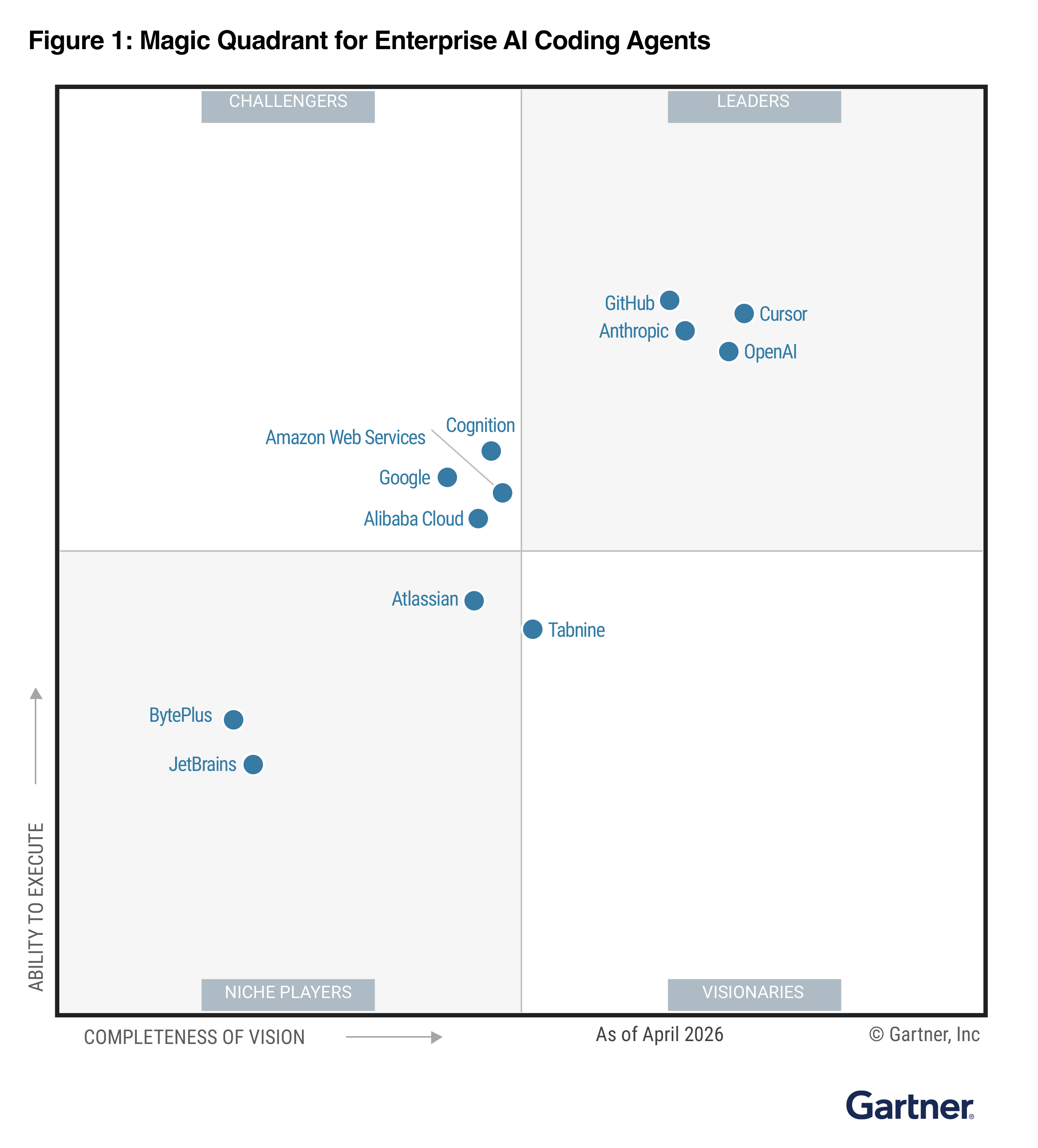
GitHub Named Leader in Gartner 2026 Magic Quadrant for Enterprise AI Coding Agents
GitHub Copilot now serves 140,000 organizations—nearly triple the number from a year ago
Gartner has positioned GitHub as a Leader in the 2026 Magic Quadrant™ for Enterprise AI Coding Agents
Gartner projects that asynchronous AI coding agent workflows will improve software engineering team productivity by 30% to 50% by 2028. GitHub Copilot has been positioned as a Leader in the 2026 Gartner Magic Quadrant for Enterprise AI Coding Agents, marking its third consecutive year in this top-tier category. Currently serving 140,000 organizations—a nearly three-fold increase from the previous year—the platform has achieved overall year-over-year growth exceeding 100%. GitHub received the highest placement for ability to execute among the twelve vendors evaluated in the report. The platform's strategy focuses on integrating agentic capabilities across the entire software development lifecycle, including code generation, review, security, and governance. By offering developers a choice of multiple AI models and integrating across editors, CLIs, and web interfaces, GitHub aims to transition developer roles from writing manual code to orchestrating complex software outcomes.
Source: The GitHub Blog
Google Cloud Updates: AI Governance, Edge LLM Benchmarking, and Fractional G4 VMs
Google AI Edge Portal bridges this gap, giving GCP developers the ability to test AI performance on 120+ Android devices
Fractional G4 VMs are Generaly Available, providing a highly efficient and cost-effective entry point for AI and graphics workloads.
Google AI Edge Portal now allows developers to benchmark and debug LLM performance across more than 120 Android devices to address hardware fragmentation in edge deployments. The newly announced Fractional G4 Virtual Machines are generally available, utilizing NVIDIA RTX PRO 6000 Blackwell Server Edition technology to provide a cost-effective entry point for AI and graphics workloads. Google Cloud has also introduced the Model Context Protocol (MCP) framework within Apigee to serve as a central control tower for managing agentic security and JSON-RPC tool authorization. Furthermore, the Google Cloud Agentic Platform is facilitating the transformation of standard APIs into governed agentic tools through specific integration frameworks. These updates collectively focus on operationalizing AI through robust audit logs, fine-grained access policies, and improved hardware optimization. Developers can now leverage private previews for advanced on-device AI testing and attend community technical sessions to master production go-live checklists for secure deployments.
Source: Google Cloud Blog
5 Design Patterns for Building Long-Running AI Agents in Production
Agent Runtime now supports long-running agents that maintain state for up to seven days.
The most common failure mode in multi-day workflows is context loss.
Most production AI agents fail because their architectures are stateless and cannot sustain workflows lasting several days, such as processing insurance claims or reconciling financial data. Google Cloud's Agent Runtime addresses this gap by supporting long-running agents that maintain state for up to seven days. Building resilient agents requires transitioning from simple request handlers to long-running server processes using patterns like Checkpoint-and-Resume. This pattern involves saving progress at granular intervals, such as every 50 documents, to balance durability with overhead and prevent starting from scratch after errors. Additionally, effective Human-in-the-Loop implementations must pause execution state rather than relying on brittle JSON serialization to maintain reasoning context. These design patterns aim to bridge the production gap where demo-style short tasks fail to meet real-world operational requirements for reliability and consistency over extended durations.
Source: Turing Post
Emerging Tech
This section explores the cutting-edge developments shaping our future, from the latest breakthroughs in AI agents and robotics showcased at Google I/O to critical discussions regarding quantum computing and hardware markets. We examine the profound societal impacts of these technologies, including their role in transforming education and digital privacy landscapes. By tracking these emerging trends, we provide essential insights into how next-generation innovations are redefining global technological infrastructure and our everyday interactions with machines.
Google I/O 2026 Dialogues Recap: AI Agents, Quantum Computing, and Robotics
Google’s Hartmut Neven and James Manyika explored the intersection of quantum computing and AI.
Google DeepMind’s Kanishka Rao and Boston Dynamics’ Alberto Rodriguez unpacked the leap in embodied physical AI
Google I/O 2026 Dialogues featured a series of high-level discussions between Google leadership and industry experts focusing on the transformative potential of proactive AI agents and embodied physical AI. Google CEO Sundar Pichai collaborated with Matt Berman to unpack the strategic vision behind the year's major technological announcements. In the realm of hardware and foundational science, Hartmut Neven and James Manyika examined the critical intersection of quantum computing and artificial intelligence, while Demis Hassabis highlighted AI’s evolving role in solving complex scientific problems. Robotics experts Kanishka Rao and Alberto Rodriguez presented significant advancements in embodied physical AI, detailing how these technologies are moving beyond digital interfaces. Additionally, the sessions explored the creative sector, featuring director Doug Liman and Mira Lane discussing how AI is currently pushing the boundaries of cinematic storytelling. These discussions collectively underscore Google's multi-disciplinary approach to shaping the future of technology and its societal impact.
Source: The Keyword (blog.google)
Hacker News Recap: AI Impact on Education, Memory Markets, and Privacy
Wozniak encouraged graduates to value 'actual intelligence' and uniqueness, reflecting anxiety under AI's reshaping of employment.
Squeezed by AI-driven HBM/DRAM demand and limited expansion cycles, low-end smartphones and other consumer electronics will become more expensive.
Steve Wozniak's 2026 commencement speech highlighted "actual intelligence" as a human advantage over AI, reflecting growing anxiety about the role of graduates in an automated workforce. Memory markets are experiencing significant price hikes for consumer electronics as AI-driven demand for HBM and DRAM squeezes supply chains. Anna’s Archive faced criticism for labeling pirated content as "our data," sparking a debate over legal ownership versus digital preservation. Meanwhile, the Seattle Shield program raised surveillance concerns by aggregating private company reports on protest activities. Development tools saw updates with BBEdit 16 and performance benchmarks for OpenSCAD's Antigravity engine, while the uv package manager's UX remains a topic of community debate despite its speed. Geopolitical tensions are also affecting research, with NIH and NASA reportedly tightening informal restrictions on collaborations with China.
Source: SuperTechFans
Data & Analytics
In the era of information, data and analytics serve as the backbone for strategic decision-making and global progress. This category explores how leading organizations leverage advanced platforms like Databricks to unify disparate data sources, streamline management, and derive actionable insights. From combating global poverty to optimizing enterprise operations, discover the transformative power of big data, machine learning, and sophisticated modeling in shaping our future and solving complex international challenges.
How the World Bank Group Uses Databricks to Drive Global Poverty Eradication
Unity Catalog was a game changer for us. It was a single unified interface where we could govern our data
The World Bank Group built a unified data and AI platform on Databricks, bringing together structured operational data and unstructured document repositories
The World Bank Group manages tens of millions of documents and processes three million publication downloads monthly to support its global mission of improving shared prosperity. To address the challenge of disjointed legacy on-premises databases and massive unstructured document libraries, the organization migrated its operations to a unified data and AI platform powered by Databricks. Utilizing Unity Catalog for governance and Databricks Volumes for unstructured content, the group successfully integrated disparate data streams for the first time. The implementation of Databricks Genie allows non-technical business users to query structured data using natural language, significantly reducing the manual research time previously required by librarians and analysts. This digital transformation shifted the organization's focus toward outcome-driven metrics, such as job creation and connectivity, rather than simple output measures like miles of road constructed. By centralizing its data architecture, the World Bank Group has enhanced its ability to surface critical lessons learned across its global project portfolio.
Source: Databricks
AI Infrastructure
This category explores the critical physical and virtual backbone supporting the artificial intelligence revolution, focusing on high-performance computing hardware and data center innovations. As the surge in AI demand triggers significant shifts in the global supply chain, such as the prioritization of High-Bandwidth Memory (HBM), industries must navigate rising component costs and resource scarcity. Understanding these infrastructure trends is essential for grasping the broader economic impact of AI scaling across the entire technology sector.
AI Demand for High-Bandwidth Memory Triggers Consumer Electronics Price Hikes
The enormous growth in AI data centers has pushed that up to an expected 20% by the end of 2026
a single gigabyte of HBM consumes more than three times the wafer capacity that a gigabyte of DDR or LPDDR does
High-bandwidth memory (HBM) allocation is expected to reach 20% of global wafer capacity by 2026, driven primarily by the rapid expansion of AI data centers. This shift forces a significant reduction in the production of standard DDR and LPDDR memory because a single gigabyte of HBM requires more than three times the wafer capacity of conventional RAM. The industry's three remaining major manufacturers are maintaining fixed fabrication limits to avoid over-provisioning, which constrains the supply available for consumer devices. Consequently, the pricing of sub-$100 smartphones is rising, potentially destabilizing technology accessibility in regions like Africa and South Asia. This market recalibration reflects a broader trend where enterprise AI infrastructure needs are outcompeting consumer electronics for essential hardware components, potentially leading to a multi-year shortage in the RAM market.
Source: Simon Willison's Weblog
This report is auto-generated by WindFlash AI based on public AI news from the past 48 hours.