Wednesday, April 15, 2026 · 10 curated articles
Editor's Picks
Today’s headlines from the front lines of the intelligence revolution confirm what we’ve suspected: the 'Copilot' era is officially over, and the 'Agentic OS' era has begun. With GPT-5.4 reaching expert-level performance across 83% of economic sectors, the debate is no longer about whether AI can do the job, but how quickly we can rewire our digital infrastructure to let it lead. The launch of 'Skills' in Chrome and HCompany’s HoloTab signals a critical pivot in human-computer interaction. We are witnessing the cannibalization of the traditional UI. When a browser can convert any natural language prompt into a persistent, one-click workflow, the browser stops being a window and starts being an employee.
For developers, the implications are stark. As noted in the Global LLM Quarterly Report, coding has become the 'Second Act' of AGI. We are seeing models like Claude Opus 4.7 not just suggesting snippets, but managing complex, long-running engineering tasks and self-correcting logical faults. This is the saturation of the SWE-Bench performance we're seeing—human-level coding is becoming the baseline, not the ceiling. The 'Turkey Problem' mentioned in the GPT-5.4 coverage is the most insightful takeaway for the current workforce: the current spike in work intensity is the friction of a legacy world trying to keep pace with algorithmic speed. It is the frantic flapping of wings before the structural shift toward what the report calls 'white-collar deflation.'
If the leading models are indeed the new operating systems, as the industry trends suggest, the role of the engineer shifts from 'builder of features' to 'architect of autonomy.' Look at the AWS Trainium2 optimizations for speculative decoding—we are optimizing hardware not for human latency, but for agentic throughput. We are building a world where the primary consumers of our code will be other agents. ElevenLabs' climb to $350M ARR by focusing on emotional emergence and flat organizational structures is a blueprint for the AI-native enterprise: high agency, low friction, and a total reliance on neural networks to handle the nuance that used to require a human touch. The message is clear: if your value proposition is still rooted in being a 'human in the loop' for routine cognitive tasks, the loop is closing.
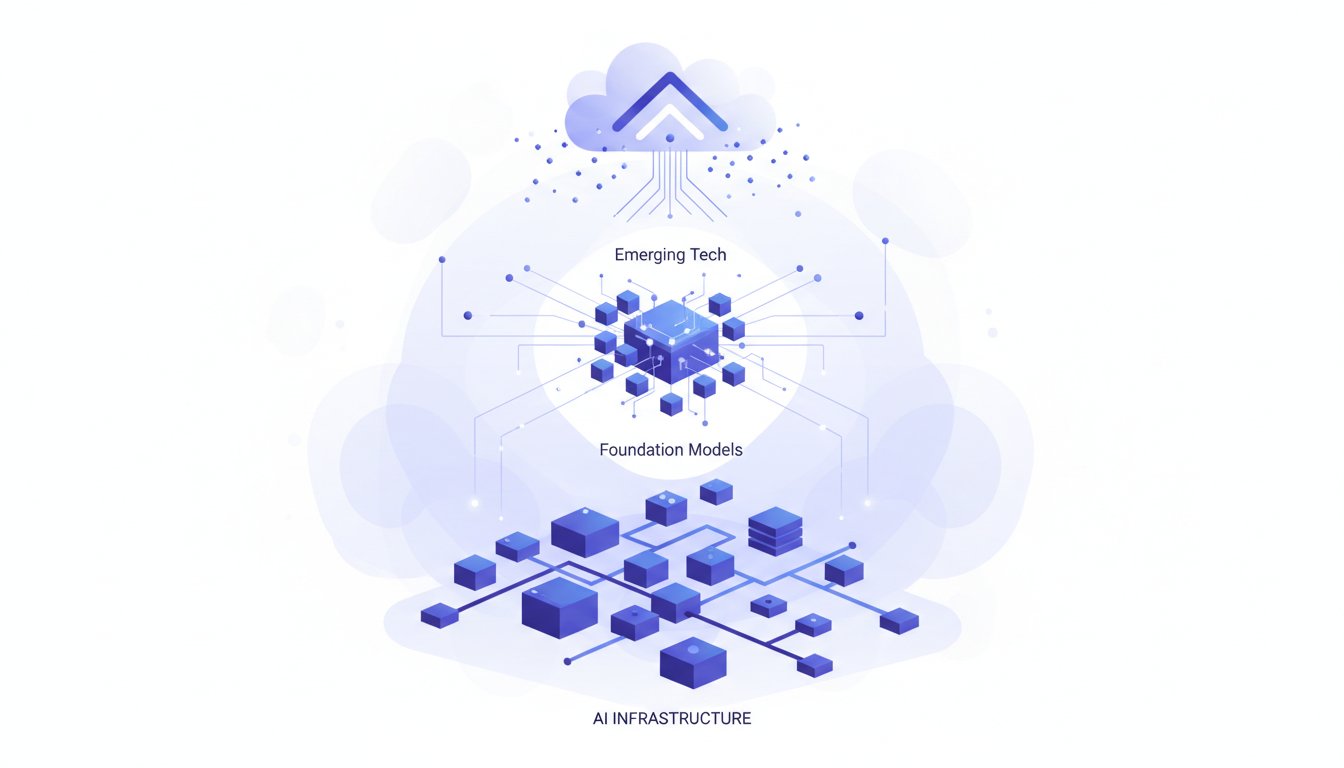
Emerging Tech
Emerging technology continues to redefine the boundaries of artificial intelligence and digital security, as evidenced by the arrival of GPT-5.4's expert-level capabilities and Chrome's new browser agent skills. These breakthroughs signal a shift towards more autonomous, specialized AI tools integrated directly into daily workflows. Meanwhile, the evolving landscape of cyber threats highlights the critical need for advanced protection, with Germany now facing unprecedented levels of cyber extortion.
[AINews] GPT-5.4 Reaches Expert Level and Chrome Launches Browser Agent Skills
GDPval rates GPT 5.4 as better than/equal to human experts 83% of the time in most swathes of the economy
Google’s Chrome “Skills” turns prompts into reusable browser workflows: Google introduced Skills in Chrome
GDPval metrics indicate that GPT 5.4 now performs better than or equal to human experts 83% of the time across most sectors of the economy. Despite the rapid advancement of AI agents, industry leaders observe that knowledge workers are facing unprecedented work intensity, a phenomenon likened to the "Turkey problem" before a major transition. Google has introduced "Skills" in Chrome, allowing users to convert Gemini prompts into reusable, one-click browser workflows, effectively bringing lightweight agentization to the browser. Tencent announced HYWorld 2.0, an open-source 3D world model that generates editable scenes from single images rather than just video. Google DeepMind released Gemini Robotics-ER 1.6 to enhance spatial reasoning and instrument reading in physical environments. Furthermore, OpenAI has debuted GPT-5.4-Cyber, a specialized model fine-tuned for defensive cybersecurity operations, while SWE-Bench performance reaches saturation with Claude Mythos at a 78% success rate.
Source: Latent Space
Germany Emerges as Europe's Top Cyber Extortion Target in 2025
Germany saw a 92% growth in leaks in 2025—a growth rate that tripled the European average.
Germany moved to the forefront of European data leak targets in 2025.
Germany has experienced a 92% surge in data leak site postings during 2025, marking its return as the primary focus for European cyber extortion. This growth rate triples the European average and follows a period where the United Kingdom was the leading target. Threat actors are increasingly focusing on the German Mittelstand due to its advanced, digitized industrial base and improved localization capabilities facilitated by artificial intelligence. The maturation of the cyber criminal ecosystem has allowed attackers to overcome historical language barriers that previously protected non-English speaking nations. Google Threat Intelligence notes that this shift coincides with a global 50% increase in data leak site activity. While shaming-site volumes are at record highs, these figures reflect a tactical shift toward secondary pressure tactics following a decline in ransom payment rates.
Source: Google Cloud Blog
Foundation Models
The evolution of foundation models continues to accelerate, with leading developers like Anthropic and Google DeepMind pushing the boundaries of multimodal intelligence. Recent breakthroughs in coding proficiency and granular audio control signify a shift toward more specialized yet versatile AI systems capable of complex reasoning. As Silicon Valley redefines the roadmap toward AGI, these core architectures remain the engine driving global innovation, transforming how machines perceive vision, sound, and logic across diverse industries.
Anthropic Launches Claude Opus 4.7 with Enhanced Coding and Vision Capabilities
Opus 4.7 is a notable improvement on Opus 4.6 in advanced software engineering, with particular gains on the most difficult tasks.
Pricing remains the same as Opus 4.6: $5 per million input tokens and $25 per million output tokens.
Claude Opus 4.7 is now generally available, delivering substantial improvements over version 4.6 in advanced software engineering and complex, long-running task execution. The model introduces higher resolution vision capabilities and improved creative output for professional tasks like interface design and document creation. While Anthropic notes that Opus 4.7 is less broadly capable than the upcoming Claude Mythos Preview, it outperforms the previous Opus iteration across various industry benchmarks. To mitigate potential security risks, the model features new automated safeguards designed to detect and block prohibited cybersecurity uses, alongside a Cyber Verification Program for authorized professionals. Pricing remains consistent with the previous version at $5 per million input tokens and $25 per million output tokens. Early testers report that the model effectively catches its own logical faults during planning phases and resists providing incorrect fallbacks when data is missing.
Source: Anthropic News
Global LLM Quarterly Report Ep 9: Coding as AGI's Second Act and Silicon Valley Dynamics
Coding has pushed AI from the first act of Chatbots to the second act of Agents capable of getting work done.
In the past quarter, the level of intelligence progress has caught up with the entire year of 2025, providing a very strong sense of acceleration.
Coding capabilities have transitioned AI from the chatbot era to the Agent era, serving as a primary accelerator for achieving General Artificial Intelligence. Recent industry observations suggest that the pace of technological advancement in the past quarter has rivaled the entirety of projected progress for 2025, driven by breakthroughs in leading models. While Anthropic maintains a competitive edge through its hands-on data culture and focus on coding, OpenAI faces challenges balancing its consumer-facing success with the strategic necessity of specialized programming capabilities. Google's Gemini series is currently perceived as lagging in coding performance, whereas Meta has emerged as a formidable fourth-place contender in the Silicon Valley ecosystem. As leading models increasingly function as new operating systems, the shift toward highly efficient agents signals an imminent period of white-collar deflation and structural unemployment. This evolution emphasizes that organizational culture and focused leadership remain critical for staying in the top tier of the AI race.
Source: 张小珺Jùn|商业访谈录
Google DeepMind Launches Gemini 3.1 Flash TTS with Granular Audio Tag Control
Our newest audio model introduces granular audio tags that give you precise control to direct AI speech for expressive audio generation.
3.1 Flash TTS achieved an impressive Elo score of 1,211.
Gemini 3.1 Flash TTS achieves an Elo score of 1,211 on the Artificial Analysis TTS leaderboard, positioning it as a highly expressive and natural AI speech model. This latest text-to-speech iteration introduces granular audio tags that allow developers to control vocal style, pace, and delivery using simple natural language commands. Supporting over 70 languages, the model is designed for high-quality speech generation at a low cost, making it accessible for diverse enterprise and developer applications. To ensure safety and authenticity, all generated audio is automatically watermarked with SynthID technology to identify it as AI-produced content. The model is currently rolling out in preview across the Gemini API, Google AI Studio, Vertex AI, and Google Vids. This release empowers users to direct AI speech with the precision of a director setting a scene through intuitive text-based instructions.
Source: Google DeepMind Blog
AI Business
AI Business explores the commercial landscape of artificial intelligence, highlighting how industry leaders scale operations and drive significant revenue growth. This category covers strategic insights from top CEOs, focusing on the underlying logic of generative models and the path to achieving massive annual recurring revenue. From ElevenLabs’ rapid market expansion to broader industry shifts, we track the financial and structural evolution of the companies defining the next era of technological innovation.
ElevenLabs CEO Mati Staniszewski on Scaling Voice AI and Reaching $350M ARR
Achieved a staggering net increase of $100 million in ARR in a single quarter, with total revenue aiming for $350 million.
ElevenLabs utilizes an extremely flat architecture, small team operations, and an ultimate pursuit of 'individual agency'.
ElevenLabs has achieved a valuation of $11 billion while targeting a projected annual recurring revenue of $350 million by the end of 2025. The company’s rapid growth is driven by a dual self-service and enterprise strategy that prioritizes low-friction adoption for individual developers before scaling to major corporate clients like Meta and Deutsche Telekom. Technically, the shift from physical vocal tract simulation to neural networks has enabled emotional emergence in AI voices, allowing for more natural accents and cadences. ElevenLabs maintains an extremely flat organizational structure where founders manage over 15 direct reports and small, 10-person teams operate with high autonomy. Future developments focus on crossing the deployment gap in automotive and mobile interfaces through voice-to-voice models that reduce latency. High individual agency remains the primary metric for talent acquisition in this AI-native operational model.
Source: 跨国串门儿计划
AI Infrastructure
AI infrastructure focuses on the hardware and software foundations necessary to train and deploy large-scale models efficiently. This category explores advancements in specialized accelerators like AWS Trainium2, alongside software frameworks such as vLLM that optimize resource utilization. By integrating techniques like speculative decoding, developers can significantly reduce latency and operational costs, ensuring that next-generation AI applications remain performant and scalable across diverse cloud environments.
Speeding LLM Inference on AWS Trainium2 via Speculative Decoding and vLLM
Speculative decoding on AWS Trainium can accelerate token generation by up to 3x for decode-heavy workloads
Fewer serial decode steps means lower latency and higher hardware utilization, helping to reduce your inference costs.
Speculative decoding on AWS Trainium accelerates token generation by up to 3x for decode-heavy workloads such as AI writing assistants and coding agents. This technique addresses the memory-bandwidth bottleneck inherent in autoregressive decoding by using a smaller draft model to propose candidate tokens that a larger target model verifies in a single forward pass. Deploying Qwen3 models with vLLM on Kubernetes demonstrates significant reductions in inter-token latency and the overall cost per generated token. To maintain high acceptance rates, the draft and target models should share the same tokenizer and ideally come from the same architectural family. Performance optimization involves tuning the number of speculative tokens to balance the reduction in serial decode steps against hardware utilization. This approach allows developers to maximize the efficiency of AWS AI chips without sacrificing the output quality of their generative AI applications.
Source: AWS Machine Learning Blog
Developer Tools
Stay updated on the latest advancements in the programming ecosystem, featuring major updates to essential frameworks and environments. This week's highlights include the release of Node.js 24.15.0 (LTS), which marks a significant milestone by stabilizing ECMAScript Module (ESM) support and introducing a built-in SQLite integration. These enhancements empower developers to build more efficient, modernized applications with reduced dependency overhead. Explore how these refined utilities and performance optimizations are streamlining the development lifecycle for software engineers worldwide.
Node.js 24.15.0 (LTS) Released with Stable ESM Support and SQLite Integration
module: mark require(esm) as stable (Joyee Cheung) #60959
sqlite: mark as release candidate (Matteo Collina) #61262
Node.js 24.15.0, codenamed 'Krypton', has officially transitioned to Long Term Support (LTS) status, introducing critical stability updates for modern JavaScript development. A primary highlight of this release is the stabilization of require(esm), which simplifies the interoperability between CommonJS and ECMAScript modules. The module compile cache has also reached stability, significantly improving startup performance for complex applications. Furthermore, the built-in SQLite implementation has been promoted to release candidate status, accompanied by new features like the limits property in DatabaseSync. Developers now have access to a new --max-heap-size CLI option for better memory management and a throwIfNoEntry option in fs.stat for more granular file system handling. Performance optimizations across Buffer operations and the internal assertion utility further enhance the runtime's efficiency. These updates solidify Node.js 24 as a robust foundation for enterprise-level server-side applications.
Source: Node.js Blog
AI Policy & Ethics
This category tracks the evolving intersection of technology, law, and societal values, focusing on how regulatory frameworks adapt to the rapid growth of artificial intelligence. We cover critical updates on intellectual property rights, intermediary liability, and government policies designed to foster transparency and accountability in tech platforms. By analyzing shifts in digital governance and ethical standards, this section provides essential insights into the legal challenges and responsibilities shaping the future of global innovation.
GitHub Policy Update: DMCA Section 1201, Intermediary Liability, and Transparency
The Court’s opinion reinforced that service providers are not automatically liable for copyright infringement by users without evidence of intent
The most recent triennial cycle concluded in 2024, setting exemptions that remain in effect for the current three-year period.
The U.S. Supreme Court's decision in Cox v. Sony establishes that service providers are not automatically liable for user copyright infringement without evidence of intent to encourage or materially contribute to such actions. This legal clarification provides essential certainty for developer platforms like GitHub, ensuring they can operate at scale without facing overly expansive liability theories. Additionally, GitHub is preparing for the 2027 DMCA Section 1201 triennial review, focusing on exemptions for AI safety research, model inspection, and interoperability. Although a 2024 petition for generative AI security research was not adopted, it highlighted critical questions regarding how current copyright frameworks apply to evolving AI development practices. GitHub has also updated its Transparency Center with full-year 2025 data to maintain its commitment to developer protections and open reporting. These updates collectively address the legal and regulatory landscape that directly impacts how software is built and shared globally.
Source: The GitHub Blog
AI Agents
AI agents represent the next evolution of artificial intelligence, moving beyond simple chatbots to autonomous systems capable of executing complex tasks across various digital environments. These proactive assistants leverage advanced large language models to interact with web browsers and software tools, effectively bridging the gap between logical reasoning and practical action. As new platforms emerge, the focus shifts toward seamless workflow integration, enabling users to automate repetitive processes and enhance productivity through intelligent problem-solving.
HCompany Launches HoloTab: A Browser-Based AI Agent Powered by Holo3
HoloTab is a Chrome extension that navigates the web just like a person would.
On March 31st, we released Holo3, our most advanced computer-use model to date.
HCompany has released HoloTab, a Chrome extension powered by the Holo3 model that enables autonomous web navigation and task automation directly within the browser interface. The system utilizes vision models and action planning to interact with websites as a human would, including filling fields and making contextual decisions without requiring technical skills. A core feature called Routines allows users to record specific workflows by performing them once, which the AI then captures and understands to re-run or schedule independently. This approach aims to eliminate repetitive digital tasks such as cross-referencing e-commerce pricing or filtering job listings across multiple platforms. By capturing both visual actions and optional narration, HoloTab enriches its automation routines with enough context to handle complex goals reliably. The tool is currently available for free to all users, marking a shift toward making advanced computer-use AI accessible to a non-technical audience.
Source: Hugging Face Blog
This report is auto-generated by WindFlash AI based on public AI news from the past 48 hours.