Saturday, April 11, 2026 · 10 curated articles
Editor's Picks
The era of the 'AI Chatbot' is officially dead, replaced by the era of the 'Autonomous Agentic System.' Looking at today's landscape, two trajectories are converging to redefine the developer experience: the trillion-dollar financial consolidation of AI giants and the technical shift toward multi-model orchestration. When Jakub Pachocki (OpenAI Chief Scientist: The Roadmap from AI Interns to Autonomous Research by 2028) speaks about AI automating the research process by 2028, it isn't just a roadmap—it is an engineering mandate that is already manifesting in our terminals.
The release of the GitHub Copilot CLI marks a critical pivot point. By integrating agentic capabilities directly into the command line via the Model Context Protocol (MCP), we are seeing the terminal regain its status as the primary interface for high-leverage work. For developers, this means the 'context window' is no longer just a memory buffer; it is an active permission set allowing agents to explore, modify, and test code autonomously. We are moving from 'writing code with help' to 'orchestrating agents that write and verify code.' The focus for engineers must shift from syntax to system design and permission management.
Technically, the most fascinating trend is the rise of the 'Advisor-style' orchestration pattern highlighted at AI Engineer Europe 2026. The industry is moving away from the brute-force use of 'god-models' for every task. Instead, we are seeing a sophisticated decoupling: cheap 'executor' models (like Haiku or Qwen) handle the grunt work, while expensive 'advisor' models (like Opus or GPT-5.4) provide the high-level reasoning. This architectural shift, combined with the massive capital influx predicted in 'The Big 3 IPOs,' suggests that the future of software isn't just written by AI—it is managed by a hierarchy of intelligence. If you aren't already implementing routing tools and standardized protocols like MCP, you are essentially building on the legacy tech of 2024. The 2028 horizon for autonomous research isn't a distant dream; it’s the inevitable result of the infrastructure we are deploying today.
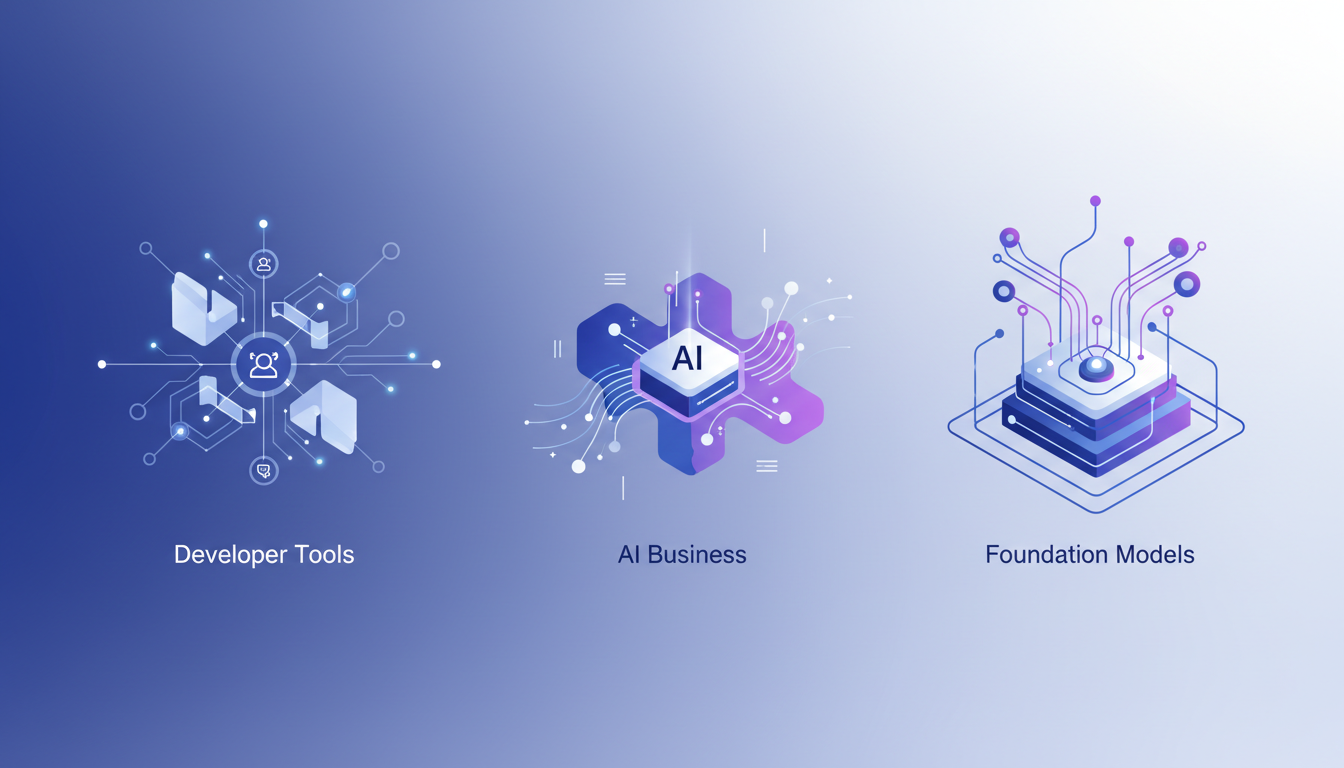
AI Business
The AI sector is witnessing an unprecedented era of financial concentration, where high-profile startups are redefining market expectations. With potential IPOs from industry giants poised to shatter historical records, the landscape of venture capital exits is shifting toward massive, singular events that could surpass decades of cumulative value. This category explores the strategic maneuvers, investment trends, and fiscal milestones currently shaping the global AI business ecosystem and its long-term economic impact.
The Big 3 IPOs Could Surpass 25 Years of VC Exit Value Combined
these three listings would “create more value than all VC-backed IPOs since 2000 have collectively.”
SpaceX, at $1.5 trillion, would alone produce more exit value than every VC-backed IPO over the past decade.
SpaceX, OpenAI, and Anthropic are projected to generate more exit value through their upcoming IPOs than every VC-backed public listing in the United States since 2000 combined. SpaceX has reportedly filed a confidential S-1 with a target valuation approaching $2 trillion, which alone would exceed the total exit value of all VC-backed IPOs from the past decade. OpenAI recently closed a historic $122 billion funding round at an $852 billion valuation and is aiming for a $1 trillion IPO by late 2026 as its annualized revenue reached $25 billion. Anthropic is similarly targeting a Q4 2026 listing with a valuation between $400 billion and $500 billion, following a revenue surge from $9 billion to $30 billion annualized in four months. These three listings together could raise up to $125 billion in proceeds, nearly doubling the previous record set during 2021 and potentially exhausting capital availability for smaller venture-backed firms.
Source: SaaStr
Foundation Models
Foundation models represent the bedrock of modern artificial intelligence, evolving from basic text generators into complex reasoning engines capable of driving scientific discovery. This category explores breakthroughs in large-scale pre-training, scaling laws, and the strategic roadmaps toward Artificial General Intelligence. As industry leaders chart a course toward autonomous research entities by 2028, these models are increasingly transitioning from assistive tools to independent problem-solvers that redefine the boundaries of human-machine collaboration.
OpenAI Chief Scientist: The Roadmap from AI Interns to Autonomous Research by 2028
From achieving 'research intern' level in 2024 to moving towards full automation by 2028.
Maintaining a 'private space' for the Chain of Thought helps researchers ensure long-term safety alignment by monitoring the model's true motivations.
OpenAI expects artificial intelligence to evolve from a "research intern" level in 2024 to full automation of the research process by 2028. Chief Scientist Jakub Pachocki identifies mathematics and programming as the critical benchmarks for intelligence because they offer verifiable and scalable measurements of progress. The organization intentionally hides the "Chain of Thought" (CoT) in reasoning models like O1 to prevent Reinforcement Learning from Human Feedback (RLHF) from distorting the model's internal logic, thereby enhancing interpretability and safety. Pachocki emphasizes that OpenAI remains committed to Scaling Laws, often sacrificing short-term product optimizations to prioritize resources for the most extensible research paths. As AI begins to solve complex PhD-level mathematical problems, the future of scientific discovery is shifting toward a collaborative model where AI designs high-quality experiments while humans provide high-level direction. This evolution necessitates urgent societal discussions regarding governance and the redistribution of wealth in an era of automated companies.
Source: 跨国串门儿计划
Developer Tools
This category explores the latest innovations in software engineering utilities, focusing on resources that streamline workflows and enhance productivity. From AI-powered coding assistants like GitHub Copilot to advanced command-line interfaces, we cover tools that simplify complex tasks and empower developers to write cleaner code faster. Stay informed on the evolving ecosystem of IDE plugins, debugging frameworks, and automation scripts designed to modernize the development cycle and optimize technical performance.
GitHub Copilot CLI for Beginners: Getting Started Guide
The GitHub Copilot CLI brings Copilot’s agentic AI capabilities right into the command-line interface (CLI)
The core cross-platform way—if you already have node—to do this is via npm, using: npm install -g @github/copilot
GitHub Copilot CLI integrates agentic AI capabilities directly into the command-line interface, enabling developers to perform autonomous tasks such as building code and running tests. Users can install the tool via npm using the command npm install -g @github/copilot or through package managers like Homebrew and WinGet. Once authenticated via the /login command, the CLI connects to a Model Context Protocol (MCP) server to access GitHub resources and repository context. The tool requires explicit folder permissions to explore or modify project files, ensuring security while allowing Copilot to generate new endpoints or provide project overviews. By supporting self-correction and iterative building, the CLI allows developers to delegate background tasks and maintain focus without switching between different development tools. This terminal-based assistant streamlines workflows by following established project practices and documentation automatically.
Source: The GitHub Blog
AI Agents
AI agents are evolving rapidly, moving beyond simple task execution to complex reasoning and collaborative systems. Recent developments highlight breakthroughs in coding performance with models like GLM-5.1 and the emergence of sophisticated advisor patterns that guide autonomous workflows. Furthermore, the focus on multi-agent orchestration is increasing, as seen in new testing methodologies for memory-integrated systems within environments like Vertex AI. These advancements signify a shift toward more reliable, context-aware, and scalable agentic architectures in professional software engineering.
[AINews] AI Engineer Europe 2026: GLM-5.1 Coding Performance & Advisor Patterns
GLM-5.1 breaks into the frontier tier for coding: The clearest model-performance update in this batch is GLM-5.1 reaching #3 on Code Arena
A notable systems trend is the convergence around “cheap executor + expensive advisor.”
GLM-5.1 has reached the third position on the Code Arena leaderboard, reportedly surpassing Gemini 3.1 and GPT-5.4 while ranking as the top open-source model available. The industry is rapidly adopting an "advisor-style" orchestration pattern that pairs cheap executor models like Haiku with expensive advisor models like Opus to optimize performance and costs. This architectural trend is supported by data showing that Berkeley’s Advisor Models more than double performance scores in specific benchmarks compared to single-model runs. Meanwhile, Alibaba’s Qwen Code v0.14.x has integrated native orchestration primitives, including sub-agent selection and remote control channels for platforms like Telegram. Developers are increasingly demanding sophisticated model-routing tools because top models like GPT-5.4 and Opus exhibit specialized strengths in backend and frontend tasks respectively. These shifts indicate a move toward complex multi-model systems where high-intelligence models delegate routine judgments to faster worker models.
Source: Latent Space
Local Testing for Multi-Agent Systems with Vertex AI Memory
Dev Signal: a multi-agent system designed to transform raw community signals into reliable technical guidance
This testing phase allows you to validate trend discovery, technical grounding, and creative drafting within a local feedback loop
Dev Signal operates as a multi-agent system designed to transform raw community signals into technical guidance through an automated discovery-to-creation pipeline. The architecture integrates the Model Context Protocol (MCP) for core capabilities and utilizes the Vertex AI memory bank to provide long-term intelligence and persistence. Local testing procedures validate specialized components like trend discovery and technical grounding on a developer's workstation before transitioning to Google Cloud Run. Configuration involves setting environment variables for project IDs, regions, and API credentials for Reddit and Gemini-3-flash-preview. Implementing environment-aware utilities allows the agent to dynamically switch between local secret files and Google Cloud Secret Manager. This verification step ensures the agent's internal logic and external interfaces are synchronized, reducing resource consumption during the development lifecycle.
Source: Google Cloud Blog
Emerging Tech
Stay informed on the cutting-edge developments shaping our digital future, from breakthrough innovations in software architecture to strategic shifts in global platform adoption. This section explores how emerging technologies and open-source movements are redefining institutional infrastructure and privacy standards across the globe. By tracking these pivotal transitions, we examine the broader implications for digital sovereignty and the evolving relationship between technology leaders and public policy in an increasingly decentralized landscape.
2026 04 11 HackerNews: EFF Exits X and France Migrates to Linux
The exposure rate of a single post has dropped to less than 3% compared to seven years ago.
DINUM announced it will gradually phase out Windows and switch to the Linux operating system.
EFF's reach on the X platform has plummeted to less than 3% of its 2018 levels per post, leading the organization to officially announce its exit due to declining platform governance. The French government is accelerating its digital sovereignty strategy by initiating a transition from Windows to Linux for administrative desktops and healthcare data platforms. Security concerns have emerged as the FBI successfully retrieved deleted Signal messages by accessing unencrypted iPhone notification databases, highlighting a major loophole in end-to-end encryption. OpenAI is currently backing a liability limitation bill in Illinois to restrict developer accountability to specific instances of malicious or reckless use. Additionally, the developer community is advocating for the Model Context Protocol (MCP) to standardize remote tool connections for AI models, while macOS users are seeking third-party solutions to bypass sluggish system animations.
Source: SuperTechFans
AI Applications
This category explores how artificial intelligence is transitioning from experimental research into practical, everyday tools across diverse industries. From Google Gemini assisting students with academic preparation to Alibaba's Qwen model enhancing the driving experience in the new IM Motors LS8, we track the latest real-world implementations of large language models. These developments highlight the growing influence of generative AI in personal productivity and the automotive sector, showcasing its potential to transform how we learn and travel.
6 Ways Google Gemini Can Help Students Study for Finals
Gemini notebooks turn your handpicked sources into a study command center that remembers your progress and picks up exactly where you left off.
Let Gemini turn your static notes into an engaging, podcast-style conversation so you can prep for finals while walking to class or doing laundry.
Google is rolling out dedicated notebooks in Gemini to Ultra, Pro, and Plus subscribers, allowing users to consolidate lecture PDFs, whiteboard photos, and class notes into a centralized study command center. The platform can now transform raw course materials into structured study guides, digital flashcards, or interactive visualizations like 3D molecular models. Students can also utilize Audio Overviews to convert static text into podcast-style conversations between two AI hosts, facilitating learning during commutes or chores. Additionally, the tool generates custom practice exams focused on complex topics to help learners identify knowledge gaps. These features leverage the Gemini Pro model to provide step-by-step guidance on difficult academic subjects. The expansion aims to streamline the study process by automating the organization and synthesis of large volumes of educational data.
Source: The Keyword (blog.google)
IM Motors LS8 Review: Integrating Alibaba Qwen and Steer-by-Wire Technology
One of them is Alibaba Qwen, which is the first time the Qwen large model has been integrated into a car; with Qwen's empowerment, the IM Motors system functions as if it has 'hands and feet'.
The LS8 is equipped with the Lizard Digital Chassis 3.0, whose core technology is the full steer-by-wire four-wheel steering system.
IM Motors' new LS8 SUV integrates the Alibaba Qwen large model and the IM AD MAX autonomous driving system powered by the Nvidia Thor chip with 700 TOPS of computing power. The vehicle features the Lizard Digital Chassis 3.0, which utilizes industry-first steer-by-wire technology and four-wheel steering to achieve a tight turning radius for a five-meter-long SUV. For its intelligent cockpit, the LS8 uses the Qwen LLM to execute complex voice-driven tasks such as ordering food through the Alibaba ecosystem. The Stellar super range extender system provides a pure electric range of 430km and a total combined range of 1,605km with a fuel consumption of 2.54L/100km. Starting at a pre-sale price of 259,800 RMB, the LS8 aims to challenge the luxury dominance of traditional German brands like BMW and Audi. This model represents a shift where AI-driven features and advanced digital chassis systems redefine the value proposition of modern high-end vehicles.
Source: 量子位
Data & Analytics
This section explores the latest advancements in data management and analytical tools that empower organizations to derive actionable insights from complex datasets. We cover strategic partnerships and technological breakthroughs, such as the integration of Databricks in clinical research, that enhance operational efficiency and accelerate innovation across various sectors. By leveraging high-performance analytics platforms, industries are transforming raw data into life-saving research and robust business strategies for a data-centric future.
TriNetX Leverages Databricks to Accelerate Clinical Research and Drug Development
Clinical development costs now average roughly $708 million per approved therapy, while protocol amendments can delay trials by an average of 260 days.
Databricks now serves as the centralized lakehouse architecture for TriNetX, consolidating RWD from electronic health records across the global network.
Clinical development costs average approximately $708 million per approved therapy, while protocol amendments can delay trials by an average of 260 days. TriNetX addresses these significant financial and temporal challenges by operating the world’s largest federated network of real-world health data, connecting researchers to insights from nearly 300 million patients across 20 countries. The organization has integrated the Databricks Data Intelligence Platform as its centralized lakehouse architecture to consolidate electronic health records and streamline complex data analytics. This partnership enables the deployment of advanced machine learning models and proprietary algorithms that optimize clinical trial timelines and therapeutic research. Furthermore, TriNetX is introducing an AI-powered Query Assistant in beta, allowing researchers to perform sophisticated analyses using natural language without requiring programming expertise. By modernizing its infrastructure, TriNetX aims to bridge the gap between complex health data and actionable clinical insights for pharmaceutical companies globally.
Source: Databricks
Research
This section explores deep academic insights and rigorous studies shaping our understanding of societal and technological shifts. By examining foundational theories and contemporary perspectives, like grand narratives in historical contexts, we delve into the intellectual frameworks that define modern progress. These selections offer readers a chance to engage with complex ideas through the lens of scholarly discourse and expert analysis, bridging the gap between abstract theory and practical reality.
E231 | Dialogue with Shi Zhan: The Significance of Grand Narratives in Contemporary China
Seemingly indestructible institutional economics actually 'failed' in the Kazakh nomadic areas?
50 million years ago, Jiangnan was a desert and Xinjiang was covered in misty rain.
Shi Zhan’s historical framework highlights that institutional economics, particularly the Coase Theorem, encounters significant limitations when applied to the kinship-based social structures of nomadic Kazakh communities. The dialogue focuses on his new book, He Shan, which shifts away from traditional dynastic chronologies to examine how geographical constraints like the Taiyuan pass and the North Wei Six Garrisons shaped political evolution. The narrative explores environmental transformations, such as the fact that Jiangnan was a desert while Xinjiang was a rainforest 50 million years ago, to illustrate the long-term impact of geography on civilization. By integrating historical geography with political philosophy, the discussion argues that grand narratives remain essential for individuals to find personal meaning within the vast trajectory of land and time. This approach provides a counter-perspective to the modern era's fragmented information by rooting identity in the enduring physical landscape of China. Ultimately, the work suggests that understanding the "destiny" of the land helps clarify the present-day social and institutional realities.
Source: 知行小酒馆
This report is auto-generated by WindFlash AI based on public AI news from the past 48 hours.