Wednesday, April 1, 2026 · 10 curated articles
Editor's Picks
The era of the 'Chatbot' officially died this morning, replaced by a much more formidable and complex successor: the Sovereign Agentic Stack. As we look at today’s headlines, the industry is no longer obsessing over raw LLM benchmarks. Instead, the focus has shifted toward the 'Control Plane' of AI. The Visual Studio March Update, introducing specialized GitHub Copilot agents via .agent.md and MCP connections, marks the formalization of the Repository-as-an-Agent. For developers, this means your codebase is no longer just a collection of functions; it is a living, instruction-aware entity that remembers team standards and external documentation through SKILL.md files. We are moving from 'prompting' to 'programming intent' at a architectural level.
Simultaneously, the rise of local-first agents like Hermes Agent from Nous Research demonstrates a growing impatience with centralized, black-box intelligence. By prioritizing 'procedural memory'—the ability to remember how to solve a task rather than just regurgitating training data—Hermes offers a template for AI that actually learns on the job. This mirrors the competitive pressure we see in the 'LateTalk' analysis, where the gap between OpenAI and Anthropic is narrowing not because of parameter counts, but because of agentic utility and system-wide integration. When AI is responsible for over 25% of production code, as noted in the Docker Sandboxes report, the bottleneck shifts from generation speed to execution safety.
However, this newfound autonomy requires a 'containment strategy.' Docker’s move to isolate autonomous agents within microVMs is the necessary response to 'YOLO mode' development. We cannot let agents roam free on host machines, but we cannot afford to slow them down either. The future belongs to those who can balance this 'Inference Trilemma'—as Meta is doing with its Adaptive Ranking Model—by dynamically matching model complexity to the task at hand. The 'Super Playground' isn't just for consumer apps like Mujian; it’s the new reality of the enterprise dev environment: a sandboxed, agent-driven, and highly specialized ecosystem where the human's primary role is that of a high-level orchestrator and security auditor.
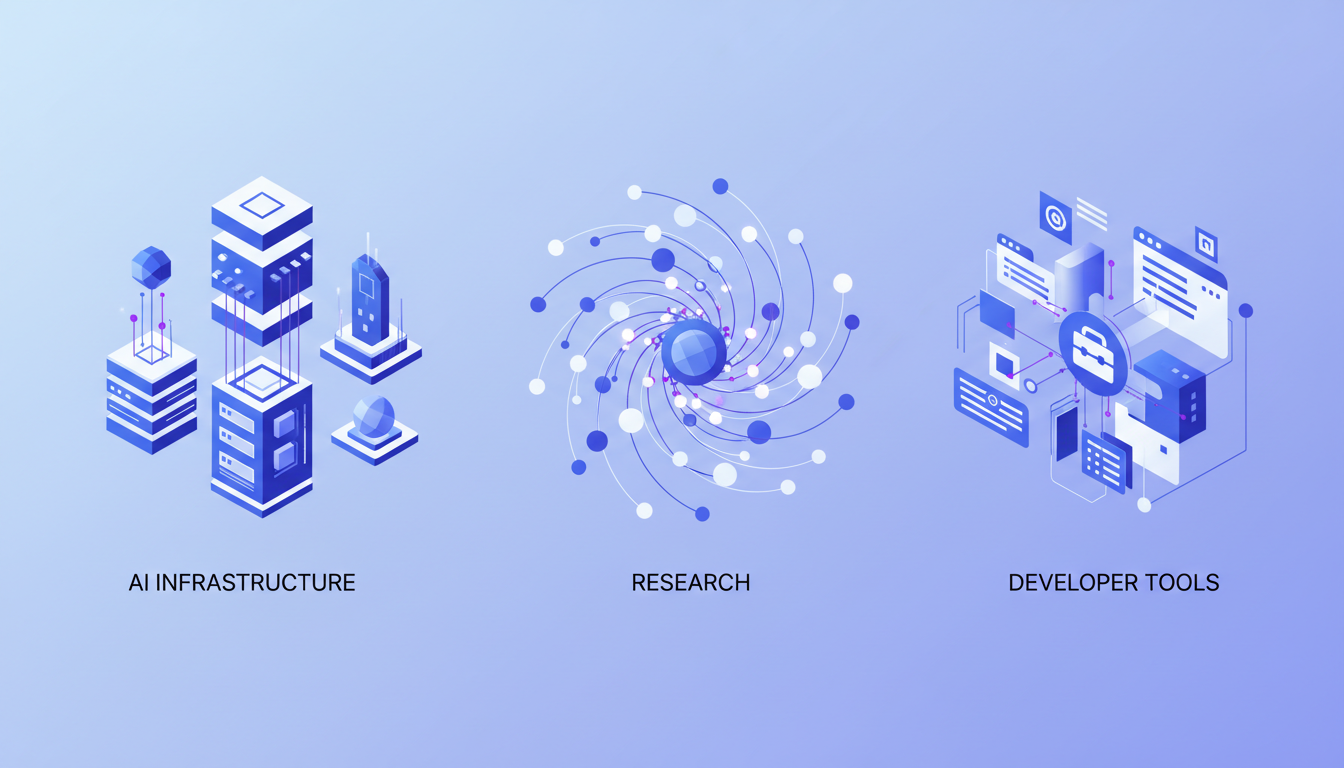
AI Infrastructure
This category explores the critical hardware and software frameworks enabling next-generation artificial intelligence. From Meta’s innovations in scaling recommendation models to LLM-level complexity to Microsoft’s deployment of modular edge datacenters for sovereign AI, we cover the essential building blocks of the industry. These advancements highlight a shift toward specialized architectures and decentralized compute power, ensuring that massive AI workloads can be executed efficiently across global networks and remote localized environments.
Meta Adaptive Ranking Model: Scaling Ads Recommenders to LLM Complexity
Since launching on Instagram in Q4 2025, Adaptive Ranking Model has delivered a +3% increase in ad conversions
Adaptive Ranking Model enables O(1T) parameter scaling, allowing us to serve the LLM-scale runtime RecSys models
Meta’s Adaptive Ranking Model achieved a 3% increase in ad conversions and a 5% increase in click-through rates since its Q4 2025 launch on Instagram. The system replaces traditional one-size-fits-all inference with intelligent request routing that dynamically aligns model complexity with a specific person's context and intent. By leveraging hardware-aware architectures and multi-card serving infrastructure, Meta now supports recommendation models with O(1T) parameter scaling while maintaining strict sub-second latency. This infrastructure-level innovation addresses the fundamental inference trilemma of balancing model complexity, computational costs, and global service speed. Key technical pillars include a request-centric architecture and co-designed systems that optimize hardware utilization in heterogeneous environments. These advancements allow Meta to integrate LLM-scale intelligence into its ads stack, delivering significantly higher value for advertisers while ensuring system-wide computational efficiency.
Source: Engineering at Meta
Microsoft and Armada Bring Sovereign AI to the Edge via Galleon Modular Datacenters
Together, we are bringing Microsoft Sovereign Private Cloud capabilities to Armada’s Galleon modular datacenters (MDC)
Azure Local, Microsoft’s on-premises cloud platform that can be used in disconnected and sovereign scenarios
Microsoft and Armada have established a collaboration to integrate Azure Local with Galleon modular datacenters, enabling sovereign AI capabilities in disconnected and regulated environments. This solution utilizes the Microsoft Sovereign Private Cloud to provide a validated reference architecture for mission-critical workloads in sectors such as defense, energy, and public safety. The platform supports a variety of connectivity options including satellite, LTE/5G, and RF to ensure operational resilience in remote or contested areas. Customers can deploy Azure services and AI-ready capabilities while maintaining full control over data residency, governance, and operational security. This infrastructure allows for the execution of modern AI and analytics workloads directly at the point of data creation without requiring persistent public cloud access. The result is a secure, portable, and rapidly deployable environment that aligns with strict national sovereignty and classification requirements.
Source: Microsoft Azure Blog
Foundation Models
Foundation models continue to evolve as industry leaders prioritize efficiency and accessibility alongside raw power. Recent releases, such as OpenAI's GPT-5.4 Mini and Mistral Small 4, highlight a strategic shift toward high-performance, smaller-scale architectures designed for cost-effective deployment and edge applications. These advancements demonstrate that optimizing model size without compromising reasoning capabilities remains a critical frontier in generative AI, enabling developers to integrate sophisticated intelligence into diverse, resource-constrained environments more effectively than ever before.
LWiAI Podcast #238: OpenAI Ships GPT-5.4 Mini and Mistral Small 4
OpenAI released GPT-5.4 mini and nano with 400k-token context windows, higher per-token prices but claimed token-efficiency gains
Mistral open-sourced the Small 4 model family (MoE, 119B total/6B active) combining reasoning, multimodal, and coding-agent capabilities
OpenAI has released GPT-5.4 mini and nano models featuring 400k-token context windows, though these new iterations arrive with a price increase of up to four times over previous versions. Mistral expanded its portfolio with the Small 4 family, a Mixture-of-Experts model offering 119 billion total parameters with specialized coding-agent and multimodal capabilities. Nvidia introduced DLSS 5 as a real-time generative AI filter for gaming and announced the Open Shell sandboxed agent runtime to compete in the intensifying agentic operating system market. Meanwhile, Microsoft is reorganizing its AI division as Copilot faces stiff competition, and OpenAI is reportedly pivoting its strategic focus toward enterprise productivity and business tools. Safety research continues to evolve with new frameworks for monitoring LLM steganography and assessing chain-of-thought faithfulness in reasoning models. These updates reflect a broader industry shift toward specialized high-performance agents and enterprise-grade reliability.
Source: Last Week in AI
AI Agents
This category explores the rapidly evolving landscape of AI agents, focusing on the competition between industry giants like OpenAI and Anthropic alongside the rise of self-evolving open-source alternatives. We highlight critical advancements in autonomous execution, including Nous Research’s Hermes Agent for local workflows and Docker’s new sandboxing technologies for secure microVM isolation. As agents move toward self-improvement and robust reliability, these developments represent a significant shift toward truly independent and functional AI systems.
LateTalk #156: AI Quarterly 26Q1 - OpenClaw, OpenAI vs. Anthropic, and Self-Evolution
Anthropic revenue is catching up to OpenAI, and Claude Code has surpassed Cursor
The triple confrontation between the latest models Opus 4.6 and ChatGPT-5.4
Anthropic's revenue reached $19 billion in Q1 2026, narrowing the gap with OpenAI's $25 billion as Claude Code growth surpassed Cursor. OpenClaw emerged as a breakthrough local-running agent in the Chinese market, effectively integrating with chat applications and utilizing long-term memory for task automation. The industry's competitive focus is shifting from raw model performance to comprehensive systems, highlighted by the strategic rivalry between Opus 4.6 and ChatGPT-5.4. Recent developments in AutoResearch signify the emergence of AI self-evolution within limited search spaces through continuous learning and weight-update explorations. Furthermore, the rise of agentic applications is driving a shift in compute demand toward inference and increased CPU usage. This technological progression coincides with a structural transformation in Silicon Valley's labor market, moving toward a model defined by elite talent augmented by AI capabilities.
Source: 晚点聊 LateTalk
Hermes Agent: A Self-Improving Local AI Alternative to OpenClaw
Hermes Agent is a self-hosted, model-agnostic personal AI agent from Nous Research designed to run persistently
it turns successful workflows into reusable skills, stores searchable session history in SQLite
Hermes Agent is a self-hosted, model-agnostic personal AI agent from Nous Research designed to run persistently and improve its behavior over time by converting successful workflows into reusable skills. Unlike the manual, skill-based approach of OpenClaw, this system utilizes a self-improving agent loop that stores searchable session history in SQLite and treats memory as a layered stack of persistent notes and procedural knowledge. The architecture incorporates a safer-by-default design with user authorization checks and isolation, ensuring that recurring jobs run in fresh sessions while filtering credentials. It features a unique identity definition through SOUL.md and supports scheduled tasks via cron for automated, proactive outputs. This shift toward procedural memory allows the agent to remember methods rather than just facts, positioning it as a safer, long-running alternative for complex personal workflows.
Source: Turing Post
Docker Sandboxes: Secure Autonomous AI Agent Execution via MicroVM Isolation
Over a quarter of all production code is now AI-authored, and developers who use agents are merging roughly 60% more pull requests.
Under the hood, each sandbox runs in its own lightweight microVM, built for strong isolation without sacrificing speed.
Over 25% of all production code is currently authored by AI, and developers utilizing autonomous agents are reportedly merging 60% more pull requests. While autonomous "YOLO mode" significantly boosts productivity, running these agents directly on a host machine poses severe security risks including unauthorized file access and accidental command execution. Docker Sandboxes address these concerns by providing a standalone environment that utilizes lightweight microVMs to create a secure bounding box for agent execution. This architecture ensures strong isolation with no shared state or host bleed-through, enabling agents to operate at full speed without requiring Docker Desktop. Compatible with tools like Claude Code, GitHub Copilot CLI, and Gemini CLI, the solution allows builders to deploy next-generation autonomous systems like NanoClaw safely from day one without needing dedicated hardware.
Source: Docker
Research
This category explores high-impact academic breakthroughs, ranging from cost-effective biological modeling to advanced predictive frameworks for machine learning performance. Recent highlights include the democratization of genomic research through mRNA language models trained at minimal cost across dozens of species. Additionally, innovative systems like the ADeLe framework are setting new standards for estimating task outcomes with remarkable precision. These studies demonstrate how computational efficiency and algorithmic refinement are accelerating the next wave of scientific discovery.
Training mRNA Language Models Across 25 Species for $165
CodonRoBERTa-large-v2 emerged as the clear winner with a perplexity of 4.10 and a Spearman CAI correlation of 0.40
We then scaled to 25 species, trained 4 production models in 55 GPU-hours
OpenMed successfully developed a species-conditioned protein AI pipeline that achieves a 4.10 perplexity and 0.40 Spearman CAI correlation using the CodonRoBERTa-large-v2 architecture. This end-to-end system integrates ESMFold v1 for structure prediction, ProteinMPNN for amino acid sequence design, and a custom transformer-based model for codon optimization. Training cost for the final suite of four production models covering 25 species was approximately $165, requiring only 55 GPU-hours of compute time. The project significantly outperformed ModernBERT in codon-level language modeling benchmarks while maintaining high sequence recovery rates of 42% on scaffold testing. This framework allows researchers to transition from a therapeutic protein concept to a synthesis-ready, optimized DNA sequence within a single afternoon. By providing the first open-source multi-species mRNA optimization system, OpenMed offers a transparent and reproducible alternative to proprietary drug discovery tools.
Source: Hugging Face Blog
ADeLe Framework Predicts AI Task Performance with 88% Accuracy
ADeLe evaluates models by scoring both tasks and models across 18 core abilities, enabling direct comparison between task demands and model capabilities.
Using these ability scores, the method predicts performance on new tasks with ~88% accuracy, including for models such as GPT-4o and Llama-3.1.
ADeLe predicts AI model performance on unseen tasks with approximately 88% accuracy by evaluating both tasks and models across 18 core abilities such as reasoning and domain knowledge. Developed by Microsoft Research in collaboration with Princeton University and Universitat Politècnica de València, this methodology assigns demand levels from 0 to 5 to characterize task complexity. Unlike traditional benchmarks that provide aggregate scores without context, ADeLe builds ability profiles to identify specific strengths and limitations, showing how performance shifts as task complexity increases. The framework has been successfully tested on high-profile models including GPT-4o and Llama-3.1, providing a structured view of where models break down. By linking outcomes directly to task demands, the system explains why a model fails or succeeds rather than just reporting a success rate. This research, published in Nature, introduces a predictive approach that moves beyond isolated testing to represent benchmarks and LLMs through a unified set of capability scores.
Source: Microsoft Research Blog
Developer Tools
This category tracks the evolving landscape of software engineering platforms, IDEs, and specialized utilities designed to streamline the coding lifecycle. With the integration of AI-driven features like custom Copilot agents and advanced navigation systems, these tools are significantly reducing cognitive load and accelerating deployment cycles. Stay informed on the latest updates to major environments like Visual Studio that redefine how modern code is written, audited, and maintained.
Visual Studio March Update: Custom Copilot Agents and Enhanced Code Navigation
Custom agents allow you to build specialized Copilot agents tailored to your team’s workflow
The new find_symbol tool lets the agent find all references to symbols across your project
Visual Studio 2026 Insiders now enables developers to create specialized GitHub Copilot agents by adding .agent.md files to their repositories. These custom agents leverage workspace awareness and Model Context Protocol (MCP) connections to integrate external knowledge sources directly into the development workflow. The update introduces agent skills, which are reusable instruction sets stored as SKILL.md files that activate automatically based on the repository structure. A new find_symbol tool enhances Copilot’s agent mode by providing language-aware navigation for C++, C#, Razor, and TypeScript, allowing for accurate refactoring across complex codebases. Beyond agentic capabilities, the release adds Copilot-powered profiling in the Test Explorer and automated NuGet vulnerability remediation in the Solution Explorer. These features aim to reduce manual context-switching by embedding team-specific standards and deep code metadata into the AI interaction model.
Source: Visual Studio Blog
AI Applications
This category explores how artificial intelligence is moving beyond simple automation to create immersive, interactive experiences in the digital realm. From building 'super playgrounds' that redefine entertainment to developing sophisticated personal assistants, we examine the practical implementation of AI across various industries. These stories highlight the innovative ways founders and developers are leveraging large models to transform how we play, work, and interact with technology in our daily lives.
Mujian Founder Roi on Building the Super Playground for the AI Era
Mujian has recently completed two consecutive rounds of financing, with the total amount reaching tens of millions of dollars.
Simulators are not about restoring reality, but about rewriting life to be more dramatic, concentrated, and fun.
AI interactive platform Mujian has secured tens of millions of dollars across two recent funding rounds to pivot consumer AI from simple companionship to complex system-based simulators. Founder Roi argues that while Character AI focused on emotional projection, the next phase of consumer products will center on lightweight, fragmented, and addictive experiences where users interact with systems rather than single personas. These simulators allow users to role-play rare life experiences, such as being a celebrity or a stock market mogul, using low-cost prompts and mobile-first tools. The platform identifies Gen Z female creators as the early power users, leveraging their desire for narrative tension and immersive fantasy over traditional technical expertise. Mujian aims to become a community-driven "AI version of Xiaohongshu," where users share slices of virtual life created by super-individuals rather than centralized game studios.
Source: 十字路口Crossing
This report is auto-generated by WindFlash AI based on public AI news from the past 48 hours.