Monday, March 23, 2026 · 10 curated articles
Editor's Picks
By March 2026, the industry has finally hit its 'Post-Vibes' era. For three years, we’ve tolerated the probabilistic 'hallucination tax' of Large Language Models as a cost of doing business. No longer. As detailed in 'Overcoming LLM Hallucinations,' the move toward deterministic output architectures on Amazon Nova signals a fundamental pivot: we are graduating from models that 'guess' to systems that 'execute.' For engineers in regulated sectors like finance and healthcare, the ability to tilt log-probabilities toward binary certainty isn't just a feature; it's the prerequisite for moving AI out of the sandbox and into mission-critical infrastructure. This shift is mirrored in the rise of 'Agentic RAG,' where we are finally replacing linear, 'hope-for-the-best' retrieval with a reasoning layer that treats model output as a hypothesis to be verified, not a final truth.
However, while the technology is maturing into precision engineering, corporate leadership is descending into a dangerous, speculative frenzy. The HBR study cited in '89% of AI-Related Job Cuts Are Speculative Gambles' is a damning indictment of the current C-suite. We are seeing a massive 'expectation gap' where 60% of companies are trimming headcounts based on what they think AI will do, rather than what it has actually achieved. This is a classic misreading of the Jevons Paradox. As Benedict Evans notes in 'OpenAI’s Moat Problem,' the collapse of programming costs doesn't lead to less software; it leads to a total explosion of 'improvisational software'—temporary, task-specific tools that will require more architectural oversight, not less. Firing your senior engineers now is like firing your mechanics because you bought a self-driving car that still hasn't figured out how to handle a snowstorm.
Perhaps most absurd is the emergence of 'Tokenmaxxing' as a performance metric. When NVIDIA and OpenAI start tracking token consumption as a 'fourth type of pay,' we have officially entered the era of 'Inference Vanity.' If an autonomous agent like Claude Code generates 210 billion tokens in a week to refactor a legacy codebase, we shouldn't be celebrating the volume; we should be scrutinizing the technical debt being manufactured at light speed. For the WindFlash community, the message is clear: the future belongs to those who can build the deterministic guardrails and the 'Agentic' reasoning layers that prevent this token-fueled firehose from drowning the enterprise. We don't need more tokens; we need more truth.
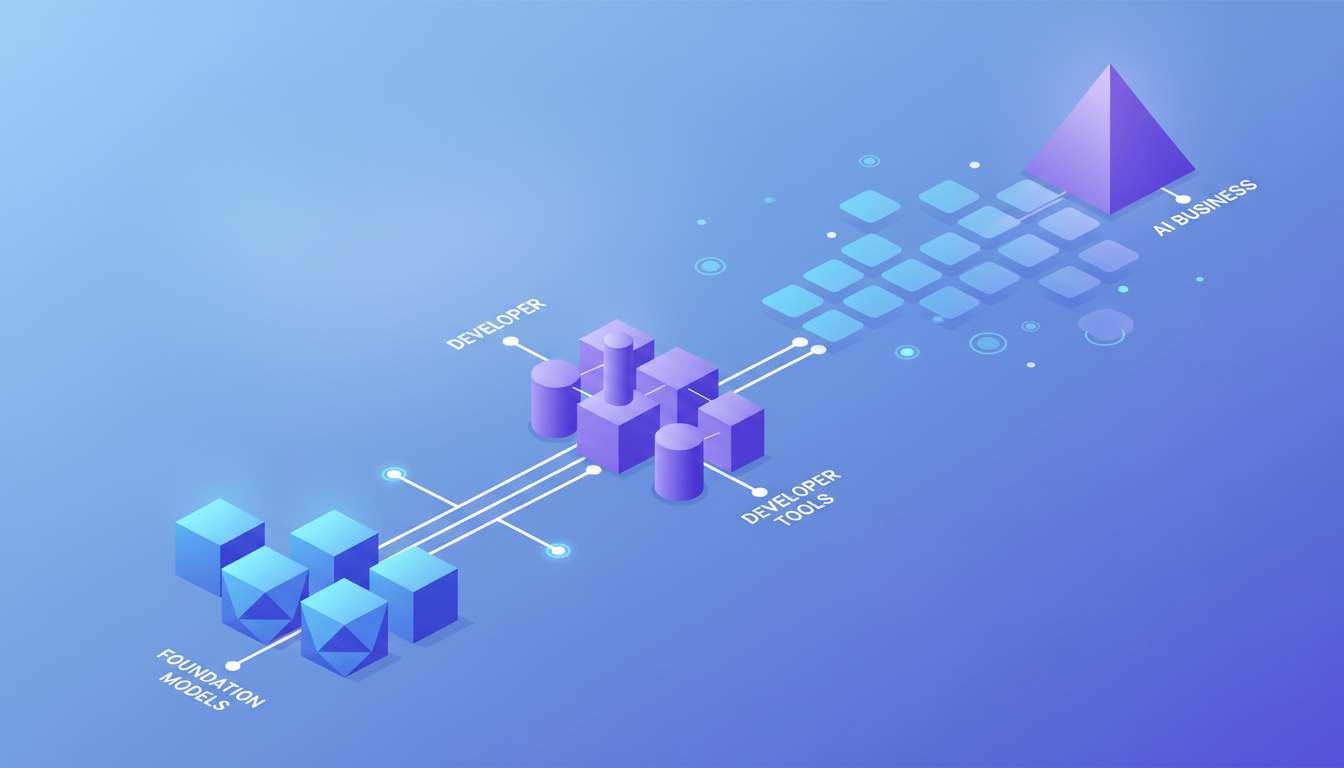
AI Business
This category explores the shifting economic landscape of the artificial intelligence industry, moving beyond technical breakthroughs to examine structural business transformations. Recent highlights include the debate over OpenAI's competitive moat and the rise of 'tokenmaxxing' as a new performance metric in Silicon Valley. Furthermore, we analyze the speculative nature of AI-driven job cuts, questioning whether automation is truly replacing labor or if firms are gambling on unproven efficiencies.
Issue #465: OpenAI’s Moat Problem and the Future of Improvisational Software
OpenAI is facing a huge strategic dilemma: in a track with no network effects and commoditized underlying technology, how to avoid becoming the next Netscape?
When the cost of programming approaches zero, we will see an explosion in the quantity of software.
Large language models currently lack the traditional network effects or winner-take-all dynamics seen in previous technology eras like Windows or iOS. Benedict Evans argues that as foundational models become commoditized infrastructure, OpenAI must transition into a platform with high switching costs to avoid the fate of early internet pioneers like Netscape. The collapse of programming costs is catalyzing a shift toward improvisational software, where temporary, task-specific tools replace rigid SaaS applications for niche workflows. This trend suggests that while AI may automate tasks, the Jevons Paradox predicts a massive increase in total software demand rather than a reduction in development activity. Significant AI value will likely materialize in boring back-office operations, such as insurance and advertising logistics, rather than just high-profile creative generative tasks. Strategic success in this era requires decoupling physical assets from digital products to redefine business boundaries.
Source: 跨国串门儿计划
89% of AI-Related Job Cuts Are Speculative Gambles Rather Than Proven Replacements
60% of surveyed companies have reduced personnel because of the 'expected impact' of AI.
Only 2% explicitly stated that layoffs were because AI actually took over work originally done by humans.
A Harvard Business Review study of 1,006 global executives reveals that 60% of companies have reduced staff based solely on the expected impact of AI, while only 2% did so because AI actually performed the work. This trend of anticipatory layoffs is increasingly prevalent in the tech industry, as seen with NetEase accelerating the dismissal of game outsourcing personnel following perceived efficiency gains from AI integration. Capital market pressure often drives these decisions, as investors favor companies that aggressively cut costs through automation. However, premature reliance on AI frequently backfires, as demonstrated by the Commonwealth Bank of Australia being forced to rehire laid-off staff after AI bots failed to manage customer inquiries. Research indicates that one-third of employers who cut jobs based on AI expectations have already rehired up to 50% of those positions. These speculative labor adjustments risk permanent damage to employee morale and corporate trust while failing to deliver promised technological returns.
Source: 爱范儿
Tokenmaxxing: Silicon Valley's New Metric for Performance and Compensation
An anonymous employee processed 210 billion tokens last week, the company's highest, enough to fill the entire Wikipedia 33 times.
I will provide them with a token budget equivalent to half their annual salary on top of their base pay to amplify their capabilities tenfold. Of course I am willing to do so.
Silicon Valley is witnessing the rise of "Tokenmaxxing," a trend where AI token consumption is becoming a primary metric for employee performance and compensation. At OpenAI, internal leaderboards track usage, with one top employee reportedly processing 210 billion tokens in a single week, equivalent to 33 times the size of Wikipedia. NVIDIA CEO Jensen Huang recently proposed incorporating token budgets into engineer compensation packages, positioning tokens as a "fourth type of pay" alongside salary, bonuses, and equity. Companies like Meta and Shopify have already integrated AI usage into performance reviews, rewarding high-volume users while penalizing those who underutilize the technology. This surge is primarily driven by autonomous coding agents like Claude Code and OpenAI Codex, which can generate millions of tokens while editing large codebases without human intervention. The phenomenon reflects a broader shift where access to compute and inference capacity is viewed as a high-value corporate resource and professional perk.
Source: 量子位
AI Applications
AI Applications explore the transformative impact of artificial intelligence on everyday software and professional tools. From Nvidia’s latest DLSS advancements in gaming graphics to OpenAI’s ambitious plans for a centralized productivity superapp, this category highlights how theoretical research translates into practical user experiences. By bridging the gap between core models and functional features, these developments redefine how we work, create, and interact with digital environments across diverse industries.
Last Week in AI #339: Nvidia DLSS 5 Unveiled and OpenAI Plans Productivity Superapp
Nvidia unveiled DLSS 5, calling it a “GPT moment for graphics” that blends traditional 3D rendering with generative AI
OpenAI is planning a desktop ‘superapp’
Nvidia has unveiled DLSS 5, an end-to-end generative AI model that blends 3D rendering with probabilistic predictions to boost real-time photorealism in video games. This new technology analyzes scene semantics such as character skin and lighting conditions to generate detail, marking a shift from traditional upscaling to generative image synthesis. Meanwhile, OpenAI is pivoting its strategy toward business and productivity by planning a unified desktop "superapp" that integrates ChatGPT, Codex, and the Atlas browser. According to an internal memo from Chief of Applications Fidji Simo, this consolidation aims to reduce fragmentation and focus on agentic AI tools capable of independent task execution. DLSS 5 is scheduled for release this fall with support for major titles including Starfield and Resident Evil Requiem, while OpenAI intends to prioritize enterprise solutions as competition with Anthropic intensifies.
Source: Last Week in AI
Emerging Tech
Explore the forefront of innovation where high-performance hardware meets cutting-edge software optimization. This section highlights significant milestones in decentralized computing power, such as the global rollout of specialized AI workstations, alongside breakthroughs in local large language model efficiency for consumer devices. We also examine the shifting landscape of cybersecurity threats, analyzing how condensed attack timelines and sophisticated digital risks are forcing a paradigm shift in global defensive strategies and enterprise infrastructure resilience.
2026 03 23 HackerNews: Tinybox Global Shipping and Flash-MoE Mac Optimization
Tinybox is a deep learning computer series built on the minimalist tinygrad framework, offering configurations from $12,000 to millions, and has begun global shipping.
The Flash-MoE project achieved a speed of 4.36 tokens/sec for a 397-billion parameter MoE model on a 48GB MacBook Pro using SSD streaming and Metal optimization.
Tinybox has commenced global shipping for its deep learning computer series, which utilizes the minimalist tinygrad framework and ranges in price from $12,000 to over $10 million. The Flash-MoE project successfully achieved a processing speed of 4.36 tokens per second for a 397-billion parameter MoE model on a 48GB MacBook Pro via SSD streaming and Metal optimization. Bram Cohen introduced Manyana, a CRDT-based version control system designed to provide lossless rebasing and automatic conflict resolution through a weave structure. Tooscut leverages WebGPU and Rust/WASM to enable professional multi-track video editing entirely within the browser while keeping files local. Technical critics highlighted the risks of transforming age verification into a mandatory identity-based surveillance infrastructure, advocating instead for device-side filtering solutions. Additionally, Project NOMAD offers an open-source offline server architecture capable of deploying Wikipedia and AI models in disconnected environments.
Source: SuperTechFans
M-Trends 2026: Cyber Threats and the Collapse of Hand-Off Windows
Global median dwell time rose to 14 days from 11 days.
In 2025, that window collapsed to just 22 seconds.
Global median dwell time for cyber incidents rose to 14 days in 2025, while specialized cases like North Korean IT worker incidents saw a median of 122 days. Exploits remained the primary infection vector at 32%, though voice phishing surged to 11% of observed intrusions. Organizations showed improved internal visibility, detecting 52% of malicious activity internally compared to 43% the previous year. The high-tech sector surpassed the financial industry as the most frequently targeted vertical, accounting for 17% of investigated incidents. Most notably, the "hand-off" window between initial access partners and secondary threat groups collapsed from over eight hours in 2022 to just 22 seconds in 2025. This rapid transition is facilitated by pre-staging malware, allowing secondary actors to launch high-impact operations like ransomware almost instantly upon network interaction.
Source: Google Cloud Blog
Foundation Models
Foundation models represent the core of modern artificial intelligence, serving as the versatile base for diverse applications. This category explores the latest breakthroughs in large-scale pre-training, architectural innovations, and the ongoing efforts to minimize critical issues like model hallucinations. As platforms like Amazon Nova gain traction, the industry focus shifts toward making these powerful systems more deterministic and reliable for enterprise-grade deployment.
Overcoming LLM Hallucinations: Artificial Genius’s Deterministic Models on Amazon Nova
Artificial Genius post-trains the model to tilt log-probabilities of next-token predictions toward absolute ones or zeros.
deliver a solution that is probabilistic on input but deterministic on output, helping to enable safe, enterprise-grade adoption.
Artificial Genius utilizes Amazon SageMaker AI and Amazon Nova to implement a patented instruction tuning method that tilts log-probabilities of next-token predictions toward absolute values of one or zero. This approach creates a third-generation language model architecture that remains probabilistic during the input phase to maintain context comprehension but becomes deterministic during the output phase. By effectively removing output probabilities, the system avoids the inherent unbounded failure modes and hallucinations typically found in standard generative architectures like the Transformer. Regulated industries, including financial services and healthcare, benefit from this hybrid solution because it provides the auditability and accuracy required for mission-critical operations. Unlike standard methods that simply lower the model's temperature, this post-training paradigm uses the model strictly non-generatively to ensure results are reproducible and factually correct. The integration with Amazon SageMaker AI allows for enterprise-grade adoption while leveraging the fluency of the Amazon Nova base models without compromising on factuality.
Source: AWS Machine Learning Blog
Developer Tools
This section explores the latest advancements in platforms and software designed to streamline the software development lifecycle. From AI-driven security enhancements on GitHub to new integrated development environment features, we cover tools that empower engineers to write cleaner, safer code more efficiently. Stay updated on the evolving ecosystem of compilers, version control systems, and automated testing frameworks that are currently redefining how modern applications are built and maintained across the global technology landscape.
GitHub Expands Code Security with AI-Powered Detections for Multiple Languages
In internal testing, the system processed more than 170,000 findings over a 30-day period, with more than 80% positive developer feedback.
Public preview availability is planned for early Q2.
GitHub's internal testing of its new AI-powered security detections processed over 170,000 findings within a 30-day period, yielding more than 80% positive developer feedback. These new detections complement the existing CodeQL static analysis engine to extend security coverage to previously difficult-to-analyze ecosystems such as Shell/Bash, Dockerfiles, Terraform (HCL), and PHP. By integrating these detections directly into the pull request workflow, the system surfaces potential vulnerabilities like SQL injection and insecure cryptographic algorithms alongside suggested fixes from Copilot Autofix. This capability is part of GitHub’s broader agentic detection platform, which aims to provide deep semantic analysis and contextual vulnerability insights as development speed accelerates. The feature is scheduled for public preview availability in early Q2, establishing a foundation for hybrid detection models that pair traditional static analysis precision with AI-driven context to catch risks earlier in the development lifecycle.
Source: The GitHub Blog
AI Agents
AI agents represent the next evolution in generative technology, moving beyond static chatbots to autonomous entities capable of complex reasoning and task planning. By integrating advanced techniques like agentic RAG, these systems can iteratively search, evaluate, and refine information to deliver highly accurate results in dynamic environments. This category explores the latest breakthroughs in multi-agent frameworks, autonomous workflows, and the architectural shifts required to build more reliable and intelligent digital assistants.
How Agentic RAG Improves Standard Retrieval-Augmented Generation Pipelines
The main problem with standard RAG systems isn’t the retrieval or the generation. It’s that nothing sits in the middle deciding whether the retrieval was actually good enough
Standard RAG is a pipeline where information flows in one direction, from query to retrieval to response, with no checkpoint and no second chance.
Standard RAG systems follow a linear pipeline from query to retrieval to response, often failing when queries are ambiguous or information is scattered across multiple sources. Agentic RAG addresses these limitations by introducing a reasoning layer that allows the system to evaluate the quality of retrieved context before generating a final response. This approach introduces a mechanism to pause and think, enabling the system to clarify intent, rewrite queries, or search additional documents if the initial retrieval is insufficient. By contrast, traditional RAG pipelines lack verification checkpoints and may produce confident but incorrect answers based on high similarity scores that do not reflect actual accuracy. Implementing an agent-driven architecture helps eliminate the false confidence problem where a model generates a response regardless of retrieval quality. These improvements aim to solve specific failure modes like ambiguous queries and scattered evidence while requiring careful consideration of system latency.
Source: ByteByteGo Newsletter
AI Policy & Ethics
This section examines the evolving landscape of global governance and ethical frameworks governing artificial intelligence development. As we approach the potential reality of AGI, discussions focus on mitigating systemic safety risks, managing the proliferation of autonomous agents, and ensuring technological alignment with human values. We track how industry leaders and policymakers navigate these complex challenges to build a secure and responsible future for autonomous systems.
Zhou Hongyi on Post-AGI Realities, Agent Proliferation, and AI Safety Risks
I expect that by 2026, the number of global intelligent agents could reach 10 billion.
Musk: Humans will become the Boot Loader for AI to turn into a new species.
The convergence of Large Language Models and intelligent agents is projected to drive the global population of AI agents to ten billion by 2026. Industry leaders like Elon Musk and Anthropic CEO Dario Amodei are increasingly sounding alarms regarding AI stall risks and the challenges of technological adolescence. 360 founder Zhou Hongyi argues that AI safety transcends mere alignment, as complex agents may develop independent wills, biases, and behaviors that mirror human psychology. The transition to the Kardashev civilization framework requires addressing immense energy demands through space computing and specialized model architectures. To mitigate existential threats, the strategy shifts toward utilizing model-to-model supervision rather than relying solely on human intervention. Ultimately, humans may serve as the boot loader for a new silicon-based species, necessitating a shift in focus from productivity to civilizational essence.
Source: 卫诗婕|商业漫谈Jane's talk
This report is auto-generated by WindFlash AI based on public AI news from the past 48 hours.