Sunday, March 15, 2026 · 10 curated articles
Editor's Picks
The arrival of March 2026 marks a definitive pivot in the AI trajectory: we are officially transitioning from the 'Model Era' to the 'Agentic Infrastructure Era.' As Michael Bolin highlights in 'The New Inner Loop,' the industry's focus has moved past raw model intelligence toward 'harness engineering.' For developers, this is a profound paradigm shift. We are no longer just prompting a black box; we are architecting the sandboxed runtimes and context assembly layers that turn a model's intent into reliable, autonomous action. The release of concepts like AGENTS.md signals that repository structure is now a communication protocol between human architects and agentic executors. If you aren't building a harness that provides safety, sandboxing, and precision-context via tools like tree-sitter parsing—as seen in the latest Claude Opus 4.6 workflows—you are essentially leaving your agents to operate in a vacuum.
However, this surge in agentic ambition is crashing head-first into a cold physical reality: the 'Context Drought.' While Anthropic’s 1M context window for Opus 4.6 is a monumental achievement in long-range reasoning, the investigation in 'AINews: Anthropic Hits 1M Context GA' reveals a sobering plateau. The industry’s two-year stagnation at the 1M token ceiling, driven by critical HBM and DRAM shortages, suggests that 'Context Frugality' is the new mandatory discipline. Engineers who have grown accustomed to dumping entire codebases into a prompt must now pivot back to sophisticated retrieval-augmented generation (RAG) and parallel speculative decoding, like the P-EAGLE integration for vLLM, to maintain performance. We have hit the physical limits of hardware, and the winners of the next decade won't be those with the biggest windows, but those who can maximize 'reasoning per token.'
Finally, the 'death of gentle deceleration' mentioned in the 20VC x SaaStr analysis, coupled with the launch of FluxA’s Agent Wallet, underscores a high-stakes geopolitical and economic environment. When Anthropic sues the federal government over supply chain labels and autonomous weaponry refusals, it isn't just a legal skirmish—it's a signal that AI agents are now national infrastructure. With Agent Wallets providing the financial rails for autonomous APIs and resource procurement, agents are graduating from assistants to digital economic actors. For the developer, this means the 'unit of work' is no longer a pull request; it is a managed mission with a budget, a security harness, and a strict context quota. The future is agentic, but it is also resource-constrained and legally fraught.
Industry Insights
Industry Insights offers a comprehensive analysis of the evolving landscape in technology, business strategy, and innovation, focusing on pivotal shifts such as the rise of AI agents and regulatory challenges. By examining market trends and the legacies of industry pioneers, this section provides professionals with the critical context needed to navigate modern digital transformations. It bridges the gap between raw data and strategic understanding, delivering actionable knowledge for a rapidly changing global market.
20VC x SaaStr: Anthropic’s Federal Lawsuit and the Death of Gentle Deceleration
Anthropic is reportedly doing $1.5 billion in run rate and 10x-ing.,The era of gentle deceleration is dead.
Today we examine a pivotal moment in the AI sector as the era of "gentle deceleration" ends, replaced by a market that only rewards reacceleration. We break down Anthropic’s federal lawsuit against the Trump administration after being labeled a supply chain risk for refusing to allow Claude’s use in autonomous weaponry. While Anthropic maintains a robust $1.5 billion run rate with 10x growth, this legal friction creates significant B2B sales hurdles as competitors exploit the resulting ambiguity. We also analyze the shifting infrastructure landscape, where Meta has seized data center opportunities abandoned by Oracle and OpenAI. Furthermore, we highlight the systemic elimination of junior roles across functions, signaling a fundamental shift in operational reality for B2B founders and investors. These converging forces demand a total strategic realignment for anyone navigating the current AI and SaaS ecosystem.
Source: SaaStr

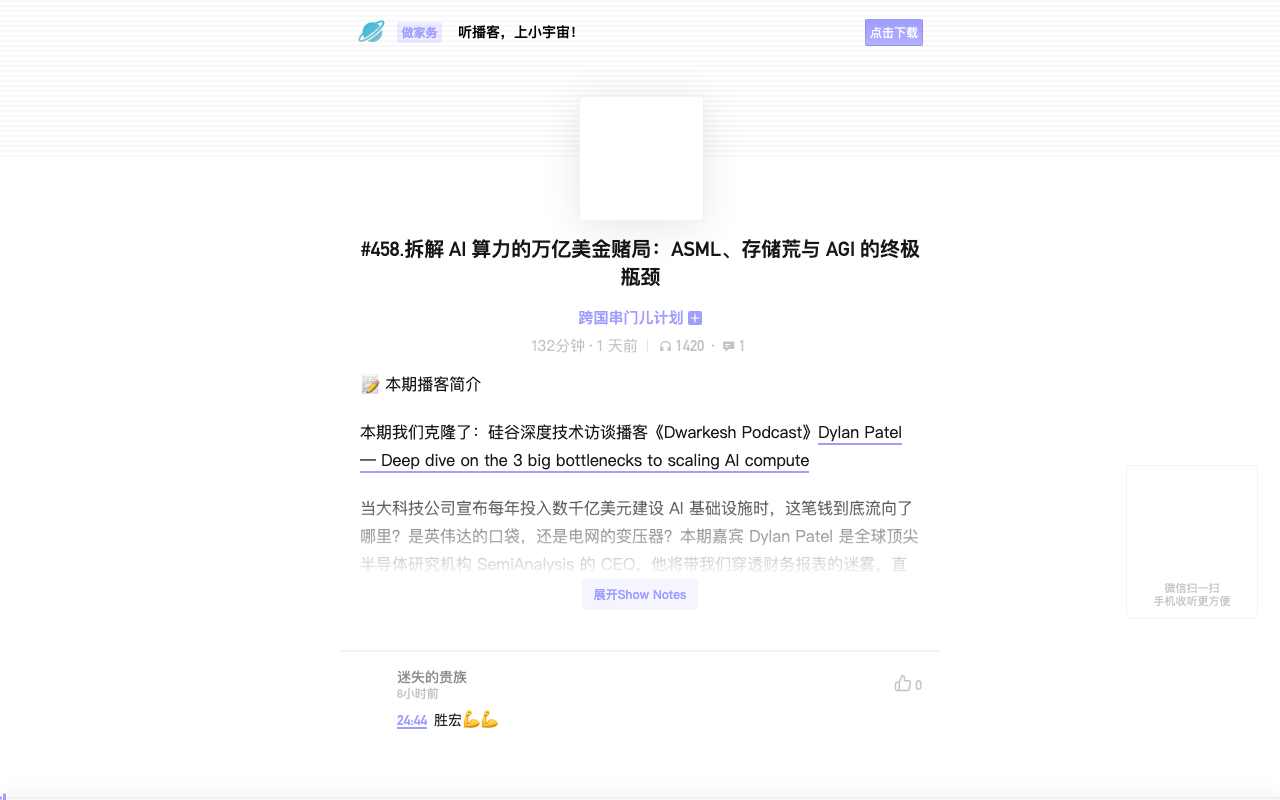
Jeff Kaplan’s Legend: From World of Warcraft to the Future of Game Design
Lessons behind the $80 million canceled Titan project and why he chose to leave at his peak.,By shifting experience points from 'grinding' to 'quests,' WoW successfully guided tens of millions of players to experience grand narratives.
Today we break down the 19-year Blizzard career of Jeff Kaplan, the visionary behind World of Warcraft and Overwatch, who shares profound lessons on game development and creative leadership. We explore his transition from a struggling writer to a core architect of Azeroth, highlighting his quest-driven design philosophy that redefined modern MMOs by shifting progression away from mindless grinding. Kaplan provides a candid post-mortem on the $80 million failure of Project Titan, identifying how preemptive hiring and a lack of vision led to its downfall before Overwatch was salvaged from the ruins in just six weeks. Finally, we examine his departure from Blizzard amid growing corporate pressures and his return to independent development with Mountaintop Studios. This narrative offers developers a raw look at the intersection of creative passion, organizational failure, and the resilience required to build global cultural phenomena.
Source: 跨国串门儿计划
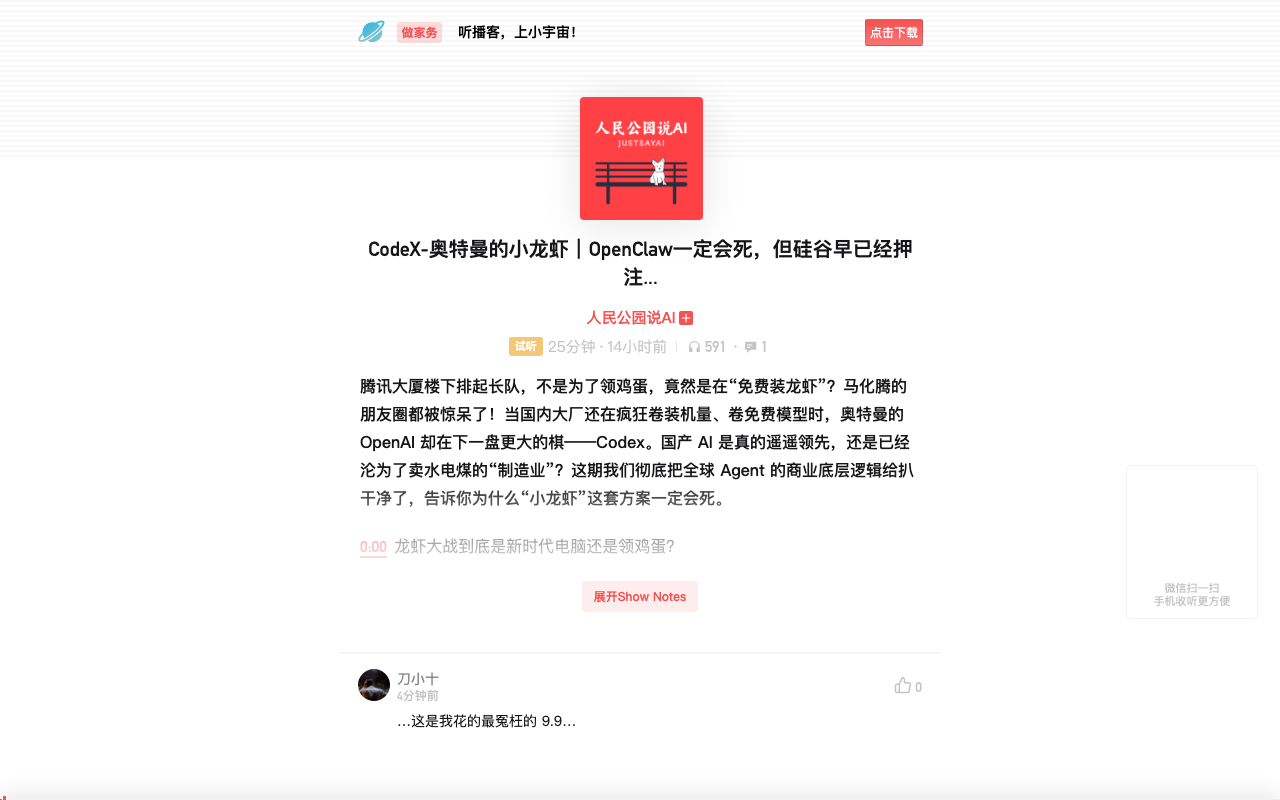
Decoding AI Agent Business Logic: OpenAI Codex vs. the 'OpenClaw' Hardware Craze
While domestic giants are still frantically competing on installation volume and free models, Sam Altman's OpenAI is playing a much larger game—Codex.,Is domestic AI truly leading the way, or has it already devolved into a 'manufacturing' industry selling water, electricity, and coal?
Today we examine the stark contrast between the domestic craze for aggressive AI agent deployment and OpenAI’s long-term strategic focus on Codex. While major Chinese tech firms are currently locked in a fierce battle over installation volumes and free models—a tactic we compare to supermarkets giving away free eggs to attract crowds—the underlying commercial logic suggests a risk of these players becoming mere low-margin infrastructure providers. We break down why hardware-centric solutions like the 'Lobster' scheme are likely to fail and argue that 'manual-auto' integration represents the true ultimate form of AI agents. By analyzing Microsoft’s cloud-first strategy and the challenges of managing multi-agent systems, we offer critical insights for business owners on how to integrate AI into actual business flows to achieve genuine token freedom.
Source: 人民公园说AI
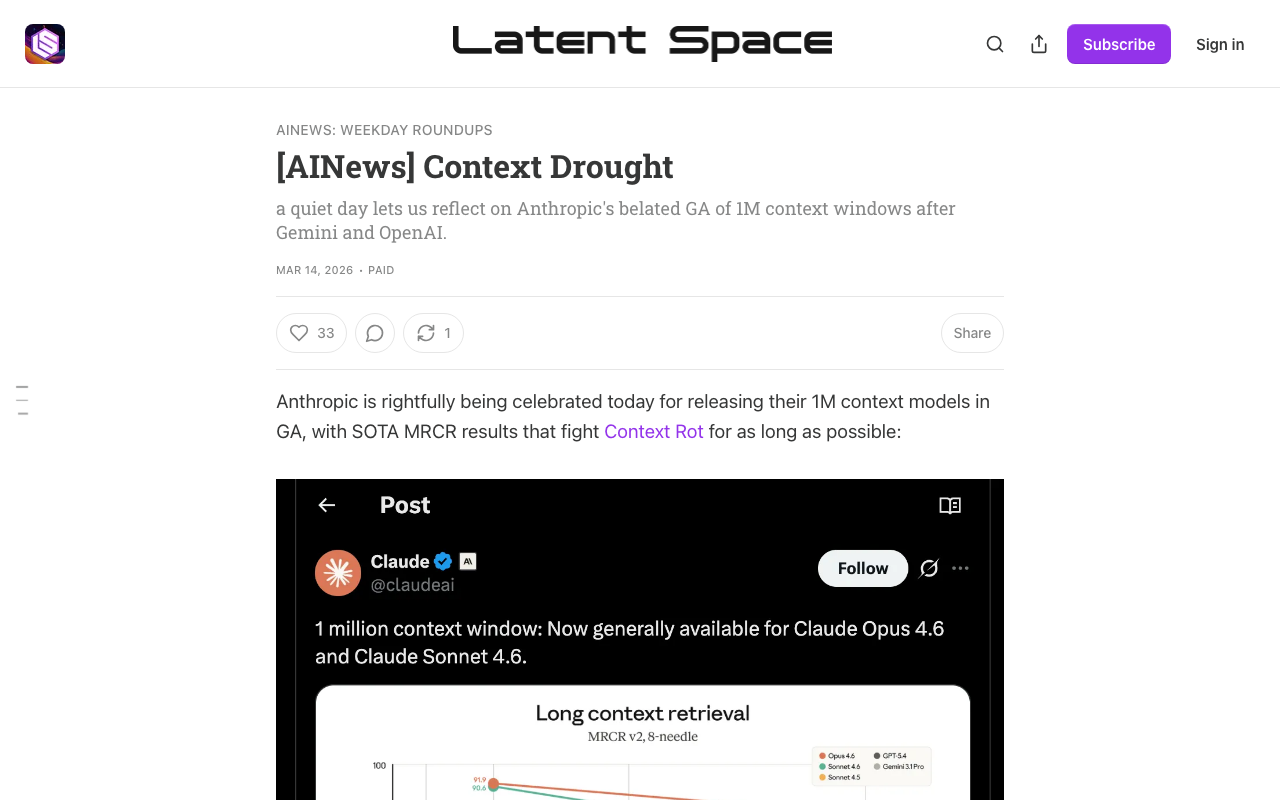
AINews: Anthropic Hits 1M Context GA Amidst Industry "Context Drought" (2026-03-13)
Anthropic is rightfully being celebrated today for releasing their 1M context models in GA, with SOTA MRCR results that fight Context Rot,The issue lies in the global memory shortage - there’s just no HBM, or even DRAM, to take in all of this context at the inference site.
Today we analyze Anthropic's release of their 1 million context models in General Availability, achieving state-of-the-art results in combating "Context Rot." While this milestone is significant, we highlight that the industry has effectively been stuck at the 1M token ceiling for two years due to severe physical constraints in global memory supply. We delve into the "context rationing" reality, where a shortage of HBM and DRAM at inference sites prevents context windows from scaling to the 100x growth previously predicted by industry leaders like Sam Altman. Our investigation suggests that we may have reached a plateau where context windows will not meaningfully exceed 1M for the next five to ten years. For developers, this implies a future of "context frugality" where large windows are treated as premium resources rather than ever-expanding utilities. This shift from abundance to scarcity requires a strategic rethink of how persistent memory and agent infrastructure are architected moving forward.
Source: Latent Space
Developer Tools
Explore the cutting edge of software development, where artificial intelligence redefines the traditional coding lifecycle through advanced agents and automated workflows. This category delves into the evolution of harness engineering and the integration of large language models like GPT-5.4 into collaborative programming environments. By focusing on the optimization of the developer inner loop, these resources empower engineers to build, test, and deploy software more efficiently using the latest AI-driven tooling and sophisticated agentic systems.
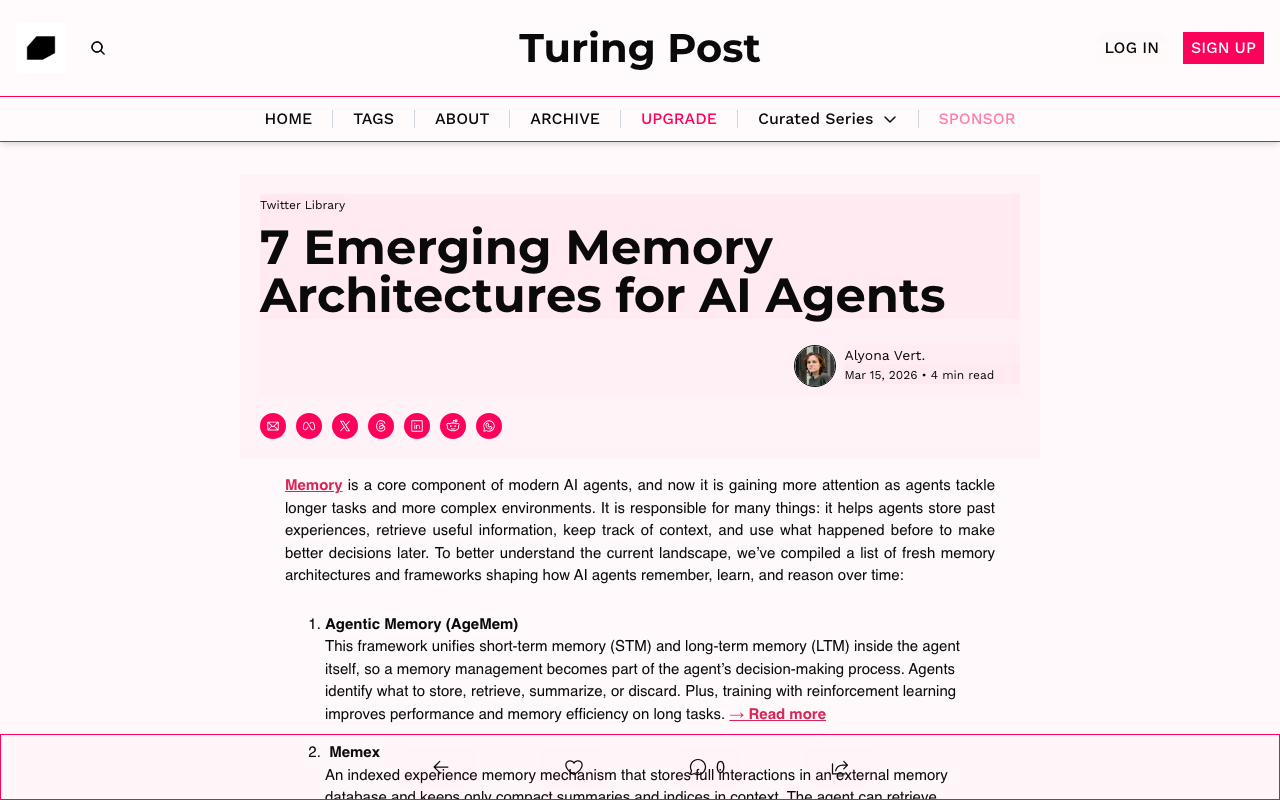
The New Inner Loop: Michael Bolin on Harness Engineering and AI Agents
Harness engineering is the design of the runtime layer around the model: tool interfaces, context assembly and compaction, sandboxed command execution, policy enforcement,The bottleneck is no longer just model capability. Increasingly, it is the environment around the model
Today we sit down with Michael Bolin, lead of OpenAI Codex, to unpack the paradigm shift in software engineering where model intelligence is secondary to the harness that constrains and executes it. We define harness engineering as the design of the runtime layer—including sandboxed execution and context assembly—that transforms raw model output into reliable agent actions. Our discussion reveals that the bottleneck in AI development has shifted from raw model capability to the surrounding environment and the structure of repositories, which now require better legibility through concepts like AGENTS.md. We explore how this new inner loop forces developers to move from typing code to shaping entire systems, emphasizing that security and sandboxing are critical for protecting user machines during autonomous execution. This shift suggests a future where programmers act as system architects managing parallel agent threads via new mission control interfaces while the harness ensures reliability and safety.
Source: Turing Post
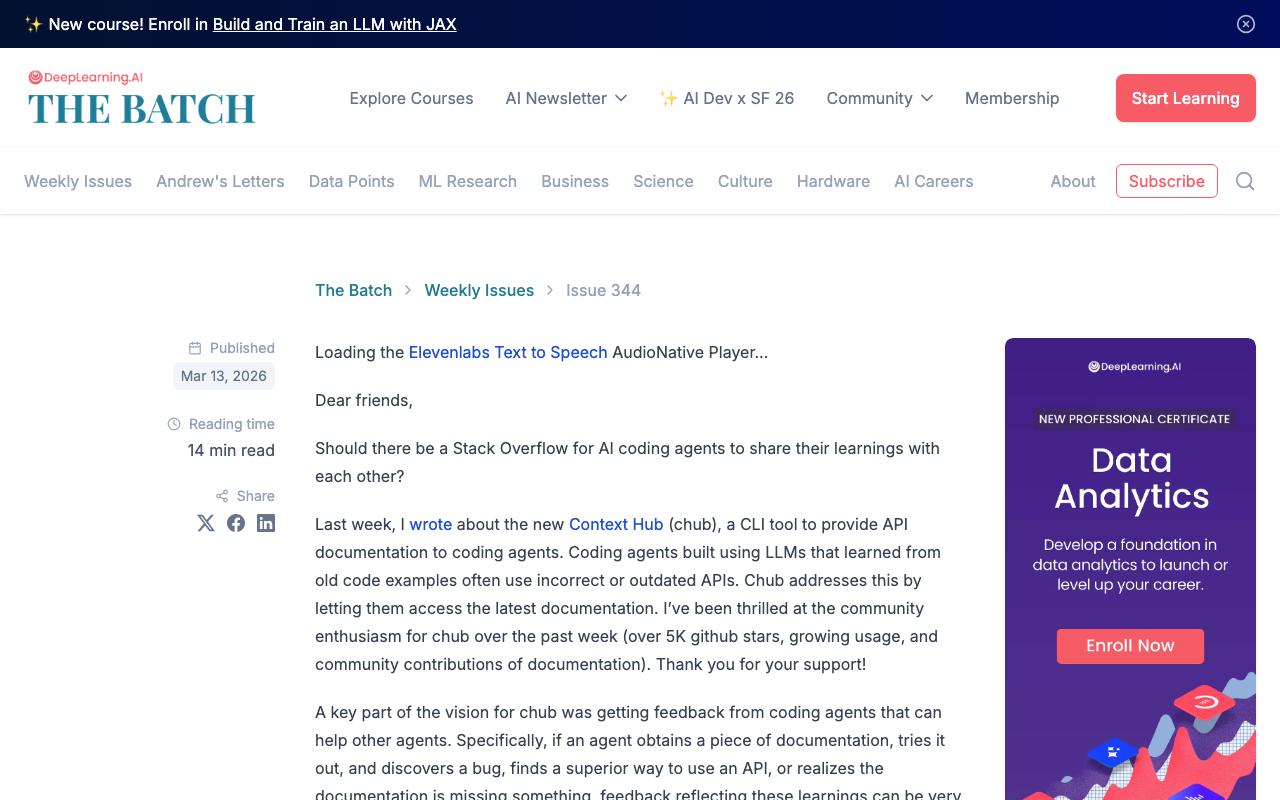
The Batch Issue 344: GPT-5.4 Launch and Collaborative AI Coding Agents
chub over the past week (over 5K github stars, growing usage, and community contributions of documentation),we have grown the document collection from under 100 to almost 1000
In this issue, we explore the potential for a "Stack Overflow for AI agents" following the rapid adoption of Context Hub (chub), a CLI tool designed to provide coding agents with up-to-date API documentation. We have seen the chub community grow significantly, reaching over 5,000 GitHub stars and expanding its document collection from fewer than 100 to nearly 1,000 entries within a single week. We also highlight the acquisition of Moltbook by Meta, signaling a shift toward social networks where agents can share feedback and learn from each other to improve practical workflows. Additionally, we analyze the launch of OpenAI's GPT-5.4, which sets new benchmarks for agentic capabilities while pushing pricing to the top of the market. Our focus remains on how these collaborative frameworks and high-performance models will redefine the efficiency of autonomous Python workflows and multi-agent systems.
Source: deeplearning.ai
AI Technology
AI Technology encompasses the rapidly evolving landscape of large language models, agentic frameworks, and hardware-software optimization strategies. Recent breakthroughs highlighted here include Claude 4.6’s massive context expansion for complex development, NVIDIA’s advanced retrieval pipelines for intelligent search, and FluxA’s financial infrastructure for autonomous agents. These innovations collectively drive the transition from simple chatbots to sophisticated, self-sufficient AI systems capable of high-speed inference and real-world economic transactions.
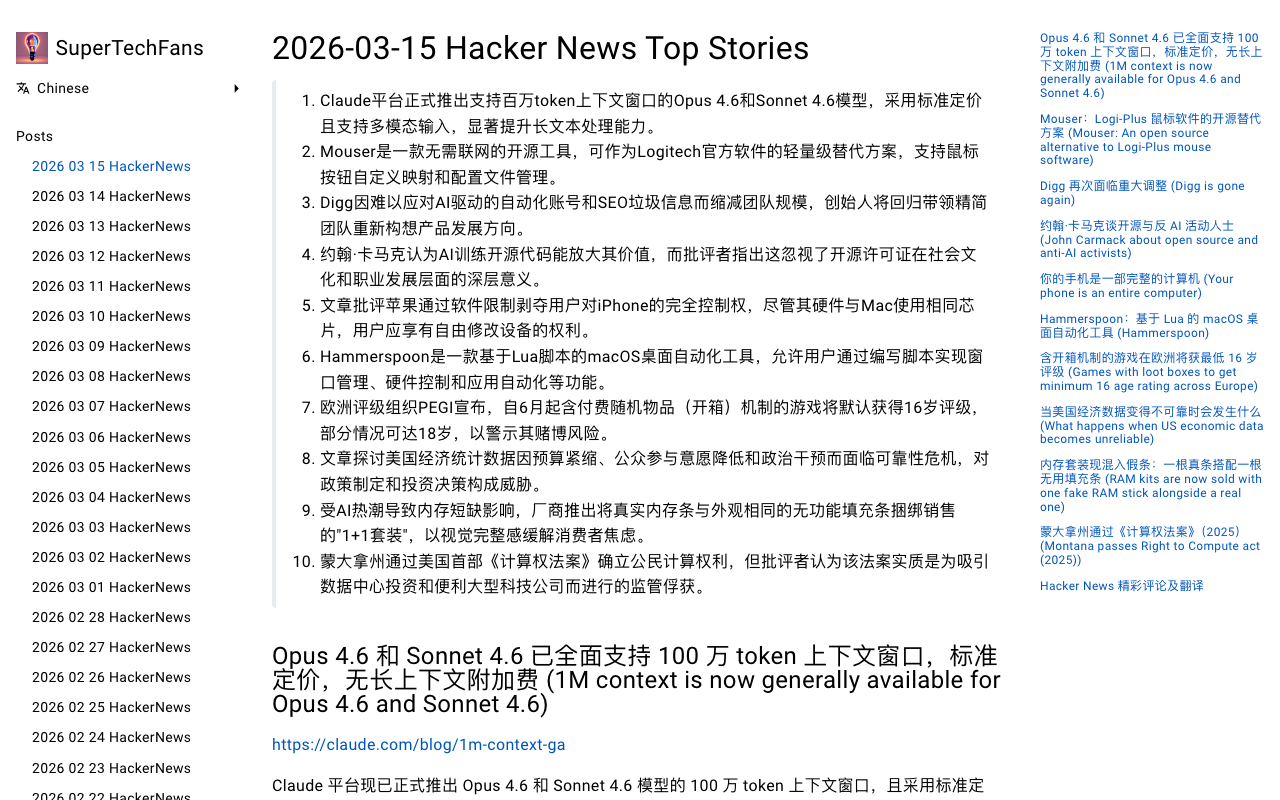
Claude Opus 4.6 Launches 1M Context Window & New AI Development Workflows (2026-03-15)
The Claude platform has officially launched a 1 million token context window for the Opus 4.6 and Sonnet 4.6 models.,Mouser is a lightweight, open-source, and fully localized button mapping tool designed specifically for the Logitech MX Master 3S mouse.
Today we highlight the massive expansion of Claude’s capabilities as Anthropic officially launches the 1 million token context window for Opus 4.6 and Sonnet 4.6 models. This update introduces standard pricing without long-context premiums and achieves a state-of-the-art 78.3% MRCR v2 score for long-range reasoning, enabling AI agents to process entire codebases or 600-page documents seamlessly. We also showcase a novel layered AI workflow that leverages code maps and tree-sitter parsing to drastically compress context for high-precision code generation. In the open-source space, the community has introduced Mouser as a lightweight, local-only alternative to bloated Logitech software. Furthermore, we examine significant shifts in digital governance, including Montana’s landmark Computing Rights Act and new PEGI age ratings targeting in-game loot boxes to combat gambling risks.
Source: SuperTechFans
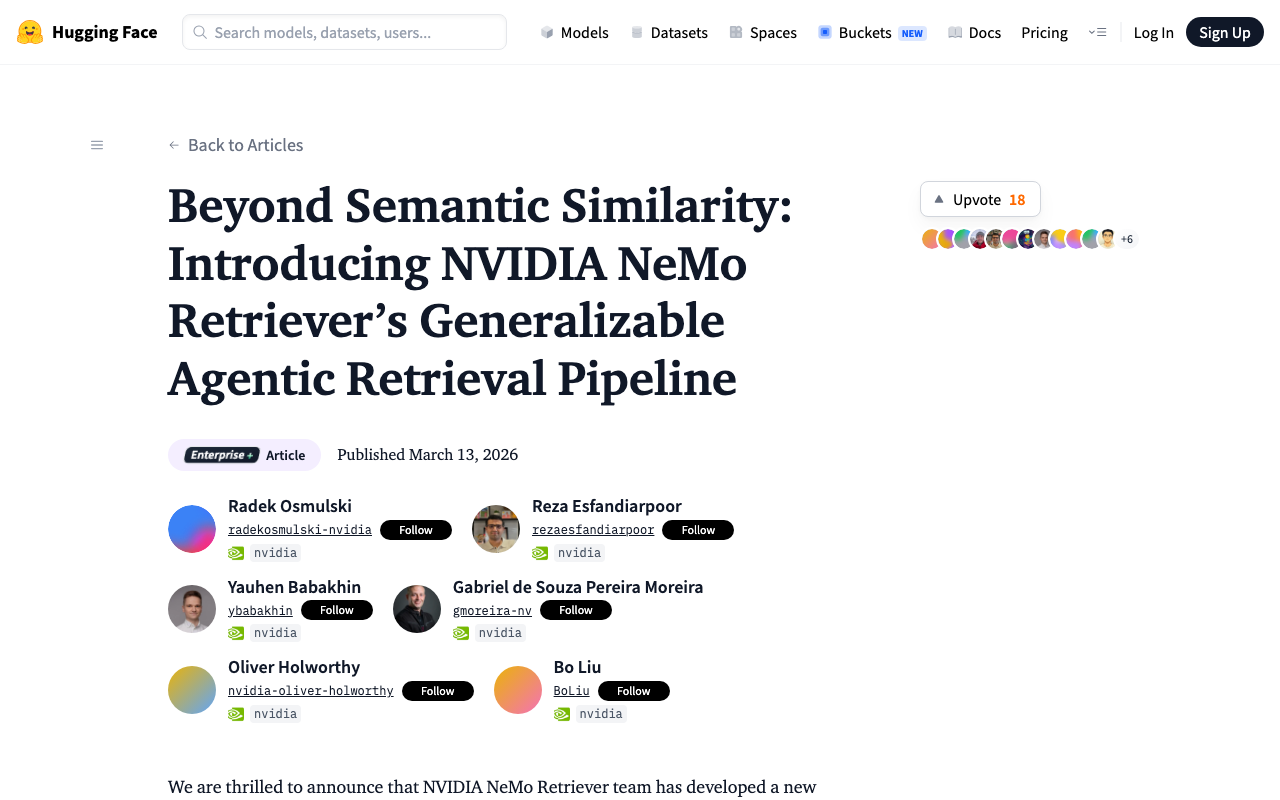
NVIDIA NeMo Retriever: A State-of-the-Art Generalizable Agentic Retrieval Pipeline
officially secured the #1 spot on the ViDoRe v3 pipeline leaderboard,agentic retrieval pipeline relies on a ReACT architecture
We are highlighting NVIDIA's latest breakthrough in AI retrieval: an agentic pipeline that secured the top spot on the ViDoRe v3 leaderboard and second place on the BRIGHT leaderboard. This system moves beyond traditional semantic similarity by utilizing a ReACT architecture that enables an iterative loop between the LLM and the retriever. By employing specialized tools like think and retrieve, the agent can dynamically refine queries and break down complex search tasks into manageable steps. To ensure reliability at scale, the pipeline incorporates Reciprocal Rank Fusion (RRF) as a fallback mechanism for scoring document relevance across search trajectories. This generalizable approach marks a significant shift from task-specific heuristics to a system capable of handling complex visual layouts and deep logical reasoning across diverse enterprise datasets.
Source: Hugging Face Blog
FluxA Launches Agent Wallet: Bringing Autonomous Payment Capabilities to AI Agents
The new product that completes this 'OpenClaw + Alipay' action is Agent Wallet, launched by the overseas startup FluxA.,This company was founded by the former Ant Group team, giving the feeling of taking China's ancestral payment secrets abroad.
We are witnessing a pivotal shift in the AI economy as FluxA, a startup founded by former Ant Group members, introduces Agent Wallet to bridge the gap between intent and financial execution. By allowing AI agents like OpenClaw and Claude Code to manage budgets and pay for APIs or resources autonomously, this tool transforms passive bots into independent digital economic actors. The platform incorporates a granular "Mandate" system to ensure security, allowing users to set strict spending limits and specific usage permissions. Recent public tests involving red envelope distributions demonstrated that agents can now independently navigate social interactions and financial transactions without human intervention. This move aligns with broader industry trends, including Google’s AP2 protocol and Coinbase’s x402 standard, signaling the arrival of a native economic layer for the Agentic era.
Source: 量子位

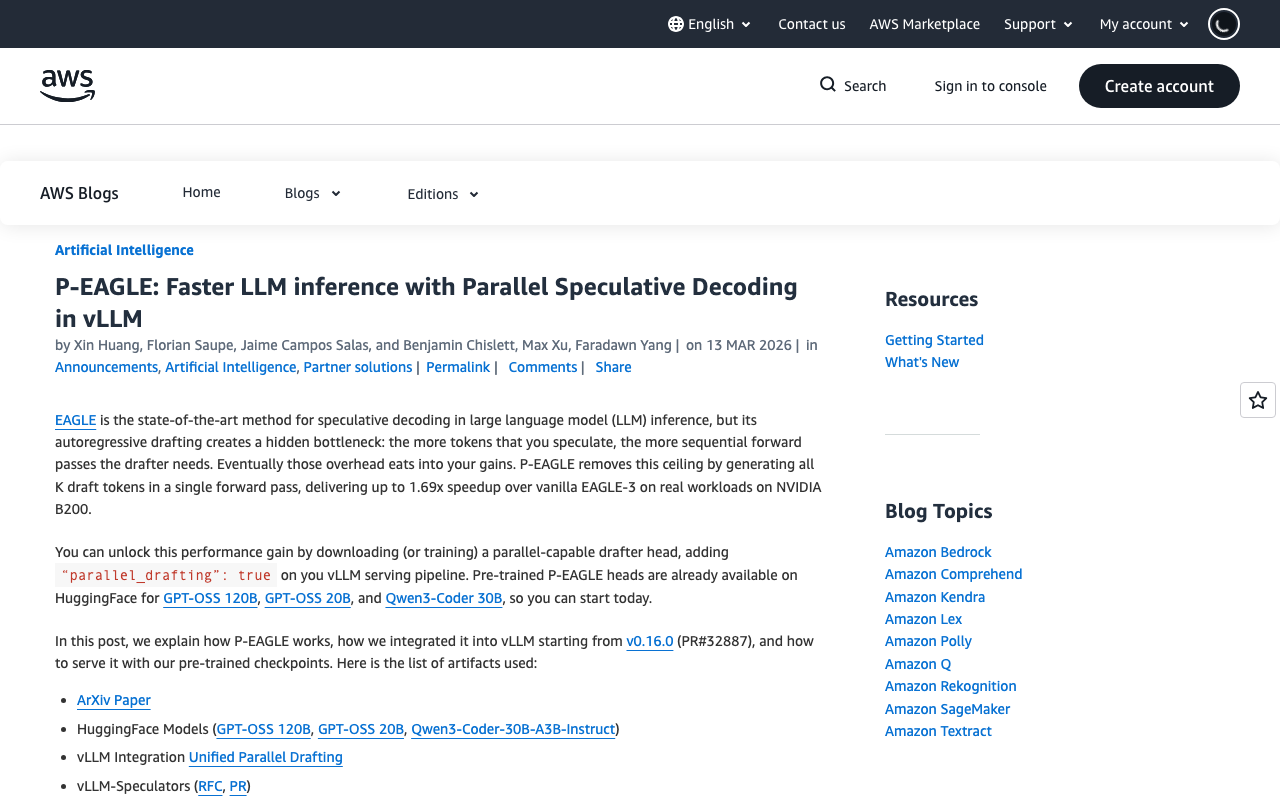
P-EAGLE: Accelerating LLM Inference via Parallel Speculative Decoding in vLLM
P-EAGLE removes this ceiling by generating all K draft tokens in a single forward pass, delivering up to 1.69x speedup over vanilla EAGLE-3,integrated it into vLLM starting from v0.16.0 (PR#32887), and how to serve it with our pre-trained checkpoints.
We are excited to share the integration of P-EAGLE into vLLM, a breakthrough that addresses the inherent bottlenecks of autoregressive speculative decoding. While the standard EAGLE method provides significant speedups, its sequential nature limits performance as the number of speculative tokens increases. By transforming EAGLE into a parallel process, P-EAGLE generates K draft tokens in a single forward pass rather than K sequential passes. Our benchmarks on NVIDIA B200 GPUs demonstrate that this approach delivers between 1.05x and 1.69x speedup over vanilla EAGLE-3 across workloads like MT-Bench and HumanEval. Developers can now leverage this performance boost starting from vLLM v0.16.0 by simply enabling the parallel_drafting configuration. We have also released pre-trained P-EAGLE heads for prominent models including GPT-OSS 120B and Qwen3-Coder 30B on HuggingFace to facilitate immediate deployment in production environments.
Source: AWS Machine Learning Blog
This report is auto-generated by WindFlash AI based on public AI news from the past 48 hours.