Thursday, March 13, 2026 · 12 curated articles
Today's Overview
NVIDIA dominates this cycle's headlines with an SEC filing revealing a $26 billion commitment to open-weight AI models over five years, alongside Nemotron 3 Super and a packed GTC 2026 agenda starting March 16. OpenAI's acquisition of security platform Promptfoo signals that frontier labs are pivoting from capability races to deployment safety, a theme echoed by SurePath AI's real-time MCP policy controls for enterprise agent governance. On the protocol layer, the MCP-versus-A2A standardization battle and Google's browser-native WebMCP are reshaping how agents interact with tools, peers, and the open web. Meanwhile, developer tooling continues its rapid evolution with Axe's Unix-philosophy approach to composable AI agents and Anthropic shipping voice mode for Claude Code. DeepSeek V3.2 matching GPT-5 at one-tenth the cost underscores that open-source models have closed the frontier gap to mere months.
AI Business
March 2026 marks a decisive shift as the largest AI companies move from capability scaling to infrastructure hardening. NVIDIA's unprecedented financial commitment to open-weight models reshapes competitive dynamics, while OpenAI's security-focused acquisition of Promptfoo demonstrates that deploying safe AI agents in enterprise has become the primary battleground. These moves signal the end of the build-bigger era and the start of the deploy-safely era.
NVIDIA Bets $26 Billion on Open-Weight AI Models to Challenge Closed Labs
We're an American company, but we work with companies across the world. It's in our interest to make the ecosystem diverse and strong everywhere.,Nvidia plans to invest $26 billion over five years to build open-source AI models, according to a financial filing with the US Securities and Exchange Commission.
An SEC filing published on March 12 confirms that NVIDIA will invest $26 billion over five years in open-weight AI model development — more than eight times what OpenAI reportedly spent training GPT-4. Executives confirmed the plans to WIRED, describing the budget as covering model development, compute infrastructure, research talent, and ecosystem partnerships. Alongside the announcement, NVIDIA released Nemotron 3 Super, a 128-billion-parameter open-weight model using a hybrid Transformer-Mamba architecture that narrowly outperforms OpenAI's GPT-OSS on the Artificial Analysis Index. The strategic calculus is clear: Chinese providers like DeepSeek and Alibaba currently dominate the open-source frontier while American labs retreat behind proprietary walls, and NVIDIA intends to fill the gap while locking developers into its hardware ecosystem. VP of Generative AI Software Kari Briski noted the models also serve to stress-test NVIDIA's supercomputer-scale data centers and push its hardware roadmap forward. NVIDIA has already pretrained a 550-billion-parameter model with specialized variants for robotics, climate modeling, and protein folding.
Source: The Decoder
NVIDIA GTC 2026 Preview: The Real March Madness Begins March 16
CEO Jensen Huang recently teased that his company will unveil several new chips the world has never seen before.,Thirty-thousand attendees across ten venues in downtown San Jose.
NVIDIA's annual GTC conference runs March 16–19 at the SAP Center in San Jose, drawing 30,000 attendees from 190 countries. Jensen Huang's keynote is expected to detail the Rubin Ultra platform — featuring NVIDIA's proprietary Vera CPU paired with sixth-generation HBM4 memory — and preview the next-generation Feynman architecture rumored to utilize a 1.6-nanometer process with backside power delivery. The company is also expected to unveil NemoClaw, an open-source AI agent platform for enterprises, alongside critical silicon photonics switches for the Quantum 3400 and Ethernet 6800 series. Beyond chips, Huang demonstrated a 2.5-hour autonomous ride across San Francisco in a Mercedes using its Alpamayo driving system, and the event will feature candid discussions with leaders from Cursor, LangChain, Mistral, and Ai2 on the state of open frontier models. This year's GTC arrives at a pivotal moment, with the $26 billion open-source commitment announced just days before lending additional weight to Huang's five-layer "cake" vision of AI: energy, chips, infrastructure, models, and applications.
Source: Fortune

OpenAI Acquires Promptfoo to Secure Its AI Agent Ecosystem
This deal underscores how frontier labs are scrambling to prove their technology can be used safely in critical business operations.,Promptfoo's technology trusted by over 25% of Fortune 500 companies
On March 9, OpenAI announced the acquisition of Promptfoo, an AI security platform whose open-source CLI and evaluation library are trusted by over 25 percent of Fortune 500 companies. The integration will embed automated security testing and red-teaming directly into OpenAI Frontier, enabling enterprises to detect prompt injections, jailbreaks, data leaks, tool misuse, and out-of-policy agent behaviors before deployment. The acquisition follows closely on the heels of GPT-5.4's launch and Codex Security's preview, forming a deliberate trifecta: the model, the security tooling, and the evaluation framework. OpenAI committed to continuing Promptfoo's open-source offering post-acquisition. With annualized revenue reportedly surpassing $25 billion by early March, OpenAI is clearly pivoting from building ever-larger models toward proving those models can operate safely in critical business operations — a strategic shift that reflects the broader industry's transition from capability scaling to deployment assurance.
Source: TechCrunch

Foundation Models
The frontier model landscape in March 2026 is defined by two concurrent trends: proprietary labs expanding into million-token context windows and thinking modes, while open-source challengers close the performance gap to within months of leading closed models. The economics are shifting fast — DeepSeek's one-tenth cost advantage forces a fundamental rethinking of compute budgets and model selection strategies.
OpenAI Launches GPT-5.4 with 1M Token Context and Thinking Mode
Our most capable and efficient frontier model for professional work.,GPT-5.4 can handle up to 1,000,000 tokens of context in the API
On March 5, OpenAI released GPT-5.4 in three variants: standard, Thinking, and Pro. The model handles up to one million tokens of context — roughly 50 to 100 times longer than previous generations — and introduces a Thinking mode that lets users interrupt mid-response to steer answers before final output. GPT-5.4 scored a record 83 percent on OpenAI's GDPval benchmark for knowledge work tasks and claimed the lead on Mercor's APEX-Agents benchmark testing professional skills in law and finance. The Thinking variant excels at coding and multi-step reasoning, while the Pro version targets enterprise deployments demanding maximum accuracy. Paired with the same-week Codex Security launch, GPT-5.4 represents OpenAI's push to combine raw capability with production-grade safety tooling. The million-token context window places GPT-5.4 alongside Anthropic's Sonnet 4.6 and Google's Gemini 3.1 Flash in the emerging arms race for massive document processing and agentic workflows.
Source: TechCrunch
DeepSeek V3.2 Matches GPT-5 Performance at One-Tenth the Cost
DeepSeek-V3.2 scored 96.0% on the 2025 AIME, surpassing GPT-5 High's 94.6%.,A typical workload costs roughly $0.07 with DeepSeek compared to $1.13 with GPT-5.
DeepSeek V3.2 has emerged as a watershed moment for open-source AI. The 671-billion-parameter model, released under the MIT license, activates only 37 billion parameters per token via its Mixture-of-Experts architecture and introduces DeepSeek Sparse Attention for efficient long-context processing. On the 2025 AIME math benchmark it scores 96.0 percent — surpassing GPT-5 High's 94.6 percent — and achieves gold-medal performance on both the International Mathematical Olympiad and International Olympiad in Informatics. The economics are equally striking: processing 100,000 tokens costs roughly $0.07 compared to $1.13 with GPT-5. The specialized variant DeepSeek-V3.2-Speciale pushes further, reaching GPT-5-level performance on hard math benchmarks. This is the first DeepSeek model to integrate thinking directly into tool use, enabling agentic workflows with over 85,000 complex prompts across 1,800 synthesized environments. According to Epoch AI research, open-weight models now trail proprietary frontiers by only about three months on average.
Source: InfoQ
AI Agents
The AI agent ecosystem in March 2026 is rapidly standardizing around two complementary protocol layers: MCP for agent-tool communication and A2A for agent-agent coordination. Google's browser-native WebMCP adds a third layer connecting agents to the open web. The emerging challenge is no longer how to build agents but how to govern them — SurePath AI's discovery of over a thousand risky MCP tools in a single enterprise within hours illustrates the urgency of the security problem.
MCP vs A2A: The Two Protocols Defining the AI Agent Economy
MCP crossed 97 million monthly SDK downloads and has been adopted by every major AI provider.,IBM's Agent Communication Protocol merged into A2A in August 2025
The hottest debate in AI infrastructure is not about models — it is about protocols. Anthropic's MCP and Google's A2A are defining how agents interact with tools and with each other, respectively. MCP, created by Anthropic and donated to the Linux Foundation's Agentic AI Foundation in December 2025, has reached 97 million monthly SDK downloads with 5,800 publicly available servers, adopted by Anthropic, OpenAI, Google, Microsoft, and Amazon. A2A, launched by Google in April 2025, handles peer-to-peer agent coordination through agent cards, task lifecycle management, and streaming via SSE. IBM's Agent Communication Protocol merged into A2A in August 2025, and in December the AAIF was co-founded by all major AI providers to steward both protocols. The emerging consensus architecture layers WebMCP for browser access, MCP for agent-tool integration, and A2A for agent-agent orchestration. Critically, these protocols complement rather than compete: MCP is the USB-C connecting agents to tools, while A2A is the TCP/IP connecting agents to each other.
Source: DEV Community
SurePath AI Launches Real-Time MCP Policy Controls for Enterprise Governance
We identified over a thousand risky or malicious MCP tools in use within the first few hours of enabling MCP Policy Controls.,MCP introduces an entirely new attack surface, one that many organizations are already exposing without realizing it.
SurePath AI announced MCP Policy Controls on March 12, addressing a critical blind spot in enterprise AI adoption. Lightweight MCP tools now run silently on user laptops via desktop apps like ChatGPT, Claude, and Cursor, linking to internal systems including Google Drive, Salesforce, and AWS management APIs — with AI issuing authenticated commands as the end user. SurePath AI's platform intercepts MCP payloads in real time, removing tools that violate policy or capability requirements before execution reaches the backend service. The company's supply chain threat detection identifies never-before-seen MCP tools that could impersonate legitimate tools or exfiltrate data. In one large enterprise customer, SurePath discovered over a thousand risky or malicious MCP tools within the first few hours of enabling the controls. This launch coincides with NIST's establishment of the AI Agent Standards Initiative on February 17, focusing on industry-led standards, open-source protocol development, and agent security research. The clear signal: blocking MCP is not practical — governing it is essential.
Source: PR Newswire
Google Chrome Ships WebMCP: Every Website Becomes a Structured AI Agent Tool
Chrome becomes a controlled layer where tasks such as searching inventory, initiating checkout, or submitting service requests are handled through explicit calls rather than visual interpretation.,The specification is being developed with Microsoft and incubated through the W3C Web Machine Learning community group.
Google's WebMCP, previewed on February 11, transforms how AI agents interact with the web. Instead of taking screenshots and guessing where to click, agents now invoke clearly defined actions through a new navigator.modelContext browser API. Websites publish structured tool contracts — such as buyTicket(destination, date) — via two pathways: a Declarative API for standard HTML forms and an Imperative API for complex JavaScript interactions. Chrome 146 Canary ships with WebMCP behind a testing flag, and the specification is co-developed with Microsoft through the W3C Web Machine Learning community group. The architecture is explicitly designed around human-in-the-loop workflows: Chrome prompts users before allowing agents to execute sensitive actions. By moving from vision-based browsing to structured protocol interaction, WebMCP delivers lower latency, near-zero interpretation errors, and dramatically reduced compute costs. Combined with Anthropic's backend MCP and Google's A2A, WebMCP completes the three-layer protocol stack connecting agents to the web, to tools, and to each other.
Source: VentureBeat
Developer Tools
The developer tooling ecosystem in March 2026 reflects a philosophical split: monolithic AI frameworks that try to be everything versus composable, Unix-style agents that do one thing well. Axe's 12MB binary challenges the framework bloat that has characterized the space, while Anthropic's voice mode for Claude Code signals that the terminal itself is being reimagined as a multimodal programming interface.
Show HN: Axe — A 12MB Binary That Replaces Your AI Framework
Good software is small, focused, and composable. AI agents should be too.,I built Axe because I got tired of every AI tool trying to be a chatbot.
Axe, a Go binary weighing just 12 megabytes with only two dependencies, applies the Unix philosophy to AI agents. Each agent is a TOML configuration file with a focused job — code reviewer, log analyzer, commit message writer — invoked from the CLI with standard input piping. Developers chain agents together using shell composition: git diff | axe run reviewer feeds a diff through a code review agent and outputs structured results. The framework supports multi-provider backends including Anthropic, OpenAI, and Ollama; agents can delegate to other agents via tool use with configurable depth limits; and path-sandboxed file operations constrain agent access to prevent unintended side effects. Built-in MCP support allows integration with any MCP server, and persistent memory enables state across runs. The project gained significant traction on Hacker News, resonating with developers frustrated by the weight and complexity of existing AI frameworks that attempt to do everything within a single long-lived session and massive context window.
Source: Hacker News
Anthropic Adds Voice Mode to Claude Code: Talk to Your Terminal
Anthropic's run-rate revenue had crossed $2.5 billion — more than double what it was at the start of 2026.,Voice mode is activated by holding the space bar to talk, then releasing to send the input.
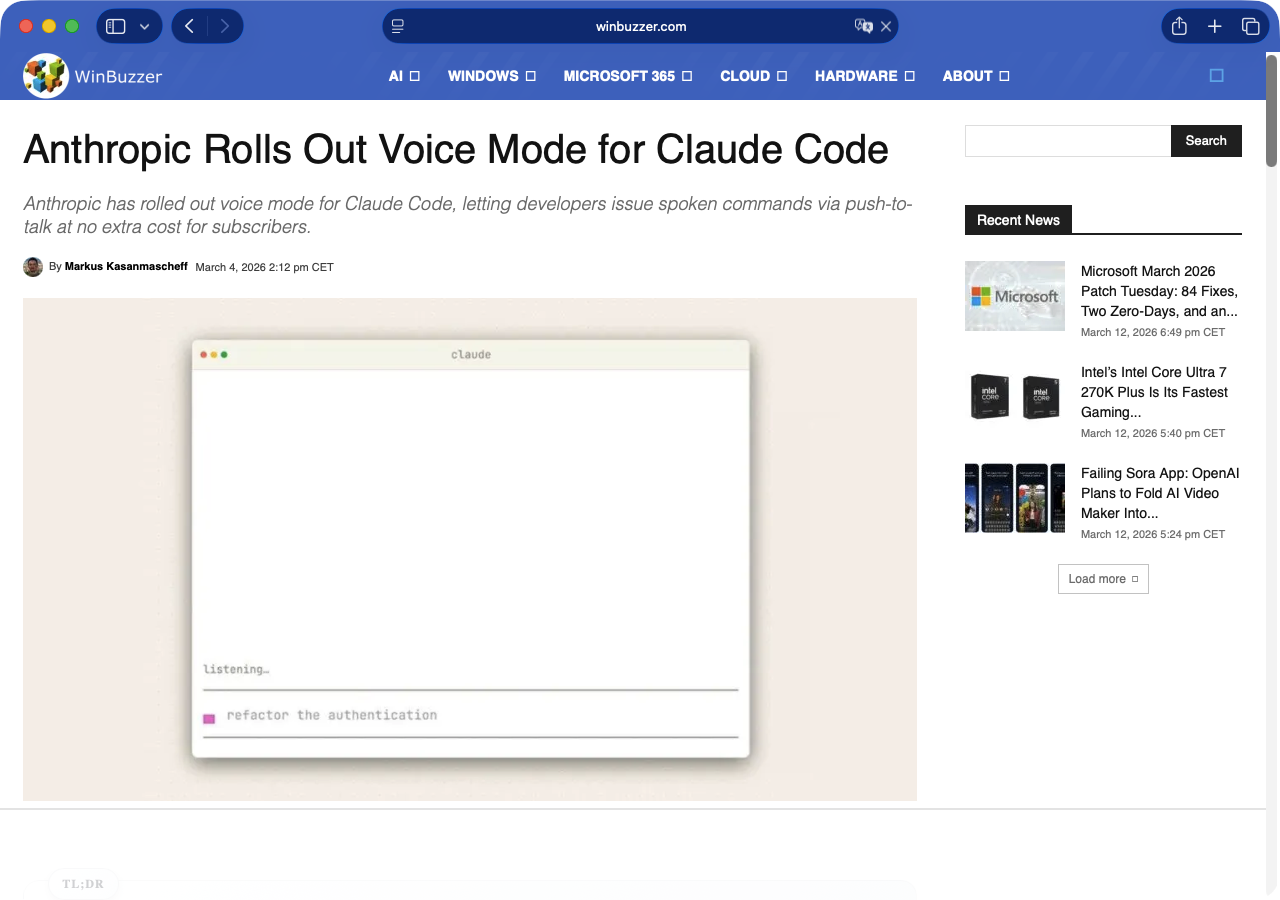
Anthropic began rolling out voice mode for Claude Code on March 2, starting with approximately 5 percent of users and expanding throughout March. The feature uses a push-to-talk mechanism — hold the space bar to speak, release to send — giving developers fine-grained control over when voice input is active during coding sessions. Users type /voice to toggle the mode, then speak commands that Claude Code executes directly in the terminal. The timing is notable: OpenAI's Codex shipped its own voice mode on February 26, one week prior, underscoring how quickly voice has moved from differentiating feature to baseline expectation. Anthropic also expanded voice STT support to 20 languages. The company revealed that Claude Code's weekly active users have doubled since January, with run-rate revenue crossing $2.5 billion. Voice mode arrives at no extra cost for subscribers, lowering the barrier for developers to adopt hands-free workflows for refactoring, debugging, and code generation.
Source: WinBuzzer
Programming
Beyond the AI hype cycle, traditional web frameworks continue their quiet evolution. Rails 8 represents a compelling counter-narrative to JavaScript-heavy toolchains, proving that simplicity, convention over configuration, and developer happiness still command loyalty — especially when paired with modern deployment tooling that finally matches the framework's elegance.
Returning to Rails in 2026: How Rails 8 Reignites Developer Productivity
This frees you from needing Webpack, Yarn, npm, or any other part of the JavaScript toolchain.,SQLite by comparison is as simple as it comes: Single file, no DB server required.
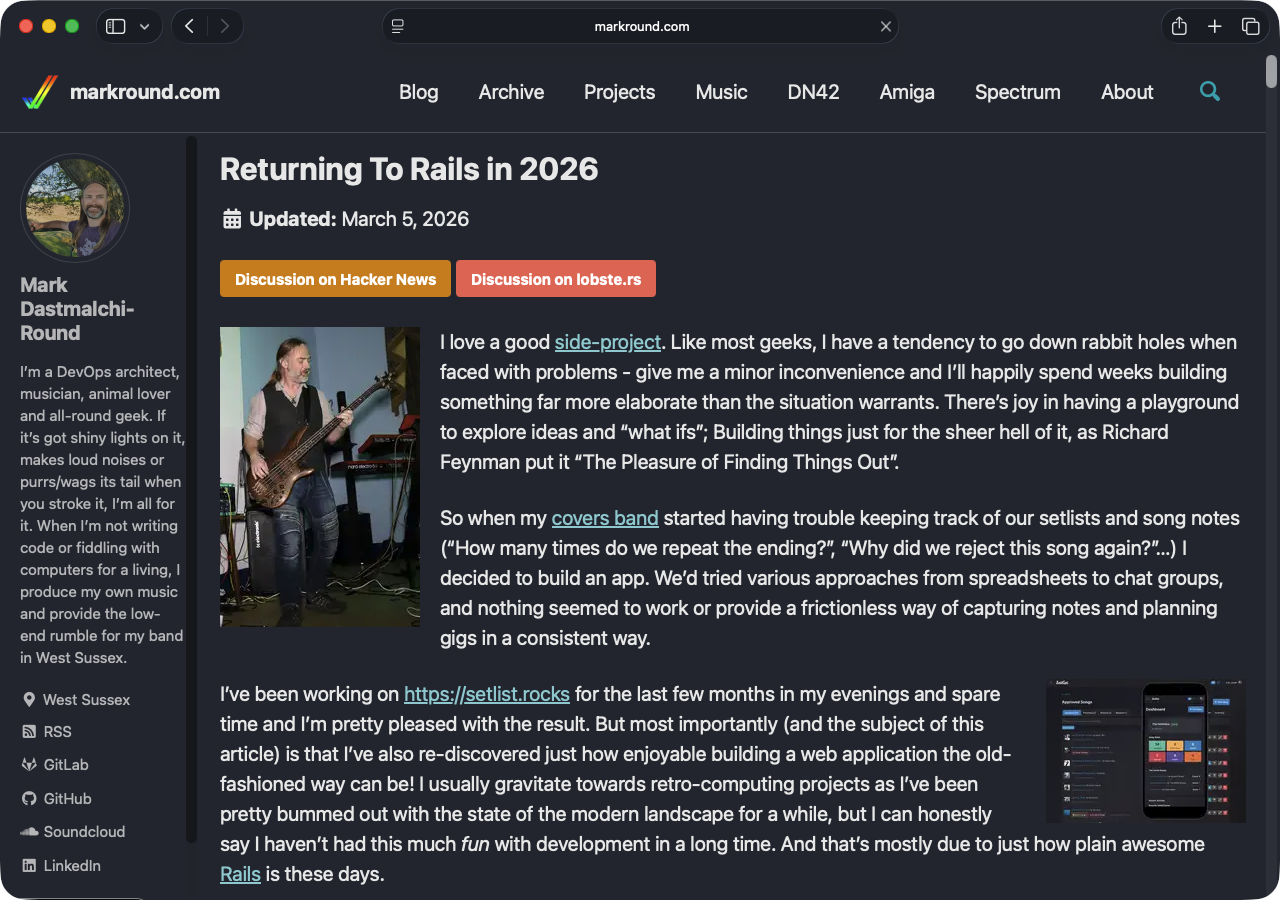
A DevOps architect returning to Rails after 13 years found a framework that has matured dramatically. Rails 8 introduces a no-build frontend approach using Hotwire (Stimulus and Turbo) that eliminates the need for Webpack, Yarn, npm, or any JavaScript toolchain. The Solid Stack — Solid Cache, Solid Queue, and Solid Cable — replaces Redis dependencies by running caching, background jobs, and WebSockets through the database. SQLite has become production-viable with sensible default PRAGMAs including WAL journal mode and proper cache/timeout settings, requiring zero manual tuning. Deployment, historically Rails' weakest link, is now handled by Kamal: a single kamal deploy command builds containers, pushes to a registry, and performs zero-downtime rollouts with health checks and a lightweight reverse proxy. Despite Ruby sitting below Lua in Stack Overflow's 2025 popularity survey and Rails ranking 20th among frameworks, the post generated 208 points and 333 comments on Hacker News — suggesting a significant cohort of developers rediscovering what convention-over-configuration can deliver when paired with modern infrastructure primitives.
Source: markround.com
AI Policy & Ethics
As AI systems move from controlled lab environments into real-world law enforcement applications, the consequences of algorithmic errors become increasingly severe. The Reno facial recognition case illustrates a pattern where technology deployed without adequate safeguards causes measurable harm to individuals — and where institutional accountability mechanisms are struggling to keep pace.
AI Facial Recognition Wrongful Arrest: Officer Admits It Never Should Have Happened
Officer Richard Jager admitted under oath that the arrest never should have happened.,Killinger had a valid Nevada driver's license, UPS pay stub, and vehicle registration all proving who he was.
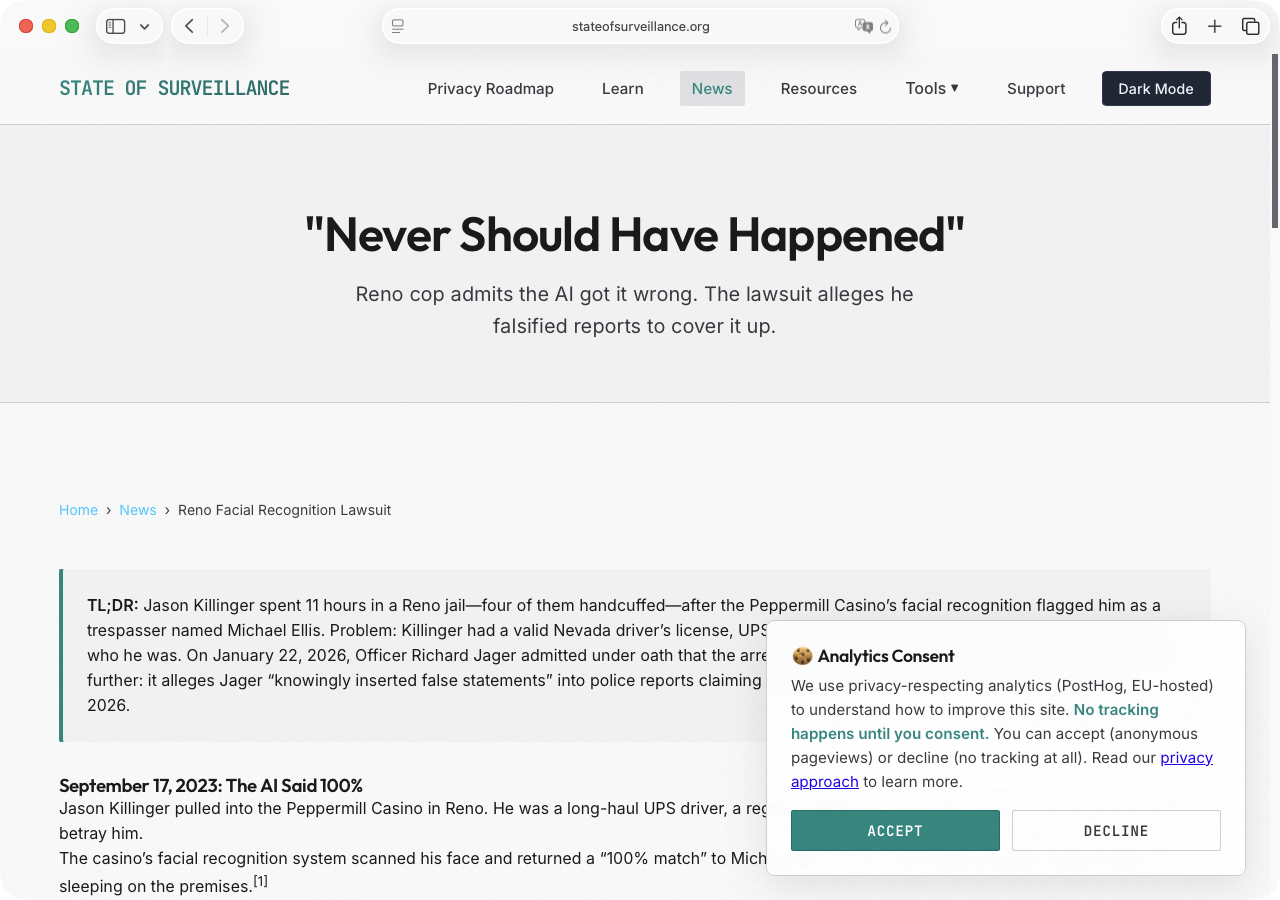
Jason Killinger spent 11 hours in a Reno jail — four of them handcuffed — after the Peppermill Casino's facial recognition system misidentified him as a trespasser named Michael Ellis. Despite presenting a valid Nevada driver's license, a UPS pay stub, and vehicle registration all proving his identity, the arrest proceeded. On January 22, 2026, Officer Richard Jager admitted under oath that the arrest "never should have happened," but the lawsuit goes further, alleging he knowingly inserted false statements into police reports to justify the detention. The case is expected to go to trial in 2026. It joins a growing pattern of facial recognition failures: at least seven known wrongful arrests in the United States, with nearly every victim being Black. Former Detroit Police Chief James Craig acknowledged that facial recognition alone yields misidentifications 96 percent of the time. The Innocence Project now supports a full moratorium on facial recognition in the criminal legal system until research establishes its validity and affected communities are consulted.
Source: State of Surveillance
This report is auto-generated by WindFlash AI based on public AI news from the past 48 hours.