Monday, March 9, 2026 · 10 curated articles
Today's Overview
On March 9, 2026, the technology landscape continues to evolve with ten key updates centered on industry insights and AI breakthroughs. Developers are witnessing a shift toward high-efficiency inference models and specialized edge computing integrations that streamline the deployment of generative applications. These advancements highlight the convergence of robust infrastructure and automated software engineering workflows, enabling teams to scale AI solutions more effectively across diverse sectors. Staying informed on these trends is crucial for engineers looking to leverage the latest optimization techniques and maintain a competitive edge in an increasingly AI-driven development environment.
Industry Insights
Stay ahead of the curve with our Industry Insights, featuring deep dives into the latest breakthroughs in artificial intelligence, software engineering, and the evolving subscription economy. We analyze high-stakes startup movements like Reflection AI, explore cutting-edge hardware from leaders like Xpeng, and break down complex frameworks like OpenClaw. This section provides the strategic context and technical analysis necessary for professionals to navigate the rapidly shifting landscape of global technology and business innovation in 2026.
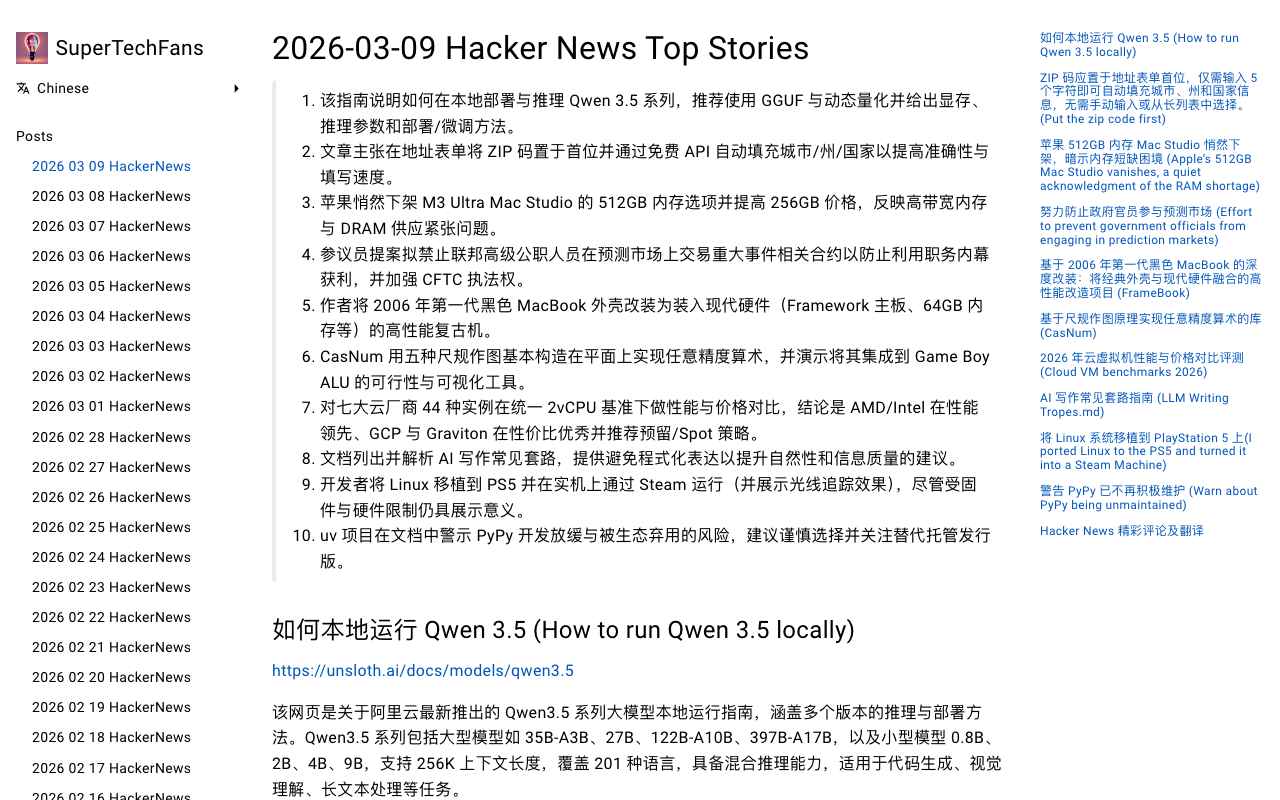
Hacker News: Qwen 3.5 Local Deployment and ZIP-Code-First UX Design (2026-03-09)
Qwen3.5 series includes large models such as 35B-A3B, 27B, 122B-A10B, 397B-A17B, and small models 0.8B, 2B, 4B, 9B.,ZIP code should be placed first in address forms; just 5 characters can auto-fill city, state, and country information.
Today we examine the latest Qwen 3.5 series release, featuring models from 0.8B to 397B, and its optimized local deployment path using GGUF and Unsloth's dynamic 2.0 quantization. We highlight that the 9B model can achieve 100 tokens/s on consumer hardware, while the 35B-A3B variant remains accessible on 22GB VRAM devices. Our report also analyzes a critical UX shift advocating for ZIP-code-first address forms to automate data entry via free APIs, significantly reducing user friction. Furthermore, we cover Apple's adjustment of M3 Ultra Mac Studio memory options, which signals ongoing high-bandwidth memory supply constraints. Other highlights include a legislative proposal to ban federal officials from prediction markets and a creative hardware mod breathing new life into a 2006 MacBook using Framework components.
Source: SuperTechFans
10 Key Insights from RevenueCat’s 2026 State of Subscription Apps Report
The top 25% of apps grew MRR by 80%+ year-over-year. The bottom 25% shrank by 33%.,Hard paywalls convert downloads to paid at a median of 10.7% vs. freemium’s 2.1%.
We analyze the massive performance gap in the mobile subscription economy based on RevenueCat’s latest data from 115,000 apps generating $16 billion in revenue. Our findings reveal an accelerating "winner-take-more" reality where the top 25% of apps grew MRR by over 80% while the bottom quartile shrank by 33%. We highlight the surprising superiority of hard paywalls, which achieve a median conversion rate of 10.7%—five times higher than the 2.1% seen in freemium models. Furthermore, the economic advantage is stark, with hard paywall apps generating $3.09 in revenue per install by Day 60 compared to just $0.38 for freemium. While the dataset leans toward B2C, these patterns in pricing architecture and conversion dynamics offer critical signals for B2B founders looking to optimize monetization velocity and stress-test their pricing models.
Source: SaaStr

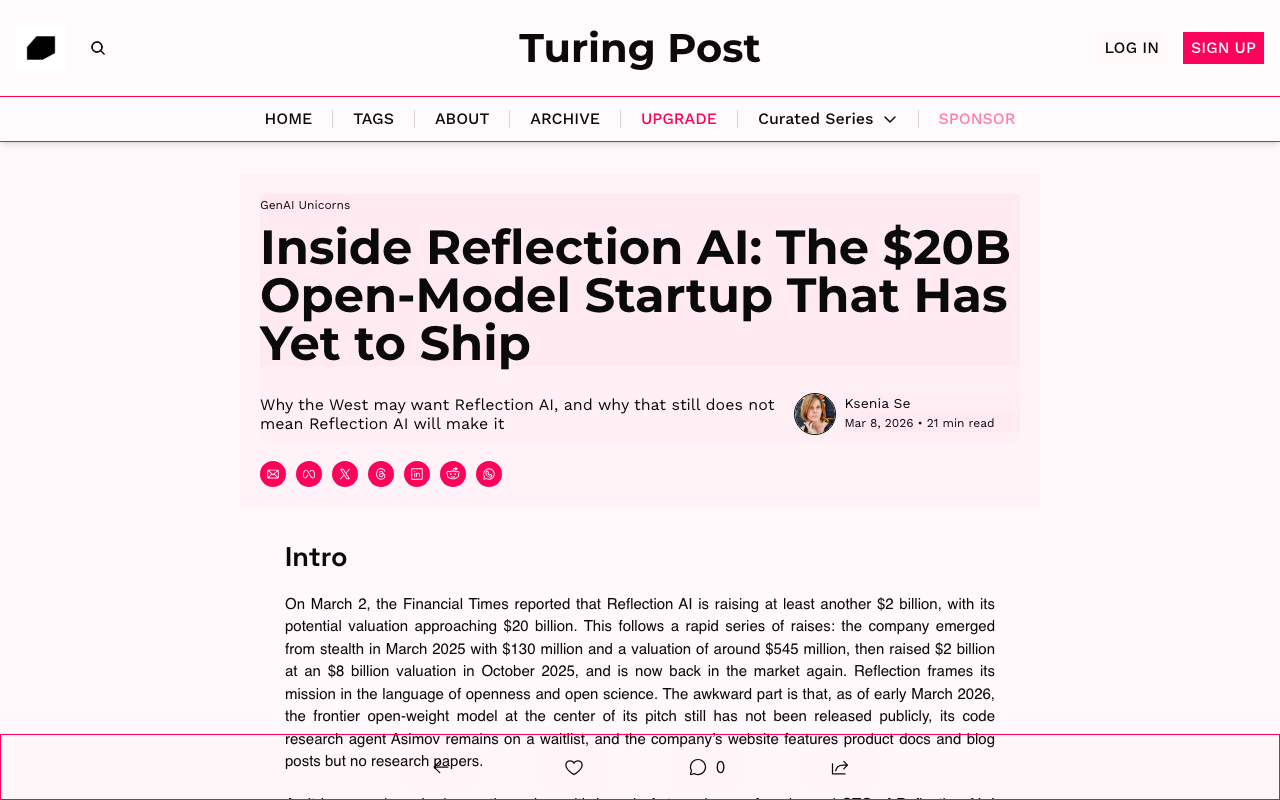
Reflection AI: The $20B Open-Model Startup Yet to Ship Public Products
Reflection AI is raising at least another $2 billion, with its potential valuation approaching $20 billion.,the frontier open-weight model at the center of its pitch still has not been released publicly
In this deep dive, we examine Reflection AI, a high-profile startup recently reported to be raising $2 billion at a staggering $20 billion valuation. Despite its rapid ascent since emerging from stealth in early 2025, our investigation reveals a striking gap between its financial growth and actual output. As of March 2026, the company’s promised frontier open-weight model remains unreleased, while its code research agent, Asimov, is still restricted to a waitlist. We sat down with CTO Ioannis Antonoglou to understand why this self-proclaimed champion of open science is operating with such secrecy. We weigh whether government demand for sovereign AI can truly sustain a business that has yet to outperform closed labs or Chinese contenders. Our analysis suggests that while the mission is compelling, the pressure to deliver is mounting as the company burns through billions in capital without a public research track record.
Source: Turing Post
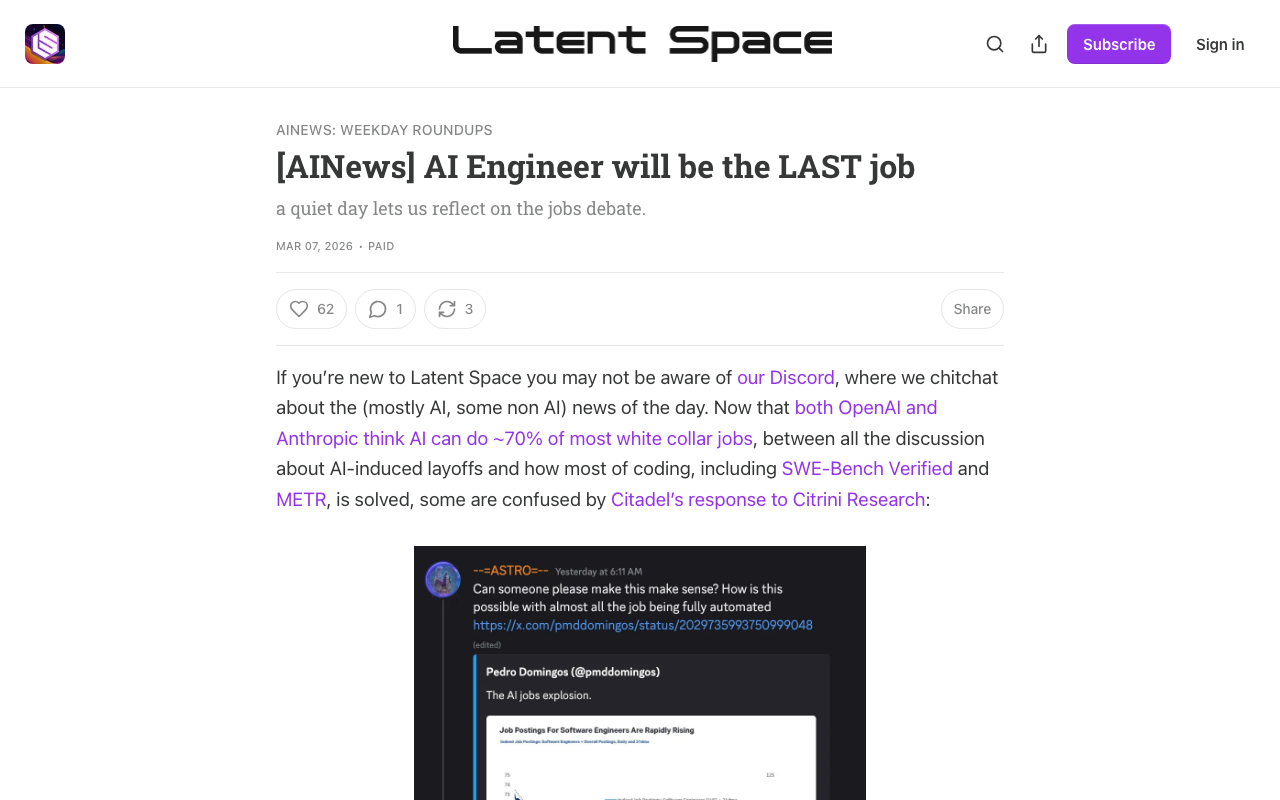
AI Engineer Will Be the Last Job Standing: AINews Digest (2026-03-05)
postings for software engineers are rebounding -HIGHER- as models get better at software engineering,Software Engineering has taken over 50% of usecases of Claude models
In this edition, we analyze why the AI Engineer is poised to be the final surviving profession as automation consumes white-collar tasks. Despite OpenAI and Anthropic estimating that AI can perform 70% of cognitive labor, demand for software engineers is paradoxically rebounding because improved models accelerate production rather than replacing it. We observe that software engineering has already claimed over 50% of Claude’s use cases, suggesting that nearly all future "knowledge work agents" are essentially coding agents equipped with specific domain tools. Furthermore, we explore the rollout of OpenAI’s GPT-5.4, which has reclaimed the top spot on Artificial Analysis benchmarks while offering new cost-efficiency tradeoffs for practitioners. Ultimately, we argue that AI Researchers will likely finish their work before Engineers are done deploying the vast "last mile" of these technologies, cementing the AI Engineer's role at the end of the job market's evolution.
Source: Latent Space
Xpeng Launches G6 Extended Range SUV with 1704km Range and Turing AI Chips
The new car is named Xpeng G6 Super Extended Range version, with a starting price of 186,800 RMB. This entry-level 1704 Max version comes standard with one of Xpeng's self-developed Turing AI chips.,This results in a comprehensive range of 1,704 kilometers under CLTC conditions. Looking at pure electric range alone, it can also cover 430 kilometers.
We are witnessing a significant strategic pivot for Xpeng as they launch the G6 Super Extended Range Version, starting at 186,800 RMB. This new model addresses the long-standing range anxiety of pure electric vehicles by combining a 60L fuel tank with an 800V high-voltage platform, achieving a remarkable 1,704km CLTC comprehensive range. Beyond its mechanical specs, we highlight the integration of Xpeng's self-developed Turing AI chips and the upcoming second-generation VLA model, which significantly elevates the vehicle's autonomous driving and smart cockpit capabilities. By incorporating CDC variable damping and upgraded safety features like high-speed tire blowout stabilization, Xpeng is moving toward a more pragmatic approach to meet family and long-distance travel needs. We believe this move signifies a broader industry trend where high-tech features must now be balanced with real-world versatility to capture market share in the competitive global SUV landscape.
Source: 爱范儿

Decoding OpenClaw: Mechanics, Design Philosophy, and Startup Opportunities in the Agent Wave
We use 20 sets of heuristic questions to dismantle the reasons behind the popularity, technical logic, essential changes, and entrepreneurial opportunities of the OpenClaw agent wave 30 days after its explosion.,Without open source, there would be no OpenClaw today.
We analyze the rapid ascent of OpenClaw, a breakthrough AI Agent phenomenon that has redefined industry expectations over the past 30 days. Through a structured framework of 20 heuristic questions, we explore why this specific wave of agents has achieved such significant traction compared to previous iterations. Our discussion highlights the 'human-like' design philosophy as a pivotal shift in AI interaction, moving beyond simple utility toward more relatable digital entities. We emphasize the critical role of open-source development in OpenClaw's success and investigate how developers can build personal 'flywheels' to sustain competitive advantages. Furthermore, we evaluate specific entrepreneurial opportunities across ToC, ToB, and infrastructure sectors while comparing the user experiences of Manus, Kimi, and Minimax. This exploration provides a comprehensive cognitive framework for founders and investors seeking to distinguish between temporary market bubbles and the true starting point of the Agent era.
Source: 十字路口Crossing

Shenzhen Unveils 'Lobster 10' Policy Amid Surge in OpenClaw AI Tutorials
Free lobster deployment in Longgang, half-price data lobster takeoff, reimbursement for self-built/purchased lobsters, and direct subsidies of millions for top-tier lobsters.,OpenClaw + Claude Code super tutorial: Build a complete development team by yourself!
Today we examine the booming 'lobster farming' ecosystem and Shenzhen's strategic response through the newly released 'Lobster 10' policy. We observe that while mainstream media warns of potential risks, Shenzhen is doubling down with massive incentives including free deployment in Longgang and million-yuan subsidies for top-tier projects. The hardware market reflects this enthusiasm, as the Mac mini has already sold out due to its popularity as a preferred local hosting choice for AI models. We have curated four trending tutorials for OpenClaw, providing beginners with installation guides and advanced skills to significantly enhance their agent's capabilities. Notably, we highlight the integration of OpenClaw and Claude Code, which empowers a single developer to manage a full-scale development team's workload effectively. This convergence of local government support and sophisticated open-source tools marks a pivotal moment for individual AI entrepreneurship in China.
Source: Datawhale

The Brand Age: Lessons from the Swiss Watch Industry's Great Transformation
In 1968, the Japanese swept all top prizes for mechanical watches at the Geneva Observatory trials, the world's most authoritative precision competition.,From the early seventies to the early eighties, sales of Swiss watches fell by nearly two-thirds.
We examine Paul Graham’s analysis of the 'Quartz Crisis' that fundamentally reshaped the Swiss watch industry between 1970 and 1980. We find that the simultaneous arrival of superior Japanese competition, the collapse of the Bretton Woods agreement, and the rise of quartz technology forced traditional watchmakers to evolve or perish. While technical performance like precision and thinness was once the industry's gold standard, we observe how survivors like Patek Philippe pivoted toward brand-centric design to differentiate themselves. By expanding the brand's visual footprint from tiny dial signatures to distinctive case shapes like the Golden Ellipse, these companies proved that branding becomes the dominant force once technology levels the playing field. We conclude that this shift highlights a universal modern trend where brand identity eventually supersedes functional utility as product differences are erased by technological progress.
Source: 宝玉的分享

Paul Graham on the Brand Age: How Technology Neutralizes Product Differentiation
When technology levels the substantive differences between products, brand fills the vacuum.,From the early 1970s to the early 1980s, the sales of Swiss watches fell by nearly two-thirds.
We analyze Paul Graham’s deep dive into the historical transformation of the Swiss watch industry following the 1970s "Quartz Crisis," a period marked by intense Japanese competition and radical currency shifts. We examine how elite watchmakers successfully pivoted from precision instrument manufacturing to high-end luxury branding once quartz technology made accurate timekeeping a cheap commodity. Our synthesis highlights Graham’s core thesis: brands emerge as the dominant force when technology eliminates substantive product differences, often leading to a conflict between brand logic and functional design. We observe that while the "Golden Age" of 1945–1970 prioritized thinness and accuracy, modern luxury relies on manufactured scarcity and aesthetic identifiers like distinctive case shapes. Ultimately, we conclude that understanding this shift is crucial for tech leaders and designers to recognize how branding fills the vacuum left by technological parity in any mature industry.
Source: Gino Notes

AI Technology
This category explores the rapidly evolving landscape of AI technology, focusing on the specialized hardware architectures like CPUs, GPUs, and TPUs that power modern machine learning workloads. We also examine essential security protocols and infrastructure patterns that ensure robust, scalable deployments of artificial intelligence in production environments. By bridging the gap between hardware optimization and software implementation, this section provides deep insights into the foundational tools shaping the future of intelligent computing.
EP205: Analyzing CPU vs GPU vs TPU Architectures and Modern Auth Patterns
The architecture is designed around matrix multiplication using systolic arrays, with compiler-controlled dataflow and on-chip buffers for weights and activations.,PKCE prevents intercepted authorization codes from being reused. That’s why it’s the modern default for web and mobile apps.
In this edition, we analyze why specific code performance varies drastically across hardware architectures, focusing on the fundamental differences between CPUs, GPUs, and TPUs. We observe that while CPUs handle general-purpose low-latency logic, GPUs leverage thousands of cores for parallel matrix operations, and TPUs utilize specialized systolic arrays for optimized neural network training. Furthermore, we break down modern authentication standards, specifically why PKCE has become the default for web and mobile apps to prevent authorization code interception. We also examine the mechanics of distributed tracing, illustrating how the OpenTelemetry Collector unifies telemetry data into traces, logs, and metrics for enhanced system observability. By understanding these architectural trade-offs, developers can better decide where to deploy specific workloads for maximum efficiency.
Source: ByteByteGo Newsletter

This report is auto-generated by WindFlash AI based on public AI news from the past 48 hours.