Wednesday, March 4, 2026 · 10 curated articles
Today's Overview
The technology landscape of March 4, 2026, highlights significant breakthroughs in AI technology, particularly in autonomous agent architectures and specialized developer tools that streamline large language model fine-tuning. This collection of 10 articles explores how industry leaders are navigating the shift toward agentic workflows while providing practical insights into optimizing production-grade deployments. For developers, these updates offer a comprehensive roadmap for integrating next-generation APIs and leveraging high-performance frameworks to enhance computational efficiency in multi-modal environments. As the ecosystem matures, the focus shifts from experimental prototypes to robust, scalable industry solutions that redefine the intersection of software engineering and machine intelligence.
AI Technology
AI technology is rapidly evolving with a focus on both high-performance large language models and efficient, lightweight versions like GPT-5.3 Instant and Gemini 3.1 Flash-Lite. Furthermore, the standardization of protocols like the Model Context Protocol signifies a shift towards secure, remote connectivity and cross-industry collaboration under the Linux Foundation. This category explores these cutting-edge advancements, highlighting how increased accessibility and robust infrastructure are shaping the future of intelligent systems globally.
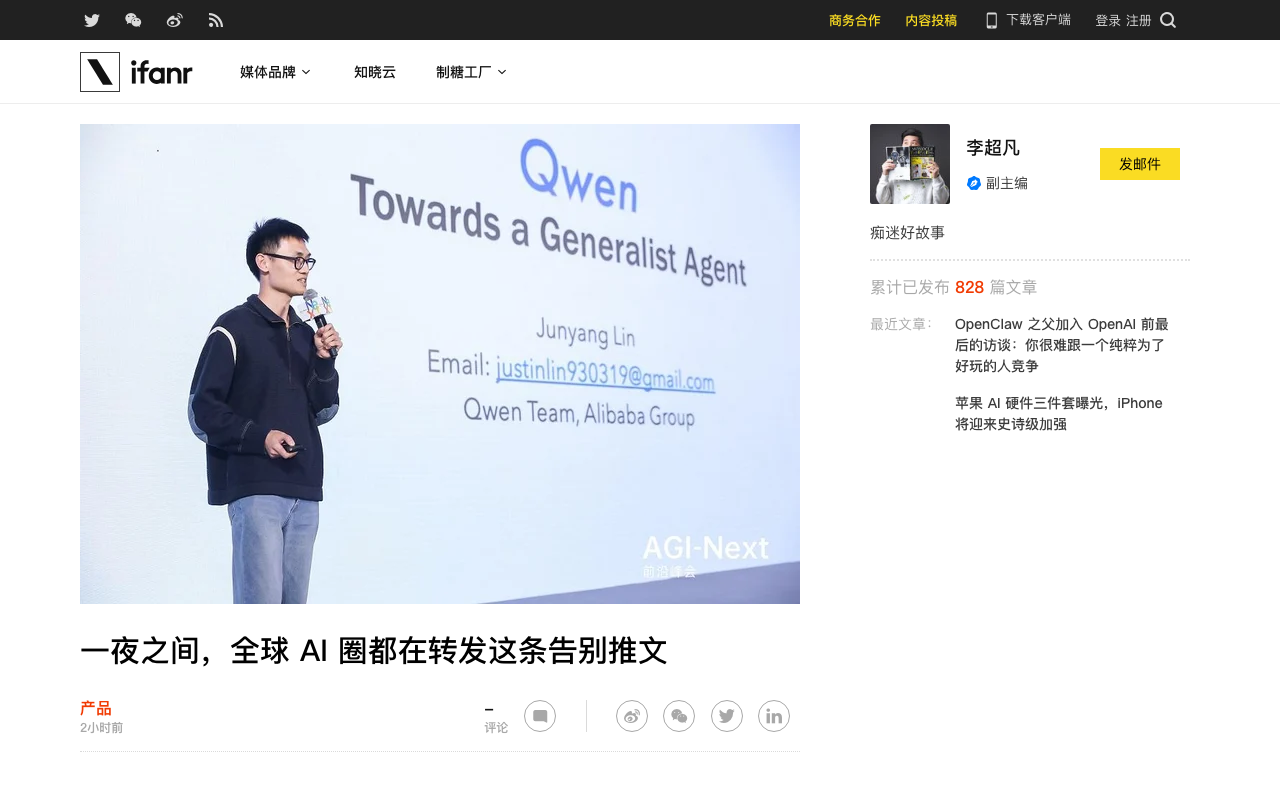
OpenAI and Google Launch GPT-5.3 Instant and Gemini 3.1 Flash-Lite
In the connected state, the hallucination rate was reduced by 26.8%, and by 19.7% when relying only on internal knowledge. The official mention specifically covers high-risk fields such as medical, legal, and finance.,The input price of Gemini 3.1 Flash-Lite is $0.25 per million tokens, and the output price is $1.50 per million tokens.
Today we examine the latest breakthrough in lightweight AI as OpenAI and Google launch GPT-5.3 Instant and Gemini 3.1 Flash-Lite to challenge the perception of low-cost models. We observe that GPT-5.3 Instant significantly improves natural language interactions and reduces hallucination rates by up to 26.8% in connected modes, making it ideal for professional writing and high-risk fields. Simultaneously, Google’s Gemini 3.1 Flash-Lite sets a new benchmark for efficiency with a 2.5x faster response time and an ultra-low pricing of $0.25 per million input tokens. We emphasize that the introduction of 'Thinking Levels' in Gemini and enhanced reliability in GPT allow these models to power complex autonomous agents like OpenClaw more effectively. These releases signal a shift where 'Instant' models now offer the precision and reasoning depth previously reserved for larger architectures, while remaining affordable for high-scale developer deployment.
Source: 爱范儿
MCP Evolution: Remote Connectivity, OAuth2 Security, and Linux Foundation Transition
evolution of MCP from local-only to remote connectivity,moving it to the Linux Foundation
Today we delve into the significant transformation of the Model Context Protocol (MCP) as it moves beyond local-only configurations to support robust remote connectivity. We examine our conversation with Anthropic’s David Soria Parra, where we explore how the integration of OAuth2 for authentication and authorization ensures high standards of security and privacy for enterprise deployments. By transitioning the project to the Linux Foundation, we highlight the commitment to keeping MCP completely open-source and widely available, fostering a vendor-neutral ecosystem for AI developers. We believe this shift simplifies the way developers connect AI models to external data sources, effectively eliminating the manual overhead associated with traditional integrations. This evolution marks a critical milestone in establishing standardized AI communication protocols, providing a scalable and secure framework for the future of agentic workflows and complex tool-calling capabilities across the industry.
Source: Stack Overflow Blog
Industry Insights
Industry Insights offers a deep dive into the rapidly evolving landscape of artificial intelligence and its transformative impact on global sectors. This collection explores critical developments ranging from breakthrough AI agent workflows and corporate financial milestones to significant shifts in hardware innovation and healthcare technology. By analyzing the intersection of technical advancements and market dynamics, these articles provide professionals with the foresight needed to navigate a software-driven future.
Beyond Vibe Coding: Managing the Software Development Loop with AI Agents
The right place for us humans is to build and manage the working loop rather than either leaving the agents to it or micromanaging what they produce.,The why loop iterates over ideas and software, the how loop iterates on building the software
Today we examine the evolving relationship between developers and AI agents through the lens of 'why' and 'how' development loops. We argue that while AI is increasingly capable of handling the 'how loop'—the creation of intermediate artifacts like code and tests—humans must remain 'on the loop' to steer the 'why loop' focused on outcomes. We believe the goal is to shift from micromanaging lines of code to orchestrating the entire process to turn ideas into software effectively. Rather than leaving agents to work autonomously or ignoring code quality, our role is to manage the loop where humans define the purpose and agents execute the implementation. This approach addresses the risks of 'vibe coding' by ensuring that humans retain control over the ultimate goals and the iterative learning process. We conclude that as LLMs improve, the distinction between clean code and functional outcomes becomes a critical design choice for future engineering teams.
Source: Martin Fowler
Anthropic Reaches $19B ARR and Gemini 3.1 Flash-Lite Debuts (2026-03-03)
Anthropic has hit $19B ARR after an extraordinary month in the news and public consciousness, taking it remarkably close to OpenAI’s latest disclosed $20B,Gemini 3.1 Flash‑Lite (Preview) shipped as Google’s fastest, most cost-efficient Gemini 3-series endpoint
Today we highlight major shifts in the AI landscape as Anthropic hits a staggering $19B ARR, placing it within striking distance of OpenAI's $20B and challenging the established market hierarchy. We are also tracking Google's launch of Gemini 3.1 Flash-Lite, which introduces "dynamic thinking levels" and achieves a 2.5× faster time-to-first-token than its predecessor at an aggressive price point of $0.25/M input tokens. Meanwhile, OpenAI has responded to user feedback by rolling out GPT-5.3 Instant, a model designed to be less "preachy" with a significant 26.8% reduction in hallucinations when integrated with search. Finally, we report on the mass departure of Qwen researchers due to internal politics, a move that could significantly impact the open-source ecosystem. These updates collectively signal an era where speed, cost-efficiency, and conversational naturalness are becoming the primary battlegrounds for leading AI labs as the industry moves toward 2027 targets.
Source: Latent Space
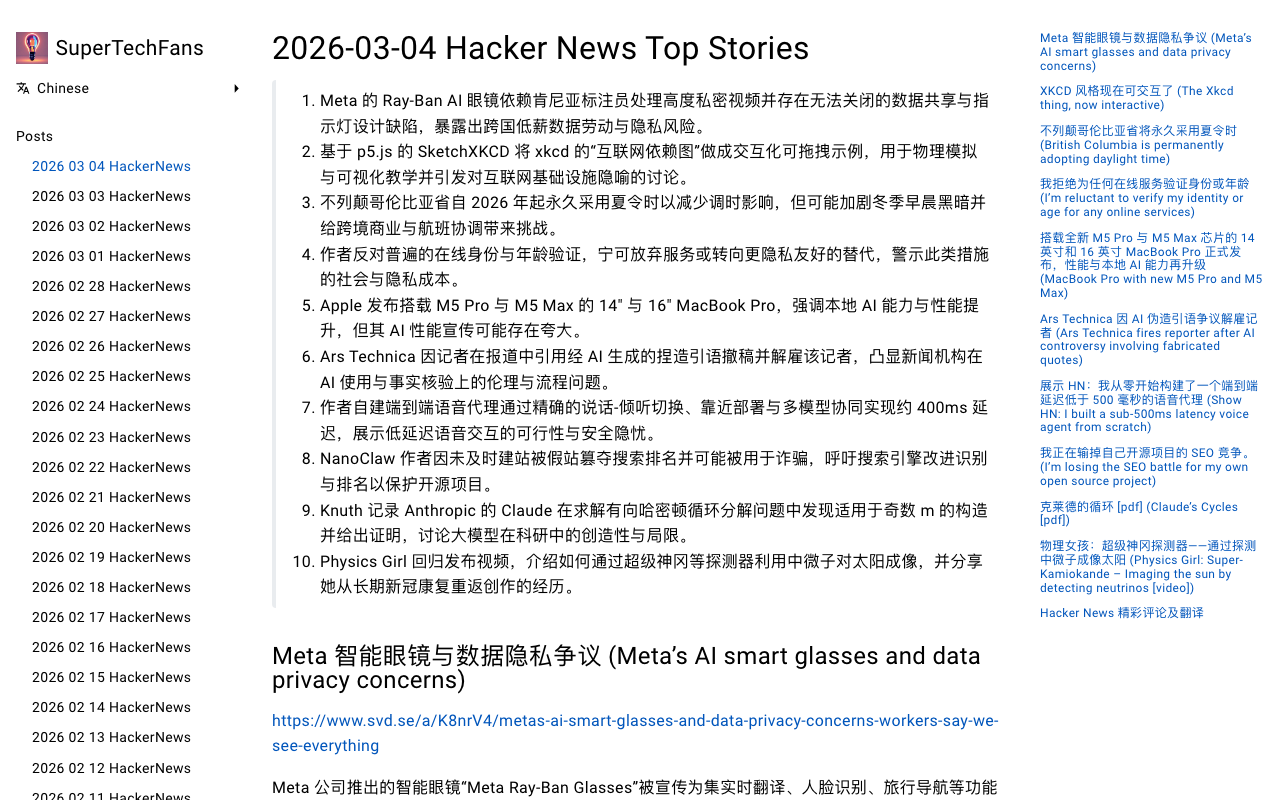
Hacker News Top Stories (2026-03-04): Meta Privacy Crisis and M5 Mac Launch
Meta's Ray-Ban AI glasses rely on Kenyan annotators to process highly private videos and have non-closable data sharing and indicator light design flaws.,Apple releases 14" and 16" MacBook Pros equipped with M5 Pro and M5 Max, emphasizing local AI capabilities and performance improvements.
Today we dive into a series of critical developments across the tech landscape, headlined by the disturbing revelations surrounding Meta's Ray-Ban AI glasses. Our analysis highlights how these devices rely on low-paid Kenyan annotators to process highly sensitive, private videos, while physical design flaws allow users to bypass recording indicators with simple tape. In the hardware sector, Apple has introduced the new 14" and 16" MacBook Pro featuring M5 Pro and M5 Max chips, pushing localized AI capabilities to the forefront despite some skepticism regarding performance benchmarks. We also examine the ethical fallout at Ars Technica, where a reporter was fired for using AI-generated fake quotes, underscoring the urgent need for rigorous verification in journalism. Furthermore, we follow computer science legend Donald Knuth's notes on how Anthropic's Claude successfully tackled directed Hamiltonian cycle problems, demonstrating the evolving role of LLMs in formal research. These stories collectively reflect a tech world balancing rapid AI integration with mounting privacy and ethical costs.
Source: SuperTechFans
E227 | AI Battle in US Healthcare: Tech Giants vs. Disruptive Startups
30% of all data created by humans comes from the medical field, but less than 5% of it is actually utilized.,A three-year-old startup, OpenEvidence, has joined the ranks of AI healthcare stars with a $12 billion valuation—40% of U.S. doctors use it daily.
We examine the rapidly intensifying competition within the U.S. healthcare AI market, where giants like OpenAI and Anthropic are racing to capture a sector that generates 30% of global data yet utilizes less than 5%. In this episode, we delve into how massive partnerships, such as the $1 billion collaboration between Eli Lilly and NVIDIA, are reshaping drug discovery while startups like OpenEvidence achieve $12 billion valuations by serving 40% of American doctors daily. We highlight that the primary entry point for AI remains alleviating the extreme administrative burden on physicians, who average 61.8 work hours per week, much of it spent on medical coding and insurance paperwork. Our analysis covers the strategic shift toward HIPAA-compliant small language models and the ongoing ecosystem war between general-purpose AI providers and specialized vertical solutions. Ultimately, we observe that medical AI is transitioning from an optional luxury to a fundamental necessity for improving both efficiency and patient care quality.
Source: 硅谷101

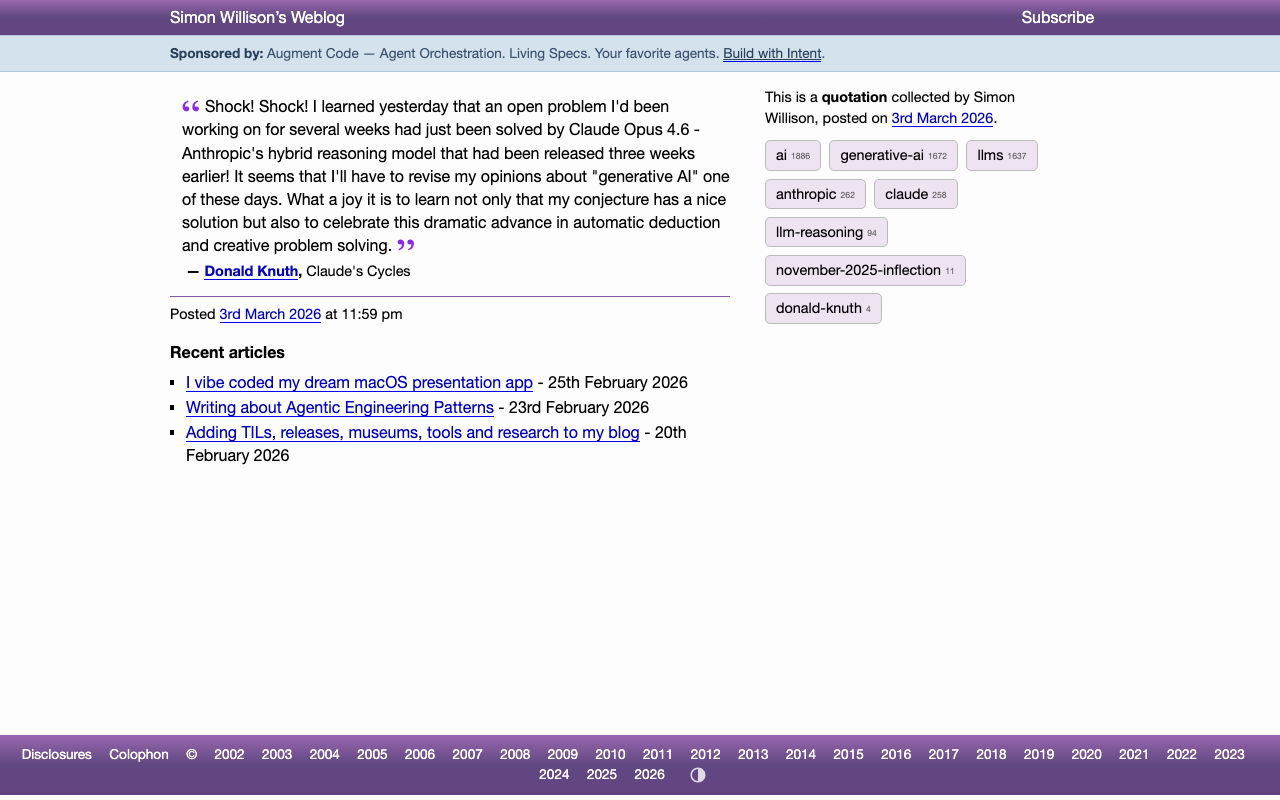
Donald Knuth Revises View on Generative AI After Claude Opus 4.6 Solves Open Problem
an open problem I'd been working on for several weeks had just been solved by Claude Opus 4.6 - Anthropic's hybrid reasoning model,It seems that I'll have to revise my opinions about 'generative AI' one of these days.
Today we share a significant moment in computer science history as legendary professor Donald Knuth reveals a major shift in his perspective on artificial intelligence. Knuth recently discovered that an open mathematical problem he had been personally investigating for several weeks was successfully solved by Claude Opus 4.6, a hybrid reasoning model released by Anthropic just weeks prior. This unexpected achievement in automatic deduction and creative problem-solving has led the author of 'The Art of Computer Programming' to admit he must revise his long-standing skepticism toward generative AI. We find this endorsement particularly notable as it demonstrates the model's capability to move beyond statistical prediction into the realm of complex, novel conjecture resolution. For the developer community, this signals that the latest generation of reasoning models is becoming a legitimate tool for high-level theoretical research and logic-heavy engineering tasks.
Source: Simon Willison's Weblog
Rethinking Software Development: From Coding to Building AI Scaffolds
Xu Wenhao admitted that his efficiency has increased by 3-5 times and he is sprinting towards 100 times.,Your role has changed—from the person doing the work to the person building the scaffolding for AI.
Today we dive into a transformative shift in the developer’s role, moving from manual execution to becoming AI environment architects. Through the real-world experiences of entrepreneurs Ren Xin and Xu Wenhao using Claude Code and OpenClaw, we highlight how productivity can surge by 3 to 5 times—with an ultimate goal of 100x efficiency. We emphasize that AI's current bottleneck isn't raw intelligence but rather a lack of context, permissions, and sandboxed environments. By adopting a three-step development method—reviewing plans, delegating execution, and verifying results—engineers can offload the bulk of coding tasks to focus on architectural design and quality guardrails. We conclude that the future competitive edge lies not in coding speed, but in the bandwidth of human judgment and the ability to manage parallel AI agents without blocking main processes.
Source: AI炼金术

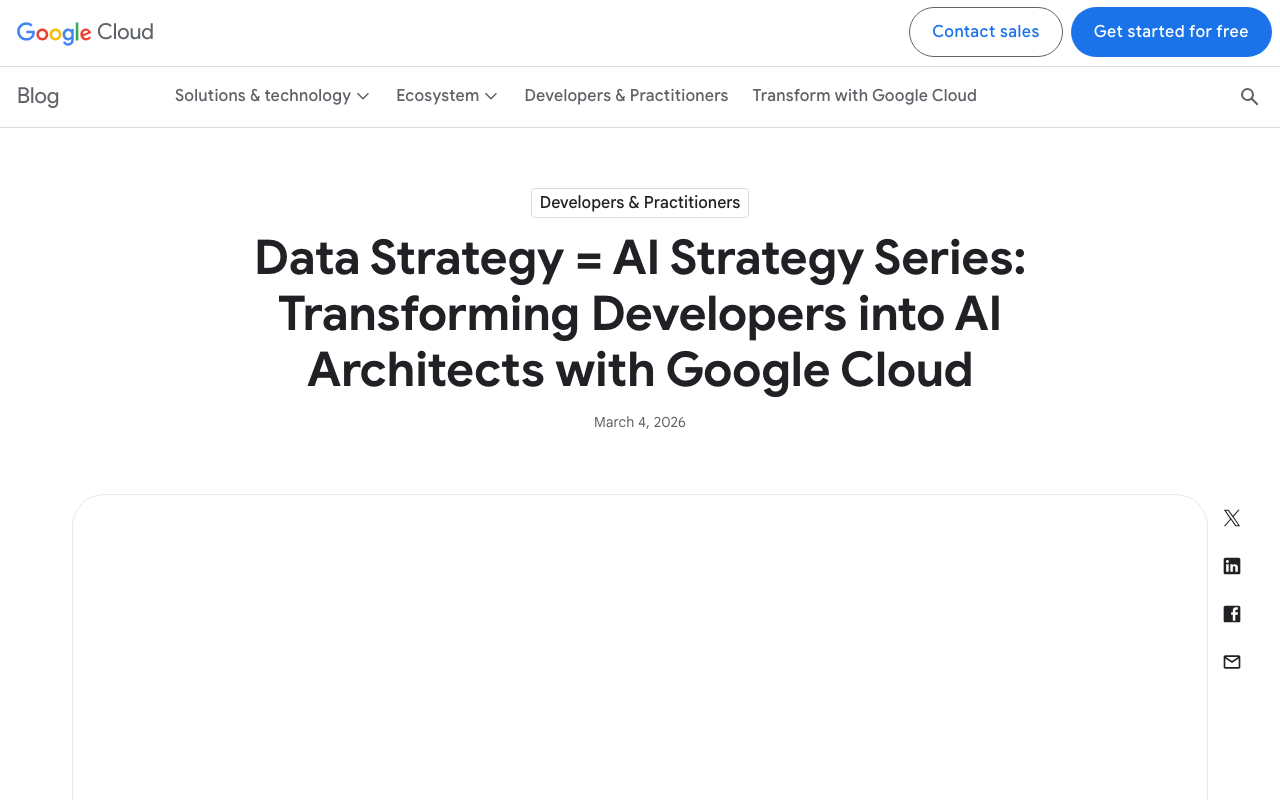
Nokia and Google Cloud Partner to Launch Agentic AI for Programmable Networks
announcing the integration of Nokia’s Network as Code (NaC) platform with Google Cloud’s optimized agentic AI stack,Nokia’s Network as Code platform — now connecting over 70 partners and 20+ network APIs — is becoming agent-enabled
We are witnessing a pivotal shift in telecommunications as Nokia integrates its Network as Code (NaC) platform with Google Cloud’s agentic AI stack. Announced at MWC Barcelona, this collaboration enables AI agents to autonomously observe and optimize networks through natural language, moving beyond traditional siloed automation. By leveraging Gemini models and standardized protocols like A2A and MCP, the system transforms complex 5G core and RAN functions into intent-driven configurations. We see this integration connecting over 70 partners and 20+ network APIs to address high-fidelity data needs and low-latency requirements for edge computing. This evolution toward a self-healing fabric ensures that mobile networks can proactively negotiate with compute nodes like Google Distributed Cloud to handle real-time demands. Ultimately, we believe this "agentic era" empowers developers by abstracting intricate network layers into a unified, programmable framework.
Source: Google Cloud Blog
Developer Tools
Developer Tools encompass a wide range of utilities and platforms essential for modern software engineering, focusing on streamlining workflows and enhancing code quality. These resources empower developers to build, test, and deploy applications more efficiently while integrating critical security measures into the continuous integration and delivery pipeline. By leveraging advanced debugging, containerization, and automated testing tools, teams can maintain high performance and robust security standards across complex software supply chains.
Docker Launches Hardened System Packages to Strengthen Container Supply Chain Security
The DHI catalog has expanded from more than 1,000 to over 2,000 hardened container images.,To support that reality, we are expanding our catalog with more than 8,000 hardened Alpine packages, with Debian coverage coming soon.
Today we are highlighting Docker's expansion of its security ecosystem through the launch of Docker Hardened System Packages, a move that drives security deeper into the software stack. Following the successful shift of Docker Hardened Images (DHI) to a free tier, which saw the catalog double from 1,000 to over 2,000 images, we are now seeing the introduction of more than 8,000 hardened Alpine packages with Debian support arriving shortly. These packages are source-built and patched by Docker, utilizing a SLSA Build Level 3 pipeline to ensure cryptographic attestation and production-grade reliability. By providing these verified components, we enable developers to maintain a near-zero CVE posture while tailoring minimal base images to their specific production requirements without switching distributions. This initiative significantly lowers the barrier for organizations like Adobe and Medplum to achieve end-to-end hardening across diverse environments while maintaining the flexibility of open-source foundations.
Source: Docker

This report is auto-generated by WindFlash AI based on public AI news from the past 48 hours.