In a dramatic turn of events that signals a fundamental shift in OpenAI’s strategic direction, three senior executives announced their departures on the same day in April 2026. Kevin Weil, who led the company’s science research initiative, Bill Peebles, the researcher behind the AI video tool Sora, and Srinivas Narayanan, the chief technology officer of enterprise applications, all left the organization as OpenAI consolidates around enterprise AI and its forthcoming “superapp.” This mass exodus, coupled with the shutdown of several high-profile projects, marks one of the most significant strategic pivots in the company’s history and raises critical questions about the future of AI innovation.
The Departure Wave: Who’s Leaving and Why
The simultaneous announcement of three executive departures sent shockwaves through the AI community. Kevin Weil, who had served as Chief Product Officer before transitioning to lead OpenAI for Science, reflected on his “mind-expanding two years” at the company in a social media post. His departure comes just one day after his team released GPT-Rosalind, a new model designed to accelerate life sciences research and drug discovery. The timing is particularly striking—launching a major product one day and announcing your departure the next suggests deeper organizational tensions beneath the surface.
Bill Peebles, the technical mind behind Sora, framed his exit in philosophical terms, arguing that the kind of research that produced the groundbreaking video tool requires space away from the company’s mainline roadmap. “Cultivating entropy is the only way for a research lab to thrive long-term,” he wrote in his departure announcement. This statement cuts to the heart of a fundamental tension in AI development: the balance between focused commercial execution and exploratory research that pushes boundaries without immediate market validation.
Srinivas Narayanan’s departure, while reportedly for personal reasons—to spend more time with family—adds another layer to the leadership shakeup. As CTO of enterprise applications, his exit comes precisely as OpenAI doubles down on enterprise AI, suggesting potential disagreements about the company’s strategic direction or execution approach.
These departures are not isolated incidents but part of a broader pattern of executive turnover at OpenAI. The company has experienced a steady stream of high-profile exits over the past year, raising concerns about organizational stability and internal culture as it prepares for a highly anticipated initial public offering.
The Death of Sora: A $1 Million Per Day Experiment
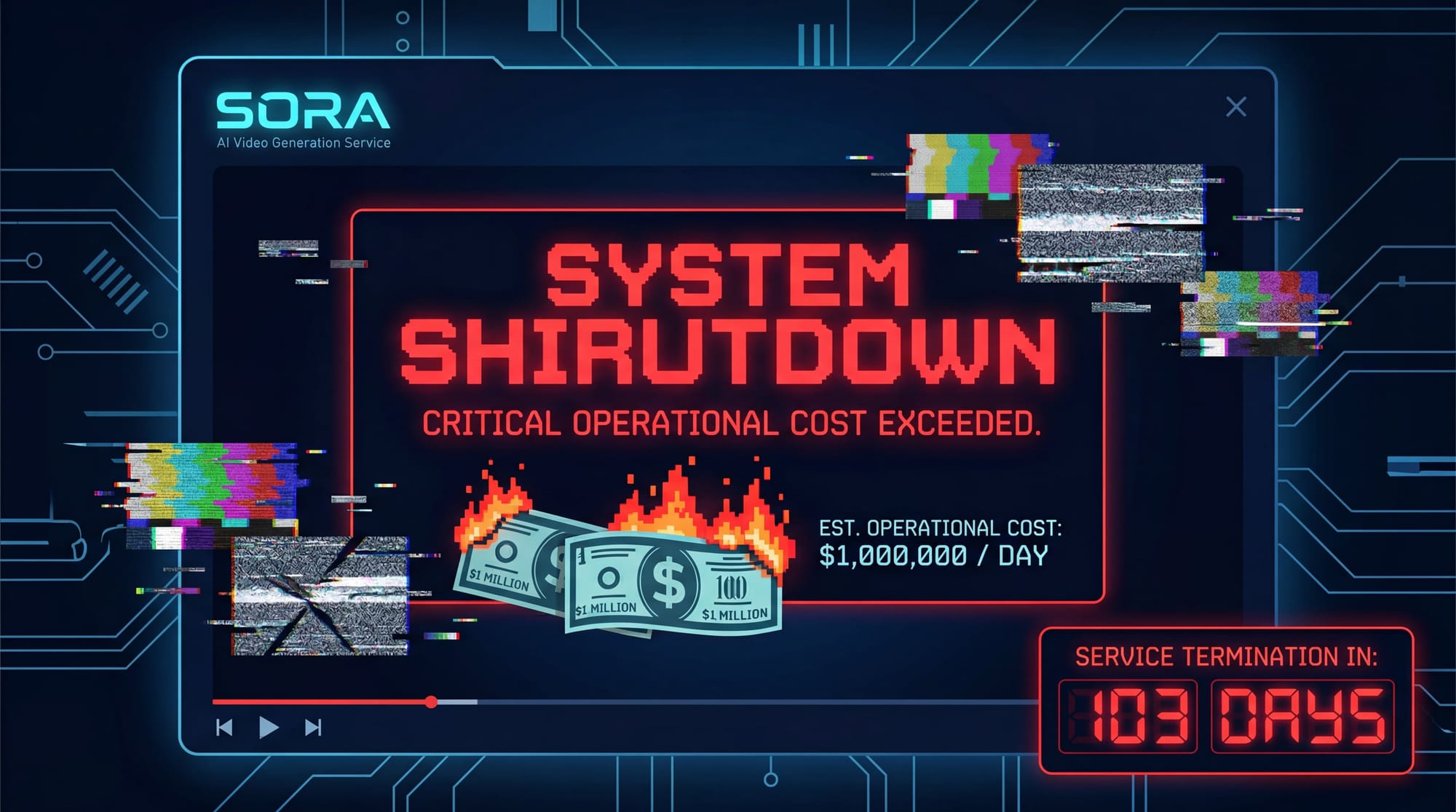
Perhaps the most dramatic symbol of OpenAI’s strategic contraction is the shutdown of Sora, its ambitious text-to-video AI tool. Launched with great fanfare and initially hailed as a breakthrough in AI-generated video, Sora was reportedly burning through an estimated1 billion partnership with Disney and achieving over a million downloads at launch.
The Sora shutdown represents more than just a failed product—it symbolizes the end of an era of unconstrained experimentation at OpenAI. The video generation tool had captured imaginations with its ability to create realistic, coherent video clips from text descriptions, showcasing the potential of generative AI beyond text and images. However, the astronomical compute costs made it unsustainable as a consumer product, especially as the company faces increasing pressure to demonstrate a path to profitability ahead of its IPO.
The timing of the shutdown is particularly revealing. While OpenAI was pulling back from video generation, competitors like ByteDance were doubling down, launching their Dreamina Seedance 2.0 model within the CapCut editing platform. This competitive dynamic suggests that OpenAI’s retreat from video AI isn’t about technical limitations but rather strategic prioritization and cost management. The company is choosing to cede ground in consumer-facing creative tools to focus resources on higher-margin enterprise applications.
OpenAI for Science: From Moonshot to Merger
The OpenAI for Science initiative, formally announced in October 2025, represented the company’s ambitious push into scientific discovery. The team developed Prism, an AI-powered platform designed to accelerate research across multiple scientific disciplines. The vision was compelling: leverage advanced AI models to help scientists make breakthrough discoveries, solve complex problems, and accelerate the pace of human knowledge.
However, the initiative’s short lifespan was marked by controversy and missteps. Most notably, Kevin Weil deleted a tweet claiming that GPT-5 had solved ten previously unsolved Erdős mathematical problems after the mathematician who runs erdosproblems.com publicly debunked the claim. This incident highlighted a recurring challenge in AI development: the gap between impressive-sounding capabilities and rigorous validation, especially in specialized domains like mathematics and science.
Rather than continuing as a standalone initiative, OpenAI for Science is being absorbed into “other research teams.” This organizational restructuring effectively ends the experiment of having a dedicated science-focused division. The move signals that while OpenAI still values scientific applications of its technology, it will no longer pursue them as a separate strategic pillar. Instead, scientific capabilities will be integrated into the company’s broader research efforts, presumably with less dedicated resources and attention.
The irony is palpable: the team released GPT-Rosalind, a model specifically designed for life sciences research and drug discovery, just one day before announcing the division’s dissolution. This suggests that the decision to wind down OpenAI for Science was driven more by strategic and organizational considerations than by technical shortcomings or lack of promising applications.
The Death of Sora: A $1 Million Per Day Experiment
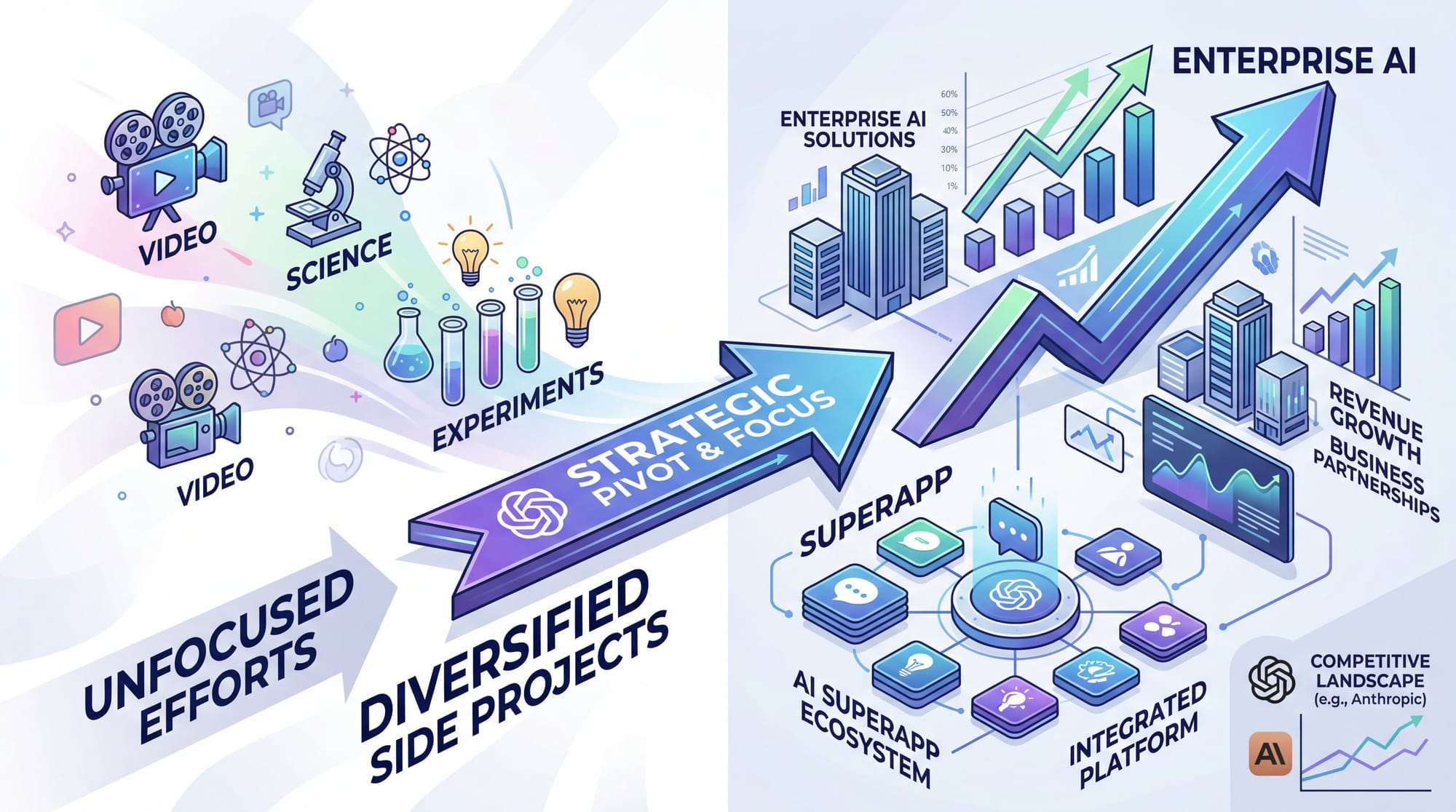
The term “side quests” has become OpenAI’s internal shorthand for projects that distract from its core mission. Fidji Simo, OpenAI’s CEO of applications, used this gaming metaphor in an all-hands meeting to describe initiatives like Sora, ChatGPT’s adult mode, and other experimental projects. The message was clear: these consumer-facing moonshots were fragmenting the organization, slowing development, and hurting product quality.
This framing reveals a fundamental philosophical shift at OpenAI. The company that once positioned itself as a research laboratory dedicated to ensuring artificial general intelligence benefits all of humanity is now explicitly prioritizing commercial focus over exploratory innovation. The “side quests” doctrine represents a choice: depth over breadth, execution over exploration, enterprise revenue over consumer experimentation.
Simo’s warning to staff cited Anthropic’s gains among enterprise and developer clients as the primary driver for this sharper focus. OpenAI has internally described its current posture as “code red,” acknowledging the competitive threat posed by Anthropic’s Claude platform. This competitive pressure is reshaping not just product strategy but the very culture of innovation at the company.
The strategic pivot raises important questions about the role of experimentation in AI development. Many of today’s most valuable technologies emerged from “side quests”—projects that initially seemed tangential but ultimately proved transformative. By explicitly deprioritizing such efforts, OpenAI may be optimizing for short-term commercial success at the expense of long-term innovation potential. As Bill Peebles noted in his departure message, “cultivating entropy” through exploratory research may be essential for a research lab’s long-term vitality.
The Anthropic Factor: Competition Drives Strategy
Understanding OpenAI’s strategic contraction requires examining the competitive landscape, particularly the rise of Anthropic. While OpenAI was launching multiple consumer-facing products and experimental initiatives, Anthropic quietly built Claude Code, an autonomous coding agent that has attracted significant developer adoption, and Claude Cowork, an enterprise AI suite integrated with Google Workspace, DocuSign, and other business tools. The results speak for themselves: enterprise customers now represent approximately 80% of Anthropic’s revenue.
The competitive dynamics are stark. Anthropic’s portion of enterprise AI spending climbed to 40% over recent months, while OpenAI’s share of the same market fell from roughly half to about 27%. This market share erosion has triggered alarm bells at OpenAI, prompting the “code red” internal designation and the aggressive refocusing of resources.
The impact of this competition extends beyond market share. When Anthropic released a blog post asserting that Claude Code could modernize COBOL-based systems, IBM’s market value dropped by approximately $40 billion in a single trading session. This demonstrates the real-world stakes of AI competition and the power of enterprise-focused positioning. Anthropic’s success has shown that the path to AI profitability may run through corporate IT departments rather than consumer applications.
OpenAI’s response to this competitive pressure is multifaceted: shutting down expensive consumer experiments like Sora, consolidating products into a unified superapp, and intensifying focus on enterprise customers. The company is essentially conceding ground in consumer AI to defend and recapture enterprise market share. This strategic choice reflects a pragmatic assessment of where near-term revenue and profitability lie, even if it means abandoning some of the company’s more ambitious and imaginative projects.
The Superapp Strategy: Consolidation as Competitive Response
OpenAI’s answer to fragmentation and competitive pressure is the “superapp”—a unified desktop application that will combine ChatGPT, Codex (its agentic coding tool), and the Atlas web browser into a single integrated experience. Announced in March 2026, this consolidation strategy represents a fundamental rethinking of OpenAI’s product architecture and go-to-market approach.
The superapp concept reverses a product strategy from the previous year that left the company scattered across multiple individual applications. In a note to employees, Fidji Simo described the result as fragmentation that had slowed the company down and hurt product quality. The centerpiece of the combined application will be “agentic” AI—tools designed to run independently on a computer and handle tasks ranging from coding to data analysis without constant human supervision.
This consolidation serves multiple strategic objectives. First, it simplifies the user experience by providing a single entry point for OpenAI’s various capabilities. Second, it allows the company to translate advances in model capability directly into user adoption and engagement across all features. Third, it positions OpenAI’s consumer scale as a “front door” for enterprise usage, as familiarity in daily life drives adoption at work.
The superapp strategy also addresses a critical challenge in AI platform competition: creating operational dependency rather than optional features. Microsoft has pursued a similar strategy through Copilot integration across Office, Teams, and Azure. By embedding AI deeply into the tools that professionals use daily, these platforms aim to become indispensable infrastructure rather than supplementary utilities.
However, the superapp approach carries risks. It raises platform lock-in considerations that should inform enterprise contract negotiations, particularly around data portability and export capabilities. Organizations allowing a single AI platform to become the operational backbone of their development and knowledge work workflows may find themselves with limited flexibility if they need to switch providers or integrate competing tools.
The IPO Imperative: Cleaning House Before Going Public
The timing of OpenAI’s strategic pivot is not coincidental. The company is planning to go public in 2026, and the current valuation of $852 billion faces scrutiny from investors concerned about the company’s scattered product portfolio and path to profitability. You cannot walk into an IPO roadshow with a collection of expensive experiments burning millions of dollars daily without clear revenue models. The superapp consolidation and the elimination of “side quests” represent the cleanup operation necessary to present a coherent investment thesis to public market investors.
Some of OpenAI’s own backers are questioning the $852 billion valuation as the company shifts its focus to the enterprise market to fend off competition from Anthropic. This investor skepticism adds pressure to demonstrate clear revenue growth, margin improvement, and strategic focus. The departure of executives associated with expensive experimental projects and the shutdown of those initiatives send a signal to potential investors: OpenAI is serious about commercial discipline and profitable growth.
The IPO preparation also explains the urgency of the competitive response to Anthropic. Public market investors will closely examine market share trends, and a narrative of losing ground to competitors would significantly impact valuation. By aggressively refocusing on enterprise AI and consolidating products, OpenAI aims to demonstrate that it can compete effectively in the most lucrative segment of the AI market.
However, the pre-IPO cleanup raises questions about what kind of company OpenAI is becoming. The organization that began as a nonprofit research laboratory dedicated to ensuring AGI benefits humanity is now optimizing for quarterly revenue growth and market share in enterprise software. This transformation is neither inherently good nor bad, but it represents a fundamental shift in mission, culture, and operational priorities.
What This Means for the AI Industry
OpenAI’s strategic pivot has implications that extend far beyond the company itself. The shutdown of Sora and the consolidation of experimental projects signal a broader maturation of the AI industry. The era of unconstrained experimentation funded by venture capital and corporate largesse is giving way to a more disciplined focus on sustainable business models and profitable applications.
This shift affects how AI companies allocate resources between research and commercialization. The “side quests” doctrine suggests that even well-funded AI leaders feel pressure to concentrate resources on proven revenue streams rather than exploratory innovation. This may slow the pace of breakthrough discoveries as companies prioritize incremental improvements to existing products over risky bets on entirely new capabilities.
The competitive dynamics between OpenAI and Anthropic are reshaping the industry’s strategic landscape. Anthropic’s success with enterprise-focused products has validated a particular go-to-market approach, prompting OpenAI and likely other competitors to follow suit. This convergence of strategy may lead to intense competition in enterprise AI while leaving consumer applications and scientific research relatively underserved.
The superapp trend, pursued by OpenAI, Microsoft, and others, points toward platform consolidation in AI. Rather than a diverse ecosystem of specialized tools, the industry may evolve toward a small number of comprehensive platforms that handle most AI-related tasks. This consolidation could improve user experience and integration but may also reduce competition and innovation in the long run.
The Human Cost: Culture and Innovation
Behind the strategic pivots and market dynamics are real people and organizational culture. The departure of executives like Kevin Weil and Bill Peebles represents not just a loss of leadership but a potential exodus of the innovative spirit that made OpenAI a pioneer in AI research. When leaders who championed exploratory projects leave because the company is eliminating “side quests,” it sends a message about what kind of work is valued and what kind of researchers will thrive in the new OpenAI.
Bill Peebles’s comment about “cultivating entropy” reflects a research philosophy that may be incompatible with the focused execution demanded by enterprise competition and IPO preparation. The tension between exploration and exploitation is a classic challenge in innovation management, and OpenAI appears to be decisively choosing exploitation—optimizing existing capabilities for commercial success rather than exploring new frontiers.
This cultural shift may affect OpenAI’s ability to attract and retain top research talent. The most ambitious AI researchers often want to work on cutting-edge problems without immediate commercial applications. Even former OpenAI members like Andrej Karpathy have shared their experiences with how AI is transforming the development landscape, highlighting the evolving relationship between researchers and AI tools. If OpenAI is perceived as having abandoned that mission in favor of enterprise software development, it may struggle to compete with research-focused organizations like Anthropic, academic institutions, or well-funded corporate research labs.
The broader AI community is watching these developments closely. If the industry’s leading companies conclude that experimental research is a “side quest” to be eliminated in favor of commercial focus, it could slow progress toward transformative AI capabilities. Breakthrough innovations often emerge from unexpected directions, and a culture that systematically deprioritizes exploration may miss the next major advance.
Looking Ahead: What Comes Next
As OpenAI navigates this strategic transition, several key questions remain unanswered. Will the superapp strategy successfully compete with Anthropic’s enterprise-focused approach, or will the consolidation create a bloated product that tries to do too much? Can OpenAI maintain its research edge while eliminating experimental projects and losing key technical leaders? How will public market investors react to the company’s valuation and growth story when it finally goes public?
The answers to these questions will shape not just OpenAI’s future but the broader trajectory of the AI industry. If OpenAI’s focused enterprise strategy succeeds, it will validate a particular approach to AI commercialization and likely prompt other companies to follow suit. If the strategy falters, it may demonstrate that sustainable AI businesses require a different balance between research and commercialization, exploration and exploitation.
What is clear is that OpenAI is at an inflection point. The company that captured the world’s imagination with ChatGPT and promised to develop artificial general intelligence for the benefit of humanity is now making hard choices about resource allocation, strategic priorities, and organizational culture. The departure of three senior executives on the same day, the shutdown of high-profile projects, and the aggressive pivot toward enterprise AI all signal that OpenAI is fundamentally transforming itself.
Whether this transformation represents pragmatic adaptation to competitive realities or a loss of innovative vision will become apparent in the coming years. For now, the AI industry is watching closely as one of its most prominent players decides what kind of company it wants to be—and what price it is willing to pay for commercial success.
The end of OpenAI’s “side quests” may mark the beginning of a new chapter in AI development, one characterized by commercial discipline, enterprise focus, and strategic consolidation. But it also raises a profound question: in the race to build profitable AI businesses, are we abandoning the exploratory research that could lead to the most transformative breakthroughs? The answer to that question may determine not just OpenAI’s fate, but the future of artificial intelligence itself.
Frequently Asked Questions (FAQ)
Why did OpenAI shut down Sora in 2026?
OpenAI shut down Sora in March 2026 because it was burning an estimated1 billion partnership with Disney and achieving over a million downloads at launch, the platform was shut down just 103 days after its consumer launch. The company decided to focus resources on higher-margin enterprise applications as part of its strategic pivot away from “side quests.”
Which executives left OpenAI in April 2026?
Three senior executives announced their departures on the same day in April 2026:
- Kevin Weil: VP of AI for Science and former Chief Product Officer, who led the OpenAI for Science initiative
- Bill Peebles: Lead researcher behind Sora, the AI video generation tool
- Srinivas Narayanan: Chief Technology Officer of enterprise applications
What is OpenAI’s superapp strategy?
OpenAI’s superapp strategy involves combining ChatGPT, Codex (its agentic coding tool), and the Atlas web browser into a single unified desktop application. Announced in March 2026, this consolidation aims to streamline resources, reduce product fragmentation, and compete more effectively with Anthropic in the enterprise market. The centerpiece of the superapp will be “agentic” AI—tools designed to run independently and handle tasks ranging from coding to data analysis.
How is Anthropic competing with OpenAI?
Anthropic has gained significant market share by focusing on enterprise customers with products like Claude Code (autonomous coding agent) and Claude Cowork (enterprise AI suite integrated with Google Workspace, DocuSign, and other business tools). Anthropic’s portion of enterprise AI spending climbed to 40% over recent months, while OpenAI’s share fell from roughly 50% to about 27%. Enterprise customers now represent approximately 80% of Anthropic’s revenue, prompting OpenAI’s “code red” strategic response.
When will OpenAI go public (IPO)?
OpenAI is planning to go public in 2026, with a current valuation of $852 billion. However, some of the company’s own backers are questioning this valuation as the company shifts its focus to the enterprise market. The timing of the executive departures, project shutdowns, and strategic consolidation suggests these moves are part of a cleanup operation to present a coherent investment thesis to public market investors ahead of the IPO.
What were OpenAI’s “side quests”?
“Side quests” is OpenAI’s internal term for experimental projects that distracted from its core mission. Fidji Simo, OpenAI’s CEO of applications, used this gaming metaphor to describe initiatives like Sora, ChatGPT’s adult mode, OpenAI for Science, and other consumer-facing moonshots. The company determined these projects were fragmenting the organization, slowing development, and hurting product quality, leading to their shutdown or consolidation.