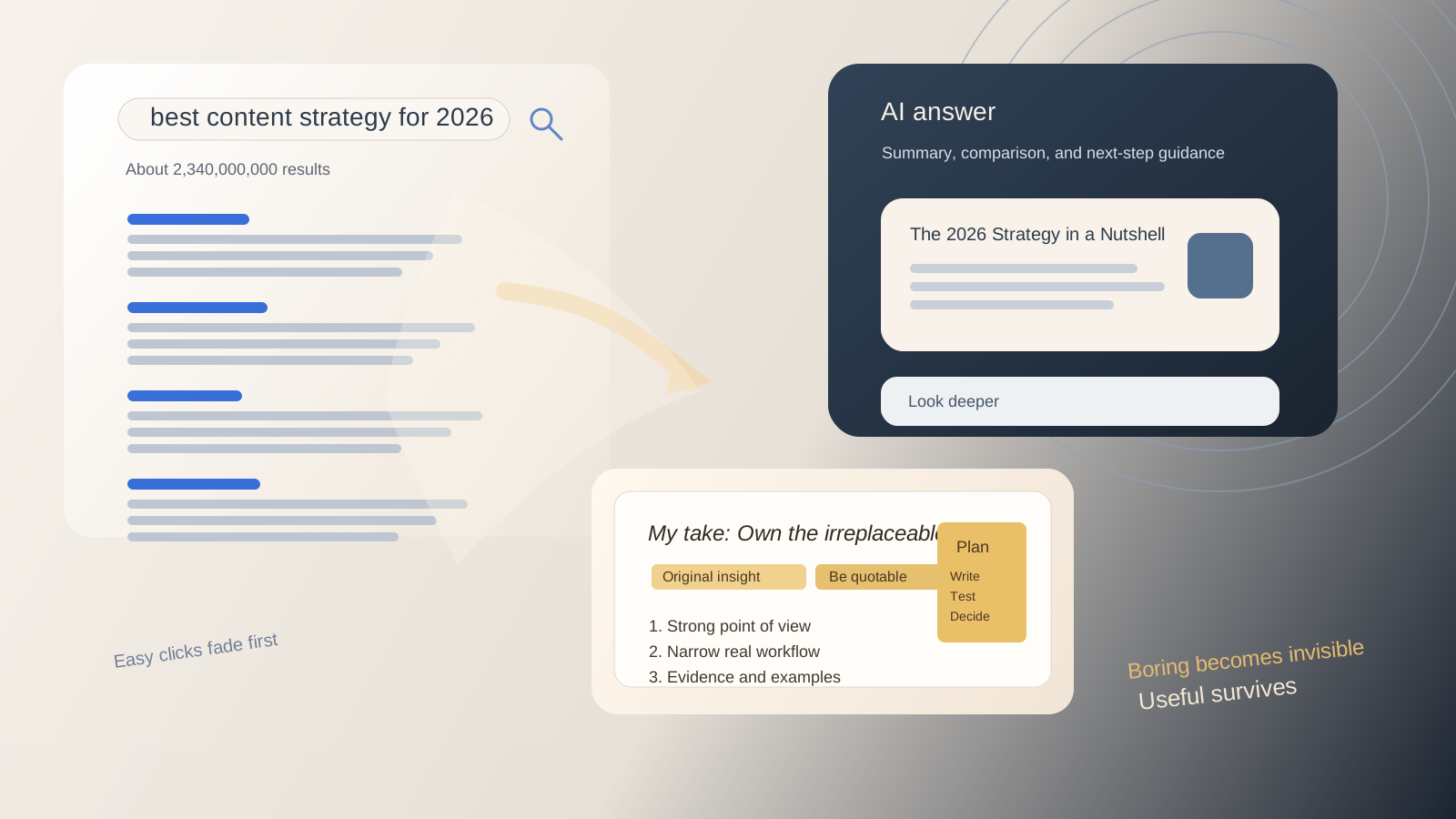
I think a lot of bloggers still have not fully accepted what is changing.
For a long time, the deal was simple: write something useful, rank for the query, get the click, and hope that enough of those clicks turn into readers, subscribers, or customers.
That deal is getting worse.
Google now answers more of the question before the visit even happens. AI Overviews handle the quick summary. AI Mode handles the longer, messier, higher-intent version of the same question. Users compare, refine, and narrow their choices right on Google instead of opening ten tabs like they used to.
That is why people keep using the phrase Google Zero.
I do not think the phrase means “the web is dead.” I think it means the easy click is dying. The lazy click. The click you used to get just because your page repeated the right words in the right order.
That is bad news for a lot of content, but it is not bad news for all content.
If anything, it makes the gap wider between content that merely exists and content that actually helps someone make a decision.
That is the shift I would pay attention to in 2026: we are no longer writing only to win the click. We are writing to be trusted inside an answer-first search environment.
1) What “Google Zero” actually means
“Google Zero” is not an official Google product name. It is shorthand for an answer-first search experience where the user gets enough value from the result page that they do not need to click through.
We have been moving in this direction for years through featured snippets, local packs, shopping modules, and direct answers. What changed is the depth.
With AI search, Google is no longer only extracting one fact. It can synthesize multiple pages, compare options, handle follow-up questions, and keep the user inside a multi-step decision flow.
That makes zero-click behavior more powerful because the result page is becoming more useful.
Google’s own AI Mode materials reinforce this direction. AI Mode is built for richer questions, follow-up refinement, and task-oriented search behavior rather than one-shot keyword lookup. At the same time, recent academic work has added evidence that AI-generated search summaries can reduce outbound clicks, especially for informational queries.
For a small blog, that leads to one uncomfortable truth:
Content that only repeats known information is easier than ever for search engines to absorb without rewarding you with a visit.
2) Why small blogs feel the change first
Big publishers can afford to absorb this change better than small ones. They have brand, direct traffic, newsletters, apps, repeat visitors, and a dozen other ways to stay alive.
Small blogs are more exposed because they often depend on:
- long-tail informational queries
- “what is” and “how to” traffic
- comparison searches near the research stage
- low-authority pages that win mainly through relevance
Those are exactly the kinds of queries AI search is becoming better at handling on-platform.
If your article is basically a cleaned-up summary of what five other articles already said, then you are feeding the machine exactly what it likes most: safe, generic, compressible material.
That is the part people should stop sugarcoating.
But there is still a real opportunity here. Small blogs can do something large content factories usually do badly: publish sharper opinions, narrower firsthand workflows, and more honest decision-making frameworks.
That kind of content is harder to flatten into a disposable summary because the value is not just the fact. The value is the judgment behind the fact.
3) The real shift: search is moving from retrieval to completion
The old search model was basically document retrieval.
The new one is much closer to intent completion.
A user no longer searches only to find a page. They search to make progress:
- choose the right tool
- compare two options
- understand a tradeoff
- build a plan
- fix a problem
- create a first draft
That is why this matters so much for content strategy. Google is increasingly trying to help the user finish the task, not just find documents about the task.
If search is becoming a task engine, then content wins differently.
The pages that matter most in AI search are not always the broadest ones. Very often, they are the ones that make a messy decision feel simple.
If I were running a small content site right now, I would treat that as the opening.
You do not need to be the encyclopedia for an entire topic. You need to be the page that answers the hardest part of the question better than anyone else.
4) What kind of content gets squeezed first
Some content categories are especially exposed in an answer-first world:
- basic definitions with no new angle
- shallow “top 10” lists built from recycled descriptions
- generic tutorials that restate product docs
- trend summaries with no interpretation
- comparison pages that avoid taking a position
These formats can still get traffic sometimes, but they are much less defensible than they used to be.
Why?
Because AI search systems are good at combining public facts that already look similar across many pages.
If ten sites say almost the same thing in slightly different wording, Google can summarize the consensus and keep the user moving without rewarding any one of those sites very much.
That is the real problem. Not short content. Not long content. Same content.
5) What kind of content becomes more valuable
If generic content gets absorbed, distinctive content becomes more useful in a different way: as evidence, framing, or decision support.
Small blogs should lean harder into content with these traits:
A clear point of view
Do not just describe the landscape. Say what you actually think.
Instead of “Here are 12 AI coding tools,” write “The 3 AI coding tools I would actually use for solo product work, and why the others do not make the cut.”
That kind of article does more than list information. It helps a reader move.
Real experience
Screenshots, failed attempts, implementation notes, pricing surprises, edge cases, annoying limitations, and tradeoffs all matter.
AI can summarize public claims all day. It is much worse at producing credible firsthand experience that still feels true after a careful reader looks at it.
Structured decision-making
Articles that answer “which one should I use here?” are usually more resilient than articles that only define a topic.
Good structures include:
- best option for beginners
- best option for a specific budget
- best option for one exact workflow
- when tool A is better than tool B
- when you should avoid both
Narrow scope, high usefulness
Broad topics are easier for Google to summarize. Narrow, high-intent problems are often better opportunities.
“What is programmatic SEO?” is easy to compress.
“How I decide whether a niche page deserves manual writing or programmatic templates in 2026” is much more specific, and therefore more useful.
Fresh facts plus interpretation
Dates matter more now because answer engines prefer current, verifiable material. But freshness alone is not enough.
The winning page combines:
- current signals
- accurate references
- practical meaning
- a recommendation
That last part is where a lot of content still falls apart. It stays descriptive when it should become useful.
6) A practical writing strategy for small publishers
If I were planning a small blog for AI search right now, I would keep coming back to a simple five-part rule.
1. Write for decisions, not just discovery
Target queries where the user needs help choosing, prioritizing, avoiding mistakes, or moving to the next step.
These are better than pure definition queries because the reader still gets value from a human-shaped answer even after seeing a summary first.
2. Make the page easy to quote
AI search rewards pages that are easy to extract from and easy to trust.
That means:
- specific headings
- plain language
- clear claims
- obvious dates
- explicit caveats
- examples tied to real use cases
Messy writing is not only bad for readers. It also makes it harder for search systems to treat your page as something reliable enough to pull from.
3. Add something the model cannot cheaply infer
This can be:
- your test results
- your workflow
- your failed experiments
- your actual recommendation logic
- a pattern you noticed before others framed it well
Without that layer, your page is much easier to replace.
4. Use comparison and constraint language
Search is getting longer and more situational. Your content should reflect that.
Useful phrases are not only keywords. They are decision patterns:
- for solo founders
- for small blogs
- under a tight budget
- if you need speed over polish
- if accuracy matters more than coverage
- when traffic matters less than conversion quality
This is how real people think, and now increasingly how they search.
5. Stop writing neutral filler
Too many sites still publish “balanced” content that says almost nothing.
In AI search, neutrality often means invisibility.
You do not need to be dramatic. But you do need to be concrete enough that someone could actually act on what you wrote.
7) A better content mix for 2026
Small publishers should probably reduce the share of pure explanatory content and increase the share of the following:
- opinionated comparisons
- firsthand workflow breakdowns
- strategy memos tied to current product shifts
- “what changed and what to do now” articles
- practical playbooks for a narrow audience
- posts that translate news into consequences
This is one reason I think the Google Zero topic is worth writing about in the first place. It is not just a panic phrase. It is a useful lens for rethinking what a blog post is supposed to do now.
The article that wins in 2026 is often not the one with the most complete overview. It is the one that gives the clearest next move.
8) The new SEO question is not only “Can I rank?”
The old question was:
Can I rank for this query?
The new one is:
If I rank, will the user still need me?
I think that is a much better filter for content planning.
Before publishing, ask:
- Does this page contain real judgment?
- Would an AI summary remove the need to click?
- Is the main value factual, or is it interpretive?
- Does the article help someone decide, not just learn?
- Is there enough specificity that a serious reader would still want the full page?
If the answers are weak, the post may still get indexed, but it is much less likely to matter.
9) The bottom line
Google Zero does not mean the web disappears. It means lazy publishing loses leverage faster than before.
AI search is raising the bar. Pages built from consensus summaries, soft opinions, and keyword padding are easy to absorb. Pages built from firsthand use, clear structure, and real recommendations are much harder to replace.
That, to me, is the opportunity for small blogs.
You do not need to out-publish giant media brands. You need to be more pointed, more concrete, and more useful at the exact moment a reader is trying to decide what to do next.
In 2026, the best small-blog content is not just optimized for clicks.
It is built to earn trust before, during, and after the answer.
Suggested follow-up angle: if this thesis is right, the next question is not whether AI search hurts traffic. It is which content formats still bring in qualified readers after the easy clicks disappear. That is where the next real SEO edge will come from.