Validation Is Not Authorization: The Real Security Gap in AI Agent Frameworks
July 27, 2026 · AI Strategy
The AI industry spent the last two weeks celebrating capability.
Claude Opus 5 arrived. GPT-5.6 variants landed on Amazon Bedrock. Google Cloud pushed agent platforms and data layers. Coding agents got more personality. Open-weight models got compared, again, to Kubernetes.
Almost none of that answers the more urgent question:
When an agent decides to act, who has authorized the side effect?
A July 2026 research note from Actenon makes the gap hard to ignore. The team scanned 25 AI agent frameworks and applications, covering 23,476 files, looking for one specific pattern: a consequential action that a model can reach, with a parameter the model controls, and no authorization check on the path.
They found 30.
That number is not a random vulnerability dump. It is a product warning.
The missing layer is not intelligence
Most agent demos still sell the same fantasy: the model understands the task, chooses a tool, and gets work done.
That fantasy works in a sandbox. It breaks the moment the tool can change reality.
Actenon is careful about what the scan does and does not prove. A finding is not automatically an external exploit. It does not mean every framework is compromised in production. It means something more precise and more useful:
on the analyzed path, a model-controlled parameter reaches a consequential sink with no dominating authority decision.
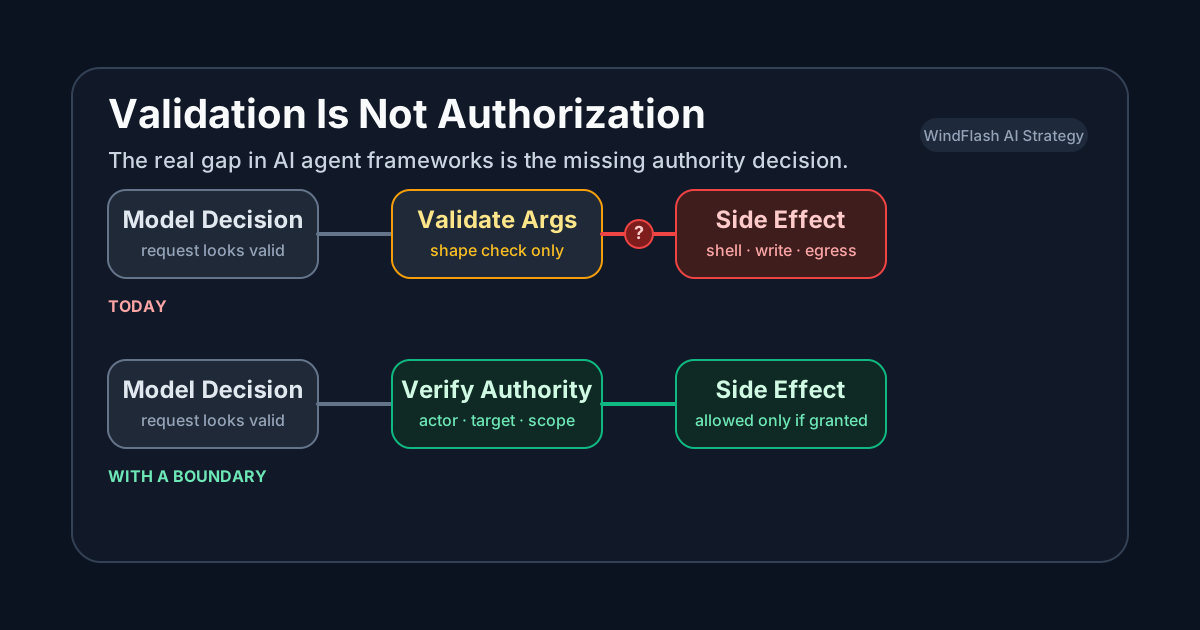
In plain English: the system checks whether the request looks valid. It does not check whether this actor is allowed to do this action, to this target, right now.
That is the difference between:
- “Is this refund request well-formed?”
- “Is this agent allowed to issue this refund?”
The first is validation. The second is authorization.
Agent frameworks are still much better at the first than the second.
What the scan actually found
The interesting part is not only the total count. It is the shape of the failures.
According to the study:
- crewAI: 12 findings
- SuperAGI: 6
- MetaGPT: 5
- Semantic Kernel: 3
- Agno: 2
- MCP server / SDK surfaces: 2
The action classes matter more than the brand names:
- 15 network egress cases with model-controlled destinations
- 7 file writes to model-controlled paths
- 3 shell executions
- 2 message sends to model-controlled recipients
- 2 file deletions
- 1 SQL execution with a model-controlled statement
This is not a list of exotic crypto bugs. These are ordinary product powers: delete data, leave the machine, talk to the network, run commands, change state.
If an agent can do those things, the product is no longer a chatbot with plugins. It is a distributed operator. Distributed operators need permission systems.
Why “well-formed” is a false sense of safety
Most tool implementations do something reasonable:
- Parse arguments.
- Check types.
- Maybe reject empty paths or invalid URLs.
- Execute.
That feels like security because it rejects garbage. It is not enough.
A model can generate a perfectly typed request to:
- write a file outside the intended workspace
- post a webhook to the wrong destination
- run a shell command that is syntactically clean and operationally disastrous
- delete the wrong prefix
- email the wrong customer set
Validation answers: “Can this request be executed?” Authorization answers: “Should this request be executed by this agent under this policy?”
Those are different product questions. Confusing them is how teams ship agents that look careful in demos and become expensive in production.
Capability is racing ahead of permission
Look at the same week through this lens.
Claude Opus 5 is being positioned for long-running agent work. GPT-5.6 models are being rolled into cloud platforms. Google is talking about agentic data clouds. Cognition is buying personality technology for Devin. Open-weight models are getting easier to host and move around the cluster.
Every one of those stories increases the chance that an agent will attempt a consequential action.
None of them, by themselves, create an authority boundary.
This is why the current agent boom feels both exciting and unstable. We are improving:
- model quality
- tool density
- memory
- multi-agent orchestration
- deployment speed
while under-investing in:
- actor identity
- action scope
- target constraints
- expiry
- human confirmation for irreversible work
- audit trails that can reconstruct why an action was allowed
The product stack is growing upward. The permission stack is still thin.
A useful mental model: treat tools as capabilities, not functions
If you are building an agent product, stop thinking of tools as helper functions.
Think of them as capabilities with blast radius.
A search_docs tool is low blast radius.
A write_file tool is medium.
A run_shell, delete_prefix, post_webhook, or execute_sql tool is high.
High-blast-radius tools need four checks at the execution boundary:
- Actor — which agent, user, or service is initiating the action?
- Target — which resource is being affected?
- Scope — is this action inside the granted workspace, environment, and role?
- Expiry / context — is the grant still valid for this session, ticket, or task?
If any of those are missing, you do not have an agent permission system. You have a model with side effects.
What production teams should do this week
You do not need a perfect formal model to improve the situation. You need a boring control plane.
1. Inventory consequential sinks
List every tool that can:
- leave the machine
- change durable state
- spend money
- contact a person
- delete or overwrite data
- run code or shell commands
If a tool is not on that list, it is probably not your real risk.
2. Separate validation from authorization
Keep schema checks. Add a second gate that answers:
Is this actor allowed to perform this action on this target now?
That gate should live as close as possible to the side effect, not only in prompt text or distant middleware.
3. Default deny high-risk actions
Do not give a general-purpose coding agent unrestricted shell, network, and file powers “just in case.” Start with the narrowest set of tools that can complete the job.
4. Require confirmation for irreversible paths
Refunds, deletions, production deploys, customer messages, and broad network egress should not be silent successes. Make the product show what is about to happen and who approved it.
5. Log the authority decision, not only the tool call
A log that says “tool executed” is weak. A log that says “actor X was allowed to delete prefix Y under policy Z because of grant G” is useful after an incident.
6. Scan your own stack
Actenon published a scanner for exactly this pattern. Whether or not you use that tool, the method is right: look for model-controlled parameters flowing into consequential sinks without a dominating authority check.
The deeper product lesson
A few weeks ago, WindFlash argued that AI is moving from tools that produce output to systems that participate in judgment. This week’s agent-framework story is the engineering version of the same shift.
Judgment without accountability is theater. Action without authorization is liability.
The next generation of agent products will not win only by sounding smarter, finishing tickets faster, or acquiring a more charming personality. They will win by making powerful systems feel bounded.
Users do not need an agent that can do everything. They need an agent that can do the right things, under the right policy, with a trail that can be audited later.
That is a harder product problem than tool calling. It is also the only one that scales.
What founders and platform teams should remember
- Model upgrades raise the ceiling of possible actions. Permission design lowers the chance of expensive ones.
- Framework popularity is not a security review.
- “The model decided” is not an authorization story.
- Open-weight serving, multi-agent orchestration, and cloud agent platforms all amplify the same requirement: an explicit authority boundary at the point of execution.
If your roadmap still treats agent security as prompt hardening plus input validation, the Actenon study is a useful interruption. The industry is shipping systems that act. The next serious product layer is deciding who is allowed to act.
Source note: findings and counts in this piece come from the July 2026 Actenon research note, The execution gap, plus the same-week industry context covered in WindFlash Daily Report for July 26, 2026.