Agent-First SaaS Is Coming. The Token Bill Is the Real Bottleneck.
May 26, 2026 · AI Strategy
The first wave of AI products asked a simple question: Can the model answer?
The next wave asks a much harder one: Can the agent finish the work at a price the business can tolerate?
That shift matters. A chatbot has a visible interaction cost. An agent has a hidden operating cost: it reads context, calls tools, searches, retries, branches, asks another model, writes intermediate files, and sometimes fails after doing all of that. The result can feel magical to users and terrifying to finance.
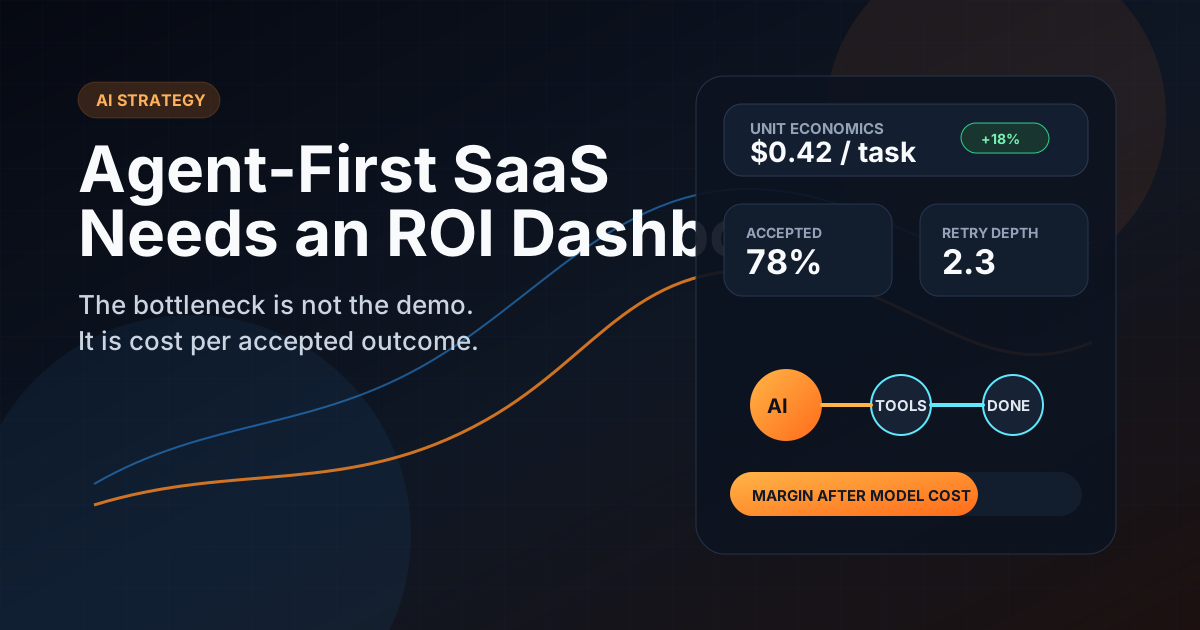
That is why the most important AI SaaS metric in 2026 may not be prompts, seats, or chats. It may be cost per completed task.
This article builds on the signal cluster from today’s WindFlash AI Daily Report: agents are moving closer to real workflows, infrastructure is becoming more specialized, and companies are starting to ask whether AI improves margins or just moves costs into a new line item.
1) SaaS is shifting from assistive AI to delegated execution
For the last two years, most enterprise AI features looked like assistants: copilots, chat sidebars, writing aids, search boxes, summarizers.
Useful, but still mostly advisory.
The new direction is different. Gartner now expects many enterprises to move away from paying for “assistive intelligence” and toward platforms that commit to workflow outcomes. In that world, humans become supervisors of systems that execute work, not just users clicking through software screens. Gartner also argues that execution authority becomes a control-plane question: identity, permissions, policy, system access, and auditability all matter.
That is the real meaning of agent-first SaaS.
It is not “add a chatbot to the app.”
It is:
- the agent can see the right business context
- the agent can take bounded action
- the agent can be audited
- the human can intervene when risk is high
- the workflow produces a measurable outcome
McKinsey’s 2025 AI survey points in the same direction. The organizations seeing the strongest AI impact are not just adding AI features. They are redesigning workflows, scaling agents faster, and defining when model outputs need human validation.
The message is clear: serious AI value comes from changing work, not decorating old interfaces.
2) The hidden cost is not the answer. It is the loop.
A simple LLM call is easy to budget. Input tokens plus output tokens. Done.
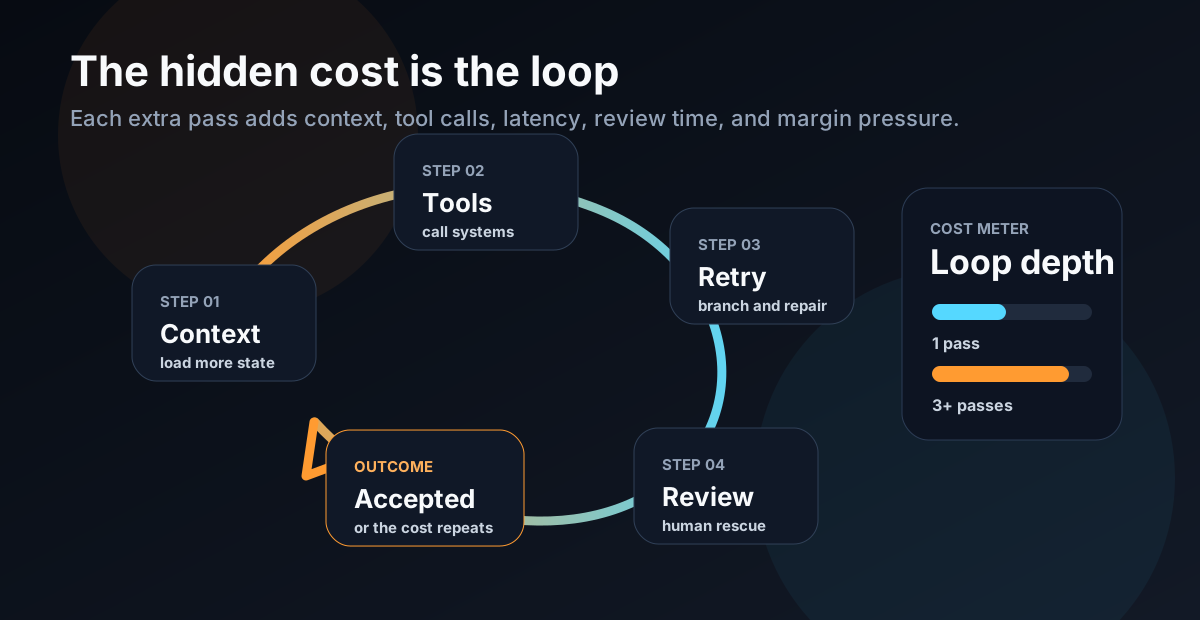
An agent is different because the expensive part is usually the loop:
- It loads context.
- It chooses a tool.
- It reads the result.
- It updates the plan.
- It tries again.
- It may call a stronger model when stuck.
- It may ask for human review.
One recent arXiv study on agentic coding tasks found that agentic work can consume dramatically more tokens than code chat or code reasoning. It also found that token usage can vary heavily across runs on the same task, and that more token usage does not automatically mean better accuracy.
That is the economic trap.
If a SaaS company charges a flat monthly subscription but every agent task can expand unpredictably, gross margin becomes harder to forecast. The product may look successful in usage dashboards while quietly becoming worse as a business.
This is why OpenAI and Anthropic both expose usage and cost monitoring surfaces. OpenAI provides organization-level usage and cost APIs. Anthropic’s Usage and Cost API is explicitly framed around usage tracking, cost reconciliation, performance measurement, alerting, and optimization.
The existence of these tools is a market signal: AI cost observability is no longer optional.
3) Why investors and founders still want agent-first SaaS
The attraction is obvious.
If agents can operate across existing platforms, a founder can imagine rebuilding whole categories of SaaS around outcomes instead of screens:
- CRM that follows up instead of reminding
- finance tools that reconcile instead of reporting exceptions
- support software that resolves cases instead of routing tickets
- analytics tools that investigate instead of drawing charts
- developer tools that ship changes instead of generating snippets
This is why the “agent-first SaaS roll-up” thesis is appearing in more conversations: buy or build software with existing workflows, then replace repetitive steps with agents.
But the thesis only works if the economics work.
If an agent saves a human ten minutes but spends too much on model calls, retries, tool use, and review, it is not automation. It is a more expensive interface.
The right unit is not “AI usage.”
The right unit is:
How much did it cost to produce one accepted business outcome?
4) Every agent product needs an ROI dashboard
Most AI dashboards still show the wrong things.
They show total tokens, total requests, model mix, latency, and error rates. Those are useful engineering metrics, but they do not answer the business question.
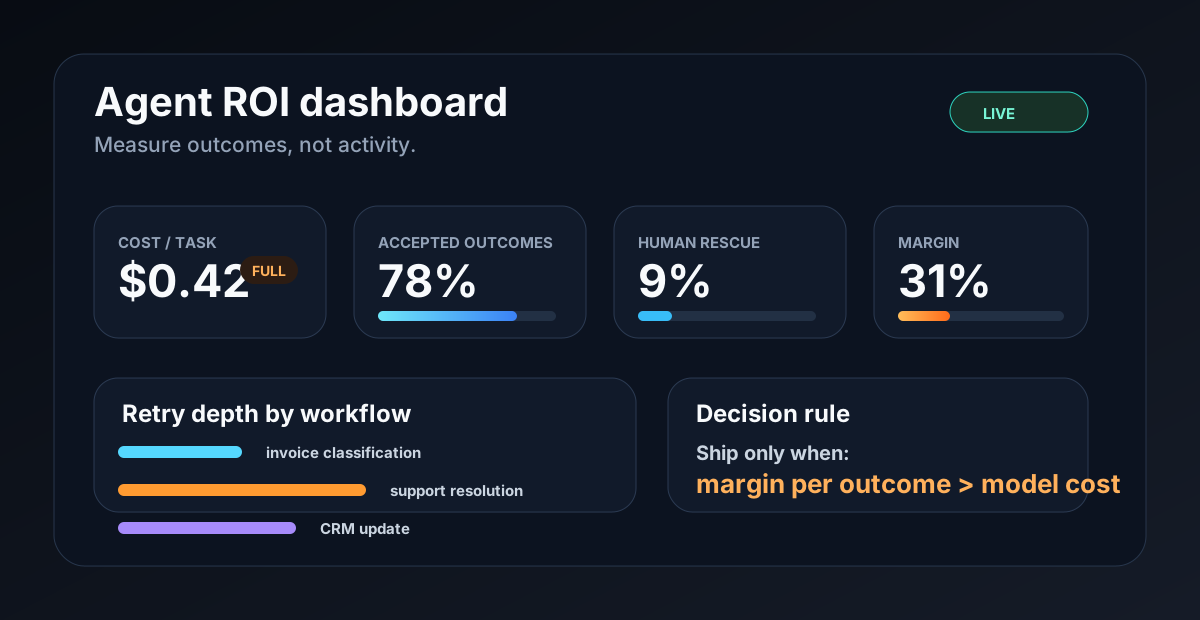
An agent-first SaaS dashboard should track at least eight things:
1. Completed task rate
Did the agent finish the workflow, or did it merely produce activity?
2. Accepted outcome rate
Was the output accepted by the user, the reviewer, or the downstream system?
3. Cost per completed task
Not cost per call. Not cost per chat. The full cost of the workflow.
4. Human rescue rate
How often does a person need to step in after the agent gets stuck or produces a risky result?
5. Retry depth
How many loops does the agent need before success or failure?
6. Escalation mix
How often does the system move from a cheaper model to a stronger model?
7. Context reuse and cache hit rate
How much of the same context is being reprocessed again and again?
8. Margin per outcome
After model cost, tool cost, infrastructure, and review time, does the workflow still make money?
Without these numbers, a company is not managing an AI product. It is managing a demo with a credit card attached.
5) The practical playbook: constrain, route, cache, verify
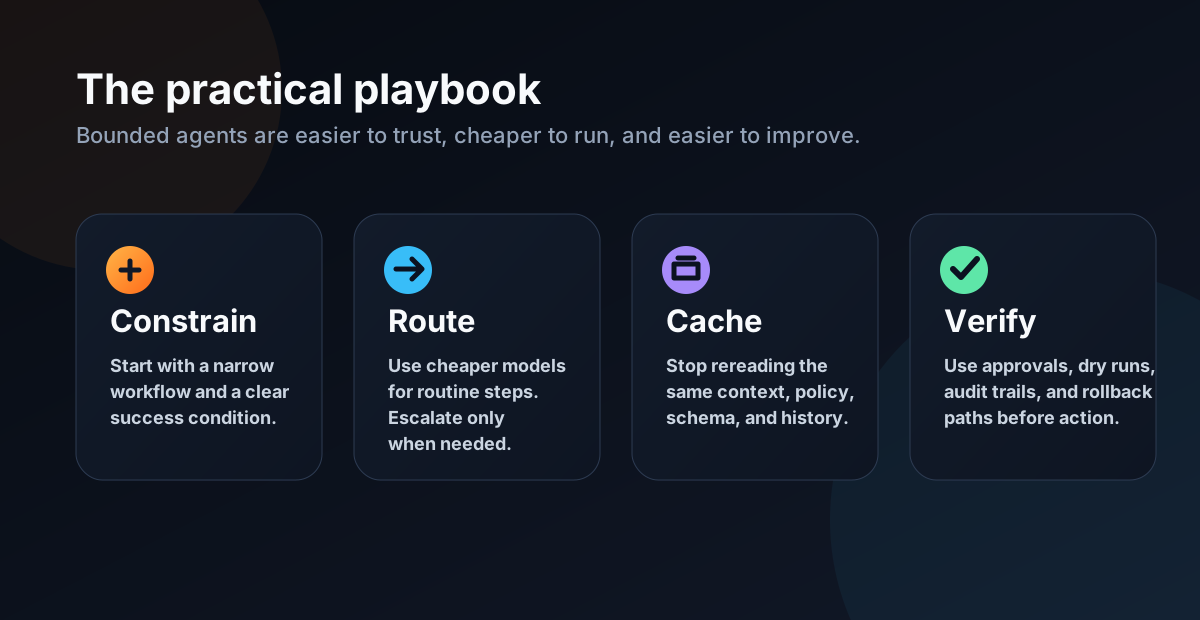
The winning products will not be the ones that simply let agents roam freely.
They will be the ones that make agent work bounded and measurable.
Constrain the job
Do not start with “an agent that can do anything.”
Start with a workflow where success is easy to define:
- close this support ticket
- classify this invoice
- update this CRM record
- prepare this renewal brief
- identify these failed tests and propose a patch
Clear boundaries reduce both risk and cost.
Route by difficulty
Not every step deserves the strongest model.
Use cheaper models for classification, extraction, formatting, and routing. Reserve stronger models for planning, ambiguous decisions, and final review. The goal is not to use the best model everywhere. The goal is to use the right model at the right step.
Cache context aggressively
Agents waste money when they repeatedly ingest the same policy documents, schemas, product docs, ticket history, and customer context.
Prompt caching, retrieval design, structured memory, and good context boundaries are not backend details. They are margin levers.
Verify before action
The more authority an agent has, the more the product needs checkpoints:
- dry run before mutation
- approval for high-risk actions
- audit trail for every tool call
- rollback path when possible
- confidence threshold before escalation
Autonomy without verification is not agent-first SaaS. It is operational debt.
6) The new founder question
The old SaaS question was:
Can we make software people will use every day?
The agent-first question is:
Can we make software that completes work reliably, safely, and profitably?
That is a different company.
It requires product design, workflow design, cost control, model routing, permission architecture, and human review design to come together. The winners will not merely have better prompts. They will have better systems.
Conclusion
Agent-first SaaS is coming because the value proposition is too strong: less clicking, fewer handoffs, faster execution, and software that actually performs work.
But the token bill is the constraint that separates demo value from business value.
The next generation of AI companies will not win by showing that agents can act. They will win by proving that agents can act with margin.